Why Everything Is More Complex Than It Seems It Should Be

layers-to-everything.png

Saturday, 8.47pm

Sheffield, U.K.

My goal is to simplify complexity. I just want to build stuff that really simplifies our base human interaction. – Jack Dorsey

T.S Eliot write that the world ends not with a bang but with a whimper. That’s a generalizable observation – regimes end that way, patterns of thinking end that way, belief systems end that way.

It’s not that simple. Jack Dorsey’s quote above caught my eye – thinking about Twitter and the news that Elon Musk was taking it private. Something that Dorsey built to simplify the way we interact has turned out to have created unthinkably complex effects – some for the positive and some for the clearly negative. I assumed that having the platform under the control of a single person might be something Dorsey would oppose but it turns out, it’s something he suggested Musk do.

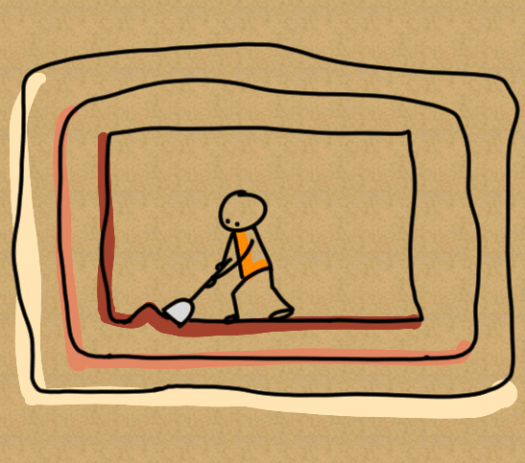
What happens when you dig into anything is that it turns out to be more complex than you think. Nothing is as it seems. Decisions are never simple. Everything has layers and layers and yet more layers.

Let me give you an example based on the concept of religion.

I come from a deeply religious part of the world – one where religion is as natural to people as breathing. It’s unquestioned, it just is, and it’s unthinkable to think that God does not exist.

I live in a different part of the world and there is religion there too. The small people in the house are taught about it at school.

One day I heard from one of these small people that they had been talking about God at school, and they were surprised that some of their friends didn’t believe in God. They were even more surprised when I said that there might be grounds for not believing that God exists. In fact, they didn’t like that much at all.

Eventually, one said, “Daddy, if you don’t believe in God then I will stop believing in God as well.” So I said “Do you want to believe in God?” The answer was “Yes.” So I said, “Ok, then. I believe in God as well.”

What is the right approach? Should you tell your children that you don’t believe in something because that is where you are in your life right now? Or do you tell them what they want to hear?

Some people might think that this is easy – one choice is true and the other is false and you should speak the truth. Of course, when it comes to the question of whether God exists or not, what’s true and what’s false is different for different people.

For a resolution to this we have to turn to Terry Pratchett and his approach to the problem.

Pratchett’s argument would be that if you take every grain of matter in the Universe and sieve it you will not find a single atom of a God anywhere in there. Grind everything up and pick through it and there will be no evidence that God exists.

That’s enough isn’t it, to say that God doesn’t exist? Isn’t saying anything else a lie?

But it’s more complex than that. If you pick through all the matter in the universe you will also not find an atom of truth, justice, mercy or love. Saying these exist is surely lying as well?

Pratchett argues that this is why we need children to believe in magic and fairies and bunnies and flying reindeer. If these are lies, then they are little lies, lies that teach children that there is more to the world than what is just in front of them, little lies that let them believe in the big lies – like truth and justice and mercy and love.

When you see what goes on in the world it’s hard to believe in anything. Layers within layers mean that what you see is not all there is, and every situation has to be looked at from multiple perspectives. Things like social media polarise us and seek to simplify debate – they ask us to believe without question in one position or another.

The one comfort we can take is that societies and people that stifle debate rot from within – they are so busy hiding from the truth that what they have left is not worth having. Maybe Musk will be good for Twitter – as a free speech absolutist he will allow everyone to use the platform. As a technologist he will look for solutions to the problems that beset the platform. As a rich and powerful person at the start of his reign, maybe it will all turn out well for him. Or not. Time will tell.

The only thing we do know is that it’s never as simple as it seems.

Cheers,

Karthik Suresh

Is There A Similarity Between Systems Thinking And Buddhist Thinking?

buddhist-systems-thinking.png

Saturday, 8.53pm

Sheffield, U.K.

However many holy words you read, however many you speak, what good will they do you if you do not act on upon them? – Buddha

I’m reading Natalie Goldberg’s Writing down the bones for the umpteenth time and stopped at the bit where she talks about her Zen Buddhist practice.

Ego is that thing in people, she writes, that tries to see the world as permanent, solid, enduring and logical. But it’s not, instead it is impermanent, ever changing and “full of human suffering.”

Full of human suffering? Yes, but there are some good bits too, aren’t there?

I haven’t looked this up but the word I remember being used that’s translated to mean suffering is dukh, or dukha – something that I understand as sorrow. Perhaps actually closer to regret. Are there many people out there filled with regret? It seems pedantic but when you think about regret rather than suffering the ideas appear much closer to other ways of thinking out there.

Real suffering is often out of one’s hands – and we shouldn’t even try and minimise that. Regret, on the other hand, is part of everyday life. Studies show that we hate regret, so much so that we will give up a chance of winning something big if there is also a possibility of losing out.

For example, if you played a game where you and another person could get a some of money – say $10. The rule is that the other person gets given the money and then they have to give you some. But they can only keep the money if you both agree on the division. If you walk away you both lose the money. How much are you willing to take?

Now, logically, you should be willing to take anything over zero dollars. But the chances are you won’t – one will seem insulting, you might want two or three, perhaps even five. The reason you don’t take the one and walk away is driven not by logic but by emotion – the fear of losing out, the regret that comes from being taken advantage of.

Time after time you will find that decision making is less about a prize and more about minimising risk – which is another way of saying don’t do anything you’ll regret later. Yes there are some people that take big bets – usually with other people’s money – but the vast majority of us would prefer a secure outcome to one that has a chance of going wrong.

This is where the permanent, solid, enduring and logical branch of thinking only works with simple things, like stones and elements and machines. That’s the positivist school that deals with physical things, things that are non-living, things that are predictable.

Life, by definition, is not permanent. It ends, is ever changing and what you want to do is get through another night without feeling like you did something wrong. The idea of structuring your situation so that it minimises the chances of things going wrong – minimises the potential for regret – while allowing for the possibility of growth and development is much closer to the holistic approach that is aimed for in Systems Thinking. That’s how the real world operates, in the relationship between parts creating a whole rather than in the parts themselves.

Goldberg reminds us of this earlier in her book. It’s about the practice – whether it’s sitting meditation or writing or business or anything else you do – the challenge you will have is dealing with the real world out there and the people you meet. And it will all come down to the actions you take and how they make you feel.

Cheers,

Karthik Suresh

Why Do People Move To A New Place?

why-do-people-move.png

Friday, 8.34pm

Sheffield, U.K.

History in its broadest aspect is a record of man’s migrations from one environment to another. – Ellsworth Huntington

I’m reading Violet Moller’s The map of knowledge: How classical ideas were lost and found and it’s introduced me to a few ideas that explain questions that have been lurking around for a while.

There’s a good chance you have a view on migration – and immigration. If you’ve lived in a country for a while, especially one that is relatively prosperous, you might see people coming and staying in the country as a story of economic migration.

You could see that in one of two ways. Either they’re travelling in search of a better life or they’re coming to take advantage of the benefits your society offers.

Maybe you recognise that some people move because they have to – because of war or because they are no longer safe. They move to save their lives.

Maybe you see that there are changes to the economic fundamentals of where they live. Some villages have only old people left, the young have moved to the cities in search of opportunity.

Moller’s book shines a light on when people move in search of knowledge – and that is relevant to the history of the community I come from. It turns out that throughout history there have been epochs when particularly enlightened rulers supported scholarship. In the West ancient Greek knowledge was preserved in private libraries and in institutions like the great library at Alexandria in the first millennium. The light of knowledge in the West was nearly snuffed out by religion but was preserved in the Middle East where a new generation of rulers established institutions for learning. In more recent history we see the renaissance and the birth of early modern science and the growth of the educational institutions we see today.

People who care about knowledge don’t move for the money – as Moller describes, what they need is a place to work and a place to sleep. Cities and governments that provide access to scholarly resources will attract scholars. Those that don’t will lose them. The world is now full of students who aren’t moving because they want a better life – they’re moving to places that will give them the knowledge they need to be successful at doing something.

What Moller’s history shows is that any nation that wants to grow has to have ways to attract scholars – bright people who can do things. A city can have everything – Athens did, Rome did, Alexandria did, Baghdad did. Baghdad in 800 AD was a global centre of learning, attracting scholars from East and West.

But wealth and power do not last – and when they turn on learning, scholars move to new locations that recognise the transformative power of knowledge.

It would see that people move for work, for knowledge and because they have to. If people try and come to where you are – it’s perhaps not because they want to take what you have but because your government recognises that they bring something valuable that will help your community grow. The day you put up barriers and keep them out is also the day from which your community will get weaker and weaker until one day, perhaps, it will be your turn to leave and find somewhere new to go.

Cheers,

Karthik Suresh

What Can Indian Or Eastern Thinking Do For Us?

tetralemma.png

Thursday, 8.50pm

Sheffield, U.K.

A monk asked Zhaozhou Congshen, a Chinese Zen master (known as Jōshū in Japanese), “Has a dog Buddha-nature or not?” Zhaozhou answered, “Wú” (in Japanese, Mu) – Aitken, Robert, ed. and trans. (1991). The Gateless Barrier: The Wu-men Kuan (Mumonkan).

When I was young my grandmother would tell me stories. We’d sit in the darkness and I would hear takes of gods and demons, of warriors and families. Stories that I barely remember now, but that once were all around me.

We grow up and learn different stories – ones that involve maths and English and we start to read Western literature because that’s what is in libraries and bookshops. And it’s good reading and fun and well written and we leave the myths and legends and the old stuff behind as something that’s no longer relevant to the way we live now.

Is that a mistake?

I was reminded that there are other ways of thinking when I saw a paper by Francis Laleman, Vijay Pereira & Ashish Malik titled Understanding cultural singularities of ‘Indianness’ in an intercultural business setting shared on social media. In this paper we’re introduced to the concept of tetralemmic logical operators. But what are those?

Western thinking is highly influenced by Greek logic, in particular bipolar logic structures that go back to Aristotle. A Problem Structuring Method in Operations Research called Strategic Options Development and Analysis (SODA) explicitly uses bipolar operators to think about choices. A bipolar approach is about two extremes, about Yes and No, This or That, Black or White A or B. Choices that are one or the other.

A tetralemmic or quarternary division is a little weird because it has four options. I see this as Yes, No, both Yes and No, and neither Yes nor No. Confusing? Not if you think about any conversation in real life where one person says yes but you know they really mean no or if they say no but you know they’re trying to get to yes. Real life is full of situations that are non-binary. Laleman et al’s paper suggests that “Indianness seems to indicate a natural preference for logical arguments” of the form seen above – very different to traditional Western thinking. So is that helpful?

The quote that starts this post is a famous Zen koan – a question that makes you think. Where did it come from?

There is a story from the Mahabharata, the old Indian epic, about five brothers and a war between family. One of the brothers, Yudhishtira, always spoke the truth but one occasion, to win the war, he said an untruth. The brothers won the war, lived long lives and when they died took a path to heaven.

They walked up a mountain, a steep pathway, the five brothers and a dog. The other four brothers slipped and fell as the path wound its way higher and higher until only Yudhishtira and the dog were left. He reached the top but had to go through a cave and there he saw his brothers in hell, being tormented and punished. He went through the cave, accompanied by the dog, and came out the other end and then ascended to heaven. He reached heaven and saw the vanquished members of his family, the ones who had caused him harm and stolen their kingdom – happy in heaven – while his brothers were in hell.

This story is from memory, from the fragments of narrative from my grandmother and from story books, perhaps mixed up in my mind, and you be asking yourself now, what is the point? What is the punchline? What’s the moral of the story?

Well, for starters, the dog goes to heaven.

But does it have Buddha nature – a soul? Yes – because it’s in heaven – and No – because it’s a dog.

But what this story also gives you is an insight into a world that is not bipolar. In this world, it’s not just that the good people go to heaven and the bad people go to hell and that’s the end of that forever and ever.

It’s that even the really good people, the ones who tell just one lie in their lives, pass through hell, even for a moment, because of the bad they have done. And the ones that have done really bad things, the greedy and the vindictive, get to heaven after serving their time. The other brothers eventually make it to heaven and everyone is reunited. So it’s not about heaven or hell, but heaven and hell and we all experience a bit of both.

So this got me wondering – what else is there that I’ve missed by looking at a purely Western approach to my area of interest – the art of making better decisions. Laleman et al’s paper points to a few more concepts such as that of Karma Yoga or right action – something that perhaps explains why I am interested in this subject although I had never considered it before. So is there value in looking at my research area through this “other” lens, is there value in Indian or Eastern approaches to thinking about areas long dominated by prevailing systems of thought?

How would one go about doing this?

Well, in a collection of essays called Rethink : leading voices on life after crisis and how we can make a better world edited by Amol Rajan, the Dalai Lama writes about how he’d quite like to bring this kind of thinking into focus. So if he thinks it’s worth doing… maybe it is.

Let me think about that some more.

Cheers,

Karthik Suresh

How To Learn From Theory And Practice

theory-practice.png

Monday, 8.26pm

Sheffield, U.K.

He who loves practice without theory is like the sailor who boards ship without a rudder and compass and never knows where he may cast. – Leonardo da Vinci

The real world is complicated and one lifetime is not enough to learn anything about it. We’re lucky we live in an age where we can learn from others, and all we need to do is pick up a book and read.

Reading is important because people can talk a lot without saying very much. Writing is harder, it takes effort to construct sentences that make sense. And it’s much easier to parse them and decide whether they’re useful or plausible or probably wrong.

Of course people can write a lot of rubbish too, spinning a single idea into a 300 page epic but good writing, peer-reviewed academic writing, tries to avoid doing that. Each sentence in a paper has value, or should have value. It should be useful to the reader – explaining context, explaining what’s new and novel and explaining why the reader should care. Perhaps that’s why it’s so hard to write a good paper. And why you should be receptive if you come across a good one.

In some disciplines ideas are enough – pure mathematics does not have to concern itself with the real world in order to do its thing. In the real world, however, theory and practice are inextricably intertwined. Your ideas about how people behave will affect the ways in which you treat them. If you believe people are fundamentally lazy you’ll create high-control organisations. If you think they are creative, you’ll allow latitude and space for exploration. If you think they can be trusted you’ll be happier with flexible working. What you think – the theories you hold – have a direct connection with the systems you construct.

And even an simple word like “system” will bring out the theory pedants. For some people a “system” is something that exists, like a computer system or a healthcare system. For others a “system” is a mental construct, they don’t exist in the real world but are instead mental models that people use to make it easier to think about the world out there.

The point of theory, however, is not to fight over the meaning of words but to help you do something useful. So what is theory anyway. Peter Checkland talks about it as a framework of ideas – related, connected thoughts that seem to explain why things work the way they do and can help guide action. Everyone has a framework of ideas that underpins how they act even if they’re not aware that it exists.

Once you take action you can reflect on your framework of ideas – first becoming aware of their existence and then critically evaluating the elements of the framework. It’s like a ball bouncing back and forth, first theory or maybe first practice – then to the other and back again. Theory guiding practice and practice informing theory. It’s a gradual process of awakening, becoming aware, questioning, seeking, developing, critiquing, arguing and explaining. In a nutshell, learning.

Life is about learning, learning about yourself, learning about the world and the people in it, and learning how you can make a difference.

Cheers,

Karthik Suresh

Should You Get Angry At The System?

personal-or-impersonal.png

Saturday, 7.52pm

Sheffield, U.K.

I am not a politician. I am just a simple person who has come to break down this system. – Volodymyr Zelensky

There are three strands of thought that are bothering me right now, so what’s the best way to disentangle these ideas?

First, let’s start with the food of my past. I was searching for “stuff” on the kind of cooking that I grew up with and came across Sharadha Kalyanam’s “Radical Culinary Love: Cooking as healing praxis in the time of COVID-19” – in the Journal of Global Indigeneity. It’s about food, yes, but it’s about more than that – it’s about food as “a strategy for resistance against the systems of power” – against white supremacist, racist, capitalist and cis-heteropatriarchal systems of oppression.

Most of those words are familiar but Cis-Heteropatriarchy I had to look up – and it’s “a system of power and control that positions cis-straight white makes as superior and normative in their expression of gender and sexuality.”

Another strand – reading a paper on the history of Operations Research by Kirby (2000) called “Paradigm change in operations research: Thirty years of debate” I learn that OR can be seen as a tool of management, an approach that seeks “to control the workplace to control the response” and enable the “means by which the work-force is more efficiently exploited.” This line of thinking has its basis in Marxist ideas, the division between owners and workers.

In these first two strands there is this element of violence being done by one group to another, the enforcing of dominant ideas over minority communities – something that is not related to just the West but is an inextricable part of the culture and practices of my cultural history as well.

The third strand also has to do with food – Dr Michael Greger’s work on the research into nutrition. Greger shows how the benefits of a plant-based diet are definitely proved in the literature – so why is it not the default diet around the world? It’s about the money, of course, the food business is big business and there are powerful lobbies for sectors that try and keep their revenues flowing in – using the same tactics that the tobacco industry used a generation ago.

There is a difference between this last strand and the first two – and it has to do with how personal the whole thing is. The ideas in the first two papers include exploitation, dispossession, erasure – concepts that suggest an intentional programme by a dominant group against all others. Greger, on the other hand, talks about the system and in particular the money – and how it drives behaviour. It’s not that the bosses of these companies are evil and hatching plans to target you – it’s just the way things are set up and they use the system to make money and get an advantage.

Now, I’d like to step away from the specific ideas in these papers as I’m not really talking about feminist theory, operations research or nutrition science. It’s the idea of the system that’s interesting here.

One approach to thinking of the system is as a big collection of interests, relationships and assets that are maintained through the exercise of power. Is this power something external – aimed at keeping others down? Or is it internal – aimed at protecting one’s own position, even at the expense of others?

There is always inertia in a system – it’s travelling in a particular direction and takes time to change course, even longer to reverse. It’s not personal, some might argue, it’s the system. And it’s definitely not the fault of those affected by the system. The only people who must take responsibility are the ones with the power to change the system. In an organisation that’s the management and in a country it’s the politicians. What you see at an individual and personal level are the effects of the incentives structured and maintained by those that have power. The aim of any group that wants to change things, then, is to influence those in power and get them to do the right thing.

It’s harder to do that, of course, if your government or company leadership are up for sale. And it doesn’t help if people who could do something but who also benefit from the system just go along with it because that’s the easy thing to do – you could argue they’re complicit with the violence if they don’t say anything.

I suppose it all really comes down to just one question.

What are you willing to do?

Cheers,

Karthik Suresh

Some Thoughts On Getting People To Entertain Different Methods

my-way-or-the-highway.png

Thursday, 9.07pm

Sheffield, U.K.

If you do not change direction, you may end up where you are heading. – Lao Tzu

My research area worries me. It’s a discipline called Soft OR and a paper I’m reading talks about how many people think it’s not real OR. OR stands for Operations Research, by the way, a field that tries to do things better.

It probably doesn’t help that I’m watching a series called “Scorpion” about a team of geniuses who deal with real-world problems. One of the characters says that there are only four subjects worth studying: maths and science, and science and maths.

I have some sympathy with this view. Maths and science are reassuring in their certainty – in their ambition to be right or wrong, true or false, good or bad. They are the disciplines that make it possible for us to understand and control the world around us.

The good thing about maths and science is that it’s easy to agree what’s the right answer, the correct approach. 2 + 2 has only one answer. Dropping a ball does not make it go up. Only one line can pass through two points unless you’re talking about non-Euclidean geometry where an infinite number of lines can pass through two points if they travel on a sphere. If you squint and ignore quantum mechanics it’s like the world makes sense.

Until you come to people. People are a special case – the one set of creatures that are teleogical – that have purpose. They have likes and dislikes, thoughts and opinions. And that makes it hard, perhaps impossible, to really know what they want or what’s the best thing to do or what’s true or false.

Trying to approach problems that involve people with maths and science is a hard thing to do. You can solve all kinds of things with maths and science but people and how they interact is not one of them. Many approaches have been tried and they do not work well.

That’s because maths and science are part of what is called a “positivist” mindset. They deal in objective truth. But people acting out their lives interacting with other people live in a different world – one that needs a “subjective” mindset to appreciate – one that takes feelings and tastes into account. More importantly, perhaps, people take a constructivist approach to life – they actively create a picture and narrative of what they see around they and why it is the way it is – and they use that mental construction to guide their decision making.

In short, what people think matters.

And what they think is a product of all the thinking and learning that has gone before – the methods and processes and tools they were exposed to over all their years of study and training. How they think is a process – a sort of tube that they go down – whenever they’re approaching a problem. We all reach for tools that we know when we’re trying to figure things out.

But this also means that we’re reluctant to move away from tools that work for us. And that’s reasonable – why waste your time trying a new way when the old one works just fine – or at least works sort of if you work it hard and you can live with that.

That barrier – that reluctance to move from one way to another – is a strength at the curse. It may make you very good at what you do, but it may mean that when what you do before obsolete or irrelevant you too head for obsolescence or irrelevance. Someone said it’s worse to be ignored than to be rejected.

The thing about methods is that they don’t matter as much as what they enable you to do. If you or your clients like the end result they will tolerate any method you use. If you don’t deliver it doesn’t matter how good your method was.

Cheers,

Karthik Suresh

How Do You Harness Collective Intelligence?

collective-intelligence.png

Wednesday, 7.17pm

Sheffield, U.K.

A peaceful world requires collective measures for the prevention of war, international cooperation to solve economic and social problems, and respect for human rights. – Goran Persson

I take a lot of notes – that’s the way I learn. Notes from books, notes in meetings, notes just because I have nothing else to do and I feel like taking some notes to remind myself what I’m thinking.

I’m interested in the power of notes to support collaborative discussion and decision making. The idea of one clever person having all the answers is a romantic illusion. Real work happens in groups and some groups work well and some work poorly. What is it that makes the difference?

1. Everyone needs to be given a chance to speak

Good meetings don’t happen by magic. All too often people get together without a clear idea of what they are going to do. Loud voices dominate and decisions are made quickly, with discussion rushed through. This is not a good thing.

A deliberative approach is different – it recognises that you need time to discuss points and work through what is needed. The idea goes all the way back to the story of the round table – and having everyone having their turn to speak.

2. What are you discussing?

It’s hard to start with a blank page – some people are comfortable there but many would prefer to comment, enhance, critique or develop an existing idea or model rather than start with nothing. Amazon takes this to an extreme. Meetings start with everyone reading a memo – a piece of writing that sets out what people need to know and what they are being asked to discuss. PowerPoints are not allowed, apparently – but the problem is not the technology – it’s that setting up a meeting without some sort of preparation is simply wasting everyone’s time.

3. Is it safe to speak?

It is very easy to choose suboptimal outcomes. Let’s say you want to rate something – applicants, books, strategies – on a scale of 1-10, that should be just fine, right? Well, if you want a good result you might want to ban people from choosing 7. 7 is an easy choice – it’s better than the middle, but not too good. But you want to be more decisive – a rating of 6 or 8 forces you to think more deeply about whether this thing is in or out. In the same way people should be able to voice their opinions without fear of retaliation – and that can be hard, depending on the context. Unless dissenting opinions can be heard, however, the group will probably make a decision that will, in hindsight, have turned out to be the wrong one.

Summary

These three points: enabling voices, having a basis for discussion, and a safe space for dissenting views, need to be in place to make collaboration better. If you want to harness collective intelligence you need to help people get the thoughts in their heads out in the open where you can listen and understand what’s going on – where they can listen to each other and appreciate different perspectives. A term that’s used in the literature is “procedural justice” – a sense that you’ve been treated the right way in the session and been heard.

Cheers,

Karthik Suresh

What Do Investors Look For In A Business?

investor-requirements.png

Monday, 7.36pm

Sheffield, U.K.

As an investor, what we’re not looking for is ‘oh this is a cool app,’ it’s ‘is this something that can become a big business?’ You need to find those that can become real businesses. – Niklas Zennstrom

I came across a document by Elizabeth Yin, the co-founder and General Partner at Hustle Fund, about how to raise a seed round and started reading. And it reminded me about some very basic concepts that we should keep in mind when thinking about business models.

There are five things in particular.

1. The purpose of a business is to create a customer

Peter Drucker said this – your business needs to create and keep customers. An idea is not a business. An idea that serves a market can be. That’s why one of the most important things you can spend time on is getting market-product fit – understanding what someone needs so that you can build a product or service they will buy.

2. Think about the lifetime value of each customer

Lifetime value or LTV is the total amount of money you will make from a customer if they stay and buy from you again and again. It’s too easy to focus on the first sale but it’s the repeat ones where you make your money.

3. How much does it cost you to aquire a customer?

You are always going to have to buy your customers the first time they deal with you. You spend money on sales and marketing, on promotion and advertising, to get them through the door and do that first deal. The commission you pay is part of the price to acquire them.

How much should you spend to acquire a customer? Well, mathematically you should be willing to spend upto a fraction under the net present value of their lifetime value. For example let’s say you get a customer who spents $1,000 with you for five years on average. That $5k over five years is worth perhaps $3k in today’s money with a fairly aggressive inflation factor. So, you could spend $2,999 on getting the customer and walk away with $1 in profit. Not that good – but still a profit.

The important point is that knowing lifetime value will help you avoid making sales mistakes. For example, you might only be willing to spend 20% of your sale in advertising revenue. If you think of the sale as $1,000 that means you might spend $200 in advertising. If you see the total value of a customer as being $3,000, however, you might be willing to spend $600. And that extra spend might be what is needed to get your growth revved up.

Which takes us to the next point.

4. It’s all about speed

The faster you grow your customers the more interesting you are to investors. Growth is what matters. If you have a good product, well, that’s a start. If customers are grabbing it out of your hands – that’s great.

5. Have you got a moat?

A moat is the thing that protects you – it’s the barrier to entry that stops others who see you doing well coming along and copying what you have. Some moats are legal – such as copyrights and patents. Others are less tangible but still real – like brand or trust. Regardless of what it is the best source of competitive advantage is having an effective monopoloy – doing something that no one else can do like you.

Pulling it all together

These ideas make a good checklist to see if you should invest in starting a business. If you’ve identified a set of customers that will buy and buy what you sell again, if you can acquire them, if you can move and grow fast, and if you can protect the business from competitors who want your market – then you have something that investors will also want. And you have just increased your chances of creating something sustainable.

Cheers,

Karthik Suresh

Thoughts About Why We Do What We Do How We Do It

technique-method-methodology.png

Sunday, 8.16pm

Sheffield, U.K.

Of course, there will always be those who look only at technique, who ask ‘how’, while others of a more curious nature will ask ‘why’. Personally, I have always preferred inspiration to information. – Man Ray

A number of papers I read talk about method and methodology. They are not the same thing. And when you throw technique into the mix you get a recipe for confusion. So let’s unpack these a bit.

I don’t like doing this, but let’s start with dictionary definitions, using Google’s English dictionary from Oxford Languages.

A technique is “a way of carrying out a particular task”, a method is “a particular procedure for accomplishing something”, and a methodology is “a system of methods used in a particular area of study or activity”.

I recently read Quentin Blake’s Beyond the page and learned about his particular technique – the one he has used for decades. It involves a light box. He works on the broad shapes and composition of his artwork on paper and then puts it on the light box with a fresh sheet of water colour paper on top and then draws with ink. That’s the way his compositions seem effortlessly fluid, the inky scratchings of dip pen nibs guided by what was done before.

A method is more than technique – while a technique gets one small part finished, method gets the work done. The world is full of methods, procedures, routines, processes and more. Some work better than others. Some are busywork, some are crucial. On a post shared on social media I read the slightly astonishing line that “no political system, no matter how venal, can corrupt a bureaucracy if it stands united and inflexibly committed to collective high standards of ethics and professional integrity.” A functioning bureaucracy, it would seem, is essential if things are to work. One might not think of a civil service in this way and perhaps it’s more important than we realize.

Methods, however, are chosen by individuals and groups – and methodology is the umbrella that hangs over the selected methods. If technique has to do with “how”, them method has to do with “what”. But methodology has to do with “why”. Take, for example, the creation of art – even something as simple as the picture that starts this blog. How would you go about creating something similar? Some people might reach for a pen and paper. Some might whip out their iPad or drawing software. But why would you choose one way over another? Perhaps it has to do with what you’re comfortable with, what you’re good at using. Maybe it’s the best tool for the job on the platform you use. That collection of reasons for why you do things the way you do is the methodology you follow – it may not always be articulated but it hangs over your approach. For all my work, for example, I prefer to use Free as in Freedom software – and that affects the tools I select and use. MyPaint for drawing. Groff for writing. GNU/Linux as a platform.

Understanding the difference between technique, method and methodology is important if you want to figure out why your work is different from everyone else out there. A key element of competitive advantage is inimability – making it hard for others to do what you do. Quentin Blake draws in a very particular way. If you try and do the same you’ll simply be copying Quentin Blake – and if someone wants Quentin Blake’s work they might as well go to him rather than come to you. You need to figure out which elements of your technique, method or methodology are inimitable – those are your unique contributions to the world – the things no one else but you can do in the way you do.

That’s what makes you you.

Cheers,

Karthik Suresh