Well-defined or Ill-defined Problems

2025-05-13_holwell-2.png

Tuesday, 9.06pm

Sheffield, U.K.

There is a lot of stuff we can’t control, but it is completely in our power to decide what the definition of what a good job is. That’s up to us. – Mike Rowe

I’m carrying on with reading Holwell, S., 2000. Soft Systems Methodology: Other Voices. Systemic Practice and Action Research 13, 773–797, and today I am going to focus on a single paragraph.

But first, some background.

I’ve been writing more on LinkedIn recently and I’m finding it tricky to find the right kind of tone.

A writer on LinkedIn is incentivised by the system to chase engagement and likes – it’s the dopamine reward for putting the “right” kind of content on the platform.

That content is designed to stop and engage you, and so it uses certain psychological triggers – clickbait of one kind or another.

With each promise in the headline, there has to be a payoff to keep you from being disappointed; you need a nugget of wisdom in exchange for stopping your scroll.

This is something that’s tricky to deliver if your message is that the world is complicated and when you start trying to make sense of it things usually get more complicated.

And that things are usually harder to do than you think.

But the kind of message that hooks you is look at this thing you need, we’ve got an easy button for it, and if you buy this everything in your life will be better.

In a roundabout way, this is the point of the paragraph that I’m reading – the difference between simple and complex, between well-defined and ill-defined problems.

A well defined problem is what is 2 x 3? You don’t need to worry about what is 2 and what is 3.

I struggled to find a word for this next point and came up with it’s a closed problem – you don’t need to know anything about the properties of graphite to figure out the answer. The pencil you use has no impact on the problem, neither does the room you’re in or the ongoing dispute you have with a neighbour.

It’s a means-ends problem – what means do I need to achieve this end? To solve the problem you must have some knowledge of arithmetic or know someone who does.

And finally, there is a stopping point. There is a solution. You know when you get to the answer that there is an answer, and this is it.

The kinds of problems we face in real life are often not of this sort, they are instead ill-defined.

There isn’t really a “problem” but a problem situation.

Take a look at the news right now.

How would you, if you were the leader of a country, respond to what is going on in politics?

It’s got to be a hard one. You may agree with the policies. You may disagree with them. You might disagree but have to pretend to agree because you haven’t got any cards. You might have to disagree because that’s what your people want you to do, but really you want this whole thing to be over and retire to your country house.

What you’ve got isn’t a problem but a problem-situation.

In such problem-situations the context matters. The way you act will be different if you have power, or if you need support from others, and whether you can count on support or if you have to persuade others.

Such approaches require problem structuring – what are the tradeoffs, what kind of agreements could you reach, what levers do you have?

I imagine the kind of frantic negotiation that happens when a bill needs to be passed and the sponsors need to call all the legislators they know and engage in horse trading to get the task done. You know it’s heading in the right direction when everyone is about the same amount of unhappy.

And then finally, there is no end point, there is no solution.

The best you can hope for is that you’ve made the world a better place – that there has been some improvement.

In the next post, we’ll try and get back on the history track.

Other Voices In The Development Of Soft Systems Methodology

2025-05-11_2000-Holwell.png

Sunday, 8.41pm

Sheffield, U.K.

There are three kinds of men. The one that learns by reading. The few who learn by observation. The rest of them have to pee on the electric fence for themselves. – Will Rogers

This post is a set of reading notes from Holwell, S., 2000. Soft Systems Methodology: Other Voices. Systemic Practice and Action Research 13, 773–797, as I prepare to give a talk on the history of soft systems methodology (SSM).

I was going to carry on from my last post which was working through the summary in Systems Thinking Systems Practice (STSP) but then I felt I would just be repeating what Checkland had already said.

I stopped, thinking I should look more widely first and searched my collection of papers and came across Holwell (2000).

She makes the following observations:

  1. Many people simply repeat Checkland’s work, more sophisticated approaches focus on specific aspects of the work;
  2. A lot of people just don’t get it;
  3. Early work in Lancaster was based on systems engineering – how do we approach that and is it dated?
  4. The secondary literature is starting to impact the way people think about SSM.

From positivist thinking to interpretivist thinking

Brace yourselves. This is going to be heavy going. I find it tricky.

Checkland’s defining contribution is bringing “the concepts and philosophy of interpretive social science into systems thinking” (Flood and Ulrich, 1991, p.186).

Let’s unpack this.

First, interpretive rather than positivist refers to two ways of looking at the world. Positivism says that the world is real and all that matters can be observed and measured. Interpretivism says that you create the world along with others in your mind.

The systems concept is about wholes and the properties of wholes.

The application of systems thinking in the social sciences is usually under the heading of functionalism. This is Emile Durkheim’s theory that socity is similar to a biological organism. There are parts to it, and there are structures that connect these parts and that the workings of these parts within the whole enables a successful society.

A functionalist model “sees” society as parts and connections and can therefore accept that these parts can be designed, constructed and managed.

Society is a machine that can be controlled.

Now, you can see that this line of thinking leads to possibly problematic outcomes, such as dictatorships.

SSM has a model of social reality that is derived instead from Husserl’s philosophy of phenomenology.

Husserl’s approach says something like rather than going with the traditional Western rationalist bias, pay attention to your real lived experience – it’s sometimes called the science of experience.

I think this must be similar to the Japanese concept of going to gemba – the place where the work is actually happening.

So I think what this is saying is that rather than starting with a framework that says this is how societies work and this is how we should organize things, go and look and see for yourself and rely on an intuitive approach, without assumptions or intellectualizing to “get” what is going on.

Which is a lot of big words to say something like just open your eyes and see what is in front of you rather than what you believe is in front of you.

The other connection SSM has is with Weber’s interpretive sociology, which combines a social group’s needs to have a coherent world view, but also what the power relationships are in their environments.

Again in simple terms – this is about why are we where we are, and how can we hold on to, or gain more power.

Think about this like a manager – why are you in your job, and how do you keep your position and get ahead?

Let’s stop here and carry on in the next post.

Cheers,

Karthik Suresh

From Science To SSM – A Summary

2025-05-07_ssm-history.png

Wednesday, 9.39pm

Sheffield, U.K.

History never looks like history when you are living through it. – John W. Gardner

In Peter Checkland’s 1981 book “Systems Thinking, Systems Practice” (STSP), there is a helpful summary of the arguments developed in the book.

The scope, however, is vast.

Let me try and make sense of the summary, by in turn summarizing it.

In the beginning, there was magic and mystery and then science came along.

As an aside, I’m currently watching the BBC series Merlin, for no defensible reason.

The legends of King Arthur are set in a post-Roman time around the 5th and 6th centuries.

In the reimagined series, there is quite a lot about the methods of science.

The scientific method and modern science are really associated, however, with the scientific revolution in the 16th and 17th century.

The three Rs made it clear what was science and what was not.

Reductionism, repeatability and refutation made it possible to build a reliable and continuously refined account of what went on in the world.

This worked very well in the restricted sciences like physics, and pretty well in the unrestricted sciences like biology.

But the methods of natural science start to break down when they are applied to complex and social situations.

In particular, they struggle with questions of ends and means – of “managing” activities.

While science is concerned with bits it’s less worried about wholes – and that’s where the systems concept entered the picture.

The systems concept is concerned with wholes and characteristics that emerge at different levels – characteristics that do not arise from lower levels.

For example, in biology, the science of cells does not explain why a particular arrangement of cells makes up a human body that sings.

The systems concept was seen as a useful way to address management problems associated with human activity.

But then we came up against different types of problems.

The techniques of analysis and engineering being used worked well on certain kinds of problems – hard ones – where there was a well defined problem that needed to be solved.

How do we bridge that large gap so a train can get from here to there, for example.

But the systems concept struggled with ill-structured problems.

How do you start to fix something that you know is broken but you’re not sure how to express the problem in the first place?

That issue led to the development of a new methodology from 1969 to 1972 in 9 studies.

We’ll dig into this in the next post.

Cheers,

Karthik Suresh

What Is Soft Systems Methodology (SSM)?

2025-04-24_ssm-definitive.png

Thursday, 9.12pm

Sheffield, U.K.

Every company has two organizational structures: The formal one is written on the charts; the other is the everyday relationship of the men and women in the organization. – Harold S. Geneen

I write a lot in this blog about soft systems methodology (SSM).

But what is that, exactly?

To find out, you might want to read Peter Checkland and John Poulter’s “A short definitive account of soft systems methodology and its use for practitioners, teachers and students”, published in 2006.

It’s the definitive account, the final say, so perhaps that’s a good place to start.

A few of Checkland’s papers complain that people don’t understand SSM and they miss the point of it in how they use it – or claim to use it.

It’s easy to get lost in the academic discussion – but I am going to make things worse by attempting my own interpretation of what’s going on with SSM.

Here’s my version of the brief version.

Let’s start with life itself – the everyday. Today, tomorrow, yesterday. All the days that we live through.

We live in a flux of interwoven events and ideas. Ideas lead to events, events spark ideas and life goes on.

Everyday life produces situations.

These situations have people in them. It’s the presence of people that make it possible for situations to exist – because they come into existence in the minds of people. A problem only bursts into existence when someone believes it does.

Let’s not worry about this too much, but the key point is that you need people to make a situation – and what those people think about the situation is what we’re focused on.

Sometimes, they think a situation is problematical. That something is wrong. That things could be better.

Why do they do that? Why look for problems, or think at all?

It’s because we can’t help but be purposeful – we act with purpose. Human beings have a brain that allows them to act intentionally – rather than randomly.

But, we usually only see situations from our point of view. We may exist in a complex, multifaceted reality that some people insist is very simple because they see it one way, and others disagree because they see it another way.

It’s the same thing – we just have different perceptions of the thing we’re in.

Wars have been fought over these different perceptions of the same thing.

But, we’re learning over time – and the thing that could help is to learn more about the situation.

We go out and intentionally learn more about the situation as perceived by the people affected by it and affecting it.

We talk to them, we ask questions, we listen to them, we build a rich picture of what’s going on.

All this learning helps us build models of purposeful activity.

This is a new bit – it’s not something most people do.

A model helps us capture that learning and put it into a form that we can look at and understand – it’s like a theory, an operating manual – something we can use.

And we use it to help us as questions about the situation, to take this model or models with multiple viewpoints and have a structured debate – a good conversation about what’s going on and what we could possibly do.

This kind of discussion helps us to decide what action to take – and to take that action.

The action, we hope, is going to improve the situation.

It’s going to affect it in some way, anyway.

And now the situation has changed – hopefully for the better, sometimes for the worse, and we now have a new situation.

If all is good, great.

If it’s still problematic, then we continue our cycle of learning, modelling, questioning, and taking action.

All this may seem simple. Perhaps even obvious. But it’s the result of decades of thinking and action research.

In my next post I think I need to go back to where it all started to show the gap between where things were and where things are, and then build a bridge between the two.

Cheers,

Karthik Suresh

Beginning At The End for SSM

2025-04-23_parthian-shot.png

Wednesday, 9.29pm

Sheffield, U.K.

God cannot alter the past, though historians can. – Samuel Butler

I talked in my last post about having to work on a talk about the history of SSM.

For the next several posts I’m going to work on this project – so you may ending up learning more about SSM than you might consider necessary.

Here goes.

I could look at this history chronologically or thematically.

Let’s start at the end.

Peter Checkland, the name most associated with Soft Systems Methodology or SSM, delivered a keynote at OR 60, the Operations Research conference.

The paper that followed was called Reflections on 40 years in the management field: A Parthian shot (friendly).

A Parthian shot is a hit-and-run battle tactic used by the Parthians, an Iranian people.

Their cavalry would attack the enemy, then turn tail and run. The enemy would chase them believing they were fleeing. When the pursuers were close the Parthians would swing around in their saddles and fire their arrows into the chasing army.

This is where the term “parting shot” comes from – delivered by the person who has to have the last word as he or she leaves the room.

The talk and paper mark the end of Checkland’s professional career and so are perhaps the right place to start from to understand the journey that led to SSM.

They are reflections on the years “spent trying to understand the everyday real world in order to bring about positive changes in real-world situations which are taken to be problematical”.

Let’s unpack some of these elements – what are real-world situations that are taken to be problematical?

Wars, for starters. The Second World War was decidedly problematical. And it led to the creation of Operations Research as a field.

After the war, however, OR practitioners looked for other fields in which to apply their learnings, such as the management of organisations.

This in turn led to a rich set of techniques that were increasingly reductionist in nature, as benefitted a field that considered itself scientific.

And that led to another issue. A technique that solves a clear problem is great. But what if the problem itself is unclear?

This is something most people never really stop to consider.

Think about the last conversation you had where someone came up with a problem.

Did you feel like you had to offer a solution instantly?

Did you feel like even if you didn’t have one, there was a solution out there that could be found?

Did you ever stop to consider that the problem might be the way you were thinking about problems?

SSM’s origin story is somewhere in this space – in that period between when people believed that science could solve everything, and we learned that people behave in ways that science finds hard to deal with.

That’s a rabbit hole for the next post.

Cheers,

Karthik Suresh

The Road Is Rarely Straight

2025-04-22_bullseye.png

Tuesday, 10.51pm

Sheffield, U.K.

A road’s just an opinion about which way to go. – Rudy Rucker

A few weeks back we went to visit the remains of a Roman fort at Housesteads.

Some unnervingly straight roads take you there.

It’s strange when you travel on a straight road in the UK.

If you do it usually means you’re on a road laid down by the Romans around 2,000 years ago.

I prefer to meander. It seems a more natural way to be. Or, I’m trying to excuse procrastinating.

I’m working on a paper about the history of Soft Systems Methodology (SSM).

I find that when I have a project to work on these days I start by avoiding working on the thing itself.

Instead, I find ways to think about how to work on the thing.

I started by re-reading John McPhee’s essay on Structure.

I go back to this one quite often because he insists that his students start with a structure of some sort. It can be an outline. It can be a diagram. But the starting point is always a structure.

I like to start with a drawing of some kind – like the one that starts each of my posts.

The approach seems straightforward – you start with a structure, with an outline – something that you can build from like a design blueprint.

But, I think that sometimes the structure can only be seen when you aren’t looking for it.

It’s something you spy out of the corner of your eye as you distract yourself with something else.

I’ve read quite a lot about SSM over the years.

If I were following McPhee’s approach I’d first collect all my notes, sweep up all the raw material I have and put it in a pile.

Then, I’d go through this list, making and organising notes chronologically and thematically.

Then I’d look at my collections of notes and start to arrange them in a way that matched the structure I was thinking about.

And then I’d write.

This is the right way. A good way.

So why do I find it so hard to do?

Instead of following this approach I complained a lot in a series of notes.

Then I had something else to do.

When I had a few minutes free again, I tapped out an outline, something that started at the end, worked back to the beginning, and listed a number of themes that need to be put in some kind of order.

I’m finding that this approach seems to be helpful with other kinds of tasks as well.

Want to write some code?

Do your research. Read background information. Take notes.

Then, take a walk. Think about something else. Avoid working on the problem.

Then start work and see how the next stage goes.

This separation between stages, the willingness to give yourself time is hard to do – but it seems to help.

Perhaps it’s about giving your subconscious time to work on something while your conscious mind takes a break.

Still, the work does need to be done.

Perhaps tomorrow I should work on getting the outline finished.

Cheers,

Karthik Suresh

Taking Time To Figure Out What’s Going On

2025-04-21_braindump.png

Monday, 8.14pm

Sheffield, U.K.

I don’t write about good and evil with this enormous dichotomy. I write about people. I write about people doing the kinds of things that people do. – Octavia E. Butler

We live in uncertain times. The S&P500 is down 13% since the start of the year and no one really knows how things will play out.

Is this really something new?

Not really. Since I became aware that such things like markets existed, back at the start of this century, we’ve had a dot com crash, a housing crash, an energy crisis, the start of deglobalisation, a pandemic, a number of big and small wars, and what’s happening whenever you read this.

If you’re interested in making decisions under uncertainty what should you do, are there any models that can help?

I’m starting to think there aren’t.

Everything gets more complex the more you look at it.

Take something simple – the amount of time you spend reading versus the time you spend writing.

What do you read these days?

My list is depressing. I look at the BBC and CNN and get a set of world highlights.

I don’t bother with social media other than taking a brief look at LinkedIn.

I read the Economist when I remember to log into my library app, which suggested in its last issue that LinkedIn is the last space where you get useful information but that’s changing because users don’t spend enough time on it – less than an hour a week versus 35 hours on Tiktok if I remember correctly, although 35 hours – really?

I find stuff worth reading on Mastadon, where you come across pointers to posts like this one by Kat Hicks.

There’s a section in this post that talks about how you see what’s actually going on, the real rules that people play by when you’re not watching.

It talks about how to understand a thing you must also understand its opposite – things come in pairs.

This is similar to Kelly’s concept of bipolar constructs that underpins Colin Eden’s Strategic options development and analysis (SODA).

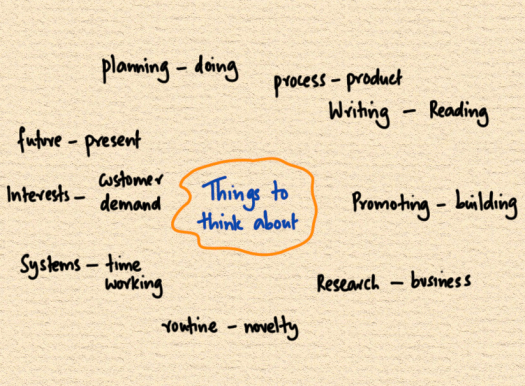
I have a lot on my mind right now and Hicks’ post reminded me of the power of pairs and I used them to jot down some of the things I’m thinking about.

Reading, in this case, led to writing.

I used a model to help me get started but, if you remember, I said earlier that I’m not sure models help that much.

So what’s going on?

I’m not going to go through the rest of my list in the image above, but what I think I’m trying to say is that life consists of contradictions.

We spend our days trying to figure out where to position ourselves between these extremes, driven partly by what we want to do and partly by what the environment demands from us.

And that means we have to be comfortable with uncertainty, with complexity, with the unavailability of clear answers and simple solutions.

We have to figure our way through situations that are never as bad as they seem and never as good as we’d like them to be.

We usually find that the future is obscured, that we see dimly, that of the many options that we could pick from none are compelling enough to commit to completely.

It’s when we commit that we take on risk. It’s when we commit that we reap rewards. How can things be both good and bad? And yet they always are.

I therefore reach this unhelpful conclusion.

Keep all your options open for as long as possible.

When given a choice between two things, do both.

Except when you have to make up your mind and commit to one thing.

Then do that.

Cheers,

Karthik Suresh

Why We Need To Try and Improve Rather Than Solve Situations

2025-03-27_improve-not-solve.png

Thursday, 8.57pm

Sheffield, U.K.

In boxing, they say it’s the punch you don’t see coming that knocks you out. In the wider world, the reality we ignore or deny is the one that weakens our most impassioned efforts toward improvement. – Katherine Dunn

Think of a situation, a problematic one.

Struggling to come up with one? Just have a look at the news – perhaps the productivity challenge that seems to afflict so many parts of the economy.

Why don’t things just work?

The larger operations get, the less nimble they are – elephants don’t dance, as the saying goes.

Managers in organisations find themselves in situations that they consider problematic. What tends to happen?

The most common response is increasing paralysis. Things can’t happen because other things need to happen first. And those other things require the first things to happen.

The Economist has an article about the need for countries in Europe to increase defence spending.

The recommended approach is to spend more money on tanks and drones and interceptor missiles.

But that needs more actual money.

Instead, a number of countries are using accounting techniques – reclassifying existing spending as defence spending, such as defence-related pensions.

Which is all very well if you want to hit a target. It’s much less useful if you want to actually defend yourself.

I don’t know if paralysis is the right term, there’s a lot of activity but no actual movement.

It’s the opposite of a duck, all flap but no glide.

At the other end of the scale is demolition, or what is now referred to as “delete” on the other side of the pond.

It’s more common in commercial settings where a new boss comes in and fires lots of people or sells off parts of the company.

It’s a form of surgery – cut off the parts that are diseased and what’s left has a chance to survive.

That assumes that the person in charge knows how to do surgery and isn’t hacking at random.

And, of course, that the patient survives once the surgery is done.

If you speak to insiders you realise that the medical system is not there to help you, it’s there to make money.

Far too many procedures are unnecessary.

We should really try and avoid hospitals altogether – the best defence is to stay healthy.

These first two strategies are the ones managers reach for first.

The third one, which they should reach for, is simple, but not easy.

It’s trying to improve a situation, rather than trying to find a solution.

Let’s take an example that comes up again and again in my experience.

You have a data problem of some kind – you need information to meet some obligation.

The first thing people do is look for a system – is there an app for that?

That’s looking for a solution – a one-stop shop, a magic bullet.

Magic isn’t real.

What’s real is that we do things a certain way right now.

We need to deliver something that we don’t do yet.

How do we improve what we’re doing so that we can deliver this new thing?

Improvement takes time, patience and understanding. You have to go to where the work is being done, see how it’s being done, and learn your way into making improvements.

Some people are too busy to take the time to make things better.

They are also too busy to have the time to learn what’s possible.

And I don’t really know how to address that situation – when people are unwilling or unable we either have to accept a paralysed situation or use coercive power.

And that’s no fun for anyone.

Trying to improve things is hard, unsexy, valuable work.

And, when it works, it can be fun.

Cheers,

Karthik Suresh

How To Prepare For The Coming Crisis

2025-03-15_into-the-storm.png

Saturday, 5.10pm

Sheffield, U.K.

Businesses, as well as individuals with desired talents, however, will usually find a way to cope with monetary instability as long as their goods or services are desired by the country’s citizenry. So, too, with personal skills. – Warren Buffett (2024 letter)

Things can seem a little bleak right now. It feels like we’re heading into stormy territory.

Markets are crashing.

The wave of optimism of the last few years, driven by hopes of an AI boom and a bonfire of regulation, have been replaced by uncertainty.

Markets hate uncertainty.

And then there is war, the actual kind and the trade kind.

Increasing protectionism and coercive politics make conflicts more likely.

How will things play out?

The one thing we know is that it’s impossible to predict what’s going to happen next.

Things could get worse. They could stay the same. They could get better. Who knows?

So, when there is such uncertainty what should you do? What should we do?

There are three things that should be in your strategy.

First, it’s about the long term.

As Benjamin Graham wrote, in the short term markets are voting machines. In the long term they are weighing machines.

If you have a 20-year horizon things will be different. If nothing else the main pieces in the game right now will be replaced on the board.

Some businesses will struggle. Others will do well. As long as you have a position in the whole market, you should stay there.

Time in the markets, as the saying goes, is more important than timing the market.

Second, it’s about sticking to your knitting

In Warren Buffett’s 2024 letter he writes that people will be able to cope with instability as long as what they do is still needed.

Try and be needed. Do useful things.

Build your business to do something people need, something that is rare and valuable, hard to imitate, which you can deliver competently.

It is time to focus on value because people are getting nervous, and when that happens they stop spending on things unless they need them.

And that sets off a downward spiral that is hard to stop – confidence is a fragile thing and unfortunately modern economies are propped up by confidence rather than substance.

Third, have a nut

I assume the term “nut” is about being like a squirrel – have a stash tucked away for the winter.

You need to have something in reserve, something that you can use if things go bad.

Something you can rely on if you have to walk away from a bad situation.

The problem with coercive methods is that they appeal to people in power and sometimes the only course of action you have is to have the power to walk away.

You cannot be controlled if you are not willing to be controlled.

Cheers,

Karthik Suresh

What We Really Need From A Product Or Service

2025-03-13_step-by-step.png

Thursday, 10.53pm

Sheffield, U.K.

Fantasy, abandoned by reason, produces impossible monsters; united with it, she is the mother of the arts and the origin of marvels. – Francisco Goya

Do you ever think about what you need from a product or service?

I find myself quite conflicted sometimes between what I need, what clients need, and what others think clients need.

Let me explain.

I was having a chat with someone about using a particular software application.

The app did something specific, as long as you gave it the data it needed.

There was still a lot of work involved in getting the data.

Once you had the data, the thing the software did wasn’t as necessary any more.

You had learned enough to do the rest of the work on your own.

I don’t think many products or services get this right.

Or, looking at it from the other end of the telescope, the products that survive do something right.

But, even then you sacrifice something.

Microsoft made it easy to use computers.

In doing so, they created a working environment where it’s easy to do easy stuff.

You just open a spreadsheet and add numbers in complicated ways.

It’s impossible, for most users, to do difficult stuff.

How many people do you know that can think of three ways to combine data from a hundred different spreadsheets?

It’s funny.

There are a thousand products that are vying for your attention.

The one thing you can be certain of is that not a single one will do everything you need.

If you push it, you’ll reach the limits eventually. Maybe even very soon.

Maybe we should think of software like we think of cars.

Worryingly, some are three-wheelers, economical perhaps but prone to tipping over if you go around a corner too fast.

Some are amazing, and come with a price tag to match.

There’s a tradeoff between factors such as speed, comfort, style, and cost.

How do you choose one? Pick the one that meets your needs.

The thing I am starting to see is that we should be using lean principles more when selecting software tools.

The most important principle is flow.

What happens next after you use the software? What happens before it? If the product doesn’t contribute to flow, then do you need it at all?

The second is to use what you already have.

If you’ve invested in systems, then you should make the most of them before buying anything else.

Then you should use Free/Libre/Open Source Software (FLOSS).

You should only choose something proprietory and controlled when you have no other choice.

Even then, think about what you will do if your access to that software is cut off – something that’s not unthinkable these days.

What will you do then?

I think we are moving into a world where it will be profitable to operate open source models.

The challenge these days is getting anyone to use your software at all.

The more users you have the more likely it is that you’ll find ones that are willing to pay.

You may not make billions but you’ll find a business model that creates value.

This may be a hard thing for some business people to understand.

Why would you invest in FLOSS?

It comes down to a belief that software is too important to be left to markets.

A child anywhere in the world should be able to access and use computers to find information, learn, and create.

People go to great lengths to control access to physical resources.

That’s bad enough.

We cannot afford to have others control our intellectual resources.

We need to be free to think.

That’s an unexpected conclusion.

What we need, from any product or service, is for it to help us stay free.

Cheers,

Karthik Suresh