Developing Knowledge Through Action

pouring-steel.png

They say a little knowledge is a dangerous thing, but it’s not one half so bad as a lot of ignorance. – Terry Pratchett

I’ve just finished “The map of knowledge: How classical ideas were lost and found: A history in seven cities” by Violet Moller. It’s a packed read, full of minute detail on how different cultures and their cities contributed the development of knowledge over a few thousand years.

You start to get a sense of the immense role chance plays in the fortunes of people when you read a good historical treatment.

Greek knowledge, for example, pioneered the use of observation as a way to understand the world around us.

Its value, however, was lost to Europe for centuries, but preserved in the cultures of the Middle East until they were rediscovered.

There’s this thing that happens with knowledge – first it’s fresh and new in the minds of people and then those minds, over generations, develop a sort of inertia – they start to become fossilised in the old knowledge they have rather than being open to new knowledge.

In my culture, for example, ancient verses have been memorised and passed down over centuries, as perfect as they were when created. Elaborate mnemonic techniques were used to ensure that they stayed that way.

One has to ask whether the effort of keeping that knowledge alive was too much to also create new knowledge.

The invention of the printing press allowed knowledge to race ahead and those cultures with access to this technology had citizens who were able to communicate and learn and collaborate and coordinate and organise – and create technologies and global empires.

The same technologies allowed knowledge of principles like liberty and equality to be used by those without the early advantage to learn and develop and free themselves.

Societies that actively curtail knowledge and prevent sections of their people from getting to them – which we see happening even now – are never going to be strong, never regain the preeminence they once had on the back of the knowledge they held at that time.

But there’s another phenomenon we have now – one where knowledge is created for the sake of creating knowledge – and that’s an interesting new problem.

The knowledge production industry has created a monster of its own – a world where so many papers are published that it’s hard to know what’s good and what’s not.

In the city I live in there are statues showing people working with molten metal, holding crucibles and pouring them into moulds.

It’s hard to think of an action with so many consequences if you get things wrong – the modern health and safety system arose out of problems resulting from industrialisation and the impact on health.

But at that point when molten metal is being poured you have something happening that is unambiguously real – there’s action taking place that has purpose and will result in a thing you can touch.

That kind of action demands real knowledge – not the pufferies of publication metrics, but something that you can actually use.

If the idea of knowledge started with observation the future of knowledge may rest with action.

Cheers,

Karthik Suresh

Walk Along A Road And Then Magic Happens

walk-in-woods.png

Friday, 7.43pm

Sheffield, U.K.

If the scholar feels that he must know everything about any topic, he is in trouble – and will not publish with a clear conscience. – Kenneth L. Pike

We are lucky enough to live in an area that has woods close by, ones that we don’t walk enough in.

But when we do go with friends we walk and talk and make plans.

One of those plans came a bit closer as a paper I worked on made its way through the first set of hurdles at a journal and is waiting to be peer-reviewed.

I’ve learned a few things along the way.

1. Understand the conventions of your genre

Academic writing is very focused, You write for a community that has worked to define its space and place and has a literature and set of ideas that give the community a foundation.

If you want to publish in a journal that serves that community you need to learn what they’re looking for and the kind of work that they will recognise. One way of doing this is to make sure there are plenty of references to earlier articles from the journal you are targeting.

It’s a lot like book publishing – you need to write for a genre – choose whether you’re doing crime, business or romance.

Mixing genres just gets people confused.

2. Take time to construct sentences and paragraphs that work

Writing is about creating sentences, a run of words that means something to the reader.

It’s very easy to create confusing sentences filled with jargon. Sometimes the jargon is actually a very precise way of saying something important, but all too often it masks a lack of real understanding of the subject.

Putting sentences together to create a coherent paragraph is much harder than it seems. You have to work and rework your sentences, pushing, teasing, moulding, cutting, massaging them until they fit together and say something sensible.

3. Abandon your work and press send

Paul Valéry wrote that art is not finished but abandoned. You will never be happy with your work, it’s never completely there, every idea and every thought perfectly captured in prose.

But when you’re done and it’s been read by your colleagues it’s time to send it into the world and see what happens.

It may come back with a demand for corrections, attract criticism, even rejected. It may take years to find it a home.

While you’re waiting there’s time to take another walk, and start thinking about the next paper, the next work of art.

Cheers,

Karthik Suresh

What Is The Value Of A Research Question?

research-question.png

Thursday, 8.31pm

Sheffield, U.K.

From journalism I learned to write under pressure, to work with deadlines, to have limited space and time, to conduct and interview, to find information, to research, and above all, to use language as efficiently as possible and to remember always that there is a reader out there. – Isabel Allende

It is impossible for someone to read all the scientific literature – millions of papers are published every year and trying to take a top down approach sounds like failure waiting to happen.

In time, perhaps, natural language processing (NLP) tools will help us read more effectively – parsing every paper and pulling out the ideas that matter.

We’re surrounded by knowledge but too much information is as bad as too little. If we can’t discriminate between good and less good, insightful or obvious, original or copied – then how can we make sense of research and draw our own conclusions?

One approach is to throw away any attempt at being systematic and top down. Instead you focus on what matters to you.

This starts with having a question – a burning one – one that matters to you in some way.

You may not be able to articulate the question clearly, but you need to have some kind of question in mind that you can use to test what comes in front of you and ask “Is this useful to me or not?”

Anything that’s not useful needs to be ignored – you don’t have time to waste reading everything. You just need to look at the stuff that looks like it’s going to help you out.

For example, one of my research questions is how can drawing be a thinking tool. That leads in many directions, including asking what is drawing anyway, and is drawing like a child different from drawing like a trained artist.

Research questions help you traverse the huge labyrinths of knowledge that we now have. They are your candle in the darkness.

Cheers,

Karthik Suresh

How Does Technology Change Learning?

ai-and-learning.png

Thursday, 8.29pm

Sheffield, U.K.

A single conversation across the table with a wise man is better than ten years mere study of books. – Henry Wadsworth Longfellow

How will technologies like ChatGPT – an artificial intelligence system that can answer any question you ask – change the way we learn? What is the point of learning anything if a computer can do it for you?

Such questions must have been asked every time a new technology was invented. Writing was probably decried by people who were able to remember things in their heads. The printed book, The typewriter, the computer, voice-recognition software… Everything is changed and yet, we seem to be able to work with the changes.

For example, over the last year I have been immersed in research papers. The first section in any paper is meant to be an introduction to the area – a scholarly summary of what’s important. The problem is that these summaries are often not very good.

You see, one starts writing with good intentions – with a view to summarising the big and important ideas. But then you start to look at the text and ask questions like are there enough papers from the journal you’re writing for, should you cite some papers that the editor has written. You start to change your paper not to make it better but to get it past the person who has the power to print it. And that’s not a good way to create good material – it’s a distraction from the actual work which is to be clear about the ideas that matter.

An AI model doesn’t have those hangups. It looks at the material in its database and creates an output. I’ve tried ChatGPT in a couple of areas and in each case it’s created a coherent summary of the key ideas.

For a researcher, that’s really useful. You can have AI software that reviews all the available literature and summarises it for you in a few seconds. You don’t need to read every paper – the system does that for you.

Now, that may not seem like a good thing – shouldn’t you read everything yourself. How will you learn? But the fact is that the words in the papers don’t actually matter – it’s the ideas that do. If you can get a grasp of the key ideas, get a sense of the framework that ties them together, then you’re on your way to understanding what’s going on. The idea of a literature review is to know what’s already out there so you can build on it. But there’s so much that you couldn’t possible read it all yourself – but your AI buddy can, making sure that you don’t miss something important.

These are exciting times but the times are probably always exciting if you like learning – there’s always something new to discover.

Cheers,

Karthik Suresh

Immersion As A Means Of Sense Making

jumping-in.png

Wednesday, 8.59pm

Sheffield, U.K.

Writing is my way of diving deep into an issue. My approach is to watch, read and listen – sometimes for years – in order to grasp the dynamics, resistance and patterns of thought that repeat and impede progress and breakthrough. – Paul Hawken

I’ve been doing a lot of research this year and in the process thinking about how to do research.

There’s a lot of information out there and you can’t tell what’s useful and what isn’t without spending some time going through it all.

Now clearly, you can’t go through it all, there’s just too much, so you have to search, to dig, to find the things that are important.

Search engines can show you some things but then you also need to follow trails, look at what others have read and discussed.

But then you have to work out whether to listen to one person and ignore another. How well do they write, and where are they being published?

If you go for the high impact journals, however, are you cutting yourself off from the information at the edges, the places where often innovation comes from?

The edge, on the other hand, is also where crackpots live, with theories and ideas that are nonsensical.

Once you start looking at things deeply you realise that the further away you are from where the “happenings” are, the less likely it is that you really understand what’s going on.

If you’re reasonably well off you really can’t appreciate what people are going through in a cost of living crisis unless you’ve experienced it before yourself on the way to getting rich.

You really can’t understand how markets function and why prices move the way they do if you haven’t been involved in trading a position.

You can talk about it and you can hold certain beliefs – ones founded in faith in long-dead philosophers – but unless you’re close to where the action is your chances of really getting it are slim.

To really “get” it then, you have to commit – to dive in and immerse yourself in what’s going on.

You’ll never understand anything or master it by watching from a distance.

You have to get involved and do it.

The challenge is that you can’t dive into everything – so you need to pick what you want to do on the basis that you’d be happy spending the rest of your life doing that.

Cheers,

Karthik Suresh

Some Rules For Living

peterson-12-more-rules.png

Sunday, 8.15am

Sheffield, U.K.

The young man knows the rules, but the old man knows the exceptions. – Oliver Wendell Holmes, Sr.

I am reading Jordan B. Peterson’s Beyond order: 12 more rules for life. Peterson is seen as a divisive character, associated with a right-wing ideology or perhaps more accurately, against a left-wing one. The ideas in his book, however, are worth considering. This post picks out three.

1. Find a home for your thinking

Peterson argues that we should respect existing institutions and structures. You may not like what is going on in the world and believe that the structures you see are oppressive ones that are built by men and need to be torn down. Tearing down without a plan for replacement, however, results in chaos.

There’s a great documentary by the BBC called People’s Century that has an episode on the end of colonialism, as European powers withdrew from their former colonies. Some colonies made the transition to self-rule and democracy while others faltered, falling into an endless series of military coups and dictatorships.

What made the difference? The Perivuan economist, Hernando de Soto, argues that democracy is more than just having a vote – it’s about having a system of institutions that have the checks and balances needed to support democratic society. In many countries this means a separation of political power, the judiciary and the military. If you control how the law is made, who can be put in jail and start a war without opposition you are a dangerous person indeed. Read the news to find out what happens when that is the case.

Robust democracies have institutions that support this ability to have checks and balances. Start a business, join a university, work for an NGO – find a home where you can develop your thinking and argue your position. In doing so you will make an impact – one that makes society better as a whole.

2. Have an ending in mind

I have argued in this blog elsewhere about my dislike of goal oriented behaviour – and its related concepts of winning, victory or domination. But having a goal is different from seeking an end, having a destination of some sort. Peterson gives an example of the difference by talking about Harry Potter and the snitch.

In the book you have a game, quidditch, that has rules and goals and players. But there’s also the snitch, a thing that if you catch, you win the game, regardless of what else happens. The snitch operates inside and outside the boundary of the game, it can go anywhere, and in chasing it Harry Potter crashes through the stadium, literally undermining the foundations of the game.

The message here is that getting to the end you want may need you to be willing to change everything around you, including the rules of the game. But how do you do that?

3. Seek the highest god (good)

Peterson draws on myths that show how societies intuited what needed to be done. In Mesopotamia they told the story of Tiamut, the primordial goddess of chaos and Apsu, the eternal father of order, who brought about children who became the elemental gods that formed the world. The children waged war on the father and killed him and the mother, enraged, created demons and monsters to control her children and grandchildren. The other gods called on a young but talented god, Marduk, born with eyes all around his head and the ability to speak magic words to fight and defeat Tiamut and he did, but on condition that he took his place atop the hierarchy of gods.

The highest god, then, or the highest good, came from having the ability to pay attention (the eyes all around the head), the ability to use language effectively (the magic words) and the will to take action to defeat chaos. These three: attention, language, and action are the skills we must develop if we want to achieve our goals and defeat our monsters.

Cheers,

Karthik Suresh

The Art Of Trying Things Out

comedy-audience.png

Saturday, 8.50pm

Sheffield, U.K.

To be a comedian, you gotta jokesmith, there’s no way around it. – John Leguizamo

A comedian on stage can deliver a fluid, effortless performance – one that makes you wonder what it takes to be so naturally funny.

The show you see, however, is not the one they started with. If you listen to comedians talk about how they developed their material you’ll hear stories about how they tried out jokes in small venues and pubs, refining and reworking their material and keeping the best stuff in – the stuff that you saw in the show.

I attended an academic conference in person for the first time since the pandemic and realised that they offer the same kind of experience to a researcher.

These are places where you can go and try out your material on a community of peers – smart, sharp people with opinions and expertise who will ask questions that test your understanding of your material. It gives you a taste of the feedback you’ll get when you try and get your paper accepted by an editor of a journal.

In my last post I wrote about the importance of rewriting. The conference experience taught me about the importance of feedback – showing your work to people who will give you their honest opinion and reaction.

It can be tough to hear, especially if it’s work that you’ve spent a lot of time developing. But you need to hear it – you want to see what reaction your work gets.

The worst thing is to be ignored. A reaction, good or bad, is information you can work with.

An idea that falls flat, just like a joke, is one you need to rework, retry, or abandon and move on.

The ones you are left with will be all the more powerful as a result.

Cheers,

Karthik Suresh

Just Writing In Contrast To Good Writing

writing-publishing.png

Sunday, 8.09am

Sheffield, U.K.

Writing, to me, is simply thinking through my fingers. – Isaac Asimov

I have published 1,213 posts with 868,016 words since 2016. This has been a labour of quantity over quality, but it is now time for a change.

My aim with this blog was to practice writing. The way to get better at writing, I believed, was to write. I hoped that by writing every day and making progress towards writing a million words I would develop the skills needed to produce words and find a unique voice that I could use to explore interesting ideas.

In this post I’m going to tell you (briefly) about what I’ve learned so far and what I’m going to try next.

You must get started and produce words

Every writer faces the challenge of the blank page. How do you start your piece? What’s the first sentence? The fear of getting that right can stop you starting at all.

The approach I take is to start with a technique called freewriting. Just start writing – begin with whatever is on your mind. An observation, a worry, thoughts about what you watched last night. Put anything down, even if it’s a rant about how hard it is to get started.

Do this for two or three paragraphs. By the fourth you’ll feel ready to move on to your main post.

Freewriting greases your mental wheels, allowing them to start turning. In order to produce the 868,016 words I published I threw away 588,267 words of freewriting. That was worth it to get started.

You must finish what you’ve started

Once you start writing you need to finish. Anything that slows you down is a problem.

I, like most if not all of you, don’t have time to waste. I decided my posts would be simple – a hand-drawn visual and minimally formatted text that could be produced in a single writing session of an hour or so.

This creates constraints that you need to work within. 1,000+ words posts are too hard. 300-600 words are a nice, easy length. The key is getting done and publishing the piece.

Having a plan can help

It’s easier to write when you have some idea of how your post fits into a larger plan. Creating an outline for a book project, for example, helps you pull out key themes and an outline structure that can make it easier to write. If, when you sit down at your desk, you already have a topic in mind it’s easier to get on with the task of creating the words you need.

Prepare for bumps on the road

Over the last couple of years, in 2021 and 2022, I have struggled with figuring out what I should do. Should I work on images? Complete book projects? Keep writing about concepts or models?

In 2022 I have published much less. August 2022 is the first month in five years when I haven’t published a single post. So is that it then for the blog?

Work on improving quality

If the secret to writing is to write, then the secret to good writing is rewriting.

I’m trying an old school approach to rewriting by first creating a draft in longhand and then typing it up. This sounds like it is going to be slower than just working straight on the computer, but it does force you to rewrite rather than just fiddle with what you’ve already written.

I have already found that this approach creates better quality material when working on my thesis. This post is my first attempt at using the same approach for the blog.

We’ll see how things pan out.

Cheers,

Karthik Suresh

The Problem With Perfect But Closed

apple-principles.png

Friday, 6.09am

Sheffield, U.K.

Be a yardstick of quality. Some people aren’t used to an environment where excellence is expected. – Steve Jobs

I watched Steve Jobs again yesterday, a biopic about the mercurial co-founder of Apple and his uncompromising approach to products.

Was he a visionary or was he so myopic that he created a “reality distortion field” and was eventually just lucky that magic happened?

The tension between his way of thinking and other ways of thinking is shown by the confrontations with his co-founder Steve Wozniak.

Jobs wanted end-to-end control over his product – everything a customer could do was controlled by him.

Wozniak wanted an open system, one that hobbyists and tinkerers could work with, play with and extend.

Jobs believed he was right – an unshakable faith in his vision.

That failed and failed until the iMac – which brought the company back.

Wozniak maintained the status quo, but innovation slowed down and others caught up, nearly driving Apple into bankruptcy, until Jobs returned.

Jobs was a master showperson – he knew how to work the press and a crowd.

Jobs believed that the interface mattered, what the customer saw and felt was crucial.

Computers had to be friendly, say “Hello!” with a smile.

They also had to be simple – you needed to be able to use them by pointing and pressing.

Jobs was right – his relentless attention to detail, pursuit of visual Zen, and uncompromising approach to product development has created one of the most profitable companies out there.

It has generations of loyal users who will defend it against all comers.

And you have to respect that.

But I am not sure that Jobs really made the world better.

In the biopic he compares the computer to a bicycle for the mind, a device that turns an inefficient organism like a human into the most efficient organism on earth.

But have modern computers really made us more efficient?

Or have they turned into prisons?

I lean towards the latter.

Computing has just as much potential to be a mechanism of control as it is a tool for liberation.

I recommend buying Apple products to old people and people who don’t really use technology because it’s simple and controlled and won’t be a hassle.

Some people, often designers, swear that they only use Apple products because they are the fastest and best – and are willing to pay the price for that power and functionality and don’t mind being locked into an Apple ecosystem.

That’s ok too.

But the majority of people who buy a Windows or Apple machine or are given them by their organisations will experience a lack of freedom and imposition of coercive control – because that’s the way things are.

Corporations have to secure themselves in a dangerous digital world – that’s just the rational thing to do.

Instead of being chained to your machine or desk, you’re now chained to your computer.

Wozniak’s tribe are the truly free people, the ones that can open and play with the technology.

They are the ones that really get the opportunity to get on the road and ride.

And that, in the end, is the single biggest failure of the computing revolution.

A machine with the potential to liberate our minds is now used mostly for shopping and glorified typewriting.

But there is hope – hobbyists and tinkerers and people with an urge for freedom can get what they need from a thriving world of Free Software.

I’m an associate member – there aren’t that many really and the FSF budget is tiny.

It’s a rounding error on Apple’s numbers.

But I would argue that the Free Software Foundation (FSF) has done more to really liberate humanity’s potential than any other organisation.

Closed systems make you money.

Open ones change the world.

Cheers,

Karthik Suresh

How To Keep Being The Change

radical-fringe.png

The most radical revolutionary will become a conservative the day after the revolution. – Hannah Arendt

What do you think of when you hear the word “radical”?

It brings to mind revolutionaries, change agents, Che Guevara like figures.

But it also relates to the ordinary everyday, and that’s where it’s relevant to our lives.

I learned yesterday, that when you get given more choices you tend to choose less radical options.

That’s an interesting thought.

For example, right now energy prices are high and people are struggling with the costs of paying their bills.

The radical option might be to fund a programme of insulation to help with energy reduction.

A less radical option is to give people money to help with the bills.

They still use the same amount, but it costs a little less.

The radical option of reduction or rationing or prioritisation is avoided because it requires changes in behaviour.

I’m not saying that the radical option is the right answer – just that it’s avoided for as long as possible.

A few weeks back I wrote about knowledge locked in research papers behind paywalls and suggested that research should open access and smartphone friendly.

That’s a radical idea but it’s being done already.

For example, Ephemera is an open access journal that is self published – it’s independent and free.

It’s critical – meaning it questions the status quo – and it’s radical – which means it’s outside the mainstream.

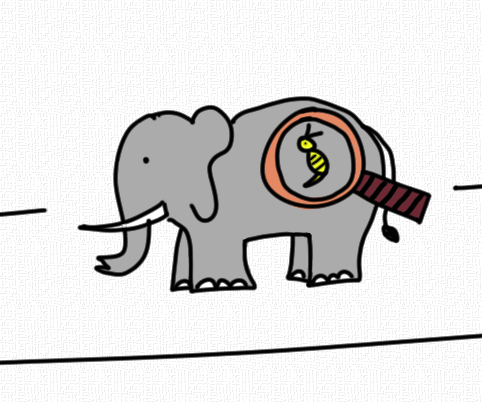
Think of the mainstream like an elephant that plods on – it’s what most people do and think.

Think of the radical like a bee, poking away at the mainstream.

Most of the time, the mainstream ignores the radical.

Often it swats it away.

But every once in a while, the mainstream changes direction, incorporating the ideas of the radical.

The whole move towards sustainability is a story of that change, first started at the fringes and now part of mainstream thought – a story we just can’t ignore as the world heats up around us.

Change, it turns out, happens at the fringes and takes time to filter through to the rest of us.

The trick, or rather the challenge, is being radical enough to propose change, while being effective enough to implement it.

Cheers,

Karthik Suresh