Do you see things as they really are?

awareness-of-context.png

Look at the picture above – what do you see?

We are far more influenced by small things than we realise.

It turns out, for example, that we are more likely to be generous after lunch than before, think a person is more warm and approachable if handed a warm cup of coffee by them than a cold drink or be affected positively or negatively by the words we hear.

We also don’t realise how important the situation is in affecting what happens next.

This is called context blindness and it happens all the time.

We ascribe people’s actions often to who they are as people – their personalities and traits – rather than the situation they find themselves in.

We believe murderers are bad people, while the murderers themselves think of their crime as something they had to do in that situation.

We see Warren Buffett and Bill Gates as super-smart people who created their own futures, rather than average people who had a series of helpful experiences that set them up for stock investment and technology startups.

This is called the fundamental attribution error and, in his book Mindware: Tools for Smart Thinking, Richard Nisbett describes how culture may have an impact on how often we make the error.

Going back to the picture, if you’re from the West (particularly American), you probably noticed the three big fish swimming to the left, then the smaller fish, vegetation and some of the other parts of the picture.

If you’re from the East (particularly Japanese), you probably noticed the stream, vegetation, rocks and shells and three big fish swimming to the left.

Apparently, people from the East pay more attention to context than those from the West, and Nisbett speculates that this, as with many things, goes back to the Greeks.

The Greeks have a tradition of intellectual independence, possibly developed as a result of their geography and economic features, and laid the foundation of scientific thinking as we know it now.

The East had a more holistic approach – with interdependent economics and value systems that required a large population to cooperate and subsume their personal interests to that of society as a whole.

Independent Western thinkers, as a result, believe that people have complete control over their actions, and so if they get it right or wrong do so as a result of who they are.

Easterners, on the other hand, are more likely to give people the benefit of the doubt and take their situation into consideration.

This small difference in mindset has a large impact in many areas.

People who believe that criminals are inherently bad and should be locked up may be unable to see the benefits of how changing the environment those people are in could change their future.

People may have become conditioned to think that they can only do certain jobs, but find new opportunities when they move cities or find new friends.

Life isn’t static – just because things are the way they are now that doesn’t mean that is the way they always will be.

Changing our context is the first step to changing our reality.
How to think critically

critical-review.png

Thinking critically about something is not the same as criticising it – just like making an argument is very different from having an argument.

In day-to-day usage it appears negative or destructive – but from an academic point it’s simply a common sense approach.

How can we approach a new situation, idea or information with our eyes open and do something meaningful as a result?

This starts with being able to consider the situation critically – questioning rather than blindly accepting the things that are put in front of us.

This is especially important in a world where we face complex choices – from whether we should act quickly or slowly on our own contribution to climate change to enthusiastically adopt the latest technology fad.

Quite often we default to doing nothing – and that may be the worst of all outcomes. That leads to atrophy and failure.

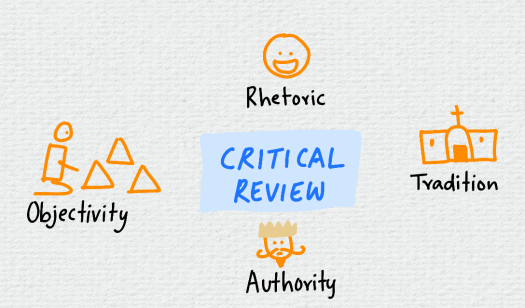
John Mingers identified four aspects of critical thinking that act as a useful checklist for us.

The first is to be wary of rhetoric.

Is the argument fair, balanced and logical or is the speaker using language in a way that could appeal to emotions or mislead us?

Is it a sales pitch rather than an insight?

It’s not always easy to tell, because we can be swayed by passionate people who believe in what they are saying – but we need to try.

The second aspect is to question tradition.

Tradition can involve unquestioned assumptions that are made by people or the culture and practices that have sprung up around an idea.

This can be a difficult thing to approach as the existing position, or status quo, is something people will cling strongly to and resist changing.

It’s easier to go along with them – but that might not be the right thing to do.

The third aspect is not to accept authority unthinkingly.

Arthur C. Clarke wrote – If an elderly but distinguished scientist says that something is possible, he is almost certainly right; but if he says that it is impossible, he is very probably wrong.

Things change – and sometimes people that have built their reputation on a particular set of ideas find it difficult or impossible to accept that their contributions could now be overturned.

If they have power, they can direct resources and attention to other areas instead.

We see examples of this everywhere – most notably in politics across the world.

The final aspect is to question the objectivity of the people involved.

Robert Pirsig in Zen and the art of motorcycle maintenance writes about how scientific work can be like sorting grains of sand on the beach into piles.

The piles represent related ideas, concepts, theories. It’s the way that we approach and classify the world.

The thing we cannot forget is that the piles do not exist on their own.

There is a person kneeling there on the beach making them.

And we need to consider how value-free and objective that person is about the issue.

For example, we would not give a news report from a state that routinely censors information the same weight as a report from a respected investigative reporter.

So, in summary, critical thinking is not about criticising.

It’s about not blindly following persuasive, traditional, authoritarian or seemingly objective points of view.

How to get better at learning

kolbs-learning-cycle.png

We see time as linear – life too as a result.

We spend time in school, perhaps university learning, and then we get into the real world and work.

Learning gets left behind.

The creation of knowledge keeps happening – by academics – but it filters out into the wider world only slowly.

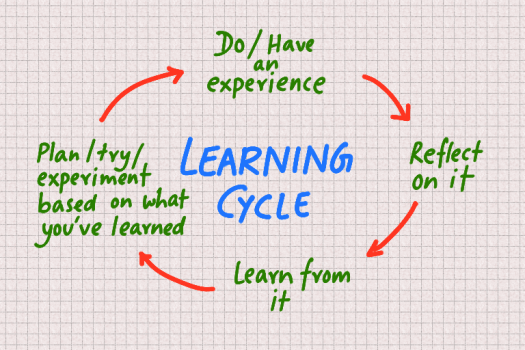
David Kolb and Rob Fry developed the experiential learning model in the 1970s – a cycle that has become the foundation of many lifelong learning approaches.

The model has four elements:

  1. Concrete experience: We do or have an experience.
  2. Reflective observation: We reflect on the experience – how it went and what happened.
  3. Abstract conceptualisation: We learn from the experience
  4. Active experimentation: We plan, try and experiment with new approaches based on what we’ve learned.

Like many models, its simplicity hides a number of challenges.

For example, in our busy lives, once we have done something how often do we get the time to think and reflect on how things went?

Some organisations, especially consulting ones, do review projects and try to get out learning points that they can use to improve how they work.

All too often, this can turn into another process that needs to be finished quickly so we can get back to the important stuff, which is usually the next pressing project or emergency.

How often have we seen people who are too busy to work out a better or easier way to do something – so they do it the long way every time.

We all are going to have experiences – one after the other.

Few of us make the conscious effort to reflect, learn and then experiment with a new approach based on that learning.

Taking the time to do that, however, could dramatically improve how we learn.

How to make your way to higher profits

power-curve-of-economic-profit.png

Most of us are stuck in a zone where we make hardly any money.

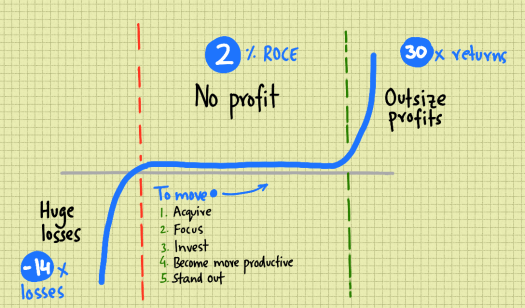
It turns out that the profits made by organisations fall along a power curve.

This means that most fall into a zone where their returns on capital employed are tiny.

They make net returns of less than 2% on invested capital, making 10% gross and paying out 8% to lenders.

Chris Bradley, Martin Hirt and Sven Smit from McKinsey explain how in this article, showing that companies at the top make around 30 times as much as the ones in the middle.

The ones at the bottom make losses of over 14 times.

This works out to around $50m in the middle, nearly $1,500m at the top and losses of just under $700m at the bottom.

They found that around half of where we sit on the curve depends on the industry we’re in – Tobacco is at the top, paper is languishing in the middle.

As the saying goes – before you climb the ladder, make sure it’s leaning against the right wall.

It’s better to be average in a great industry than great in a poor one.

This has echoes of Warren Buffett who wrote when a management with a reputation for brilliance tackles a business with a reputation for bad economics, it is the reputation of the business that remains intact.

As this McKinsey article shows, returns are highest in pharmaceuticals, household personal goods and software, and lowest in utilities, telecommunications and transport.

So what’s the answer?

It turns out that to move up the curve, we need to do the basics plus a bit.

The authors come up with five points.

The first is to have a disciplined acquisition process. We need to evaluate and buy businesses that are a good fit for us.

The other four are basic good business practice.

We should focus on the areas that are doing best, moving more resources to them.

We need to invest in our capability, putting capital into the business so that we have the technology and resources to respond to the market.

Becoming more productive goes without saying – doing more with less.

We need to stand out – differentiate ourselves by innovating and creating new business models.

Interestingly, this power curve could be used to describe individuals and their careers just as much as organisations.

A few make a lot of money, the vast majority get by and some lose a lot.

The question that we need to answer is what moves we’re going to make next.

The authors argue that these need to be big ones – just doing what everyone else is doing isn’t enough.

We need to do more and go further if we want to break out of where we are and move towards a more profitable position.

Doing nothing is a bad idea.

How to optimise only the things that matter

bottlenecks.png

Much of what we do can be described in the form of a process flow – and we often assume that if we can improve performance by improving parts of the process.

To improve traffic flow, for example, we could have all cars drive at the same speed – surely that will help?

That doesn’t turn out to be the case.

We can see this effect when something happens on the motorway that causes a lane to be shut.

It doesn’t matter how well everyone drives individually.

The flow rate of the vehicles is set by the capacity of the number of lanes available and so, when we lose one, everyone slows down as the same number of vehicles now has to pass through the lesser number of lanes.

Eliyahu M. Goldratt, in his books Goal and Theory of Constraints, sets out how the throughput from a process is going to result from one constraint or bottleneck.

To improve the throughput – the number of things coming out of the process – we need to figure out where the bottleneck is and what we need to do to improve its performance.

It’s a waste of time spending effort optimising any other part of the process, because the performance of the system overall will still be set by the bottleneck.

Goldratt sets out a five-step process for dealing with constraints. In adapted form, these suggest we should:

  1. Figure out where they are.
  2. Decide what to do about them.
  3. Decide how everything else works based on the impact on 1 and 2.
  4. If, in doing all this, the constraint is no longer the limiting one, then go after the next one.
  5. A warning – we need to keep repeating this, as the limiting constraint will move around.

The way we often figure out where constraints are is because they have piles of work-in-progress (WIP) in front of them.

The same thing applies with knowledge work.

A person can be a bottleneck if the work they do is slower than the rest of the work carried out by others, and so they become the limiting factor in the operation.

Aligning how we work with bottlenecks has a number of benefits:

  1. We know that throughput is set at the capacity of the bottleneck. To increase output, we need to work on the bottleneck.
  2. This means that we can minimise inventory to the level required by the bottleneck. Working any other part of the operation simply piles up money in stuff that will take time to be processed.
  3. We can also reduce operating expenses because we don’t need more people in areas that don’t directly contribute to the bottleneck activity.

In summary – when we try and optimise an activity we often try and speed up parts of the system.

What we need to do instead is improve flow through the system.

And that starts by focusing on bottlenecks.

When should you get really interested in new technology?

technology-readiness-levels.png

The pace at which technology is developing appears to be speeding up all around us – so what should we do in such an environment?

Technology developers and evangelists can have any number of brilliant ideas and solutions, but as buyers and users that may have to use the technology for a number of years, we need to be careful.

The Gartner hype cycle is a popular way of looking at different technology and says that they tend to pass through five phases:

  1. A new technology is created.
  2. We expect too much from it.
  3. We’re disappointed when it doesn’t meet those expectations.
  4. We learn and change and figure out how to use it properly.
  5. It helps to be more productive up to a point, and then the effects level off.

It’s a nice graph, but there is little evidence to say that is actually works or has any science behind it.

It’s more a picture of how industry insiders collectively think about technologies at a point in time than an accurate reflection of the journey technologies take from creation to mass adoption.

A more useful indicator, used widely in academia, is the idea of Technology Readiness Levels or TRLs.

TRLs originated in the aviation industry, where pre-flight checks are common before taking off – a process called flight readiness reviews.

Having a checklist to go through and check and double check critical elements is a major contributor to flight safety.

NASA took this one step further, and came up with the idea of checking whether technologies were ready to start being used in programmes – a technology readiness review.

This led to the idea of readiness levels – and a formal version of these are used by many organisations.

For those of us that need to make a decision about a specific technology option, the picture above shows an adapted version of the TRL framework that may be useful.

In essence, we go from low TRL levels, where a technology progresses from basic principles to a model that works in the laboratory between levels 1 and 4.

At the other end, at 9, we have systems that are proven, work in the field and are probably widely deployed – but that are also mature and perhaps need changing

The interesting stuff is happening between 5 and 8, and this is where we should focus our attention.

Take blockchain technologies, for instance.

The idea of the blockchain and demonstrators with code have been around for a while.

Bitcoin, arguably the first proper prototype that began operating on the web in anger, has been around for nearly a decade.

We are now in a situation where there are a number of prototypes being operated – we can create apps on ethereum now and test them out – but there are still challenges that need to be solved around scaling and power usage.

So, we might score blockchain a 7 with strong potential to go onto 8.

That might suggest that a good time to get involved is right now.

How can we make better decisions in organisations?

decision-process.png

Is the quality of decisions made in organisations any better now than it was fifty years ago?

We have quicker, faster, better technology – but human nature and the way in which we think and act is still unchanged.

Which makes a working paper on Management Information Systems from 1971 by Anthony Gorry and Michal Morton an interesting read.

They use a framework for thinking about the kinds of decisions managers have to do.

Managers have to collect information and make decisions at three levels:

  1. Strategic planning: Choices about the future, done in a non-routine and often creative way.
  2. Management control: Getting the best out of people.
  3. Operational control: Making sure tasks are done effectively and efficiently.

Information for strategic planning is outward looking, taking into account market conditions, regulation and what competitors are doing – but is only required when the planning activity is taking place.

Management control is about people – selecting them, keeping them and motivating them.

Operational control is inward looking, focused on what is happening right now – and the information needed to support this is obtained and looked at on a frequent basis.

So, the obvious step is to think that the better the information that we have, the better our decisions will be.

That is the one of the touted benefits of Big Data, Machine Learning and AI – if we get all the data and crunch it, the information that comes out will help us make better decisions, or make them for us.

If we think about a decision process as a black box, with information going in and decisions coming out, surely we can improve the quality of decisions at all three levels by improving the quality of information?

But there are two things we miss.

The first is that different kinds of decisions need different types of information.

Merely collecting all the data that is out there is not the answer – and we know that from nature and biology.

We often think that we see a lot of things around us. In reality, our eyes can only see in a fairly narrow band, focusing on the thing that they are pointing at.

Our brain fills in the rest of the information, so it looks to us like we are seeing a wider scene.

Instead of more data, biological systems focus on a subset of data that is important for the specific situation.

The second thing is that we can also work on improving the decision process, and this starts by recognising that the problems we apply our decision process to can be structured or unstructured.

If a problem is structured – like working out the optimal size of a batch or the most economic schedule – we can collect the relevant data, analyse it, make a decision and monitor its impact using ongoing real-time data.

Many problems however are unstructured or “wicked”.

These can’t be solved simply by throwing more data at clever algorithms.

Instead they need better decision processes – better models that can express the complexity of real world affairs.

This requires us to use human intelligence alongside machine learning and artificial intelligence.

The computers are there to support us – not think for us.

Not yet anyway.

How to analyse the future

analysing-the-future.png

Thinking about the future is not easy.

As humans we fall prey to biases, and two in particular are important.

The first is hindsight bias where, looking back, we think that things that have happened were far more inevitable than they actually were.

For example a Trump victory seems like it was pre-ordained now – Hillary never stood a chance against the Twitter machine.

At the time, however, not many around the world seriously thought Trump would win.

The second is foresight bias – we believe some things are more likely to happen than others and so bet on them more heavily.

We need tools and methods to guard against these biases and reason about the future more effectively – and the military and intelligence establishments are a good source of information on these.

For example, this guide sets out a detailed approach to counterfactual reasoning, one of the tools every analyst should be able to use.

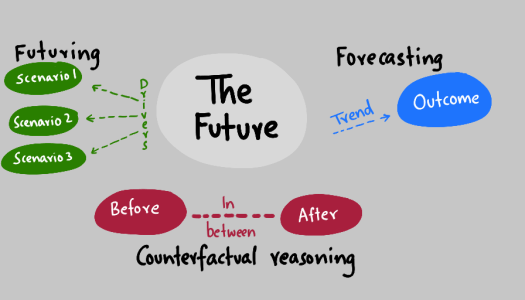
When we think about the future we often do one of two things.

1. We look at trends

We see trends and infer outcomes that result from those trends – a technique called forecasting.

For example, we might see a trend towards decentralised currencies with bitcoin or a trend towards widescale adoption of solar photovoltaic and distributed generation.

We forecast an outcome based on these trends – the end of traditional banking or energy firms.

2. We create possible futures

We do futuring when we look at drivers and come up with possible scenarios that might result.

For example, the widespread use of mobile phones will make desktop or offline services less relevant for things like getting media, checking mail and reading the news.

Counterfactual reasoning

Counterfactual means counter to the facts, and we reason that way by asking questions like “What if” or “If we”.

We can look at a problem in terms of antecedents and precedents – or before and after a fact.

Approaching a problem in this way has two benefits – it helps us explore cause and effects and it lets us be more creative.

For example, take a statement like the fall in the price of solar panels means that we will have widespread adoption in residential neighbourhoods.

That seems like a perfectly reasonable statement – but what happens if we break it down?

Should we start a solar panels sales business right now?

The before bit is a fall in the price of solar panels – which we see happening right now.

Cheap solar panels clearly lead to cheaper costs for the equipment.

But, does that alone justify the conclusion about what comes after – widespread adoption in residential neighbourhoods?

It does not – because we haven’t looked at the components in detail.

First, we need to examine why prices are low. Is it because the technology is getting better and cheaper, or is it because massive capacity increases in China are resulting in panels being dumped on the world market?

Then we need to think about the in-between – what may happen if what we predict takes place.

Low prices for panels don’t get around other problems – such as the connection constraints in neighbourhood, the other costs of installation such as scaffolding, and the possibility that high demand for installations coupled with low numbers of qualified tradespeople after BREXIT may result in bumping up the costs overall.

Then there is the after – new homes are very likely to have panels fitted – they can be designed in.

But will there be a rush by homeowners to retrofit panels or will they be put off by the up front cost and possible impact on sale prices?

If existing homes are slow to change, the overall rate of change will be slow because existing housing stock stays in place for decades so for everything to be replaced with new energy-efficient housing could take a century.

Summary

We can jump very quickly from what we see now to what we think will happen in the future.

The purpose of using analytic methods in a structured way is to help slow us down and examine the situation in more detail, coming to a more considered view on what may happen.

The conclusions we come to as a result may help us make better decisions.

What we should do before investing in technology

technology-impact.png

We often think of technology as a good thing – surely having the latest version of something is obviously the best way and people who do that win?

Perhaps not.

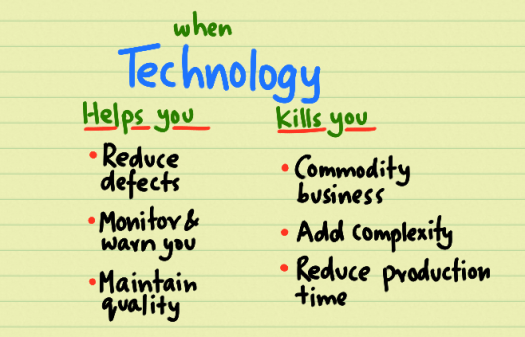
Charlie Munger said – The great lesson in microeconomics is to discriminate between when technology is going to help you and when it’s going to kill you.

Most companies would benefit from new production technology that is more efficient and so uses less energy.

The deciding factor, however, is what that technology does for the business

Does it help it create more products, for example.

In a commodity business, being able to push more product out means that the market has more supply and so prices go down.

The cost and energy savings made by the more efficient technology is wiped out by the reduction in prices to customers.

All of the benefit goes the customer, with little staying with the manufacturer.

The Japanese are well-known for having slow upgrade cycles, using older equipment for much longer.

This is because changing things adds complexity and could reduce the amount of time the factory actually operates.

In addition, changes often introduce new problems, and Japanese companies value stability and continuity.

They invest in systems that help them reduce defects, by continually monitoring a number of parameters and warning them when things are going wrong.

This helps them maintain quality.

Having good monitoring systems lets workers manage more systems and machines each – while good working practices, maintenance regimes and stable technology let operations carry on without crisis or constant intervention.

All too often, we look for a silver bullet – a new technology solution that will solve all our problems.

We should start, however, by making sure that we are using what we already have well – and good monitoring systems are our eyes and ears into the operations.

It’s simple really – we need to do the basic things a little better, every day.

And that starts with looking and improving what is in place before buying something new.

What type of service model do you have?

types-of-service-models.png

The UK economy is dominated by the service sector, which makes up more than 80% of GDP.

Many industrialised countries are in a similar position, moving away from raw material extraction and manufacturing to an economy based on service and, increasingly, knowledge based activities.

How should we think about service businesses?

We often start by thinking of a service as something people do for other people but this doesn’t capture the full picture.

In 1978 Dan R.E. Thomas, writing in the Harvard Business Review, suggested that we need to ask two questions to understand the model used in a given service business:

  1. How is the service rendered?
  2. What equipment or people render the service?

Matching services with business models

Although the article is old, it can be adapted into a framework to help match services with business models.

On one axis, we can think of people and their skills, ranging from relatively unskilled to professionals with extensive qualifications.

On the other, we set out how they use equipment and whether it needs to be operated, monitored or can be automated.

Services that require a human operator range from mowing a lawn, which can be done by someone relatively unskilled with a mower, to heart surgery, which requires a team of professionals with specialised equipment and facilities.

Monitored services can range from overseeing equipment, such as a car wash to more complex plant operations and consulting services.

In these situations the people don’t need to get physically involved but use systems to keep track of operations and change settings as needed.

Automated services range from vending machines at one extreme that have a fairly straightforward task of dispensing products to expert systems such as a health website that allows us to diagnose ourselves and decide whether we need to go to a hospital or not.

Why knowing the kind of service model you have is important

The kind of service model we operate decides how we scale the business.

If a business depends on one person’s time to succeed, then scale can only happen by adding more similar people.

Think lawyers, accountants and management consultants.

There is a reason why most professional practices are small.

They can only grow by putting in more capital and pushing up their fixed costs base which, if revenue fails to grow as expected, means they eventually slide into failure.

There aren’t that many ways to get around this. A common solution is to find patrons – small or big.

Scaling equipment, on the other hand, may be an easier option.

As more of the service is automated, the same number of professionals can deliver a better service to customers.

Unless it spills over into self-service.

There is a crucial difference between service automation that makes things better and cheaper for users and service automation that makes things better and cheaper for providers.

Getting users to do more of the work can easily fall into the latter category.

The right blend of service and equipment

A good service business, it would seem, has a core of people with appropriate skills and scales by adding technology and automation that improves service quality to customers before adding more people.

As with most things, that’s easy to say, but not simple to do.