How Do You Invent Or Reinvent Yourself?

2024-03-15_brand-you.png

Friday, 9.28pm

Sheffield, U.K.

The only thing new is you finding out about something. Like nothing’s really new, but you reinvent it for yourself and find your inner voice. – Mike Watt

We just watched the film “Up”. Again.

It’s a sad film. And a happy one. In other words, a complex one.

Here’s the thing.

You build your life with every decision you make. Every choice. These choices are like moves – you probably had more than one option – so which one did you pick? And are you happy with the choice you made?

I wrote about moves some time back. We’re in the middle of a seismic shift in the way things are done, just like we were ten years ago, and like our parents went through the ten years before that. Things always change. The question is how do we respond?

I often start by picking up a book. Or discovering one.

This time, I uncovered one. Or, at least, it turned up as we tidied a corner of the house. It’s Tom Peter’s ‘the brand you’

Over the next few posts I’m going to work through this book – first trying to understand the ideas and then seeing if I can apply them.

Let’s begin.

Jobs are changing, like they changed before and will change in the future.

If you want to stay relevant you need to think of yourself as an independent contractor, someone who provides professional services – whether you’re in a job or not. This is what Peters calls “brand you”.

As a professional, there are three things you must do to stay relevant.

First, you need to get very good at something. You need to have a craft and practice and practice so that you are one of the best out there at doing what you do.

Second, you need projects that stretch you and showcase your learning. Projects that are impressive, that people pay attention to. This is the evidence people need to believe that you can do what you say you do. You’re only as good as the last thing you’ve done.

And third, you need to network. You need to find a way to reach other people and make them aware you exist. The problem for most of us is not that we’re rejected but that we’re ignored because there is so much interesting stuff out there.

In the next post let’s look at how to say what we do in a single sentence.

Cheers,

Karthik Suresh

Why You Should Manage Your Energy And Not Your Time

2024-03-14_energy-not-time.png

Thursday, 9.22pm

Sheffield, U.K.

Productivity is being able to do things that you were never able to do before. – Franz Kafka

Scott Adams, of Dilbert fame had a quote about working smart rather than working hard which I am going to slice and serve up for a different flavour.

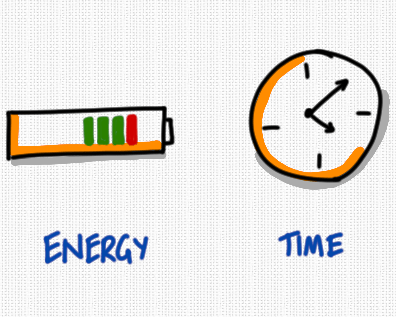
Manage your energy, not your time. People who manage their energy get happy and rich. People who manage their time get tired.

When I was younger everything was important. Productivity mattered. Being productive was about moving paper, about getting things done. About ticking off everything on the list.

At a certain stage in life that’s a good thing. When you’re young the most important thing is to be reliable. If people can rely on you they will give you more to do, and the more you do the more you learn, and the more you learn the more people can rely on you to do the right thing.

It’s a virtuous cycle.

When you start you say yes to everything. Later in life you start to realise that everything doesn’t matter equally. Some things are more important than others and the skill you need is not to get things done but to work out what’s worth doing.

And I don’t think worth is all about money.

In fact, taking money into consideration is the wrong way to do anything.

In my culture, there are four ways to get peace of mind.

You can act. You can pray. You can meditate. And you can think.

If you’re reading this blog you can probably figure out which practice I lean towards.

We experience life a minute at a time – but it also speeds by without warning.

Why spend it tired?

Cheers,

Karthik Suresh

How To Make A Good Decision

2024-03-12_3-secrets.png

Tuesday, 12 March 2023

I think that somehow, we learn who we really are and then live with that decision. – Eleanor Roosevelt

In a standard lifetime we make only a handful of truly important decisions.

Often, we don’t even realise we’re making them unless we pay attention.

At every moment a million possibilities await you but choosing one path closes off others.

Or so I used to think.

I’m interested in making good decisions. As we all should be. As we should teach our children. I remember one of my children’s primary school teachers laughing about having to run after four-year olds shouting “Make good choices!”

There’s a book called the three secrets of wise decision making that I go back to every once in a while.

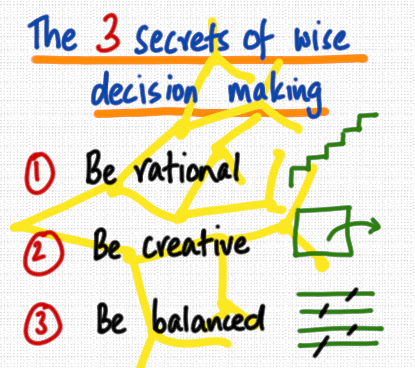
The first “secret” is to be rational. Look at the information in front of you with your brain switched on rather than your emotions. Fear and greed make for poor long term decisions. Reserve them for the times when you need to deal with tigers or diamonds.

The danger is that you make a decision and then look for reasons to justify your choice. A good indicator of whether you’re being rational, says the writer, is whether you react to information that challenges your ideas with interest or with defensiveness or anger.

You have to live with the consequences of your decision, and it is your ten-year older self that will look back with approval or regret at a decision that cannot be changed.

The second secret is “creativity” – which is really quite hard to define but you know it when you see it.

It’s easy to get stuck and think that the options you see are the only ones you have. Stepping out of the box seems impossible but it’s something you still have to do – or something you should try and do before settling for an option.

It’s dangerous to say you can’t do something or something can’t be done because there is probably someone busy getting on doing just that as you speak.

The last secret is “balanced judgement”, which is about formally taking the effort to consider multiple factors that matter. The simplest way to think about this is to draw a set of lines and look at them as a survey instrument. You need more than one question on there to get some balance into your decision making.

There are a number of tools that can help you get better at doing each of these steps but one of my favourites is the decision tree – something that sits behind all these approaches.

The decision tree represents all the possible futures that you can have, how the decision you make now ripples through and creates new pathways or closes other ones down.

Sometimes you can straddle two branches for a while, at other times you have to pick one or the other.

It’s never easy to make these choices. You have to figure out what you’re heading for: are you maximising opportunity; or minimising regret?

And, as I often do, the deciding criteria is the one set out in ‘Zen and the art of motorcycle maintenance’.

Will making this choice give you peace of mind?

Cheers,

Karthik Suresh

What Kind Of Mental Models Do We Need For The Next Ten Years?

2024-03-11_service.png

Monday, 9.28pm

Sheffield, U.K.

The pendulum of the mind alternates between sense and nonsense, not between right and wrong. – Carl Jung

What would you do differently knowing what you now know?

What rules would you suggest your children follow?

A few of mine that come to mind are simple ones.

  1. Be early. If you can’t be early, be on time.
  2. Always take notes.
  3. Learn how to make good choices about money, starting with keeping accounts.

Others are harder, and they start to contradict themselves.

Like.

  1. Work hard. But also work smart.
  2. Cultivate a deep knowledge of a field. But also have a broad understanding.
  3. Study hard and get a good job. But you could lose it at any time.

There’s a thing that happens when you first go to a foreign place – once you see something you can’t unsee or unlearn it – and you often forget that others don’t know what you know.

There’s an experiment that shows this with young children.

If you put a box of chocolates on a table and ask a child what he or she thinks is in there, the answer will be “chocolate.”

If you open the box and show the child that the box is, in fact, full of pencils, close the box and ask the question again – this time you’ll get the answer “pencils.”

The interesting thing is that if you now ask the child what another child will say if asked the same question (a child that doesn’t know what’s in the box) the answer will be “pencils.”.

Now that the child knows what’s in there it’s hard for them to imagine that someone else doesn’t also know what they know.

But, as you know, they don’t.

So are there things we should talk about because it’s possible that not everyone knows?

I think there are – but there is also a problem – it’s very hard to just “know” something. Even if you’re told about it you have to go through a certain kind of experience to be able to appreciate it.

It doesn’t matter how many descriptions you read of a foreign place – going there teaches you something you just can’t learn from the explanation.

Perhaps media is different – if you watch a documentary or movie – effectively living the experience through a simulation – perhaps that makes a difference.

You can see how complicated this is. Perhaps that’s why YouTube is such a learning revolution – it makes it possible for us to follow along rather than learn through instruction and then practice on our own – which may explain these 13 hour sessions where you see someone build an app from scratch and learn how it’s done.

Let’s get back to my point – what models do we need now?

First, what models did we already have?

400 years ago we had butchers, bakers and candlestick makers. Small businesses, one-person bands, providing products and services.

200 years ago we had factories and the rise of jobs. Factories needed people to do specialised work and needed people to manage others doing work and we ended up with the modern industrial system.

Which is how we think of work even now. A job. Something we do from 9-5.

Then you have post-modern ideas of work that leave the factory model behind and instead operate a network model of some kind. One where connections and small groups do something for someone else.

The last 50 or so years have resulted in a bunch of jobs that have to do with administration – what David Graeber calls bullshit jobs. I’m not sure that’s fair because just like factory work needed supervisors knowledge work needs people who do something similar – administration.

Where are we now?

Well, the rise of generative AI could mean that lots of people will not be hired to do certain things – like copywriting or programming because people can use those tools to get the results they want.

But I think it might be more complicated than that.

Average writers and programmers may be able to save time and have the AI write average content for them.

But good writers and programmers will also get the AI to write for them, and because they’re good they’ll probably pull further ahead.

After all, if you give both an average hobby cyclist and a professional racer the same new shiny bike, which one will do better?

The only way for someone to catch up with someone who is doing better now is to have a better bike. And that’s not what’s happening.

Each innovation will end up making those who are already doing well do even better – widening the gap between the have and the have-nots.

These are not equalisation technologies – they are difference multipliers.

It means that if you start a business now you need fewer people to get more done.

Twenty years ago I saw businesses doing things with 20 people that I could do with a spreadsheet. The same thing applies now – you can build capability that doesn’t need as many people as before. That’s what technology does.

I was watching a programme where a character was searching for his goat.

The goat mattered because it gave him 2 litres of milk a day and his family survived on that. That’s less than a pound a day. Although in 2021 it turns out that it was more like £15. So an improvement.

But that’s not the point.

If you’re one of the have’s – count yourself lucky.

Because this is a multi-generational challenge to address for the have not’s.

Cheers,

Karthik Suresh

What Is A Good Model For Marketing These Days?

2024-03-07_content-spam.png

Marketing is what gets you noticed, and that side of it something – this side of it, if you like, doing interviews – is the side of it that I least enjoy, and yet is 50% of the project. – Rowan Atkinson

A few years ago content marketing was the thing – you were supposed to show what you knew and how you could help by sharing your knowledge and teaching others about a specific niche that you specialised in.

Focus. That was what mattered.

Are things any different now?

Probably not. If anything focus is even more important. Even if we don’t want it to be.

Let’s back up.

I heard a new term today – “content spam”.

That’s where people keep putting out content, bombarding you with it on the basis that some people will engage with it and some of those will commission work from you.

The model there is nothing new. It’s a numbers game. Put enough stuff out there and the law of large numbers says that someone will eventually want what you’re selling.

But there’s an investment of time that goes into doing this – you need to create and share material and it makes sense to do that about something very specific.

That’s because no one wants a generalist. They want someone with deep expertise in solving the particular problem they have.

Deep expertise and a strong track record is what you need to get over the trust barrier with a prospective client.

But the time you spend developing that expertise is time that you probably don’t spend marketing yourself.

Marketing has a cost. It’s either going to cost your time and money or it’s going to cost someone else’s time and money. The person with access to a market needs to get paid. You will always have a cost of customer acquisition.

There’s also the question of time. Sometimes you’re early to the party and it’s about being first to get a new customer. Sometimes you’re late and it’s about taking away a customer from someone else.

So what is good marketing now?

It’s whatever works to get you noticed by a prospective customer who then starts a conversation with you.

Cheers,

Karthik Suresh

Some Thoughts On Activity Modelling

2024-03-05_activity-models.png

Storytelling is the essential human activity. The harder the situation, the more essential it is. – Tim O’Brien

I’ve been thinking about activity systems recently and trying to work out what I think they could be.

That’s a little complicated, so let’s back up.

Peter Checkland writes about human activity systems in “Systems Thinking, Systems Practice”. What does he mean by this term?

Let’s start at the end, first there’s the idea of a “system”.

We all use the word system but sometimes mean different things. For instance, a computer system is something you can point to that has components and connections. The transport system is something you can point to with planes, trains, automobiles and so on. The judicial system is something you can point to, with judges and police and jails. The education system is something you can point to, with students and buildings and teachers. All these uses of the word “system” have some kind of connection to a thing out there that you can point to, with parts and interconnections and emergent behaviour.

Checkland uses the word system to refer to something that might exist only in your mind – a description of a thing from a particular point of view.

This is a little abstract and not everyone agrees that it makes sense.

His argument is that the other words matter.

What we’ve got is the existence of humans and so the “system” we’re talking about doesn’t really exist out there because it can only exist inside someone’s head.

You can’t point to the “system”, you can only suggest that it’s made up of certain parts.

And if you group those parts and call them by a name that doesn’t really make sense to anyone who doesn’t already know the parts.

This is a big bit of Zen and the art of motorcycle maintenance as well.

So, from this point of view a system is simply something that makes sense to people.

Some systems exist – like the ecosystem.

But we humans also take action in these systems – purposeful action – we want to do something for a reason.

And so we have human activity systems that are “sets of purposeful human activities”.

Or in simpler language it’s a list of things we do connected so they have some kind of order to them.

And we can show that with nodes and links, things to do and the connections between them.

It’s possible that everything can be represented in this way.

Now, why does this matter?

And if you’re honest with yourself and you’ve managed to read this far, you’re probably asking yourself why anyone cares.

But let me carry on.

If you want to do something you often make a list of things to do.

Sometimes, if you’ve had some training you’ll set out a process, steps to do in order.

Both these things can be checked off and stepped through.

An activity model is sort of the same thing but instead of being a “time” based thing it’s a “doing” based thing.

It’s a plain English description of what needs to be done.

And the keen eyed among you will have noticed I’ve switched terms here.

The “human activity system” has a lot of baggage – it requires an understanding of systems theory, an acceptance of multiple points of view and an agreement that a model is simply a particular representation of what humans do.

An activity model, in my mind, is what needs to be done.

That seems simpler.

Now, I’m going to try and work this into some kind of argument that has a place in a thesis.

I am not feeling particularly confident…

Cheers,

Karthik Suresh

The World’s First Website

2024-03-04_first-website.png

My website’s kind of fun for me. I get to do drawings on that. It’s kind of fun. – Jeff Bridges

So, I wasn’t expecting this.

A few days ago I remembered that there was a first website.

It’s here.

https://info.cern.ch/.

I like it. I wish the web was still like this, because it was useful for those of us that like to read.

The point of it was to connect information to other information. Hypertext was text that linked to other text. And you also had hypermedia – which was sound and images and stuff like that.

The basic idea was that information could be nonlinear – it could connect to anything else and you could discover new, surprising things.

And with so much out there you needed an index, something that would help you find more information on a topic.

Well.. that was then.

The web is still about connections but instead of a distributed collection of information we have a few, very large sites that people live on.

Rather unhappily, I think.

The problem with search as a strategy is that you need to know what you’re searching for in the first place.

And sometimes we don’t know what we’re looking for.

But the really interesting stuff isn’t what gets the attention.

What we see is what people pay to put in front of us – and if you live in the West you probably don’t notice how cleverly this is done.

When I used Google in India I was amazed at just how blatantly it acted as an advertising machine – all the results looked promoted and you couldn’t find anything organic.

The Internet today is like the Standard American Diet – full of empty calories – all fat and sugar.

But there are good diets out there – for your mind, that is.

The first website knew it – it links to Project Gutenberg, a library of free books.

And you can discover other gems.

I start these posts with a search for a quote.

And I found the one above by Jeff Bridges – the actor – and given the topic of this blog I was intrigued.

Go look at his site.

Jeff Bridges.

You didn’t expect that, did you?

Maybe there is hope for us after all.

Cheers,

Karthik Suresh

What Do You Think Of Stable Doors?

+TAGS:

2024-02-28_stable-door.png

Wednesday, 9.42pm

Sheffield, U.K.

Being born in a stable does not make one a horse. – Duke of Wellington

There was a bit of an uproar yesterday in the small corner of the Free Software world on Fosstodon – the Mastodon instance about that kind of thing.

WordPress was in talks to sell its user content to the AI large language models businesses.

Your data, that is, if you have a blog on WordPress.com.

Like I do.

It’s not all bad, you can go into the settings and check a box to opt out of doing this.

Looking at the date on that, looks like the documentation only came out yesterday (27th Feb 2024).

So I’m not actually that far behind shutting the stable door.

Now… I haven’t heard about this on any of the other social media platforms, possibly because they are full of self-promotion and less useful stuff.

Another mailing list that I’m on sent a note around about Stack Overflow, the popular question and answer service, being inundated with responses generated by AI.

Long, tedious, not very helpful ones at all.

There’s a term for what is starting to happen to almost everything around us.

“Enshittification

The enshittification of everything is happening.

The amount of noise in the world is increasing exponentially now that we have created machines to make the noise faster.

Words, pictures, videos – all the things that took time to create and make are now created in seconds.

Maybe less.

And the reality is that we are the worse off for it.

Not because the stuff isn’t good – some of it is.

But because there’s so much of it that it will take us forever to even look and see to find what we might like.

It’s like what happened to Amazon a while back.

Once anyone could publish you ended up with the general enshittification of ebooks.

You had a good book and then some random bloke decided that he’d write the “summary” of the book and now many people probably use AI to write a bunch of summaries based on other people’s summaries.

It’s pureed vomit. That’s what it is.

So here’s what’s going to happen.

  1. We’re going to go back to our favourites – watch the same shows again and again.
  2. We’ll go with recommendations of people we know and trust for new things.
  3. We’ll try the things that go viral accidentally – that somehow everyone has found at the same time. Traitors anyone?

Actually, this is no different from what we were doing before.

Carry on folks.

Cheers,

Karthik Suresh

What Impact Will AI Have On You?

2024-02-27_research-problem.png

Tuesday, 9.08pm

Sheffield, U.K.

What are we having this liberty for? We are having this liberty in order to reform our social system, which is full of inequality, discrimination and other things, which conflict with our fundamental rights. – B. R. Ambedkar

I haven’t worked on my thesis in a few days and it’s been nagging at me – I know that I should do it.

I was a bit worried because I couldn’t remember where I had gotten to and how I would lay down the next sentence.

So I had a quick look at the document and realized something interesting.

The last time I worked on the page I was thinking about what the next few sections might look like.

So, I asked ChatGPT to suggest an outline for what I needed to include, and had put the response (suitably edited) in as a prompt.

When I came to look at it later I realised that some of the brainwork had been done for me – I simply had to work on the next bit and answer the question on the page.

This is an interesting outcome.

Some people are threatened by AI because they think it will take their jobs away.

The reality is that someone who is good at their job can become even more productive with AI, outperforming others even more.

For example, say you’re a fairly good writer – what impact will AI have on you?

Well, you might think that anyone can write as well as you because they can use a large language model and pump out text.

But so can you.

In fact, what you can do is have the LLM help you write better.

Which means what you create is probably going to be better than what an average writer can do with the AI tool.

In other words the same hammer wielded by a novice is going to have different results than one wielded by an expert.

I think it’s already clear that AI models do not replace you.

One of two things can happen.

You avoid the new technology and become irrelevant – the world moves on.

Or you embrace the technology and do even better than you do now.

Is there really even a choice?

Cheers,

Karthik Suresh

How To Think About Career Moves

2024-02-23_decisions.png

Friday, 9.34pm

Sheffield, U.K

The harder routes you climb, the more interesting the climbing gets and the more crazy moves you are forced to figure out. – Adam Ondra

Knowing what you now know, what would you do differently?

I’ve been looking back over the last ten years or so, at the kinds of things I came across and studied and what things are still relevant and which are less so.

I feel like I’ve been through a few cycles and, like any trader knows, until you’ve been through an up and a down you don’t really know what it’s like and how you will respond.

And it’s not just about your response when things are down – it’s also what you do when you’re at the top.

The biggest mistake people make with money is buying high and selling low.

What mistakes do they do with their careers?

This decision tree from the book Career Games is a good one.

At any point in your career you can make moves.

These moves can be instrumental or they can be blunders.

Take, for example, someone early in their career.

Putting your hand up for a project shows ambition – and doing that means you will probably be considered when the next, larger project comes around.

That could, in some cases, be a career defining move, one that sets you on a path of promotions and success.

Or it could be a career-refining one – positioning you for growth in your department.

Sitting back could be a blunder.

At best, it might be minor, a career distracting move that sees other people, perhaps ones less able than you, move on and progress further.

Or worse, sitting back and complaining, or even sabotaging what’s happening could be career limiting at best and career ending at worst.

Of course, the moves you make are only the manifestation of your career strategy.

Which in turn stems from your analysis of what you want from your career, what is important to you, what you want out of a job and exactly what your competitive advantage is in any potential negotiation.

The move is the tip of the spear, the thing people see.

The thing pushing it along is what matters.

The line that started this post is one from Brian Tracy, a motivational speaker that I haven’t really thought about in years.

And I think I should end with another from Zig Ziglar who reminds us that you can get everything you want if you help other people get what they want.

And that is probably the simplest strategy of all.

Cheers,

Karthik Suresh