Why we should charge for reading free stuff

information-overload.png

In 1971 – 1971! – Herbert A. Simon – participated in a discussion about the problems of an information rich world.

He reminded the audience of how economics works. Let’s say we have rabbits – and we end up with lots of little rabbits as a result.

Our world has an abundance of rabbits – we’re literally swamped by them.

But, abundance is always accompanied by scarcity.

In our rabbit rich world, there isn’t enough lettuce to go around – so we have a lettuce poor world.

And it’s the same with information. In a world where there is lots of information there will be a lack of something – the something that information consumes.

And what is that? Information consumes attention.

So, to properly value our attention, we should really price up how much our time costs and charge ourselves for the lost attention.

In simple terms, if we make $20 an hour – reading a magazine costs the $5 it takes to buy it and the $20 it takes to read it.

Even if the information is free, it isn’t costless, using this approach.

So, the second point Simon makes is that we should choose how we allocate our attention very carefully. We need filters. We need ways of taking lots of information and only paying attention to what matters.

That means we need processes to filter information. Analysts who take it all and put out only what matters.

Too many analysts thing that their job is to feed people with information. That’s just wrong.

Their job is to hack away at the information and leave only what matters.

And the same thing applies to how we store information.

In a world where we can find information on almost anything on the internet, there is simply no need to keep it.

We need to move from storing information to being able to find it when needed.

That’s where computers come in. Used properly, they help us. Used poorly they become gigantic sinks of unprocessed, unfiltered information.

According to Simon, we need to make a simple change.

We need to change from thinking that we need more information – that more information is better – to thinking of our attention as being a scarce resource that must be preserved.

Our focus should be on less but better.

How high-level performers become experts in their chosen field

resonance-model.png

We’d all like to be good at something – and the chances are that we have achieved a level of expertise in one area or another – whether it’s sport or academics or caring for someone else.

Sometimes we might wonder if we have become good at the right things for us – perhaps we studied law to please our parents rather than because we really wanted to – and now we’re a card carrying member of the unhappy professionals society.

How do some people seem to avoid that fate – and become good at something they choose to do?

There are four steps, according to Doug Newburg who in 2002 created the Resonance Performance Model (RPM) to describe what high-level performers do from his research.

Start with a dream

We need to start with a picture of where we want to get to – and how we want to feel when we get there.

We also need to be aware of what gets in the way – people, conditions and experiences that don’t help us feel that way.

Then there is preparation

We need to put in the time, the effort to build the skills, capability and capacity we need.

Whether it’s putting the time into studying or practice, top performers work on themselves and their abilities.

We’d be best off doing this strategically as well, focusing our efforts on areas that matter and where we can see results.

Things are always going to get in the way

There will be bumps along the path, little ones and big ones.

By being aware that they will come along, we’ll be better prepared to deal with them mentally, physically and emotionally.

Sometimes they can be terrifying or paralysing – and slow us down a lot.

We need to remember and revisit the dreams we have

At which point, we need to remind ourselves why we started this whole thing in the first place. Why we set off to become good at something that mattered to us.

Writing down goals helps. Reflecting along the way helps.

We need to make the time to look at the picture and where we are in it so that we don’t get stuck.

We achieve resonance when we achieve a fit between what’s in us and what is outside

Resonance happens when how we feel inside and what we have outside fit well together – when we are able to do something we like, are good at and can find flow in our work.

The RPM is a simple model – but like most simple models it tells us simply that if we want to do something, work on it every day, tackle the inevitable setbacks and keep ourselves going by keeping that dream in mind – we’ll get where we want to one day.


What are we trying to do?

four-fold-path.png

The Minimalists are Joshua Millburn and Ryan Nicodemus – the poster children of a movement called minimalism – that they offer as a tool to find freedom.

The ideas behind it are simple – own less stuff. Have less, but better. And, dovetailing with Marie Kondo, only keep the things in your life that spark joy.

The interesting thing about minimalism, when you search for it, is that there are people documenting how they are experimenting with it, and people who seem vehemently opposed to it – calling it an oppressive gospel or another form of consumerism.

Focusing on stuff, however, is not the point.

The point is found in the word freedom.

Minimalism is a way to be free of being attached to things. As someone said, first you own things and then things own you.

Take a new car, for example. It’s nice having something new – but is it also nice having the fear that it will get scratched or the alloys will get dented.

But for many people, freedom means being able to drive in a car they love or live in a home that is homely rather than a house.

So, is it possible to test of whether one is free or not? Are we doing what we want to do, or are we living out a life someone else has decided for us?

There are four things we should perhaps look at.

The first is to reflect on our choices. How did we get here – and what choices did we make along the way.

After all, choices got us here, and choices will get us out as well.

The second is to look at our actions – what are we doing every day? Where does the time go? What are we planning to do?

The third is to see if we are learning. Do we have ten years of experience or one year repeated ten times.

And finally – are we happy being who we are – are we at peace with ourselves?

These four choices map onto quite ancient philosophies – we spend our times choosing, acting, learning – and in so doing create what we are.

Less stuff – more stuff – does that really matter?

Less free – more free – how much more does that matter?

How can we make more confident decisions?

confident-decisions.png

There are many situations when we are trying to work out what is best to do. Should we hire a marketing firm? Should we buy that building? Should we hire that person?

In all these cases we don’t know if we’re going to be successful. And, more importantly, we’re not confident that we’re making the right call.

Is there a way we can change this – be more sure of ourselves and the choices we make when we have to?

Three approaches – perhaps even formulae – may help.

First, make sure that it is actually important

Not all decisions are worth taking time over. As we get more to do, perfectionism gets in the way of progress.

Some people try and read everything, check everything. That’s laudable, but not smart.

The smart thing to do is focus on the things that matter – and the 80/20 rule or Pareto principle is one to follow here.

Of all the things on our lists, a few matter as much as the rest put together.

The key is figuring out what those are and choosing to put everything else on autopilot. The extreme example here is people who wear the same kind of clothes all the time so they don’t have to spend time choosing an outfit.

Then, look at the choice from multiple perspectives

A good rule for meeting requests is never to accept them.

Or at least only accept the ones that we are really happy with. But how do we know that?

A common issue is that we heavily discount the future. We are happy to book a meeting in a months time that we would not book in today, for example.

So, we need to apply the 10/10/10 rule.

Would we be happy with the outcome of that decision 10 minutes from now, 10 months from now and 10 years from now?

If yes, then we should go ahead. If not – then maybe we should pass on this one.

Very few choices or decisions are really once-in-a-lifetime ones. If we take the trouble to put ourselves in the path of opportunity, these decisions come along like buses.

By only choosing the right ones, we’ll probably get to where we want to end up much faster.

Finally – is the decision going to move the most important needle?

A concept behind many successful business models is the idea of one key metric.

A community in India, for example, called the Marwaris have an ancient system of accounting that totals their sales and expenses daily to keep an eye on daily profit.

If we have a market stall and use their technique, for example, and we’ve sold less than we wanted to during the day, then we might choose to defer an expense or part pay it so that we don’t incur a loss that day.

This simple technique means that we get better at managing our cashflow. Also, making a profit every day means that we’ll be in profit at the end of the month – and at the end of the year.

In other businesses, the Net Promoter Score, the difference between the customers you have that will recommend us to someone else and the ones that will not, can mean the difference between growing and winding up.

In summary decisions are hard – but we can make them easier by focusing on the important ones, looking at them from multiple perspectives and really asking ourselves if they will move the most important needle in our business.

3 things managers have to do if they are going to manage remote teams

managing-remote-teams.png

Imagine setting up a new business or expanding an existing team.

The first things many organisations do is think about adding people at an office. We need desks, computers, software, phones and all the other things that go with bringing that person online – and that takes time, effort and money.

Why do we do this?

In a world where most people we want to work with already have a desk, a computer and an internet connection that lets them get all the software and communications tech they need – why do we keep thinking working in an office is the way to go?

Or is that still the case? Research from Upwork, the freelancing website, says that two thirds of companies use remote workers. As talented specialists get harder to find, companies that are willing to offer remote working can choose from workers around the world.

Many organisations that have started up now have entirely virtual workplaces – with no central office at all.

So, what do our organisations and managers need to do to make virtual teams work well?

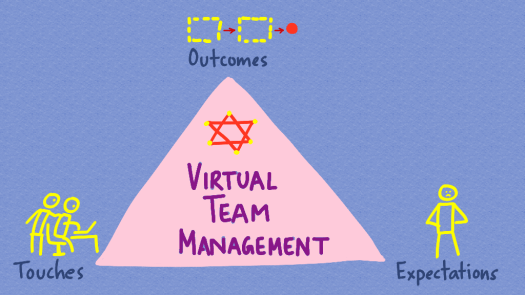
There are three things we need to get right.

1. Focus on outcomes, not process or how we would do it

Individuals now are developing increasingly individual ways of working – and that can be a challenge.

Take something as simple as taking notes – a fundamental part of work.

I’ve jumped from using a reporter’s notebook to a legal pad to One Note to text files to journalling software to Google spreadsheets to custom Excel files back to Moleskine notebooks.

In some businesses notes need to be recorded in a particular way for legal reasons. Reporters need to keep their notes in case they get sued. Policemen need to keep their pocket notebooks as evidence.

For most jobs, however, how people take notes doesn’t matter. What they do after that does matter.

For example, do they liberate the main points from their notes and share them with colleagues who need to know them? Does a sales person’s notes provide enough information for a service team member to take on the account?

With remote teams we need to focus on outcomes – the way things turn out – rather than the way in which they are done or the way in which we would do it.

2. Be clear on what you expect from others

I remember being on a train down to London and hearing a conversation a few years ago.

The speaker, who sounded like an entrepreneur, was quite loud and making no effort to speak quietly – but the gist of the talking was that a remote worker who was at home couldn’t be contacted on instant messaging – and that wasn’t acceptable.

Any sort of situation that makes us want to stand with our hands on our hips crossly is one where our expectations are not being met.

In this case, the entrepreneur’s expectation was that the remote worker needed to be available to contact during work hours on this system.

The worker may have had a perfectly good reason to be away from the desk at that time – or may have been in the park throwing snowballs. We don’t know – but that simple inability to contact the worker was enough to cause a work problem.

Some organisations recognise that instant messaging interruptions are as bad as actual interruptions, and set expectations that such contact is by arrangement and usual business is conducted by email.

The point is that much irritation can be avoided if expectations are clarified up front.

3. Make the effort to make contact and stay in touch

At the same time, workers will find managers much more relaxed if they make the effort to keep in touch.

Where there is little or no face to face contact, email updates, messages and phone calls can all help keep the lines of communication open.

Managers get nervous when they don’t hear anything for long periods of time. And – quite probably – when people don’t keep in touch it’s because things aren’t working and they are looking for, or working on, something else.

Lack of contact quite often leads to termination of appointments.

Interestingly – sharing personal updates before moving to business can help reinforce the feeling of being on the same team and help maintain a warmer relationship.

Summary

Many of us, if we don’t already, will experience remote working, virtual teams and more flexible ways of working.

For new starters, it will simply be the norm. For older workers, it is what they do as they move away from corporate jobs and focus on a more balanced life that looks after their health and family.

Whether we’re in offices together or on the phone – the things that make us human are what will cause us to succeed or fail.

Working towards a common outcome, being clear on what we expect from each other and taking the time to keep in touch and talk will help us manage this new world of work.

Why the best questions have to do with what is invisible

looking-for-what-isnt-there.png

Imagine having to ask the CEO of a company about their strategy or a prospective employee about his or her capability.

What they show and tell us will depend on the kind of questions we ask.

How do we know we are asking the right ones? The ones that will throw up opportunities and show us what is really happening?

There are lots of lists of questions we could ask. The important ones are about what is not there – and there are three important versions of these.

What is the unmet need?

The first comes from Jo Miller’s conversation with Ellie Pidot, VP of Strategy at Medtronic who asks What are your customer’s unmet needs?.

One way to think of this is like whitespace on a page.

What is left out helps us make more sense of what is there.

We can ask people what they do and what they want and we will be told a story, probably one that is logical and coherent.

They might tell us what they are doing – and the things identified as needs.

All too often, what they tell us and what they actually need can be different.

This happens quite a lot in IT, for example. There is often a gap between what software developers think people want and what they actually need.

The best programmers are able to bridge that gap and create the right kinds of tools to help us.

What would an outsider do?

The second question comes from Freek Vermeulen who asks what would other, external people do, if they found themselves in charge of this company?

This can be thought of like a blank page.

What would we do if we were starting from scratch? From a zero base – with no sunk costs or investments of time, effort and energy?

Bryan Tracy suggests asking – knowing what I now know, would I do things differently?

Are there things we would do more of, less of, start or stop?

It’s hard looking at the same things through the same eyes.

It might help if we try and look at them through the eyes of someone else, someone we respect. What would they say or do?

Then – do we have the courage to do that ourselves?

What would be least risky?

The third question is from Tim Ferriss’ interview with Joe Gebbia, the co-founder of Airbnb.

Many people think that to get ahead we need to take more risk. Higher risk equals higher returns.

That’s not really the case.

Take B2B sales, for example. Joe points out that B2B customers, given a choice between a low price and low risk, will take the lower risk option.

Entrepreneurs who have taken what seem to be huge risks often have carefully calculated the downside and decided that they can live with the odds.

The Dhandho approach follows this – Heads I win. Tails I don’t lose much.

Often the course of action that people will follow is not the one that gets them the most but the one that looks the safest.

So, in this case, its the absence of obstacles that matters.

Summary

There are more questions that we could ask than ever could be answered.

We need to ask the ones that show what isn’t there.

The whitespace, blank page, absence – that’s where the opportunities are hiding.

The 3 critical processes you must try and improve at your business

three-timelines.png

If we had to make sure that just three processes were working as efficiently as possible in our business, which ones should we choose?

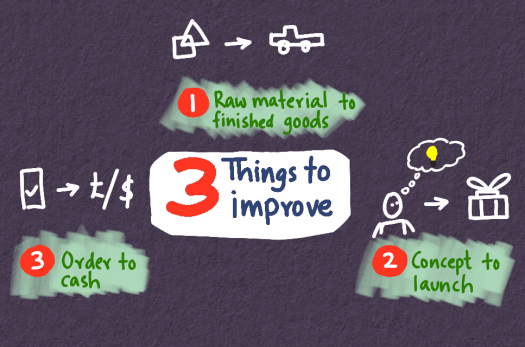
According to David Bovis three timelines developed by Toyota are enough:

  1. How we convert raw material into finished goods
  2. How we go from concept to launch
  3. How we go from order to cash

So, what are we trying to do when improving each of these?

Raw material to finished goods

The whole point of our business is that we add value to something. Whether its taking raw materials and turning out a physical finished product or providing a service that carries out some kind of knowledge work, we still need to work our way from a start point to an end point.

In a world with infinite digital storage space we end up keeping everything. Emails from ten years ago to every bad photo we ever took.

It takes real discipline to stop things piling up – whether in visible piles of stuff or paper or in ever growing digital folders.

So how can we improve this process? There are four things to look at:

  1. Maintain systems before they fail: From manufacturing systems to computer equipment, we need to look after our kit.
  2. Reduce the amount of parts and supplies: Do we need to have ten different types of notebooks in the supply cabinet or buy a year’s work of cleaning supplies?
  3. Keep things in the right place: We often can’t find stuff just because it’s not put back properly.
  4. Put stuff that needs to be thrown away in a set place: When things are ready to go, put them in an agreed place so they can be removed.

Concept to launch

This is an interesting one – especially if it’s taking a new product to market.

We need to create things that customers want more than they want the money in their wallets.

Just building it isn’t enough – it needs to be saleable – exchangeable for real money.

That means we have to work backwards from what customers really need (which isn’t the same as what they say they need) and build products to address their needs.

Everything that doesn’t do that is optional – perhaps even wasteful.

Another consideration – not always taken into account by product developers – is that customers, especially business-to-business ones – will choose an option with less risk over one that has a better price.

If something does what is needed and can be shown to be robust, it can often beat a competitor with more bells and whistles.

Order to cash

The final process to get right is the timeline from order to getting paid.

For many products, or services sold like products, we pay up front and receive the product later.

Service businesses, on the other hand, tend to invoice after the work is done.

Improving an order to cash process means looking all businesses, whether product or service, as product businesses where all or some of the payment is made earlier in the process.

Summary

For all three timelines, we’re trying to keep only what is needed – remove everything that adds waste and keep the things that add value.

It’s how we do that which matters.

How to set out a persuasive argument

minto-pyramid-principle.png

Consultants at the international strategy firm McKinsey are famous for their ability to take huge amounts of information and come up with clear and focused strategies for their clients.

That’s not something that we see all the time – how many meetings have we sat through that seem to have no point, presentations that meander all over the place and discussion or recommendation papers that are impossible to understand.

Is there a way to cut through all the noise and present information in a way that helps listeners understand their options and make decisions quickly?

Yes there is – and it’s called the Pyramid Principle.

Barbara Minto, the author of The Pyramid Principle: Logic in Writing and Thinking, came up with the principles in her book while working at McKinsey – and then implemented them in training programmes at the firm.

Her insight was to see that the order in which we present ideas is critical.

When we’re solving a problem, we need to start from the beginning and work through to the solution at the end.

When presenting a recommendation, however, we start with the solution and then expand on why we believe that is the right thing to do.

Why do it this way? Well, because people are busy and dying to get to the point.

If we can explain something more clearly with less information they can make decisions more quickly.

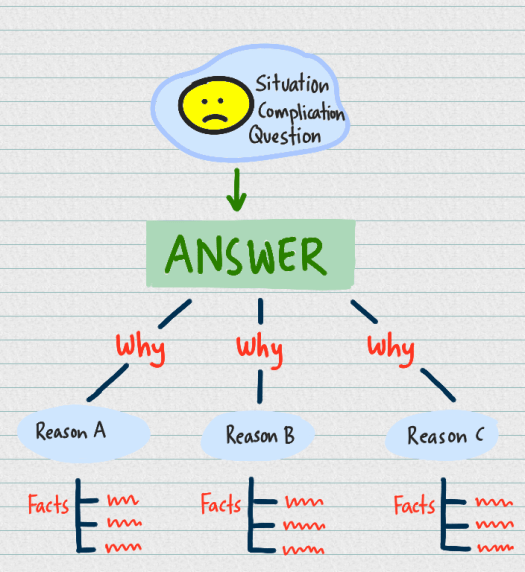
The Pyramid approach has three parts to it:

  1. Tell the audience a story leading to a key question – which we answer up front.
  2. We then set out the key reasons why we believe the answer is the right one.
  3. We put forward facts and evidence to support our beliefs.

In most cases requiring a solution, we start with a situation where there is a complication – something isn’t working the way it should.

Our starting point is to ask a question – how can we make things better?

The story we tell describes the situation and complication, poses the question and then presents the answer – up front.

The audience knows in the first few moments of engaging with us or our material what they are going to get from us.

So then we set out the key themes – essentially answering why we believe our answer is the right one.

Three themes is a common approach – but it could be more if all of them are mutually exclusive and completely exhaustive – the so called MECE approach. More than seven, however, will usually confuse things.

Then, for each theme, we set out more facts and evidence to support our position.

By following the pyramid principle, we are going to connect far more quickly with the people we are trying to persuade and get across the decision we want them to make and the reasons and evidence that supports why they should make that decision.

And that is much more persuasive than a rambling discussion that sends everyone to sleep.

How to do more of what matters and less of what doesn’t

value-to-waste-ratio.png

Taiichi Ohno, the man behind the Toyota Production System, believed that only a quarter of the work done adds value for the customer.

There are two linked words there – value and customer.

Some things that add value are seen by the customer – better service, making it cheaper and more simple.

Other things are not – improved safety, better screws, brighter tail lights.

What takes the other three-quarters of time?

Another quarter is incidental work, stuff loosely associated with the main value adding activities.

The rest is waste.

With physical systems – like making cars – we can focus on waste because it’s visible.

If there is excess stuff, it piles up. At home, if we’re buying the kids too many toys that’s clearly visible.

So we can focus on removing and eliminating waste wherever we can see it.

That’s easier said than done, especially when we need to get rid of stuff we already have.

But we can try and create rules and habits that mean less new waste is created.

In knowledge work, that waste comes in the form of emails and meetings and requests for long reports.

In this paper by Matthew May, he argues that because we can’t easily see waste piling up in knowledge work we need to focus instead on what work adds value.

That means working on our own lists of jobs before looking at our emails and responding to other people’s priorities.

It means avoiding all meetings.

It also means picking up the phone sometimes instead of sending out emails.

But that doesn’t really get to the point of it all.

The point is that there is a ratio between doing things that add value and everything else.

We’re trying to maximise that value to waste ratio – cut down the waste and increase the value.

At the same time, the size of the whole work package also needs to shrink.

It doesn’t make sense to do more. A lot of the time it actually makes a lot of sense to do less, to have less, to need less.

An attitude of removing, however, focuses our attention on the rubbish around us.

Which means we might miss the good stuff.

We should instead develop the ability to work on things that add value – and incidentally get rid of everything else.

How simple rules can help us become better at everything

simple-rules.png

Complex situations need equally complex solutions. Or do they?

This is the question explored in Simple Rules, a book by Donald Sull and Kathleen Eisenhardt.

Let’s be honest – how many times do we make something look really complicated so that we can come across as knowing more than everyone else or justify the fee we are charging.

But really, in many many areas, just using simple rules will give better results than complex ones.

So, what are simple rules and how can they help us?

Sull and Eisenhardt split simple rules into those that help us become more effective and those that help us become more effective.

Becoming Effective

Becoming more effective is squeezing more out of the time we have and that means saying yes to some things and no to others.

We can do these in three ways.

Boundary rules

First there are boundary rules. These are binary decisions of the yes/no variety.

What should we do and what shouldn’t we?

For example, when revising for exams for my first degree, I had two very simple rules.

I never worked after 12 in the afternoon and on weekends.

Working from 9 – 12 for four weeks before the exams was more than enough time to revise and prepare for them.

Prioritisation rules

The next kind of decisions revolve around what to do first.

The classic example of this is how medics triage patients during an accident.

Everyone is tagged based on the severity of their condition and how urgent it is that they are seen.

I remember being in an aircraft accident simulation as one of the volunteers to train the response teams where we were all labelled with the injuries we had supposedly sustained.

I had a broken foot and so was transported slowly by ambulance while enviously thinking of the helicopter ride being taken by the person with far more serious injuries.

Prioritisation can be a double edged sword, however, leading to unnecessary escalation and messing about unless the rules are clear and applied consistently.

Stopping rules

The last kind of effectiveness rule has to do with when to stop.

Enough needs to be enough. Cultures that have a rule that people should stop eating just before they are full have much lower obesity levels than others that stop eating when they are full.

Perfectionists sometimes don’t know when to stop. In most cases, it’s good to stop early – and that leaves us with the capacity to go longer on the things that matter.

Becoming Efficient

Where effective is about doing the right things, being efficient is about doing things right – and once again there are three types of rules.

How-to rules

How-to rules set out a pathway, a series of steps to follow.

The best example of this is the idea of mise-en-place – laying out everything that is needed and following an efficient sequence of operations to cook.

One thing I learned here was to put the pan on the fire before starting to get ingredients out. By the time I had everything, the pan was hot and I could get on with cooking.

Coordination rules

Coordination rules are about playing nicely with others – working as a team.

A nice example is when to use the words you and we.

When we talk to someone else and need to talk about a negative situation, say the person did something wrong, how should we phrase the sentence?

Is it You made a mistake or We made a mistake.

Using you will immediately result in the listener getting defensive and upset. With we, there is a recognition of collective ownership and a more likely move towards thinking of ways to stop the problem happening again.

Timing rules

The last set of rules are about timing – when to do things.

For example, many productive people believe that we should the things that are most important to us first thing in the morning.

When I started writing this blog, I did just that – the first thing I did every day was to write. And having that rule made it much easier to do the work needed

Many activities have cadences – a sequence that needs to be followed to get results. Getting the timing right on these is crucial.

Summary

Simple Rules is an easy-to-read book that sets out a clear map of what simple rules look like and how to come up with them.

So here is a simple rule – Read the book.