How To Think Big

think-big.png

Wednesday, 7.33pm

Sheffield, U.K.

Let’s look at the power of thinking today.

Descartes said, “I think, therefore I am.”

You hold a model of reality in your mind. Your brain lives in a dark, windowless cave. Everything you see and sense is re-created in your head.

Okay… so what?

The point is that your head is a place where you hold models. Models of how things are, how people treat you, how the politics of your office work and how your relationships develop.

And, if it’s just a model, you can change things by deciding what to put in the model – and make a real impact on your life.

Let’s take a simple example. You have a task to do – any task. There will be three things you need to figure out:

  1. Your attitude to the task
  2. What you need to do
  3. How you’re going to get it done

These three things can be pushed together to form a model. How will you play with the model if you want to do well – if you want to become big? How will this Think Big model work?

1. When in doubt, be confident

Imagine you’re at work in a team meeting. The boss called it because a problem has come up with a customer’s account – your contractor missed completing one of the items on a snag list.

How will the boss view you as you sit with the others in the room?

Are you a problem solver – the one that can be trusted to take this problem and manage what needs to be done until the customer is happy?

Or are you the person that finds all the problems – the detail oriented person that can find all the things that could go wrong?

Here’s what you shouldn’t be – the person with all the problems and no solutions.

That person is a drag. They might be right – but they suck all the air out of a room and leave everyone feeling despondent.

And what they’re not right about is that there is no way out.

There is always a way out.

You need to be confident that you’ll find a way.

It’s really just a simple strategy. If you’re confident, you’ll get a chance. If you’re not, you’ll get listened to, and then put on a team led by the confident person.

2. Write down what you are going to do

Your confidence comes because you have a plan.

Perhaps, taking one step back, you need a plan to be confident in the first place.

Your mind is going to follow the instructions you give it. Not always. Your emotions get in the way often. But, a good starting point is to decide what you’re going to do and write it out, step by step.

Then, follow the instructions. Run them like you would a computer program.

For example, if you want to be more confident the next time you’re in a meeting, try this:

  1. Walk in and take a chair facing the door, ideally one where you can watch the most important person in the room.
  2. Decide you’re not going to put any pressure on yourself to participate or speak up. It’s okay to be quiet and listen.
  3. When you make a point, build on someone else’s first. Follow a strong argument with reasons why it will work.
  4. When you’re asked whether you can make something happen, say yes.

Treat this sequence of instructions like a program. Programs are never completely right, they always have bugs – but its one you can run and see what happens.

If you do all the things on the list – you will have achieved the following:

  • You’ll feel more powerful just being in a powerful position in the room
  • By watching the most important person you’ll see early what will fly and what will be shot down
  • By listening carefully, you’ll see the bigger picture rather than panicking about what you’re going to say
  • By building on someone else’s point, you’ll make friends
  • By saying yes, you’ll be seen as someone willing to bat for your team

3. Fix the bugs. Remove, or avoid obstacles in your way

There will always be people who believe what you want to do can’t be done. Problems that crop up. Events that change things.

If you let any of these things stop you, the only person that loses out is you.

You have no choice. You need to get rid of these obstacles.

If you can’t get them out of your life, then you need to get around them somehow.

And the way you do this is with rules – back to the program again.

Tweak the program. Change a routine. Write a new line.

Run it again, see what happens. Make a change. Repeat the process.

You are what you think you are

At the end of the day, reality doesn’t control you.

You create your reality in your mind.

Cheers,

Karthik Suresh

Will The 3 Lists To Freedom Method Help You Free Up Time?

3-lists-to-freedom.png

Tuesday, 10.39pm

Sheffield, U.K.

Do you have too much to do?

Probably – if you’re like most people. Life seems to have a way of piling on stuff.

Whether its paperwork, gadgets or pounds around the middle, we pass the time attracting things that hang around and build up and get in our way.

The answer, some would say, is to work harder, get more organised and get things done.

It’s a long way from how people thought our working lives would pan out a century ago…

In 1930 John Maynard Keynes, one the most eminent economists of the last century, believed that in a hundred years we would all only need to work 15 hour weeks to have a good living standard.

Which goes to tell you that you shouldn’t listen to economists – financial crisis anyone?

The point is that we all work – some of us are in low wage jobs that mean we have to put the hours in to pay the bills. Others because we are in high wage jobs, but we are desperate for the new house or car which means we need to put in the time at the office.

Or, maybe you’re building a business and have a thousand things to attend to – from producing and delivering a service to the rest of the jobs that go into keeping a business afloat.

One way to free up time is to employ other people to do things for you. But what should you outsource and why?

Chris Tucker says you should make three lists. Make some columns on a piece of paper and get started.

In the first column think about the things you need to get done but don’t like – even hate – doing.

Do you get too much email? Does it take too long to carry out research? Are you sick and tired of doing background research before you try and reach a new prospect?

Or do you hate gardening or cleaning the house?

In the second column list the things you can’t do (or that you could do – but others could do better).

There is a tricky one.

Perhaps you can do copywriting, website design, photo editing, and vehicle repair.

But which ones can you do really well? To a professional standard?

This list is really the list of things that you can get a professional to do better than you.

Finally – there is the list of things you shouldn’t do.

One simple way of working this out is to look at your income and working hours. Let’s say you work 2,000 hours a year and you make $50,000. That means you make $25 an hour.

If you spend four hours cleaning your house that’s cost you $100. You might not be paid that by anyone – but that’s still the value of your time.

If you can get someone to do it at half the cost – you’ve effectively bought back time – which you can now use more effectively somewhere else.

The secret is to spend your time on the most valuable thing you could be doing.

The point of these three lists is to pull out everything you can outsource – and then you can go and find virtual assistants or local employees and get them to do these things.

Will this save you time?

Some. You will replace work time with management time – so you’ll need to get good at management.

Adding people is not an easy fix. So really, before you outsource, you should do everything you can possibly do to automate.

But before you automate – you should really see what happens if you just stop doing it.

In a nutshell – if something you could do is both strategically important to you and will have a big impact – then you should do it.

The things that are core to your business and life come first.

Everything else can be dumped, automated or outsourced.

Cheers,

Karthik Suresh

How To Engage Prospects Without Having To Sell To Them

engineering-as-marketing.png

Monday, 10.36pm

Sheffield, U.K.

Github, recently bought by Microsoft, is turning into the world’s largest software graveyard.

But, you don’t just find software there.

Take this cool collection of marketing resources for engineers, curated by Lisa Dziuba of Flawless App.

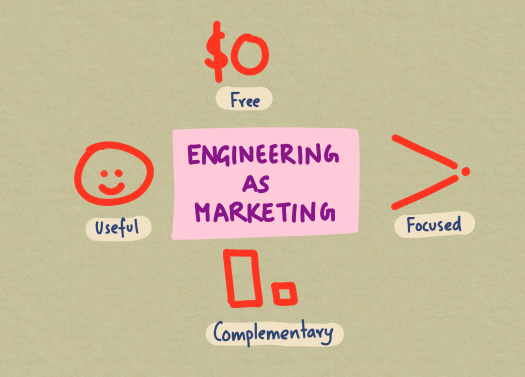
Flicking through these got me to the concept of Engineering as Marketing, popularised by Gabriel Weinberg and Justin Mares in Traction: How any startup can achieve explosive customer growth.

What does this mean?

You can’t just tell people what you do and show them a brochure and expect them to buy any more.

First of all, it’s hard to get to speak with anyone. They’re all busy. And, unless what you do is exactly what they are looking for right now, they’ll cut you off.

That’s if you get through the receptionist and the email only policy.

And that’s because telling isn’t selling.

Increasingly, what we’re trying to sell in product and service companies is technology. Brains aren’t enough.

You need tech as well – and with tech you have to show what you can do. Demo or die.

But what if you have a large, complex and expensive product?

Or what you have something like a book to sell? Something that doesn’t have a technology element to it.

Take the energy business, for example. It can take from tens of thousands to many millions to develop a new solar project.

I’ve just typed “solar irradiance calculator” into Google.

The first website that comes up is for a Solar Electricity Handbook.

The handbook is the best selling solar energy book today, the website says.

But on the website, they also have a calculator, which lets you see how much a solar installation will perform in the city of Masis, in Armenia – should you wish to do something like that.

And here’s the interesting thing.

The second link on Google is for a company that is using this calculator – and gives the first site a linkback.

That’s a perfect example of engineering as marketing.

The company has created a free tool.

That is focused, no pun intended, on calculating a specific thing – how much sun energy do you get in a particular place.

It’s complementary – which means that it doesn’t steal sales from its main product. You can use the calculator without losing any sales of the book.

The book is the main product and the calculator is a useful additional bit that might get you to the website and even buy the book.

And its building useful links from other sites that use the tool.

Most examples of engineering as marketing focus on the big examples – Hubspot and the like.

But – small companies with small budgets can also use this strategy very effectively.

You might struggle to get time with decision makers to talk to them about what you do.

If your product is relatively expensive – it’s going to take time to develop a relationship with them at a number of levels.

If you provide free and useful tools that don’t cannibalise your core business – they could end up coming to you.

For example, if you use a calculator on someone’s website for long enough, you might be interested enough to talk more about the rest of your products.

Take the solar PV project business – if you can provide tools that make it easier to find locations with good sunlight – you might find people coming to you to ask about your design and installation services.

Like many of the best solutions, engineering as marketing doesn’t try and tackle a problem head on, you go around it instead.

And it doesn’t need to be expensive. Creating microsites, calculators and other small tools don’t need to cost a lot or take much time.

But you do want to make then free, focused and useful.

And, importantly, not make you lose sales.

Cheers,

Karthik Suresh

What Is The Secret Behind A Creative Leap?

problem-solution.gif

Saturday, 10.03pm

Sheffield, U.K.

Brian Tracy, the motivational speaker, starts one of his talks by saying something like “Before I came in today, I read every one of your resumes and I know all your job titles.”

He points to someone in the first row. “You sir, your title is Chief Problem Solver.” To another, “You’re VP of Problem Solving.” And to another, “Executive Problem Solver.”

This gets to the heart of where the interesting stuff happens in business today.

Either you’re in a job where you’re told by your boss exactly what to do, and you do it that way or you get fired.

Or, your boss doesn’t know what the right answer is and needs you to figure it out, in which case you have a client, not a boss.

The first kind of job is manual labour. And, when you think about it, many jobs need that kind of approach – from working at a fast food chain to carrying out heart surgery.

You wouldn’t want your meal cooked in whatever way the chef fancies – perhaps they’ll try it a little under cooked this time to test out if the flavour is better?

You’d want your surgeon to do exactly what is needed – and not go off on a diversionary expedition inside you to follow up something more interesting?

But, there was a time before those jobs and tasks existed in the way they do now. Someone figured out how to make fast food work.

The McDonald brothers worked it out. They created a restaurant where every move was orchestrated. Every step and action had a purpose.

At a recent visit to a McDonalds, I counted around 15 people behind the counter, and no one was getting in each other’s way.

In the film “The Founder”, you hear the story of how they did it – how they noticed that people wanted burgers and fries and not much else off the menu – how they tore down their restaurant and rebuilt it from scratch and created a whole new concept in dining as a result.

We see the end result, but we rarely see the process. Often, people who do creative things can’t explain how they do it – it’s almost magical.

But… it’s something many people are interested in and study. In this paper, Kees Dorst and Nigel Cross look at creativity in the design process.

There are two states we can be in – a problem state and a solution state.

Imagine them like mountainous islands separated by a forbidding stretch of water.

The challenge is to get from one side to the other.

People who do this well start by exploring their mountain in detail.

They look at the problem, what the client feels, how it impacts them. They try and look at it from different angles and viewpoints. They ask themselves questions that try to prod creative thinking, lateral thinking.

They look at possible solutions – explore the solution space. What are the approaches that have already been tried? What could we do differently? What’s the opposite of what is being asked for.

Then, they start to frame the problem – settle on a way to view it.

This means focusing on the things inside the frame and discounting the things outside it. Focusing on the things that matter.

Trying to match up the problem space and the solution space.

All this work is trying to build a bridge – a bridge between the problem space and solution space.

This bridge is the thing that links the two in a way that works. Some bridges won’t. Some will – and they will work well enough to be selected to go ahead.

So, the creative leap is like building a bridge. But what it takes – what it needs is immersing ourselves in the problem and solution space, going past the simple and default and first solutions that come to mind and forcing ourselves to look longer and further and harder.

When we see a finished product – whether it’s a book, an idea, a business model – we might think it sprang to life fully formed. This way of doing things is the only way.

And that way lie jobs that are filled with boredom.

The interesting jobs are the ones where you solve problems – where you make clients happy.

A warning, however. This doesn’t mean you’ll make money.

The McDonald brothers had to eventually sell their business to Ray Kroc, who went on to create the business we know today.

They solved the operations problem – to create fast food.

He solved the business problem.

Either way, they’re all creative problem solvers.

Cheers,

Karthik Suresh

How Do You Know You’re Going To Succeed?

path-to-success.png

Friday, 9:12pm

Sheffield, U.K.

What would you think of a book called Winning Through Intimidation?

It brings to mind a book full of lessons on how to be more assertive, how to be the biggest, baddest person around. The kind of stuff someone about to go to prison for the first time might need to know.

The author, Robert Ringer, talks about this right from the start.

It’s not a book about how to beat others down.

Instead, it’s about how to get through being intimidated by others, how to keep going when there are obstacles in your way.

Where this starts to become useful is when we have to think about making and following a plan.

Take sales, for example. Every company has to makes sales.

It doesn’t always have to grow – that might be a goal but it isn’t essential – but it must make enough sales to cover its costs.

Here’s a pattern that seems to happen a lot when we’re trying to get sales.

Say you have a small company – it’s makes enough money to make the prospect of hiring a sales person a reality.

So, we get the cost of a person in the budget for next year – plan for the thousands a month it will take.

Is that enough? Will that person be able to come in and reliably meet the targets set every year?

Probably not… and that’s because just having one sales person isn’t enough to be successful.

You need a system. A system that includes a good product that is better in important ways than the competition, a good price, good information, a good order taking and distribution system and so on.

You don’t need a hugely expensive system that has every possible option thrown in.

But you do need a complete system.

A sales person can’t sign get a deal signed if there is no paperwork drawn up. They can’t get in the door if you don’t know the kind of person that wants to talk to you and can help them make contact.

It’s very easy to get discouraged and dismiss a project of this kind as a failure.

We hired a person who looked good on paper and at the interview, but it didn’t work out. We need to hire better next time.

We rarely notice that we have a broken or non-existent system in the first place – and no matter how great the sales person – we never had a chance at success.

But here’s the other thing.

We’ve also paid for a very expensive lesson – one that cost us in salary and time.

And it costs us even more if we fail to learn from what has just happened.

We’ve stumbled and fallen into a pit. We can curse and withdraw or we can move forward.

We can think about what we’ve learned, what went badly and what went well and, knowing what we know now, what we could do differently.

When we do this, we start to pull ourselves out on the other side of the pit.

And we start taking steps that move us in the direction of success.

We may stumble and trip again and again. There will be more pits.

But unless we learn and move forward, we will simply be left standing, looking at the failures we have had.

The next thing we try could be the thing that leads to success finally.

Failure is a state of mind. It happens when we decide to stop.

If we decide not to, if we always ask what is next, we’re going to find a way through. Always.

Cheers,

Karthik Suresh

How To Get Yourself To Do Something Even When You Don’t Feel Like It

activation-energy.png

Thursday, 10.34pm.

Sheffield, U.K.

Have you ever really really wanted to do something. Or known that you should do it.

Exercise more. Eat better. Be nicer to your other half. Spend more time with the kids.

It’s not easy. Change never is.

So, why don’t we just do it – what gets in our way?

Some people say you just need willpower. Set a goal – decide to do something and then get on with it.

Maybe it has to do with tracking. Measure yourself, keep records, take photos. That should work right?

It might have done, once. But for many of us, as life gets more complicated and full of stuff, we run into problems.

And a model from chemistry can help us understand this.

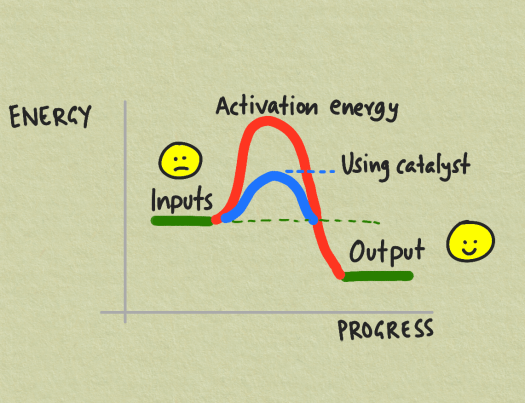
Let’s say you want to turn methane and oxygen into carbon dioxide and water. Methane and oxygen are the inputs.

You need to start by burning the methane – adding a spark – a flame.

That flame is needed to get things started. Without it, nothing happens. Once it’s there, the burning starts, the reaction takes off and we get the output.

Let’s compare this process to one many of us struggle with. Getting ready to go to the gym.

Let’s say you want to go first thing in the morning – perhaps 6am.

If you stagger into bed after a late night watching films and downing a few beers it’s going to take a lot more energy to get you out of bed when the alarm goes.

If you need to rummage through the wash basket to find your gym clothes, retrieve your shoes from the back of the cupboard and get any others stuff you need together – you’re using up more energy.

If you’ve booked a gym 20 minutes away from home because it’s got great facilities, you need to think about the 40 minute drive you have to do – is there time before work?

Perhaps it’s easier just to stay in bed.

What you’ve done is increased the activation energy needed to get you exercising to such a high level that the reaction never happens.

You turn off the alarm, roll over and go back to sleep.

Now – what happens when you add a catalyst?

A catalyst in chemistry speeds up the reaction – it lowers the activation energy needed.

In the gym example, if you sort your bag out the previous night, leave your gym clothes next to the bed, get your shoes and socks ready, join a gym a five minute drive away and go to bed at a decent time – you’re much more likely to make what you want happen.

In many cases – using more energy – working harder is not the answer.

Using a catalyst is – reducing the amount of energy needed to do something. Removing barriers, eliminating decisions and cutting out distractions.

Take sales for example. If you set yourself a target of making 100 calls a day, you’ll burn out in a week.

If you decide to make one connection a day – a call, an email, a LinkedIn contact – at the end of a year, you’ll have 300-400 more leads than you had at the start.

If you really want to do something – don’t try and work harder.

Set up your life so that it’s as easy to do as possible.

Then, even if you don’t feel like it, your system will kick in and you’ll get it done anyway.

Cheers,

Karthik Suresh

How A Trade War Works And What It Means For You And Me

trade-war.png

Wednesday, 9:44pm

Sheffield, U.K

Unless you’re completely switched off from the news – you know there is a trade war going on.

The US, China and the EU have their gloves on – and they’re not playing nice.

So, how does a trade war work, what does it mean for businesses, and what’s it going to mean for us?

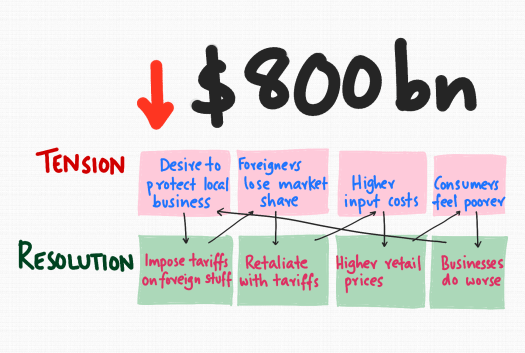
In these situations, I find it useful to trot out a model from Robert Fritz’s book Corporate tides.

Basically, in any situation you have tension and resolution, yin and yang.

And, when you work through a sequence of tension and resolution steps – you are left with a feeling of despair at the futility of “solving” any problem – let alone one so complex as global trade.

So… let’s step through what happens.

One country, in this case the US, feels that it’s being taken advantage of by another – China, the EU, the rest of the world really.

US businesses are suffering. Not all of them, of course. Mostly the pain is felt by more mature industries that make commodities – things that can be manufactured anywhere in the world.

The people that work in those businesses are hurting.

So – any politician will do what is needed to help his people – and the obvious answer is to impose tariffs on all that foreign stuff.

Make it more expensive, and then the locals will be competitive, have room to breathe, have room to raise prices and the workers will be happy.

Only the foreigners will lose market share – and who cares about them anyway?

Well, they do. The foreigners do.

They’ve got people hurting as well – especially now.

So they retaliate with their own tariffs on the stuff that the US makes.

The US imposes tariffs on steel. China retaliates with tariffs on soybeans.

China steelmakers lose half their market. US soybean producers lose half theirs.

Now what happens?

Costs rise. They rise because imports are more expensive because of the tariffs. And they rise because local providers have room to increase prices.

Input costs for businesses go up and what do they do?

Well, they’re not going to watch their profits evaporate. All they can do is raise their selling prices – put the retail price up.

And what happens when things get more expensive for us consumers?

We feel poorer. Our money doesn’t go as far, and we wonder what’s going on and perhaps we should cut back on spending.

And businesses do worse.

Which, when we go back to where this all started – with the desire to make things better for businesses – is a bit of a let down.

All that’s happened at the end of all this is trade is down – and it’s going to fall by around $800 bn – as set out in this rather detailed play by play review of what’s happened so far.

This is the fundamental irony of economics.

Anything we do to try and “control” things usually results in something nasty happening somewhere else.

People in charge don’t like that – they want to be in control and make things happen.

Markets don’t take that well.

James Carville once said: I used to think if there was reincarnation, I wanted to come back as the president or the pope or a .400 baseball hitter. But now I want to come back as the bond market. You can intimidate everybody.

It’s taken hundreds of years to learn that.

Try and control the market and everyone becomes poorer.

Set it free – and people get richer.

The current move across the world – towards protectionism, isolationism and lots of other isms – are more likely to make things worse instead of better.

But… it’s not all bad news…

There’s always opportunity when things start to go wrong and people panic.

The question is – what will uncertainty mean for your business. Will you do better or worse?

And what can you do now to prepare for the inevitable slowdown?

You could do worse than remember the words of Charlie Munger – Warren Buffet’s business partner.

“It is remarkable how much long-term advantage people like us have gotten by trying to be consistently not stupid, instead of trying to be very intelligent.”

Or… as the Hitchhikers Guide to The Galaxy might put it .

DON’T PANIC

Cheers,

Karthik Suresh

What Are The Simple Rules That Will Radically Grow Your Business?

business-basics.png

Tuesday, 9.22pm.

Sheffield, U.K.

John Caples was one of the best known names in copywriting and advertising, and worked for 58 years in the industry.

What, one might think, would someone who started writing in the 1920s have to say to us – a century later – about the nature of life and business?

Plenty, it turns out.

Caples learned his trade in mail order advertising, a tough school where you could precisely measure the return you got from your investment.

Mail order advertisers learned what worked, what didn’t and quickly focused on the approaches that made them a profit.

So, what’s it like today.

In many industries, technology has swept away the old ways of doing things, but created chaos and confusion along the way.

Take emails, for example.

No one denies that email has made it easier to contact people. You can get a message to someone across the world in seconds.

But… can you find a contract in your records from five years ago?

What if you’ve changed email service providers? What if all the documents were sent electronically?

How many photos or documents or spreadsheets can you find from even a few years ago that relate to a project you’ve finished?

One of the things we’ve lost by going digital is memory – we forget too much.

What does that mean?

It means that we’re so overwhelmed with the new and shiny that we forget to focus on the basics.

Caples said that there are two basic rules we need to follow to be successful in business – especially if we want to move from having a hobby or lifestyle business to one that can grow radically.

The first is to create business formulas – repeatable steps that produce results.

Your business exists because it uses resources to produce something that people want.

You can follow a new approach every single time you need to do something.

For example, if you run a law practice, you can approach each project as a completely new thing – a blank slate.

You wipe your memory of everything that has been done before and start again from scratch.

Or, you could create templates and processes and repeatable fill-in-the blank solutions for common problems.

Which approach do you think will scale?

You can make a perfectly good living from producing bespoke work. To grow you need to be able to create standard work that you can do yourself, or hire other people to do for you.

In other words, find what you are successful at and repeat it. Then scale it.

The second is to try something new every once in a while.

If you stick with a successful approach and only do that, then one day you’ll wake up to find that the market has changed and you’re no longer relevant.

You do need to have ideas, invest in research and development and make sure your business isn’t obsolete.

And, in today’s technological world, the more your business is based around technology, the quicker it becomes redundant.

People, however, don’t change. If your business is appealing to people – technology is simply a channel to help you reach them.

Like most things – these two rules seem incredibly simple.

  • Repeat the successful
  • Try something new

Some people might say – that’s just obvious. So obvious it’s not worth pointing out.

Very well then – if they know this already – then they must already have a successful, growing business, no?

No?

Try going back to basics every once in a while. I know I need to.

How To Leverage Yourself With Other People’s Support

leverage.png

Monday, 8.19pm

Sheffield, U.K.

I’m reading Brian Tracy again, and the points he makes about leverage in his book, Focal Point.

Leverage is about getting more output for the same amount of effort.

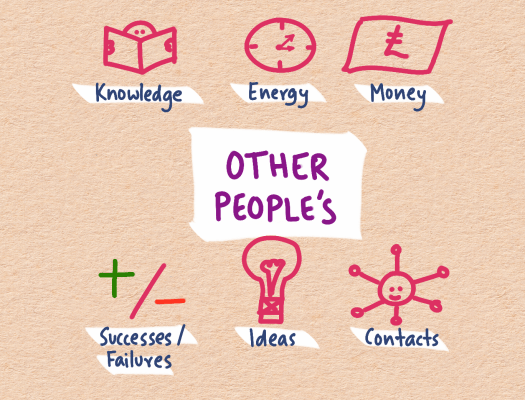
I was talking to a friend today about knowledge.

Many people have learned their trade and craft over 30 years on the job – they have experience.

They make decisions drawing on what they have learned over time. It’s possible that they don’t know why something is the right thing to do, but their gut tells them – and they have learned to trust their gut instinct.

But – that doesn’t mean we should take 30 years to learn the same things.

Many experienced people reflect on their experience and share their knowledge – in books and articles – and we should make the most of this.

Acquiring knowledge can help us skip years of experience. Experience still matters – but we can go so much further as a result.

Then there is energy.

We only have so many hours in a day – so many productive hours we can put in.

We should try and get the best out of each hour – and that means using other people’s energy to do everything that they can do better than us.

If you’re not practical – outsource all the jobs to someone who is. If you’re practical, get your bookkeeping and marketing done by someone who’s good at those things.

Robert Kiyosaki writes about money in such a simple and direct way that it hurts.

How long would it take you to save a hundred thousand dollars?

For most people, we’re talking years.

How long would it take you to borrow a hundred thousand dollars?

For many people, that could be pretty fast. Perhaps online.

The point is that if you’re good at borrowing money and investing it in something that gives back a higher rate of interest than you’re paying – you’re onto a winner.

Watching other people and learning from their successes and failures is crucial.

How many people do you know that have become successful and then spectacularly failed?

What made them do that?

Once again, all the information is out there. We just need to spend the time watching and learning and then picking the things that led to success and avoiding the things that led to failure.

It’s hard coming up with good ideas. So we should learn from those that other people have.

Everything we see around us is an idea that has survived the test of time. If you see a business model, a habit, a routine, a process that works – learn it and build on it.

It’s very rare that we see a completely new thing – most of the time we build on, iterate and improve on existing ideas.

Finally, there is the network – other people’s contacts.

Many of us know a few people. But together, we have access to a lot.

Other people can help you reach further through their contacts and connections. As the saying goes, your network is your net worth.

But isn’t all this other people’s stuff just using people?

No.

It’s the foundation of social structure. The bedrock of economics.

If we simply try and use other people – no one will help us. Or they’ll stop once they realise how selfish we are.

If you genuinely try and learn, give business to people, create returns for people, avoid failure and strive for success, search for the best ideas available and create and nurture good relationships – you just can’t help but do well.

Human beings are social animals. We prosper when our society prospers.

As Zig Ziglar said, You can get everything in life you want if you will just help enough other people get what they want.

How To Achieve Mastery

mastery.png

Sunday, 9.53pm

Sheffield, U.K.

I once listened to a Professor of Public Philosophy talk about work.

The whole idea of work is very poorly defined, she said. What exactly is it and how can we tell when we’re doing it?

Work has a few characteristics. First – it’s something we have to do, rather than something we want to do. In other words, there is a reason for doing it and we’re not just playing.

Then, it’s something that we do in exchange for money. If there is no money involved, it’s something other than work.

You may agree or disagree with her definitions and my memory may not be exact – but she said something else that was interesting.

Do you work for the sake of the work you do, or do you work for money?

Some people love what they do – they feel involved and committed and would do it even if they weren’t paid. Although they would then need to do some other work to actually get paid…

But others work for the money, or so they say. What do they want out of work?

Well, the Professor said, if you work for money, then before you can ask what you want out of work, you have to ask what you want out of money.

What is it that money gives you? Is it the ability to go on holiday? To buy nice things? Are you ok working at a job you dislike for the money that gives you the things you want out of money?

But that isn’t really the focus of this piece.

For many of us, we don’t work for money, and we don’t have the perfect job that we would do for free. So what is it we want?

One of the things we crave is mastery. The others, according to Daniel Pink, are autonomy and purpose.

So, how do we achieve mastery?

The author Robert Greene has written a book on the topic and, in this interview, sets out some of his ideas on the topic.

The place to start is with deliberate practice. As Zig Ziglar said, you don’t wander about and find yourself at the top of Mount Everest.

Whatever you do – sport, business, writing – the way to get better is to practice. And that practice needs to be deliberate, breaking down everything you need to do and working to improve each part.

But how do you know what to do?

You need to become a learning machine. There is information out there on everything. There are books, experts, resources.

The question is whether you have a system to take all this knowledge and process it, analyze it and internalise it. Make it your own.

There is a second part to doing anything. It’s easier to do something when you have a deep connection.

If you’ve entered a profession because your parents wanted you do but really don’t like it at all, you can end up living a life that doesn’t fulfil you.

It’s better to work on something that interests you, something that truly makes you happy.

Or you can settle for being happy by taking the money and doing fun stuff. Your choice really.

But how do you stand out?

Some people do that by knowing more and more about less and less. Academics can fall into this trap, where they know everything about something two other people in the world care about.

That’s great from a knowledge point of view – but don’t expect to get rich that way.

A better option is to combine two or three skills and create a niche that no one else is doing.

Scott Adams writes about this. He says he was an average cartoonist, an average storyteller and knew a little about engineering.

When he put all three together, he created one of the most loved comics in the world.

But it also takes time to get started.

We need to be grounded in reality. Realise that when we start we are an unknown, a small cog in a big machine.

We need to pay our dues, do the grunt work needed to be known and trusted enough to be given responsibility and chances.

That’s an apprenticeship we need to go through on the route to mastery.

And along the way we will meet people.

If we can maintain good relations with them, we are more likely to prosper.

We’ll find colleagues who will support and teach us, friends who will be there for us and mentors who will pull us up.

As the saying goes, your network is your net worth.

And what happens at the end of all of this?

At some point, you are so good at something that it’s self sustaining.

You work on something you love, get better every day, work with people you like, admire and trust and make a good living.

You’ve achieved mastery.