How To Redesign A Service Operation

2024-04-21_service-centre-design.png

Sunday, 8.40pm

Sheffield, U.K.

Our prime purpose in this life is to help others. And if you can’t help them, at least don’t hurt them. – Dalai Lama

This is the third post in a series looking at key ideas in John Seddon’s ‘Freedom from command and control”.

The ideas in this post are possibly the most important ones to learn if you want to dramatically improve how your business operates and how happy your team are.

Let’s start with a question that comes up all the time.

How many new people do we need?

You’ve got a problem. Things aren’t working very well. Or you see an opportunity. There’s a market you can get into. What’s stopping you?

Your answer, quite possibly, is that we’re too busy already – we need more people.

Everyone is maxed out working on stuff and there is no time left to deal with these issues or go after opportunities.

But hold on, what are your team actually doing now?

Some managers have no idea what the actual work is that their team does.

And that’s a problem, because you need to know – you need to sit with them and learn about what they’re working on.

This is the demand being placed on them.

But what we don’t realise is that there are two kinds of demand: value demand and failure demand.

Value demand is work that clients actually need – this is the outcome that makes them happy, such as the successful payout from their insurance claim, the signing of an important contract, the cash back from an error that you helped to argue.

Failure demand is the work resulting from a mistake – that error that requires rebilling the entire year, the handoff to someone that drops the ball and requires redoing all the interviews, the person who sits on a problem until it is too late and creates a massive PR issue.

Both types of demand look like work but they’re not.

What you’ve got to do is drive out failure demand and increase the time you spend on value demand.

Some people think sales is all about demand – you need a salesperson to get the client to agree to things, right?

Wrong. In most cases a salesperson, Seddon argues, is like one of those players at a fair picking ducks out of a pond.

It’s not their special ability that makes the sale but the fact that the duck is within reach.

It’s the demand that happens to meet you at the right time.

So, to sell more, you need to be awake to value demand and all of your team need to know what that looks like so you can sell more and build your business.

But how do you get that keen eyed, motivated, enthusiastic team?

You do it by getting them focused on the customer and doing good work.

You don’t break them into silos and divisions and have work going from one place to the other.

Instead, you try and get one person to manage the end to end process for a customer, from getting started, to delivering the result.

If that person doesn’t know enough, you don’t hand off the work to someone else.

Instead, you pull expert support and work with the person to get the job done, which means that they will see how to do it and get trained along the way.

Eventually, they’ll do more and more and you’ll have a team of experts all delighting customers with their capabilities.

And, by the way, your team will be happy at work which means they’re less likely to leave.

And that virtuous combination, happy customers, happy team will lead to profits and growth.

Good operations create good businesses that grow.

It seems very simple doesn’t it.

But it’s not easy. You have to unlearn assumptions you’ve had for a while and learn new approaches that are based on tricky things like trust and patience and the ability to deal with uncertainty and complexity.

We’ll talk about some of that later.

Cheers,

Karthik Suresh

Key Principles That You Need To Know

2024-04-20_manufacturing-ideas.png

Saturday, 9.28pm

Sheffield, U.K.

Life is a series of natural and spontaneous changes. Don’t resist them – that only creates sorrow. Let reality be reality. Let things flow naturally forward in whatever way they like. – Lao Tzu

This is the second post in my study of John Seddon’s ‘Freedom from command and control’.

Before I go through some of the key ideas that will help you create better service businesses, I need to jot down a few notes about representing knowledge.

As you might have noticed I use drawing as a way to structure my thinking, which then helps me to write a post.

My approach is inspired by several approaches to drawing as a way of thinking, including mind mapping, concept mapping, sketchnoting and thinking maps.

A good introduction to diagramming techniques used in systems thinking can be found here.

I recently came across Paul Fernhout’s website from a talk he gave at Libreplanet 2021 and discovered itIBIS – indented text Issue Based Information Systems – based on the work of Werner Kunz and Horst Rittel in the 1960s.

Essentially, this is a way of visualizing complex information using textual or graphical tools.

It’s similar to what I do with notes, and there are overlapping issues of theoretical interest, that I should probably pull out as I carry on with my PhD.

But the point I want to make is that it’s given me some thoughts about how to think my way into a piece of useful writing.

A document that I go back to a few times is Get Writing by M. Batchelor.

One of the suggestions she makes is to work out your outline in a talk.

An outline, as you know, is a structure of what you’re trying to communicate. And it’s a technique I’ve always hated.

I prefer to work out what I want to say by writing it down and seeing what happens.

But that ends up in rambling works like this post, which your well behaved AI tool will never write.

And that’s ok, because what I’m interested in is getting thoughts into your head, not just heaping up content.

So… one way of writing an outline is to use this idea of indented text as a way to examine what you’re reading and thinking about.

The IBIS technique has three key components – questions, comments and pros/cons.

But we’re not limited to just that – for example in the image above I’m using Colin Eden’s bipolar structure of “rather than”, represented by three dots like this “…”.

So the first line should be read as “learn and improve rather than command and control”.

Okay, one last thing.

We tend to think that we use reasoning to think objectively about our options and make balanced decisions.

It turns out that might not be right.

Mercier and Sperber (2011) argue that we use reason to win arguments and that might be a better explanation of what happens in real life.

So, the reason you’re seeing the image above as a mix of text and diagrams is because I’m thinking of experimenting with that as an aid to arguing the points I’m learning about. You can see the points. Maybe the pictures will help. Let’s see, shall we.

The ideas that you need to know to help you create better services come from ideas that were worked out in manufacturing, in particular Toyota.

They figured out that learning about a system and trying to improve it led to better outcomes than trying to boss people around and control them with numbers in spreadsheets.

It was more efficient to only do something when a customer needed you to do it – you started making a car when a customer asked for it, rather than building lots of cars just in case.

We’ve just rewatched the new Karate Kid, so the picture is of the teacher and student connected with bamboo poles. One moves only when the other does. That’s connection.

So how do you build a connection?

Well, by working on the relationship, of course.

You don’t just get there by relying on marketing.

If you spend your time connecting to customer needs then you won’t need as many people pushing paper creating budgets and forecasts and hopes and dreams – you won’t need a management factory.

And if you know what customers need you can create it for them, even if it’s different each time – even if it has variety.

That’s going to shock some people who will argue that only rigid standardization can work.

Ignore them.

The way to create what customers need is to have your team bring their brains to work rather than mindlessly obey your orders.

If your team is engaged, cares about clients and wants to do a good job they will build what is needed.

And your total costs will fall, when viewed from an end to end perspective. It might look like you’re spending too much time with one customer, but what you learn will drive down total costs.

Focusing on customer needs and doing only what needs to be done as effectively as possible means work flows unimpeded through your organisation.

That leads to economies of flow rather than economies of scale.

And these ideas are going to be fundamental as you take the next steps in your business.

Cheers,

Karthik Suresh

How To Create A Service Business That Works

2024-04-19_a-new-way.png

Friday, 8.10pm

Sheffield, U.K.

To give real service you must add something which cannot be bought or measured with money, and that is sincerity and integrity. – Douglas Adams

This is the first in a new set of posts that goes through the ideas in John Seddon’s 2003 book “Freedom from Command and Control”.

You will be able to read all the related posts using this link.

Why pick this book to study?

Most businesses operate on thinking that was created a hundred or so years ago.

People like Taylor invented the idea that you could make people act like robots, repeating actions in the most efficient way. Ford worked out that you could arrange them in a factory doing simple things again and again and end up with a complex product like a car, and Sloan figured that managing budgets was the way to make money.

These ideas were new and very successful at the time, particularly in factories.

Now, they just don’t work. But people still try and use them because they haven’t learned any other ways to get the job done.

Juran and Deming did work that transformed how manufacturing is done and how factories are run but service businesses still operate with the old ways of thinking.

Seddon’s book is one that tells us what to do to make things better.

Some of the ideas that we need to think about are shown in the picture above.

Let’s say you’re starting a business tomorrow – how should you think about delivering your services?

Do you think about roles and responsibities? Who’s the boss? Who’s in charge? Who are your subordinates?

That’s a command and control way of thinking – there’s a hierarchy in the office and some people do the thinking and others do the work, and one group boss over the other.

The other way is to think in terms of systems. What are the parts, what connects them, how do they communicate, and what emerges if they all work together?

Systems thinking is a big topic so we’ll come back to that later.

The next thing to think about is where managers spend their time.

I saw a series a while back about a project improving a hospital. The bosses sent in an administrator who spent all their time sat in the office poring over spreadsheets and numbers.

Never once walked the halls, met the staff, or watched the work being done.

Real managers get to where the work is, they get involved in the operations because they alone have the power to improve things.

You cannot wield power effectively sitting in an office – you have to get out there.

Now, what should you work on?

People in organisations quickly adopt roles, and these roles form groups, and those groups fossilize into functions.

Suddenly everyone is busy doing something but no one can explain why they are doing that thing.

You must have come across this – the most common example is that report you do every month that takes six hours that you email and then get no feedback, no questions, but you’re still told that it needs to be done every month.

Instead, real work is what customers need doing. Not what they ask for, but what they need, what makes their situations better.

That’s called customer demand – it’s how you help them. It turns out there’s two kinds of demand – a good one and a bad one, but we’ll talk about that in another post.

If you stop doing stuff that doesn’t need to be done, like that report; stop doing it, or automate it; that’s you removing waste. If you don’t get rid of waste you increase costs – that’s six hours of time where you could have done something else or just put your feet up and relaxed.

In summary

A good service business works when you try and learn and improve so that you can create mopre value for clients.

Focusing on the numbers – the budgets – in a service business is more likely to cause you to cut corners, complicate things, make the service worse, have customers abandon you, and reduce profits.

The money will flow when you do the right things, remove waste, and make customers happy.

More in the next post.

Cheers,

Karthik Suresh

What Can You Find Everywhere?

2024-04-18_opportunities.png

Thursday, 8.41pm

Sheffield, U.K.

Opportunity is missed by most people because it is dressed in overalls and looks like work. – Thomas A. Edison

I’m done with this mini project – to browse through Tom Peter’s ‘the brand you’ and see what it says.

Here’s what I’ve found so far:

  1. You need to think of yourself as an independent contractor rather than an employee, even if you are one.
  2. You need to be good at something, you need to work on good projects, and you need a network.
  3. You are your projects – they demonstrate your value.
  4. Figure out how to package yourself – what’s the bundle of benefits you bring to a client?
  5. Do things that matter, do something useful, and be nice to people.
  6. Have a purpose. Serve a community.
  7. Go to where the work is being done, to the front lines, and you’ll learn what needs doing next.

Onto the final point then.

I don’t know if you know what it’s like to be an immigrant. Or to go to boarding school.

They’re both situations where you go somewhere new with very little and you have to make a go of things.

There are some good experiences and some bad experiences and then there are more experiences.

What makes the difference, I believe, is your attitude to work.

I’ve not met all that many people – I spend too much time reading and working – but I’m pretty sure that the number of people who get their heads down and get on with the work is less than the ones that don’t.

The most irritating people are the ones that seem to think they’re special, that they’re particularly good, that everyone else should recognize their brilliance.

The ones that see certain kinds of work as beneath them.

But there’s something very special about focusing on the work, something almost magical that happens.

It’s where you find opportunities.

Some people think that people that are successful are usually lucky.

This is true, but only when you accept that the definition of luck is when preparation meets opportunity.

You prepare for opportunities by working so that when they come along you’re ready to grab them.

When you look at the world this way it’s full of opportunity, there’s fruit on every tree as you skip along.

You won’t see opportunity if you trudge along, eyes down, looking at the road for where to place your feet.

You have to look up and look around.

I was told yesterday that we’re not programmed to do this – we have no natural aerial predators. Much of the stuff that gets us is crawling along on the ground.

So it takes effort.

I still remember a random opportunity from years ago. I had a car with a problematic brake caliper. I went into a garage to ask if they had a repair kit. The owner said that they didn’t do that any more, it took too much time and so people just replaced the whole part instead. And then he said to come over any time if I wanted a job – just because I was interested in doing the kind of work that people normally didn’t bother to do any more.

So that’s the last lesson from the book.

Opportunities are everywhere. You just need to look up.

Cheers,

Karthik Suresh

How Do You Create A Product Or Service That Sells?

2024-04-17_course-of-action.png

Wednesday, 8.46pm

Sheffield, U.K.

If we knew what it was we were doing, it would not be called research, would it? – Albert Einstein

I’m getting close to the end of this mini project whipping through Tom Peter’s book ‘the brand you’.

What’s I’ve seen in the pages I’ve gone through are thoughts about the importance of creating products, of innovating, of paying attention to design, performances, calling cards, presentations.

A bit of a mishmash of stuff really.

But the thing that jumped out at me, the thing that’s the most important takeaway is this.

You will learn what you need to know if you go to the frontline.

Peters has a military background and it turns out that military planners sketch a course of action – creating a drawing using a graphical vocabulary to show a commander’s plan.

My drawing does not follow that vocabulary. It’s based on a distant recollection of geography lessons decades ago.

But the point is that there are people on the front line and there are people way behind the front lines and you need to figure out where you’re going to get the real information to decide what to do next.

If you go into an organisation and talk to the bosses you’ll get a particular perspective, a highly filtered one.

All too often, it seems like bosses convince themselves that the stories they tell about their businesses are actually true.

You can tell the difference between a boss that manages by reading dispatches and one that walks the front line.

It’s the difference between a hospital manager who sits in a room reading budget reports and one that walks along the wards.

It’s the difference between someone who has a nice office and one that sits along with the rest of the team.

Organisations tend to fossilise into hierarchies with reporting lines and structures that mean interaction slows down – and when that happens learning dies.

But you, as a consultant, are different.

You can go in and talk to the people at the front line, the ones doing the work.

You can listen to the people who know what works, what doesn’t, and what needs fixing.

The thing is, sometimes people know that something needs to be made better but they don’t know how to do it and, more importantly, how to bring the rest of the organisation with them.

That’s where the opportunity is for your product or service – to address the uncertainty about what to do next.

At this point you’ve found a problem that needs solving or a situation that needs improving.

And you can think about how to help.

So, the one takeaway from this part of the book is this.

Go and talk to people doing the work before you decide what action to take next.

And then build your product or service to take that action and deliver the outcomes your client needs.

Cheers,

Karthik Suresh

Thoughts About You And Your Community

2024-04-16_community.png

Tuesday, 8.55pm

Sheffield, U.K.

Every successful individual knows that his or her achievement depends on a community of persons working together. – Paul Ryan

I’m still working through Tom Peters. More than half way through. And I have a few thoughts to connect.

The first is getting clear on the difference between a product business and a service business. A product is a thing people want or need. The thing is what matters. A service is an outcome that they want or need. The results are what matter.

Creating and managing either type of business comes with challenges. But let’s focus on service businesses because that’s what I’m interested in right now. What’s really at the core of a service business?

Two things.

Community. And Purpose.

Community is the idea that connects to the current section of Tom Peter’s book ‘the brand you’. The community is the group of people you serve. The group that your Clients come from, clients with a capital C. These are the people that you work with, that give you business, to whom you give value.

If you’re employed right now your client is your manager, the person that needs you to produce positive outcomes. We start with no clients, move to having a client, and progress to having multiple clients as we develop our capabilities and let go of our limitations.

Start. Learn. Earn. Connect. Create Value.

Service businesses are hard to scale and that’s not a bad thing. These are firms that depend on people giving other people value, giving other people service. But what is it that makes it possible for you to deliver a service of value?

I don’t think it has to do with the service itself. If it were, you’d be able to treat it like a product.

Some people do. The holy grail, it seems, is to “productize” services. To take something that’s about community and connection and scale it so that it becomes about process and self-service.

That results in something, quite often a better something, like reliable electricity, good phone lines, as service businesses transition to product businesses.

The thing that’s at the heart of a service business that’s still about service is the idea of “purpose”.

Purpose matters.

Let’s put this in another way – one that might be easier to grasp.

I met a priest recently. One who said that what he did, what his life was spent doing, was serving his community and god.

If you substitute purpose for god in that thought you have the essentials for anything else you do.

If you run a cleaning business or if you run a financial brokerage – the purpose you bring to the task makes a difference.

A good purpose is to delight your clients. A poor one is to make as much money as possible.

I still remember the face of a guy, licking his lips as he described charging an obscene amount of commission on a transaction for a less-informed client.

Not the kind of person I wanted to work for or work with.

That’s why you have to choose your clients carefully. Choose to work with ones that need what you offer but that also are worthy clients.

I can’t define what makes them worthy but you’ll know it when you see it.

Cheers,

Karthik Suresh

Finding Out What You Really Value

2024-03-21_value.png

Thursday, 9.02pm

Sheffield, U.K.

Never let anyone or anything define your value or limit your dream. – Judy Sheindlin

Day n+1 of ‘the brand you’ by Tom Peters.

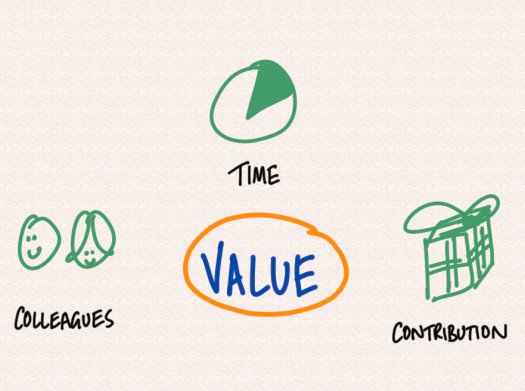
Today’s topic is about value and the idea that if you’re not sure what you value most you should look at three aspects of your life.

First, check your calendar. What do you spend your time doing?

I’m watching “Scrubs” again. Because it’s on and I don’t know what else to watch and it’s good.

The story is set in a hospital and I sometimes wonder if doctors today are doing what they wanted to do with their lives.

The image we have of a doctor is someone who wants to help patients. The reality is often someone that has minutes to spend with you before rushing off to the next thing.

If they stick it out – why? Is it for the rush, for the success, the money? Whatever the answer, it is a hint to what one values.

The second thing to look at is your contribution, what comes from you?

For me, that’s a simple one. What I like doing is getting thoughts down. In text, like this. And in code, to get something done. I can spend hours trying to make something work, something that transforms one kind of information into another.

The kind of thing most people would chew their arms off to avoid doing.

I came across a quote while looking for one to start this one that said something like Linux only has value if people don’t value their time.

But it really depends on what you think is worth doing with your time – for some of us tinkering with text based tools on the command line is a good use of time. A much better use of time than clicking icons and hoping things don’t crash.

We digress…

What’s your output? For many of us it’s information these days. For others, it’s still a thing of some kind. A product or a service, that covers most of the bases. Unless you’re one of those people that tells others what to do because you have power and/or money. That works too although I can’t imagine a more soulless existence.

I guess the Ferrari takes some of the sting out of it.

And then finally who do you like hanging out with?

The changes are that the amount of money you make is the average of the people you spend the most time with.

I don’t really know if this is particularly helpful other than that many people belong to a tribe or tribes of one kind or another.

And some of us are on the fringes.

There is a thing about weak networks being important, the people who will respond to you but you don’t know very well.

The thing that will make or break you, however, is the people you know or don’t know.

I know that AI is taking over everything and I find incredibly useful.

But somewhere out there is someone who you will only do business with if someone you both know and like introduces you.

That’s just the way it is.

So, to maximise your value follow a three step process.

  1. Do only things that matter.
  2. Be someone that contributes something useful to the world.
  3. Be nice to others.

Cheers,

Karthik Suresh

Learning To Advertise Ourselves

2024-03-20_image.png

Wednesday, 7.50pm

Sheffield, U.K.

The more informative your advertising, the more persuasive it will be. – David Ogilvy

I was talking to a friend and we are starting to realize that the way we did things is not the way they do things now.

We have new generations coming through, with different experiences. And the differences are starting to show.

Gaming, for example, wasn’t really a thing for me. That wasn’t just a timing thing but also a place thing. But for many people now, including my children, it seems as essential as breathing.

Reading – that doesn’t appear to be much of a thing. An informal poll of the thirteen year olds I know suggests that around 10% of children like to read.

For pleasure, anyway. I suspect the rest would quite happily read anything they were really interested in as kids are learning machines.

A lot of people learn from video these days. I do too. And I hate to admit this, but it is probably more effective than reading on its own. Note the “on its own”. I don’t think video replaces reading, but reading plus video is better. Reading plus video plus AI is probably better still, even if brings us closer to the apocalypse.

I think I am something of a luddite technology enthusiast. I like stuff that works and that stuff tends to be old, like the vi editor I am typing this on. The first version came out 48 years ago. I will probably happily use it in 48 more if I am still around.

But I also like the new technology and tend to explore its limits pretty quickly. The test is not newness but utility – does it work?

I think that’s the same with video. The test is not to game the algorithm or create 30 second stress inducing content. The point is to explain things simply and clearly. But of course, that will not get likes. It won’t give you the short-term dopamine boost that comes with the rewards of social approval. But it may be useful – for me as I learn to talk about things I am interested in – and perhaps for others who share an interest in some of these ideas.

As a result I will be experimenting more with video, so you might see some more of it on the site.

Cheers,

Karthik Suresh

How Do You Package Yourself In 2024?

Monday, 7.56pm

Sheffield, U.K.

Information about the package is as important as the package itself. – Frederick W. Smith

I’m continuing to work my way through Tom Peters’ ‘the brand you’.

I listened to a webinar by Peters. He is an engineer with an MBA. We have that in common.

The book still doesn’t have enough for me though. But it has enough to get started. And we start today with the idea of a “package”.

How do you package yourself? What comes to mind?

Well, that was all very well in 1999 but you can do something different in 2024.

I’ve been talking about AI a lot in these posts, but that’s because it’s exciting technology that is going to make a difference to many people.

A difference that’s good and bad.

I wrote earlier about AI being a difference multiplier. People who are already good at stuff will become astonishingly better.

But some will find their skills are less necessary.

Now, I have some ideas that I need to work into a package about this, and I haven’t fully sorted this out so I’m going to just work through it a little with you.

Here’s what people think.

AI is all very well but it’s only going to do the grunt work. The real creative stuff will still need humans.

That is not a safe assumption to make.

Let me give you an example.

People say that AI can crunch the numbers but it can’t do strategy. That’s high quality professional work, that is.

But what exactly is a strategy?

This blog is full of attempts to think about strategy – a quick count shows I’ve used it 1,081 times so far.

One way of thinking about a strategy (something that I’m still trying to write up) is as a model – nodes and links. Parts of a plan and the connections between them.

Well, if you think of it in that way, AI can definitely do this work.

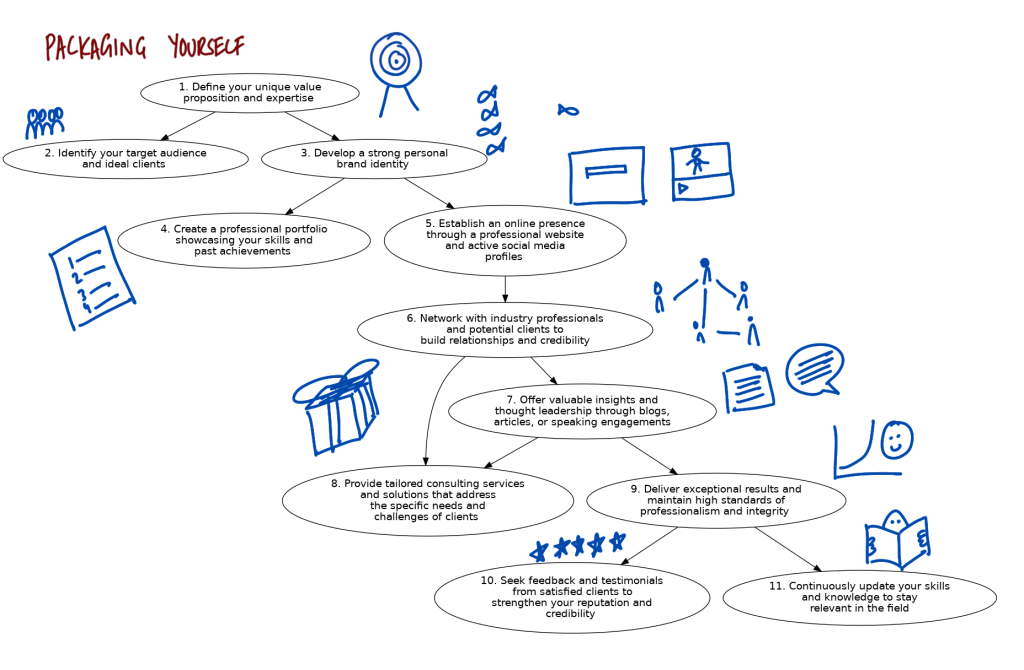
For example, Peters tells us to package ourselves. I’m a professional, a consultant, so I asked AI to create a strategy to package me. And what it came up is in the image above.

There are 11 points there and I’d be hard pressed to come up with many more.

If you’re going to package yourself now would you use the advice in Peters’ book to ask “who are you anyway?” or would you just work through this model and compare it to where you are right now and what you need to work on?

I would.

And this leads me to the idea that I’m leaning towards.

I think strategy consulting could be killed by AI.

AI can take all the information that exists and put it into a plausible and persuasive framework that you can use to take action.

It can give you a strategy based on what is known to work.

Well, to clarify, it can give you a strategy based on what most people think works.

There are certain areas where it’s wrong because the weight of presumed knowledge is wrong. But that’s for another day. Unfortunately when the truth is hidden underneath mistakes that causes its own problems.

What you then have to do is take action – get your hands dirty and do the work.

(perhaps with the help of AI again, of course)

Like most technologies, this whole AI thing is going to have good and bad effects.

But while it’s fresh and new I think it could help us to take action to improve our situation and those of the organisations we work with.

Cheers,

Karthik Suresh

Why Your Projects Are What Make You Credible

2024-03-16_project.png

Saturday, 9.33pm

Sheffield, U.K.

Profit in business comes from repeat customers, customers that boast about your project or service, and that bring friends with them. – W. Edwards Deming

This is the second post in a series related to Tom Peter’s book ‘the brand you’.

It’s a small book and one that’s I’m slightly regretting having picked to go through because of the eccentric nature of the text. There’s a lot of colour and bold and mixed capitals and other distracting formatting artefacts.

But let’s try and ignore that and focus on the actual points that matter.

What matters for you in your career is the set of projects you have worked on and the project you are working on now.

The “project” is what a researcher might term the unit of analysis for a practising manager.

Projects are the things, according to Peters, that add value in modern organisations.

Now, I don’t think this is entirely correct.

I think there are also processes that add value. For example, organisations are full of scheduled repeated activities that need to be done well for clients to be happy and for services to be delivered. There are a host of “human activity systems” that operate steadily all the time. You can’t argue that these don’t produce value.

But perhaps Peters is talking about adding value and I think we can all see that that’s where a project comes into play. It’s something you do when you want to make something better or do something different or new.

Something that fills a gap in the way in which we do things today.

So how do you choose what projects to work on.

Well, you could never turn down a project because every project has the potential to turn into something big.

But a better strategy might be to go for the projects that address something painful and urgent. Projects that matter. Projects where the problem owner is hanging on by their fingertips.

If you can create something that will make the situation better through your project, you will end up with a grateful client, colleague or boss. Someone who will appreciate what you’ve done and tell others about how great you are.

Where what you’ve created makes a difference even after you’ve moved on.

It’s one thing to find these projects and offer to do them.

But what is it that makes a project successful?

Perhaps we’ll find out later in the book.

Cheers,

Karthik Suresh