What Is The One Thing You Must Wipe Out In Every Sale?

removing-risk.png

Thursday 10:05pm

Sheffield, U.K

Are we in a brave new world where technology is all that matters and classic human skills are not going to be needed any more?

Or is human nature going to prevail – as we obstinately cling to our biological ways of doing things?

Take the success of Amazon, for example. What makes it special? Why has Ebay become so popular?

The most obvious answer is that they timed it well – they had the technology and created the systems and processes – the infrastructure – needed to do business in the world of the Internet.

You could buy books on Amazon and sell your old stuff on Ebay.

But – just because you can do something doesn’t mean you will.

The two internet giants (and others) created new markets that were transparent and that you could trust.

Reviews, Ebay seller ratings, guarantees, escalation processes – all these helped reassure people that their money was safe if they used the platform to make a purchase.

Many of us can still remember a period when we didn’t fully trust things online. We might look it up online, but then go into a store to buy it.

Then we went into stores and checked online to see if we were getting a good price.

Now, we use stores like display cabinets – a place to look at things before we place an order from the cheapest place online.

The thing that Amazon and Ebay got right, eventually, was removing all risks for us as buyers of products.

And this is something Facebook is learning, perhaps painfully.

Facebook enables us to be producers and consumers of information – of stories and pictures and memories.

The problem is that they have also allowed their platform to be a seething quagmire of misinformation, propaganda and sleaze.

We don’t trust them or their platform, or feel it’s a safe place for us and our kids – and now they are having to do something about it.

They’re learning something that great marketers have always known – if you want someone to make a decision, take away every barrier, every risk that they could possibly face.

Let them try it out, pay later, offer a guarantee, let them have their money back at any time if they’re not happy.

Bend over backwards to make sure that they can make a decision and be confident that they can back out if they have even an iota of regret.

Some people are scared of doing this – what if they get taken advantage of?

But – back to human nature – more people will do the right thing. There will be some people who take advantage of you, but that will be a small number that is more than offset by people who decide to take a chance on you because of what you say you’ll do to remove any risk for them.

And, if you have a good product or service, you know they’ll be happy.

If we’re not confident that we have something good – then we need to fix that first.

But after that… you know that it will help the customer.

So… wipe out every last little bit of risk and then let them make the choice that is best for them.
The 7 Basic Fundamentals Of Selling Anything

key-marketing-variables.png

Wednesday, 8:10pm

Sheffield, U.K.

I’m musing about value – and how to get it across to someone else.

It feels like there are lots of people with many ideas.

There probably always were – if someone looked into it, they’ll probably find that the percentage of people with ideas has stayed the same over time.

It’s just that there are more people to start with, and it’s easier to talk about our ideas, what with social media and email and all that kind of stuff.

But most of us have had no real training in telling the difference between a good idea and a bad one, a profitable idea and a money pit, something worth doing well and something not worth doing at all.

Our brain plays tricks on us as well. It’s well known that people fall in love with things they have done themselves – the IKEA effect – where we regard our amateurish creations as at the same level as professionals.

But then – we also need to remember that experts aren’t always right – amateurs often invent things that go on to revolutionise industries.

For example, the Wright Brothers worked with bicycles but built the world’s first successful aeroplane.

But, on a more down to earth basis, what do you need to know in order to sell something?

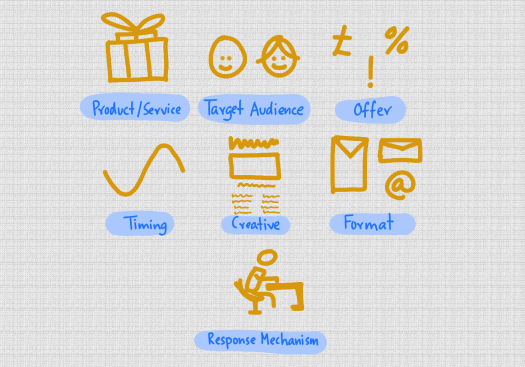
There are seven key factors that, according to the Institute of Direct Marketing (IDM), are key to selling anything.

1. A product or a service

That seems obvious – and you possibly have one already. Whatever it is, you need to be able to talk about its features, advantages and benefits.

What can it do, why is it better and what will it do for your customer.

2. Aimed at a target audience

You can’t sell to everyone. In fact, there will be a small number of people who need what you have, want it more than they want the money in their pocket and actually want to talk and buy from you.

Everyone else is milling around, getting in the way while you get to that core group of people – your customers.

The better we know and understand our target market, the better we will be at…

3. Creating an offer that they find irresistible

You can sell anything. Cow dung is valuable – it’s a heating fuel, organic fertiliser and floor covering…

It comes down to price – how much, discounts – what percentage will you take off, and terms – how quickly, what quality.

Someone will bite – and you just need to make those terms as attractive as you can.

4. You need to think about how they’ll see it

Are you going face to face, sending letters or reaching out electronically.

The format is simply the way in which you put the information in front of someone but…

5. The creative is how it looks when it’s there

Many people think pretty pictures sell – but the mistake is thinking that’s all you need.

You need something your prospect can read easily, understand quickly. The harder you make it, the more people you’ll lose.

Plus – you need different approaches for different people.

6. And they’ll be ready for it at different times

Fashion is the perfect example of seasonal selling – following the weather and what you need – and helping you make impulse decisions.

But there are other things that matter – budget cycles are important, common renewal dates are worth targeting and there is an overall business cycle in many industries.

7. But nothing matters if people don’t come back to you

The final part of the selling puzzle is making it clear how to come back to you.

The other day I nearly walked away from a purchase I had already decided to make because the person I was talking to explained everything about what they were doing, except how to order.

They talked about the website to the point where I thought that was the only way to order.

It was only as I was about to walk away that the point about signing up now came up – and that rescued the sale.

Customers need to be told what to do to order. In detail.

More is nice… but the basics are essential

These seven steps are crucial when trying to sell anything – and I’m going to keep them in mind when assembling any piece of product or service marketing from now on.

How To Stand Out From Your Competition

how-to-stand-out.png

Monday, 9.33pm

Sheffield, U.K.

What is the single biggest problem with looking at what your competitors are doing and trying to emulate them?

For example – if they have a flashy website and spend loads on pay-per-click advertising – do you have to do that as well to compete?

If they attend particular trade shows or go to awards, do you need to have a presence there as well.

Does a me-too strategy work?

The problem is that if you do what everyone else is doing, then what is it that sets you apart? Why should someone choose you over someone else?

This is something that many organisations struggle to get right. The boss looks over at the competition – perhaps she gets an email newsletter – and wants to know why her company isn’t sending out stuff like that.

It’s much easier to mock up a newsletter and start sending it out instead of questioning whether the newsletter adds value and if clients would actually read it.

Competing on such a basis is effectively an arms race, with everyone spending money to keep up with everyone else.

And, because the Internet effectively makes it free to send out stuff, ridiculous amounts of crap floods into our inboxes every day.

There’s a simple principle that we should keep in mind when advertising what we do.

If you are holding a red flag in a sea of blue flags, you’ll stand out from everyone around you.

That doesn’t happen if you’re holding a red flag and are surrounded by others also holding red flags.

If your business is doing what everyone else is doing then you have to come up with something new, something unique – that makes you look different from everyone else.

Many businesses are too scared to appear anything but corporate. They think that by projecting an image of themselves that is all polished wood and starched shirts they will come across as professional and competent.

Fear rules how they make decisions. They don’t want to send out controversial messages that polarise their audience. The words they use are dull and insipid.

It’s not about shocking an audience. Instead it’s about attracting their attention and then getting a message through to them.

And that’s very hard to do with everyone else shouting at the same time – especially on the internet.

Imagine how you would act if it cost you $10 to send each message. You’d be much more careful about who you sent it to, what you said and how you created a deal for them.

This doesn’t mean we should ignore the competition.

You should study them, read every message they put out and learn exactly how they advertise themselves.

Then – figure out what you can say and show that is different.

3 Critical Reasons Why Owners Let Their Businesses Fail

reasons-why-owners-dont-invest-in-productivity.png

Saturday 10:31pm

Sheffield

There is a problem – definitely in the UK and more widely in Europe and small businesses in the developed world – and it has to do with how much work we’re doing.

Many businesses are not productive enough – the amount of work done by each person in the business is flatlining.

And this is a problem for one very simple reason.

As more people look for work, including from the vast labour markets in India and China, the supply of qualified, skilled people increases.

Existing businesses will face more competition from more places – and if they’re not getting better at what they do all the time, then someone else will take them out.

So why do small businesses, in particular, struggle to keep up?

To start with, there are three things they can do to improve their businesses – they can invest in better systems, create better processes and hire better people. And this creates three problems.

1. They’re Too Busy Paying Rent To Worry About New Technology

Most businesses owners are neck deep in work.

There are customers to deal with, suppliers to shout at, employees to manage, rent and wage bills to pay and tax to collect and give the government.

Almost every small business owner is spending too much time working in the business to step back and make the time to work on the business.

So – wanting money out of them for something they don’t understand is not going to go down well.

However good a new technology – most business owners just haven’t got the time to get their heads around it and work out if they will benefit from it.

2. They’re Entrepreneurs – Not MBAs Or Accountants Or Lawyers

May people who start businesses have a passion for what they do, or they’ve taken over the family business, or they spotted a gap in the market for a product or service.

They’re creative opportunity spotters, risk takers and problem solvers.

That’s great when you need sheer force of will to convince suppliers to give you credit, customers to give you business and people to work for you in exchange for promises.

It’s not so good when you need to pass a security audit or comply with GDPR or file an environmental compliance application.

Often businesses don’t have the skills in-house or the contacts outside to get qualified advice on what they should do and how they can do things better – whether it has to do with improving sales and operations, cutting costs or having better contracts in place.

3. They Don’t See The Point Of Investing In Training

This is the hardest one for many business owners to get – and it’s the equivalent of shooting themselves in the foot.

You only have two options – you can hire someone with the skills you need, or you can train them to the level you need.

Many business owners don’t want to pay for training. They see that as an immediate cost and, once the person has been trained, what happens if they simply leave?

All that investment disappears. Instead, why not just hire someone that another company has spent a lot of money to train?

That’s Why They Die A Slow, Lingering Death

People don’t want to mess up their business – they just do because sorting things out for the long term is just so much harder than dealing with things right now.

But we should… think about these three sayings:

  • If you don’t make time to exercise, you will have to make time for illness.
  • Forewarned is forearmed
  • If you train people, they may leave. But, what if you don’t train them and they stay?

If you’re too busy to fix your business now – then it will be a lot harder when the competition has moved in and taken most of your customers.

Understand the value of good advice.

And – train your people. Having a good training system in place that takes inexperienced people and turns them into superstars is the best insurance against having to hire superstars that will leave you the first chance they get for a better offer.

It takes one set of skills to create a business. It takes another set of skills to keep it alive.

The Single Best Tactic to Use to Achieve Your Goals

no.png

Life is just too busy.

There’s always too much going on.

If you’re young, there are parties to go to, friends to meet, movies to watch and places to visit.

If you have a family, the kids take up all your time, and what is left is spent tidying up and trying to get some sleep.

If you’re older, perhaps the grandkids keep you busy. Or there’s holidays with the friends, cruises and charity work.

Is this a good thing?

Possibly. Many people have worse lives and struggle with daily living.

But the fact that others have it worse doesn’t change the reality of the life we live.

So, what can you do about it?

There’s a great ad that Saatchi and Saatchi did for The Health Education Council.

It just says No. And below, it says still the most effective form of birth control.

And this is good advice with almost everything we do.

The point is that we spend a lot of our time doings things others want us to do.

At home, we need to deal with asks from family.

We exchange our time at work for money, and get told what to do as a result.

And, if we want to be nice and useful and not get fired, we do the things we are asked to do.

But, at some point, we could lose track of why we are doing anything in the first place.

What drives you, what do you really want?

And is what you are doing every day getting you closer to or further away from what you want.

Perhaps we can’t remember – all the years have buried our real wants under layers of reality, demands and expectations.

A good tactic to peel back the layers is the perfect day exercise.

Imagine your perfect day. The one that would make you totally happy. What does it look like?

Where do you wake up. What is the room like, the bed, the view?

Maybe it’s not a room, but a hammock on your beach hut in the Caribbean.

What’s the first thing you do? Who is there with you? What is breakfast like?

How do you spend your morning? Do you jet off to a high powered meeting in NYC or LA or are you having brunch with friends in Paris? Or walking the dog in the highlands of Scotland?

Describe your day in detail, from start to finish. Write it down quickly, without censoring yourself. No one is going to see this, so be completely honest with yourself.

Then, look back at what you have written and compare it with what your life looks like now.

If you’re dreaming of being a documentary film-maker but spend your days doing forensic accounting for waste management companies, then something has happened along the way to nudge you off course.

It’s not a problem.

You have the rest of your life to get back on track – starting right now.

And the way to get started is by saying No to the things that take you further away from your perfect day.

Not to all of them, not all at once – that will just get you fired and ruin all your relationships.

But, perhaps – that’s what’s actually needed in some cases.

For most of us, we need to correct course, not sink our boat and swim, spluttering and flailing, towards a new one.

Try saying No to more things from now on.

The most important lesson I learned from a sales master

recipe.gif

I’ve spent a big chunk of my life in formal schooling. School followed by diplomas, followed by university, then work and back to university.

And, on the whole, this has not been too much of a disadvantage.

Being good at school has little to do with how much you achieve or how well you do in life. Robert Kiyosaki joked that A students worked for C students, and B students worked for the government.

There’s some painful truth in that.

But – my studies were always for a purpose. I saw a degree as the cost of entry to work – the basic thing that was needed before anyone would hire me for anything.

It was only after ten years in work, when I went back and did an MBA, that I studied because I really wanted to. I wanted to learn about business, and I devoured everything I could find.

The great thing was that all the theory I was learning made sense – it explained a lot of the experiences I had so far.

But, not everything.

I understood more about why I felt the way I did as I worked in an organisation that changed size and character.

I had words that could explain what I had seen and felt – and that was amazingly freeing. I wasn’t imprisoned by those experiences – I could learn from them.

And, more importantly, I could see and learn from others. But, in addition to seeing, I could also describe what they were doing. Theory AND action. Something sorely lacking in the world of business now.

And one of the things I experienced was working with a master of sales – a master of working the phones and getting to people.

The first thing he could do was get through to someone on the phone. He had been taught by the Wolf of Wall Street – Jordan Belfort – and knew all the ways to pick up the phone and get through to someone at the top.

That was incredible to watch.

But… it wasn’t enough.

He’d draw the picture in the animation above. In a phone conversation, for example, there are a number of things you need to say. Think of them as points between the start and finish.

You need to move from point to point to get from the start all the way to the finish.

If you start running up and then fail at one of the points, you crash and die.

There’s no coming back… if everything isn’t connected, you won’t get to the finish line.

For example, let’s say you start with an intro, then a brief presentation, followed by qualification and then a close.

If you miss any of the steps, it won’t work.

Going wider, let’s say you speak to someone and they ask for a proposal – if you haven’t got one to send, then you’re going to fail.

If you send a proposal, without a clear place they can sign and accept, you’re going to fail.

The whole point is that everything needs to work for your process to work. You can’t just focus on one end or one bit and expect everything else to fall into place.

It’s a simple lesson – but one that makes all the difference, especially when it comes to theory and practice.

In theory, you may know what you should do.

In practice, you need to follow a series of steps, things that you need to do that you can do again and again.

And, if you do them, you’ll get from the start to the end – and build a successful process in your business.

Since you’ve read this far….

I hope you’re finding the stuff in this blog useful – and it’s stuffed full of models for getting better at management and business. I write it as much to learn myself as share with you.

Please post a comment and let me know what you think, how you’re finding it, and whether there is anything you would like to read more about.

Or – drop me a line at karthik@karthik-suresh.com and let me know what you think.

Thanks in advance.

The one surprising state of mind you need to call on to succeed

samurai.png

Thursday 8:27pm Sheffield

Did you do what you were supposed to do today? Go to work? Follow the rules? Keep your head below the parapet?

That sounds like a good day’s work. Let’s say it was better than that – let’s say it was a great day’s work.

You finished your todo list, helped a co-worker complete a few more jobs and got a large contract signed. Everything is fabulous.

You go to your manager, bursting with excitement – you’ve got all this stuff done, it’s time to pick up some praise and a well-deserved reward.

So… what do you think you’ll get?

  1. A huge cash bonus.
  2. An all-expenses paid trip to Bali with your family, with everyone flying first class?
  3. More work.

Most of us spend our lives working on other people’s priorities

We live in a world where the education system teaches us to fit in – to be good workers. And that’s great for lots of people.

But not for everyone. And the system doesn’t know how to cope with those people in any way other than putting them in straitjackets.

So we get contracts and rules and policies and training – all things designed to squish us into a role where we do what we are told to do and nothing else.

In other words, we act like pragmatic, reasonable people – agreeing what we should do and doing what we agree, most of the time.

What would a Samurai do?

Hagakure is The Book of the Samurai, a collection of conversations with Yanamoto Tsunetomo, an 18th Century Samurai who became a Buddhist priest.

The Samurai point of view that comes out of these writings is not pragmatic, not reasonable – and it’s not a philosophy. It’s a state of mind, and not one that is easy to understand.

In one of the stories, a warlord attacks and kills another one. When this happens, the soldiers of the dead warlord are ronin, masterless Samurai. What should they do?

The answer is clear. They must take revenge. The way of revenge is simply to force your way into the other warlord’s house and be cut down.

Don’t stop and think. Don’t consider details – like how many soldiers guard the place or what you need to attack. When you do this, the time goes by, your start to think, and then you give up.

It doesn’t matter if the enemy has a thousand soldiers waiting to fight you. You go in with the mindset that you will start with the first one and cut them down, one by one.

Even if it looks like you will lose, take action – recklessly, irrationally. Go in, cut them all down, or be cut down.

Don’t wait and think. Act. With no regard to reason or outcomes.

Would you attack a warlord guarded by such people?

Sometimes life needs that kind of attitude. Was Steve Jobs reasonable about removing all the buttons from the iPhone? Was Elon Musk reasonable about going to Mars?

George Bernard Shaw wrote “The reasonable man adapts himself to the world; the unreasonable one persists in trying to adapt the world to himself. Therefore all progress depends on the unreasonable man.”

To win, you need to be the kind of person that will fight, even when it is absolutely certain that you must lose.

When the time comes, you do not reason – you must only act.

How to come up with a pitch that doesn’t suck when asked “what do you do?”

diving-pitch.png

Everyone’s heard of an elevator pitch, where you get in with a total stranger at the bottom of an elevator and during the ride up deliver a pitch that gets them to fall in love with you and give you lots of money.

Except that never happens.

What I’d do is ride up in silence and try not to let my breathing get too loud while avoiding all eye contact, which is the right and proper way to do things.

Anyway…

Let’s assume we’ve actually had this ridiculous conversation up the elevator – what do people suggest you say.

Well.. here are a few examples. And some more here

Now, there’s nothing wrong with them, except that few people could actually deliver most of those sentences and not come across as a bit OTT.

There are two things to think about really in these situations.

1. Who is asking the question?

Is it a new acquaintance? A possible customer? A friend trying to understand more about you?

What we say in the first few seconds creates an impression – and what we often want to do is come across in a particular way.

The context in which we’re asked the question matters.

2. What do we want the listener to take away from the pitch?

Many of us find it hard to reduce our lives to a few sentences. We identify with work, with hobbies, with families and with communities.

So, to a new acquaintance we might want to talk about how we fit into the community, while to a customer, we want to talk about our business. When joining a sports team we might want to stress our passion for the game.

We should think in headlines rather than pitches

Say we’ve gone up the elevator in silence. And (for no really good reason) we both decide that we’re going to take a dip in the outdoor pool and bump into each other. And, in the embarrassed period that follows, we end up introducing ourselves.

So, what would you say if you were asked that question just as you were about to jump off the diving board into the pool?

There isn’t time for the big build up to the paragraph you were planning on saying. You need to describe what you do in a sentence.

What we should do is borrow from John Carlton’s playbook. His formula says:

We help [group of people] do [benefit] even if [believable worst case scenario].

For example, we help small businesses file their accounts on time even if we have to spend all night sorting receipts in a shoebox.

Could you say that?

Might need some work – but it’s still easier than some of the longer ones out there.

Now, I need a few of these…

What to do when you’re struggling for ideas

becoming-unstuck.png

Sometimes I’m out of gas – running on empty – and the ideas just aren’t coming.

I want to write, I’m sat waiting for inspiration to strike. And I’m still waiting.

What am I doing wrong? And what could you do differently?

You wouldn’t be here at all

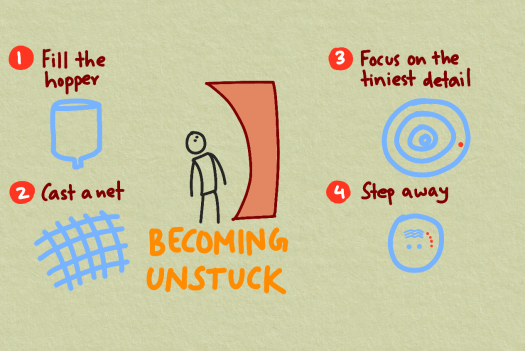
The first thing I should have done is kept the hopper full. The hopper is the collection of jottings, the notes from the day. The things you noticed, the things that stood out, the things that made you stop.

And the hopper doesn’t need to be that full. Say you write once a day, like I do, all you need is two or three ideas in the hopper and you’re sorted.

If it stood out in the first place, it’s probably a good one – good enough to get a first draft out anyway.

You’d look around for inspiration – go wide

We’re surrounded by stuff that could inspire us. All you have to do is pick up a book, or do a search and see what else is out there. The chances are that something will catch your eye.

The trick is taking an idea and making it your own. It’s not enough just to copy something that someone else has done. That’s no use.

Instead, it fusing a few ideas together and coming up with a new one that creates something interesting.

Still stuck? Focus – go deep

Robert Pirsig, in Zen and the Art of Motorcycle Maintenance tells the story of a student who came to him, wanting to write a 500 word essay about the United States.

He had a sinking feeling, and told her that might be too much – to focus instead on their town.

She came back and was still struggling. Narrow it down, he said, to the main street of the town.

Still no joy – she couldn’t think what to write.

He was furious now, she just wasn’t looking.

“Narrow it down to the front of one building on the main street”, he said, “Start with the upper left hand brick“.

She came back with 5,000 words.

Narrowing it down and starting with the smallest detail had finally unlocked it for her.

Finally, step away – but only when your forehead starts to bleed

Much advice on becoming unstuck says to take a break – but when is the right time?

Not straight away. Not right at the beginning.

First – spend some time just staring at the screen. Focusing. Willing yourself to have an idea.

Just sitting.

Why is that important?

Because what you’re trying to do is get your mind to move, like a stuck screw. And like that screw, you can’t just try once and walk away. You need to try it every way, apply some pressure, hammer it, scream a little – try until you’re exhausted and can’t do any more.

Then you walk away.

Then… you’re brain does its magic thing and moves and unlocks. When you come back, it happens – the screw turns and the ideas come pouring out.

And when all else fails?

The one thing you need to do to make a plan successful

godfather-scene.png

Coming up with a plan is simple, isn’t it?

Make a list of steps, work on them, think about them, tune them and act on them.

Once that’s done, we’re done and can get on with life as usual. Success is bound to come, isn’t it?

What do you think is missing from this process?

Imagine the last strategy session you were part of. The chances are that a bunch of people got in a room – minds on the things that they were working on earlier.

There is an agenda – everyone gets ready to go through it. Someone manages the discussion. Everyone gets a say. And the hours pass by.

Ideas go on the flipchart – mindmaps sprout with lines weaving across the page. Everyone is watching the MIPITR – and it’s not you.

The MIPTR is the Most Important Person In The Room. That person has power. What they say goes. So, everyone watches the MIPTR and says the right things to stay on the right side.

That’s not fair. Some people don’t. Some people have the guts to stand up and say what they think. They make good points that go on the flipchart and everyone nods, and some people hate them for being so brave.

The day goes by. In the last hour, someone starts to work through the actions and put together a list. The hard work of planning is over.

Then what happens? The plan gets emailed around. If it’s a very organised organisation, there are regular catch up meetings. Everyone makes sure they’ve got no unfinished actions. It all looks good and on track.

The months and quarters go by. It’s Q4 – what’s happening? Has the plan been successful?

Don’t know. If there is an organisation that’s still tracking its actions and plan nine months later – it needs a medal. That’s not how things usually work. In reality, after the first couple of months, the plan is no longer top of mind, and people forgot all about it.

This is not new. Dwight D. Eisenhower talks about something he heard in the army – *plans are worthless – but planning is everything.

So, what’s the missing ingredient?

The secret is found in a scene from the Godfather. Michael and Don Corleone are going over their plans and say the following words:

VITO CORLEONE (after a long pause) I don’t know – your wife and children – are you happy with them?

MICHAEL Very happy…

VITO CORLEONE That’s good. (then) I hope you don’t mind the way I – I keep going over this Barzini business…

MICHAEL No, not at all…

VITO CORLEONE It’s an old habit. I spend my life trying not to be careless – women and children can be careless, but not men. (then) How’s your boy?

The secret is to keep going over the plans. In the open, with your team. To talk about them – remind everyone what the plan was in the first place. Tell everyone else about the plan. Tell the people working for the people in the room.

A plan on paper is worthless. Actions alone are worthless. A plan will only be successful when everyone knows what the plan is and what they need to do.

And doing that is harder than it looks. That’s because one person, usually the one who came up with the plan, is completely clear on the plan.

Everyone else is trying to catch up. Talk with them about it. Let them restate it in their own words. Let them ask questions. Listen – and tweak the words in the plan to answer those questions up front next time.

The more you talk about your plan with the people you need to execute it, the more likely it is to be successful.