How To Get Started With A Killer Presentation For A Consultative Sale

from-to-think-do-matrix.png

Tuesday, 8.54pm

Sheffield, U.K.

People don’t want quarter-inch drills. They want quarter-inch holes. – Theodore Levitt

Is the consultative selling process about persuasion?

Are you trying to bring someone round to your point of view? To get them to change their mind?

Or is it more complex than that?

Think about the last presentation you did or saw. What was it like?

The chances are that there were a fair number of slides. They went through the history of the company, what they do, how things work. Lots of stuff.

But… how much of it was useful? And did it get you to change your mind?

Well, to find out if something was useful or not, you need to start by asking what it is that you want in the first place.

I’m betting you haven’t really set that out. After all, who sits through a presentation if they already know what they want. You’re there to learn and see and make up your own mind.

Ah… there is a clue. What you want is to be able to make up your own mind. To make an informed decision.

I think that’s the point of a consultative sale. It’s not really about persuasion. It’s about informed decision making.

But what does that mean. How do you make an informed decision?

Well, an informed decision is not necessarily right or wrong. We usually can’t tell whether something will work out or not in advance. What we’re tying to do is arrange the facts we have in a way that makes sense – and tells a story that we’re comfortable with.

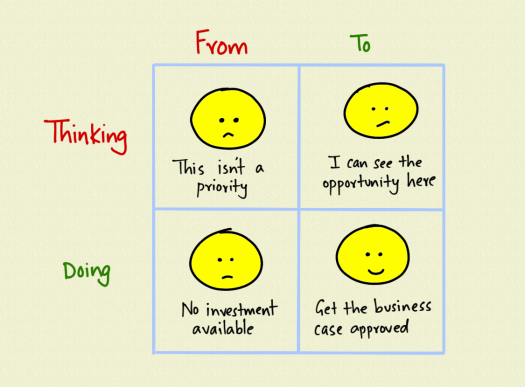
There are very few good books on creating good business presentations. Dr Andrew Abela’s is one. He is the author of Advanced Presentations By Design and has a free ebook on his site, where the matrix above comes from.

In any presentation situation, you need to figure out what you’re trying to get from the audience. What’s the result you want? What’s the end game?

Let’s say you’re trying to pitch your consulting service which helps companies design and deliver webinars to help with brand awareness and lead generation.

You know all about why companies should use this approach. For you, it’s a no-brainer and it’s hard to believe it when a prospect just doesn’t get it and why it’s worth the money.

That’s frustrating.

Can you do anything about it? Can you create a pitch that will help people understand why this is such a great thing?

The answer to that is yes – and it starts by working your way through the matrix.

Think of a prospect that you’re trying to sell to right now. Perhaps it’s the owner of an office furniture provider. Someone that supplies desks and drawers and chairs to companies. Let’s assume it’s a “he” and has been in the business thirty odd years.

This person is not going to take to your product naturally. Perhaps he’s never been on a webinar himself. Maybe he knows what one is, but thinks it’s something only new high-tech businesses do. Not something for him.

What he’s thinking right now is that what you’re selling isn’t a priority. He doesn’t need it and can get along quite happily without it.

He’s even made the decision already as he’s listening to you – this isn’t something for him. There is no investment available.

So, what you’re using the matrix to work out is what he is thinking and doing right now. That gives you a clear understanding of where he stands on the issue.

If you just try and close for the order the chances are you’ll get a no. Or be thrown out. Depends how much patience he still has left.

Before you can go for the close, you need to get him to see the opportunity that’s out there. The one that he’s missing out on.

You need to take him from thinking this isn’t a priority to thinking that he can see what’s in it for him.

When he can see what’s in it for him, then he’s going to be more open to the idea that this is worth investing in.

And that might get him to open up his wallet. To ask you what he needs to do to sign up and buy what you have.

The starting point for your presentation, then, is not the last one you did or the bunch of slides you always use.

No, the starting point is for you to work out what you want your prospect to do.

Then, you need to get clear on what he’s thinking and doing right now. You need to know that because that’s where you’re going to start. By stepping into his shoes.

Then, you’re going to take him on a journey. A journey that will end with him thinking differently about what you’re putting in front of him.

So, how are you going to take him on that journey?

You’re going to do it with a story – and that’s the focus of the next post.

Cheers,

Karthik Suresh

ps. As a reminder, this is the twelfth (or thirteenth) post in a series that I’m planning on eventually collecting into a book on Consultative Selling. If you are reading this and are interested in this topic, please let me have any feedback, good or bad, so I can make this as useful and easy to read for you as possible.

What Kind Of Business Are You In?

Monday, 9.09pm

Sheffield, U.K.

types-of-businesses.png

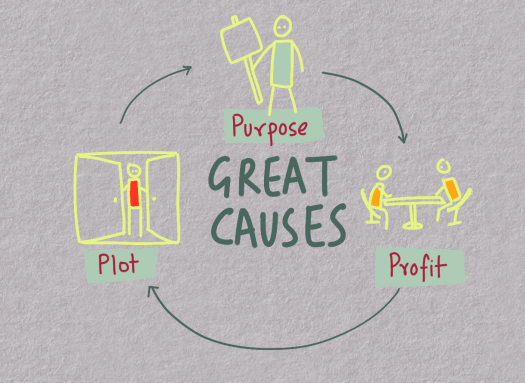
Every great cause begins as a movement, becomes a business, and eventually degenerates into a racket. – Eric Hoffer

Zig Ziglar, the motivational speaker, used to tell a story of a friend of his who was struggling to make it as a salesperson.

His friend sold cookware – pots and pans – but was finding it hard to convince his prospects to buy them. He would call on people, take them through the sales pitch but then, when it was time to ask for the order, be unable to close.

So Zig asked him a question.

Continue reading “What Kind Of Business Are You In?”

Why You Need To Focus On Serving Your Customer, Not Trapping Them

freedom.png

Sunday, 8.58pm

Sheffield, U.K.

If you’ve been following the last few posts, you’ll know that I’m pulling together some thoughts about consultative selling.

Except it’s sometimes not really about selling. And it’s sometimes not really about consulting.

It’s more about you. What you stand for. What I stand for.

Sometimes when you look at the world it’s like facing a featureless wall. A wall that you can’t scale. A wall that stops you where you stand.

Some of us don’t see things that way. They see a wall as something to be torn down. Most of us, however, keep our heads down and say nothing.

We get on with the important stuff. The really important stuff. Like raising our families and staying alive and getting ahead in the world.

We’re not activists. We’re realists. We deal with the world as it is.

Let others do all the protesting… that’s not for us.

To be fair, there does seem to be a lot of that going on.

In Copenhagen, there is a place called Christianhavn – which hosts Freetown Christiania – a little enclave of rebellion in an otherwise ordered and stylish city.

Walking around there, you see signs of entrepreneurship all around you – ranging from a blacksmith to jewellery and pottery.

And then there is the weed.

On stands made from a stack of three packing crates are plastic bags, full of weed. And people stood behind the stands. Selling.

Just like any other business…

Of course, it’s illegal and the police are in to do a raid shortly after.

The point is not really about what they’re selling – it’s about the fact that people there are making a stand for what they believe in.

And that’s the thing that’s missing from most business cases. Belief.

I’ve been reading some of Richard Stallman’s essays again. I wouldn’t be able to write these words in the way I’m doing right now without what he created.

Stallman believes that software should serve you – it should respect your freedom and community. It should be free – free as in freedom and not free as in beer.

Why does this matter?

It matters because there is always an uneasy truce between control and service. Businesses exist to serve their customers. They’d much rather control them, given a choice.

The best kind of customer is one that doesn’t have a choice. A customer that is addicted to what you provide.

Unsurprisingly, the central strategy of most companies now is to figure out how to get you addicted.

Addicted to your phone, to social media, to the software you use. To make it sticky, to make it hard for you to change or get away or do something else.

And this is where, as a consultant, you may need to decide where your loyalties lie.

Is your intention to have a captive customer base. Or is your intent to serve your customers.

If it’s the latter, then you must respect their freedom.

But how? For what?

First, just read the definition here to get started to understand what free means in the context of free software.

Then let’s think about the world of consulting for a minute.

Where do most of the ideas and concepts that are used by organisations come from?

They usually stem from the scribblings of an academic. They are created through publically funded research.

Then they’re made more lay person friendly. Sometimes they’re given names – A/B testing, Lean, Business Models.

People try and make what they have special – usually by trying to create a brand and product and set of ideas around a concept to set it apart from other concepts.

For example, I came across Edamame beans recently – exposed to the marketing push about how great it was.

I didn’t know anything about Edamame beans – I assumed they were a little known kind of vegetable, harvested at great cost and effort from the depths of some strange rainforest.

Of course, you know that they are baby soybeans. But Edamame is still a brilliant piece of marketing packaging. Still beans though, whatever you call it.

Okay.. now what if you came up with an approach, a way to solve a problem – and then made it free as in freedom.

You’d simply be following that old proverb give a man a fish and you feed him for a day; teach a man to fish and you feed him for a lifetime.

So, is my argument that your job as a consultant is not to do a job for a client but to teach him how to do it?

No. Not really.

I’m just saying that if you want to serve your customer, you’ll choose the best way to help them, whether that’s doing the work for them or teaching them how to do it.

Any way other than that – any way that doesn’t put your customer’s well-being first – is one that tries to trap them rather than serving them. The way app companies try and increase the amount of time you spend on their platforms.

And if you do that, in what way are you different from those drug dealers in the Freetown?

Cheers,

Karthik Suresh

ps. As a reminder, this is the eleventh post in a series that I’m planning on eventually collecting into a book on Consultative Selling. Although, after this post, it might go in a different direction and just be about consulting. If you are reading this and are interested in this topic, please let me have any feedback, good or bad, so I can make this as useful and easy to read for you as possible.

How To Fail At Getting Your Point Across To A Prospect

analytic-thinking.png

Saturday, 9.04pm

Sheffield, U.K.

I’ve had a few days where I haven’t been able to write, for various reasons. And that makes things difficult, because the point of a routine or habit is to keep it going. An interruption feels like going backwards, like having to start again.

But we’ve got to do that all the time. Cope with rejection, failure and disappointment and keep going. Interruptions and obstacles are simply part of the process.

So, what shall we look at today?

I’ve been thinking about communicating, about getting your point across.

If you’ve written a document trying to describe what you do, the chances are that you understand every word you’ve written, every point you’re making.

That’s because you’re familiar with everything – familiar with the terminology and jargon and customs of your field.

So what’s actually happening in your mind? What is it that is going on when you try and explain something to someone else?

One of my favourite books is Robert Pirsig’s Zen and the art of motorcycle maintenance and this explains a very important concept in a couple of pages.

Many years ago, I struggled to learn Chemistry. Years later, I found it impossible to understand electrical power systems.

To understand why, let’s see how Pirsig might teach you about a motorcycle.

To understand a motorcycle, he writes, you need to understand its components and functions.

Starting with the components, you can divide them into a power assembly and a running assembly.

The power assembly has an engine with a power train, with cylinders, pistons, connecting rods….

And so on for a page or so. Just like you’d read in a textbook about motorcycle maintenance.

Then, he stops, and explains that there are four things happening here as this description is taking place – actually five.

The first of the five, the one that will turn 98% of the people reading off, is that this is boring, boring, boring. All this talk of functions and components and whatever else. Who needs to know this stuff?

But, if you can get past this point, then there are a few other things that you don’t often pick up.

The first is that if you don’t know what a motorcycle is already, this lesson won’t help you understand what one is.

If you don’t have a picture of a motorcycle in your head – if you can’t see the things that the teacher is referring to – this description will not make the pictures pop into your head.

This is why I struggled with electrical systems. I had never seen a protective relay or seen one in action – and the description and academic discussion about it just made no sense whatsoever.

This is the same problem I have when trying to explain why I use plain text and a command line interface to manage this blog to someone whose entire experience of using a computer is on a Windows platform with a mouse.

It’s the same problem you’ll have explaining your thirty years of marine engineering experience to a graduate student doing his first procurement internship.

If your prospect doesn’t already know what you’re trying to explain, all the words in the world won’t help her get it.

You’ll need to start with words she understands already, concepts that make sense to her right now.

The second thing is that the observer – the person – disappears

Pirsig points out that many descriptions of things completely leave out any mention of people and how they relate to the thing.

Say you’re selling a software product. You might spend lots and lots of time describing all the features of the product, all the things it can do.

How often do you ask to speak with the person that will actually use your product. Or give an example of how a particular person in a different company used your product to make a difference to the way she worked?

You see this with companies all the time. They are too worried that if they inject any personality into what they do, identify any individuals, then they won’t look serious or professional enough.

As a result, they hide behind vague mission statements, promising everything to everyone and never actually clearly saying what they do.

But the fact is that you don’t do business with a company. You do business with people at that company – and the way in which you feel about the company is how you feel about the way the people in that company treat you.

One of the biggest things to remember if you’re selling to someone is to make that person the centre of your focus, not your product.

It’s not about you and your product. It’s about them and their problem.

The third thing is that value judgements disappear

When you’re talking to someone you want to make a good impression. You often want to please them, to make them happy.

The problem with this approach is that you can end up saying nothing really at all – simply agreeing with a prospect and getting forgotten by them later.

The way you stand out in any space is by taking a stand, taking a position.

And that usually means having values – having a view on what is good and what is bad.

The worst kind of place to be is neutral. Neutral means that you don’t care which approach is good or bad – you’ll just take the one that meets your targets or makes the most money or whatever else.

If you’re doing a consultative sale, however, you have a duty to help your prospect make the best decisions for him or her. And that means saying what is right and not just what is convenient.

The argument against this approach is one where you say that your job is to give the prospect all the information and her job is to make a decision.

That’s all very well. The reason you do that, however, is not because it’s a good way to be but because that way you can’t be sued if things turn out badly.

But, if the lawyers had their way, the safest thing for you to do is nothing at all – just don’t do any business and you’ll have no problems – other than the problem of paying their fee.

So… to make a real difference.. get off the fence and have a point of view.

The final thing to notice is that it’s all in your mind

All this talk of structures and components and functions is simply a creation of your mind or someone else’s mind.

It’s not reality. Reality is a collection of lumps of metal and plastic and rubber that combine to make the motorcycle.

So what came first – the motorcycle or its description?

Pirsig calls this a deadly analytic scalpel, so quick that you don’t even realise what’s happening.

It’s easy to assume that systems are fixed – they’ve always been that way.

If you’re doing sales certain methods work – the Challenger approach, the SPIN system.

What you miss is that all these structures were drawn after people saw what happened and tried to come up with a way to describe what was going in.

It’s not reality – it’s a model. It’s not even a model of reality… it’s just a model in your head.

Okay, this is getting a little abstract, so here’s the point.

Let’s take something like racism. You’d agree it’s abhorrent.

A hundred years ago, it was normal.

Seeing women as inferior to men was just the way it was not that long ago. That’s not the case now – although in certain parts of the world men are fighting to keep things the way they were.

The point is that your prospect has certain ways of thinking, certain structures already in her mind. She sees the world in a certain way and describes and justifies how she thinks.

So, if your approach or face or gender doesn’t fit the prospect’s way of thinking, you won’t succeed.

It doesn’t say anything about you… it’s just the way things are in that situation.

Which is why you should pay no attention to results or outcomes.

The only thing you can influence is process – what you do.

Whether you succeed or not, meet targets or not, is simply irrelevant.

If you focus on doing the best you can do, things will work out. And if they don’t, that doesn’t matter either.

Because all that stuff, the results, the outcome, the structure, the system – they’re all constructs in someone’s mind.

They don’t matter.

The way you live your life does.

So, in summary…

If you’re trying to get your point across to someone, start by putting her in the centre of your picture, not the product or service you’re trying to sell.

Try and see things from her point of view, ask questions that help you understand how she understands the world she’s in.

Get clear on what is good and bad – about what you do, and about how you can help.

Finally, try and work towards a common structure and model and description. Don’t try and cut and paste something you’ve done before – create something that both you and your prospect can look at and understand together.

If you can do that, have that kind of conversation, you’ll know what they need and be able to put forward a proposal and a pitch that will work for them.

One that you can win.

Cheers,

Karthik Suresh

ps. As a reminder, this is the tenth post in a series that I’m planning on eventually collecting into a book on Consultative Selling . If you are reading this and are interested in this topic, please let me have any feedback, good or bad, so I can make this as useful and easy to read for you as possible.

What Does Being Ethical Have To Do With Anything?

ethics-of-selling.png

Tuesday, 10.13pm

Sheffield, UK

No one ever admits to doing anything shady. Do you?

Yes you might just add something onto your expenses once in a while or increase your commission just before signature on the off chance that no one will notice. Perhaps you have to say that the thing you’re selling works in dusty conditions even though you know it doesn’t because you’ll be fired.

The fact is that in business you often have to bend the truth. After all, everyone is only looking to hire someone with experience, someone who has done the job several times and is also the cheapest on the market. If you’re relatively new, you might have to big yourself up, talk confidently – after all, confidence sells.

So where do you draw the line. At what point do you realise that you’re doing something that’s unethical. And does it matter?

It might seem a little strange to jump into the ethics of selling so quickly – after all you’ve just started reading this book. Surely that’s something to worry about later – after you’ve got your customers and business. Can’t you retrofit ethics into your business?

I think it’s important to start with understanding your own position on being ethical in selling, especially when it comes to consultative selling.

The aim of a consultative selling process is to help your prospect arrive at the right choice for him or her. David Maister, Robert Galford and Charles Green write about this as being a Trusted Advisor.

Trust has to be earned. As the saying goes, it takes a lifetime to build up a reputation and seconds to destroy it. The problem is that sometimes you have to make hard choices – between what you get or lose and what is the right thing to do.

Sometimes it’s the other way around. You’re doing everything right, but your client is the one that acts badly. That hurts as well. You learn not to trust people like that.

Here’s a suggestion on how to approach ethical selling.

Let’s assume you’re not in the business of outright lying – selling something you know is complete rubbish.

What you have is valuable to your customer, but also has pros and cons. What do you do in that case? More importantly, what will the salesperson you hire do?

For starters, the way they act will probably depend on the way in which you pay them. If what they make is heavily dependent on a commission on the sale, then they’ll do everything they can to flog your product, including lying through their teeth.

If they’re on a salary and don’t lose or win based on the sale, then their primary interest will be in serving the customer. They’ll probably take a more objective view.

In my experience, a pure salesperson compensated on the first basis struggles to make any sales at all. There’s a conveyor belt of them, moving from firm to firm as they come in, get all excited, make some noise, find it’s actually quite hard, then move or get pushed out.

On the other hand, quiet consultative folk, possibly the ones in charge of the business or experienced at doing the work, have one conversation, figure out what the customer needs, put in one proposal and end up getting some business.

If you run a business that is designed around a hard sell process, you’ll attract a certain kind of staff and create a certain kind of culture. The problem is that the bad will drive out the good in this situation.

What you really want is a team around you that are dedicated to serving the customer first and making money second. It may seem idealistic, but if you do good work and add genuine value, then you will be entitled to a fair share of that value you create.

If you truly create value, the compensation will follow.

It’s also important that you have a clear idea of the kind of clients you want to work with. Isn’t it better to have a small number of clients who value your advice, that you can really serve and pay attention to closely and get along with rather than a large number who don’t trust you?

As Warren Buffett says, a good rule is to only work with people you like, admire and trust.

When it comes down to it, however, there’s only one thing you need to remember to know that you’re acting ethically.

You know the golden rule – treat others in the way you would like them to treat you.

To really operate in an ethical way – follow the platinum rule. Treat others the way they would like to be treated.

Cheers,

Karthik Suresh

As a reminder, this set of posts is part of a series that I’m planning on eventually collecting into a book. If you are reading this and are interested in this topic, please let me have any feedback, good or bad, so I can make this as useful and easy to read for you as possible.

Why Should We All Learn How To Sell?

the-sales-environment.png

Sunday, 7.32pm.

Sheffield, U.K.

It’s time to try a little experiment.

I started writing this blog a little over a year ago. I didn’t really have a plan. More just a vague feeling that I wanted to write and the way to write was to get started and write.

It also took some time to figure out what I wanted to write about. Was it long detailed technical pieces about my field? Was it a short braindump every day? What form and structure and tone would be appropriate?

Well, actually, I didn’t figure any of it out. The process of writing every day meant that all those things simply emerged. And they are still emerging and developing so I’m not really sure where they will end up eventually.

There are some patterns, however, that keep repeating.

All my posts, the last few hundred anyway, start with an idea, which I draw. It might be a concept diagram, a rich picture, a graphic organiser.

They aren’t really sketchnotes – some of my early posts are – but a sketchnote is full of elements, complicated and beautiful but also hard to digest unless you’ve done it yourself.

Then, the words simply fall out of the graphic. The process of drawing the idea makes the writing much easier.

Now, after nearly 200,000 words posted (199,095 to be precise) it feels like it’s time to try something new.

Robert Pirsig, writing in Lila, says that he writes things down on little slips of paper to get them out of his mind. The act of writing down means that his mind is free to let go of those ideas. That letting go is important if you want to let new ideas in, like pouring away old tea in a cup if you want to get any more in.

That’s what this blog has felt like for the last year. A place to collect all the ideas and thoughts and things that I’ve come across that seem interesting or thought provoking or worth knowing.

Perhaps it’s time to get a little more focused.

It’s coming up to the last quarter of the year. For many of us that means looking ahead to 2019 and making plans for what we’re going to do. And a big part of that plan involves thinking about sales.

Whether you work in a company as a salesperson, run a profit centre, are expected to make rain, work as a freelancer or consultant on your own or are looking for a new job, knowing how to sell is an essential part of your role.

I’m talking about selling as one of the things you do. Not something that happens at head office in a different department. No. It starts with you. You’re at the centre of this picture that I’m looking at.

So, when you think about what selling involves, some things start to push themselves forward. There’s your customer, of course. Their business. How they make decisions. Then there is your business and your product. There’s your business and the team and network around you. Then there is your story – the story you’re going to tell to create a relationship with that customer. And then there’s the market – that big thing that acts as the backdrop to everything you do.

Many people have written about this. From academic textbooks to pop psychology, from ra-ra look at me books to biographies and how-to manuals, there’s lots out there to read and think about. So, why is it worth writing anything else about it?

It’s easy to get overwhelmed by stories of success – how someone use a particular approach to get where they are now. There’s the promise of a blueprint – do what I did and you’ll get the same results. Or there’s the fear that you’re so far behind that there’s no point in trying because you’ll never catch up.

The thing is that all these stories and ideas and concepts and blueprint are models. They describe a particular view of reality, not reality itself. They certainly don’t describe your reality, and my reality. So, it seems to me that it’s worth looking at a wide range of models and picking the ones that help us understand where we are better.

And so that’s the point of this experiment.

Over the next 30-90 days, I’m going to meander through the sales function. I’m going to try and pull together models that help explore the picture that has you and your customer at the centre. And my hope is that these models will help you and me question where we are when it comes to doing sales, and take action to improve how we do it.

What I’m also hoping is that what emerges from these posts is something of a first draft of something that will eventually become a book. Like Pirsig did with Lila. An emergent text rather than one that tries to sell a particular point of view. The kind of book I’d like to read to work out what I should be doing.

Let’s hope it works out.

Cheers,

Karthik Suresh

What Do You Need To Do To Get Extreme Success?

extreme-success.png

Saturday, 9.44pm

Sheffield, U.K.

Charlie Munger, the Vice-Chairman of Berkshire Hathaway, is well known for his views on the importance of mental models – concept that you can use to explain and understand why things happen the way they do.

Take extreme success, for example.

What is it that makes Walmart or Google so successful? And are these principles that can be used for smaller firms or even for ourselves as individuals?

Munger says extreme success is likely to happen when key factors combine in certain ways.

A. One or two factors – taken to extremes

When you think Walmart, you probably think cost. When you think Google, you think search.

These companies have taken a leadership position in a particular space – in their industry and in our minds.

If you want a prestige car, you’re going to think BMW and Mercedes first. Then there are the others.

Now, perhaps one doesn’t think of extreme success in the context of a local convenience store, but the factor that keeps them going is that they’re open late. Later than most others anyway.

So they thrive in their small niche, extremely successful in their own way.

B. Combining factors to get exponential results – the lollapalooza effect

This is the idea that 1 + 1 + 1 = 30, not 3.

Toyota have an ad out at the moment, showing a Hilux behind a glass panel and with the words in case of apocalypse, break glass.

You could argue that a Hilux gives you the ability to go anywhere and survive, has functionality that is world-class but is still something you can fix on the side of the road and is priced like a Toyota and not a Hummer.

It’s like the old joke comparing Land Rovers and Land Cruisers. If you want to go into the Australian outback, take a Land Rover. If you want to come back, take a Land Cruiser.

Scott Adams says that when he combined average skills at writing, drawing and knowledge of engineering the resulting comic, Dilbert, struck a chord with millions and took off.

It’s the combination that did it, not just any one factor.

C. Great performance over a number of factors

So here you need to look at organisations that get a lot of things right – and that’s not easy.

The more things you have to do, the more things that can go wrong.

Take Amazon, for example. It’s a company that does a ridiculous number of things – from providing a platform where you can buy almost anything to the support structures around your purchase, like recommendations and next day delivery.

Or take one of those survival watches. If you get one of them, you need to be confident that it will survive a plunge into freezing water, keep a signal going that can be picked up by satellite and looks good enough so you can wear it to an expensive fundraiser.

It’s hard to do a lot of things right. When you do, you’re going to get far.

D. Ride a wave

The final factor is that you’re lucky enough to be in the right place at the right time. Bill Gates was in the right place when IBM kickstarted the personal computer industry. Google came out with search algorithms just as the web reached the point where Yahoo’s listings couldn’t keep pace with the growth in pages.

The waves might be large, macroeconomic ones like the transition to renewable generation or the invention of the shipping container.

Or they might be small ones, like coming out with a diet that catches the eye of an influencer and spreads.

The thing with waves is that it’s hard to predict when they will turn up. You just need to get in position and, if you’re lucky, one will come along and lift you up.

So, do these apply to small businesses and individuals?

Well… as a model, perhaps we can use them and see. As George Box wrote all models are wrong, some are useful.

For example, can you be a leader in a particular factor? Cost, for example. While all your competitors do things manually, can you automate stuff so that you can be cheaper, but offer much more?

Can you put things together so that they have an exponential effect. For example, it’s incredibly hard to recruit people who can read, write and do arithmetic (to a high standard!). If you can… then there are many consulting jobs waiting for you with high salaries.

Are you a superb generalist – someone who can walk into an industry and fix everything from sales to operations to R&D. If so, perhaps that’s your edge.

And finally – have you qualified in a field whose time has come? Neuroscience, perhaps? Or big data?

What’s perhaps clear is that if you want to succeed, it’s not just about working hard.

You also need to know why you have an edge.

And then work on the things that sharpen your edge.

Cheers,

Karthik Suresh

Making Sense Of It All – Is It Even Possible?

sense-making.png

Thursday, 9.21pm

Sheffield, U.K.

Have you ever noticed that when you sit at your table and look at your glass – I mean really look at it – it turns out that it isn’t there at all?

Of course you haven’t, because glasses don’t act that way.

Electrons do.

You’ve probably heard of the Heisenberg Uncertainty Principle. It’s the idea that you can’t tell where something is and how fast it’s moving at the same time.

With an electron, if you try and look for it – that action will give it some energy, a boost, and it will end up speeding somewhere else. If you get its speed right, it will now be in a new place.

So you end up with this idea that an electron is everywhere at the same time, a sort of cloud rather than something precise.

And this is seems like a passable metaphor for society if we want to make sense of it all.

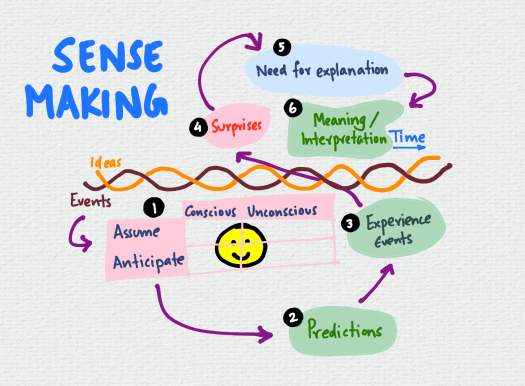
So we start with a flux of events and ideas, the braided rope of everyday life.

How do we make sense of what’s going on?

Take an approach that Meryl Louis set out in 1980.

She says that we the events we experience result in us making conscious and unconscious assumptions and anticipations.

What these let us do is make predictions.

Then… we experience events as they happen, as they unfold with time.

Some of them turn out like we predicted – but sometimes they don’t. We’re surprised.

That results in us needing to come up with an explanation – something that in turn helps us interpret and attribute meaning to the surprise we’ve just had.

Something that helps us make sense of it all.

So far so obvious – what’s the point of this all?

Well, one point is kind of screamingly obvious. All this happens in our minds. The actual flux of events and ideas doesn’t really care about any of this.

The second is that sense making is closely linked to surprise. We need to be jolted out of the everyday to see and discover something new.

Let’s say you do the same thing every day. You go to work, drive the same route, sit at the same desk, follow the same routine. How likely is it that you’ll experience something different?

Probably quite low.

It’s nice to have a simple life – one with routines. But if you’ve got too much of that, you need to get restless, a little worried, a little angsty about it all.

It’s very easy to assume that what you do is not very good, no one else will hire you, you’re not very marketable or sociable or attractive.

And if you’re in an environment (which you’ve constructed by the way with the decisions you’ve made over time) where your predictions about how things will happen come true all the time – then you’ve created a version of meaning, of sense as a result.

This can happen to individuals, to organisations, to families.

The antidote to the everyday is to get some surprise into your life.

And the thing is you don’t know where that will come from – you just need to create the opportunity for more surprises to enter your life, surprises that force you to re-examine your existing ideas and come up with new ones, ones that have a different kind of meaning.

Perhaps this needs an example. Perhaps not.

Here’s one. The fallacy of centrality.

This is the assumption that if something is important, then you’d know about it. And you don’t, so it’s not.

That leads to all kinds of problems.

Have you ever experienced a situation where someone new came in, promising to sort everything out. You put forward an idea for something that would make things better, but that person ignores you. They’ve never heard of this approach, so it clearly can’t work.

Except they then fail – and your approach works.

The problem is that the way in which they made sense of things failed when they experienced the events you did as well. Perhaps they were surprised, perhaps they learned from it. Perhaps not.

What this means for us is that the world is complex. For us to make sense of it all, we need to be alert to surprises, because that’s how we learn.

And if you’re not being surprised enough, you need to change something. Now.

Cheers,

Karthik Suresh

Why Do Some People Have All The Power?

power-structure.png

Tuesday, 6.54pm

Sheffield, U.K.

It’s easy to assume the world is the way it is and that’s how it’s going to stay.

It’s hard to imagine an alternative to the status quo. Can you imagine Google and Facebook not being as big and powerful as they are now? Doing a search on any other engine?

Logically – it’s possible, even likely. Societies change, regimes fall and companies disappear. All the time.

But, when you’re in the middle of a situation, whether personal, business or political, it’s hard to see where the change is going to come from.

Which is where power theory may help.

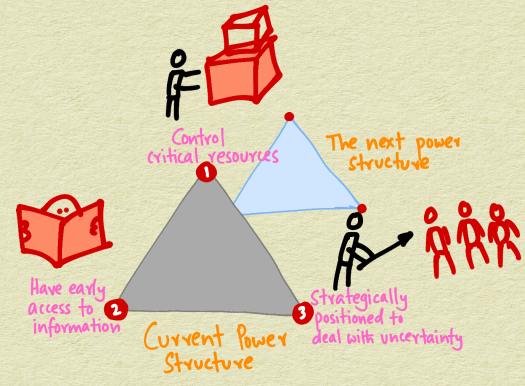
This paper by Oliver E. Williamson says that you need to have three things to grab power in an organisation:

  1. You need to control critical resources.
  2. You need to have early access to information.
  3. You need to be strategically positioned to deal with uncertainty.

Technically – he argues that the most critical part of the organisation will get these assigned to them. So, for example, if marketing is the bit of the organisation that makes the most difference, then it will be given these three things to do.

He also says that power theory is not great at explaining things – it’s a bit of a pied piper – because if you have control, why would you give it up? Why wouldn’t you stop power being taken away from you?

Now… I’m not sure I agree with his dismissal of the concept, because it seems to be useful in explaining both how things are and how they might change. Bear with me.

Let’s say you run a big car company in the US in fifties and sixties. The rest of the world has been devastated by war but the mainland US is unaffected and starts to churn out stuff for the rest of the world, supported by natural resources, a big population and abundant industrial expertise.

You’re in control. You make plenty of money. People buy your cars all around the world. Gas is cheap, so your cars are big and comfortable. You’ve got plenty of political support because of all the people you employ and the politicians you support.

You’ve also got all the statisticians and data analysts and government reports you need to see about the industry. Plenty of information on sales and resources and competitors. Nothing really gets past you.

You have a perfect power triangle – you’re in the strongest shape of your life – and it looks like nothing can ever challenge your dominance.

Until it does.

The Japanese car producers, who you’ve dismissed as makers of small, cheap, tinny cars that the American public will never buy, start to make better cars.

More importantly, however, there is a oil crisis. The Middle East creates a cartel and sends prices sky high. And suddenly all your big cars are hugely expensive to run, you don’t know how to make small economical cars and the Japanese have an opening – and people start to try their cars and like them.

Your problem is that you weren’t strategically positioned to deal with this kind of uncertainty.

And that’s because it’s really hard to predict such a dramatic shift in circumstances, especially when things are going so well.

Let’s take another example.

Microsoft was unchallenged in the PC operating system world. It ran most machines. The rest hardly made an impact.

The thing that they weren’t strategically positioned for was the Internet – and that let Google in.

What this shows us is that power is temporary – it’s a function of control, information and positioning.

At a point in time.

There’s no point in controlling critical resources if they become irrelevant. Just ask the coal industry as it wilts in the face of renewables.

There’s no point in having early access to information, for example through leaks from the government, when the Internet doesn’t give a hoot what politicians think and lets anyone talk to anyone else in the world.

And there’s no point being positioned behind a big wall if there’s a big tunnel forming right under it.

However fixed something seems to be, however powerful the current people in charge appear to be, there’s another power structure forming behind them, invisible to them – but getting ready to replace them.

Let’s hope it’s a better one.

Cheers,

Karthik

What Does It Mean To Be A Consultant Or Real-Life Researcher?

action-research-human-situations.png

Sunday, 6.13pm

Sheffield, U.K

There’s a story about how a Japanese company invented the first bread maker that you could use at home to make one loaf at a time.

No one had managed to create one so far. The way in which bread was kneaded by human hands seemed impossible to replicate with a machine. Perhaps it was just impossible.

So, one of the engineers at the company went to work for a bread maker for several months. He learned how to make bread and spent his time learning all the steps – the mixing, the kneading, the rising and everything else that goes into making the perfect loaf.

Then he went back and came up with a design. In the 1986, 84 years after Joseph Lee patented the first bread machine, the first bread makers for home use were released.

This little story illustrates something about how modern organisations work in real life that we often miss.

On the radio a few days back someone described how all organisations are now information processing machines. That isn’t a new concept, however. The Western approach has always seen companies as machines, as things that can be directed and programmed and controlled.

This is because of how much the scientific approach has influenced everything we see. The success of science in dissecting everything around us and explaining how things work according to laws and rules has made it the natural way to think about things.

Which is why you hear people talking about hypothesis and experiments in the context of startups and businesses. That’s straight scientific thinking. Reductionist and absolute and on a search for truth.

So, when you get consultants, especially those with a scientific or engineering background, coming into an organisation to improve things – you get a very strict, scientific approach to things.

I’m guilty of this. I saw many problems as technical ones – ones that could be solved with the right application of logic, mathematics or programming.

The thing that people like us miss is that human situations are not like scientific ones, especially stuff like physics.

The difference is that when you come up with a theory about how the earth and moon move around the sun, the sun, earth and moon don’t really give a damn what you think and don’t change how they act.

When Trump comes up with a theory about how to solve the U.S trade deficit, you get a global standoff that turns into history in the making.

The difference is what happens when people are involved.

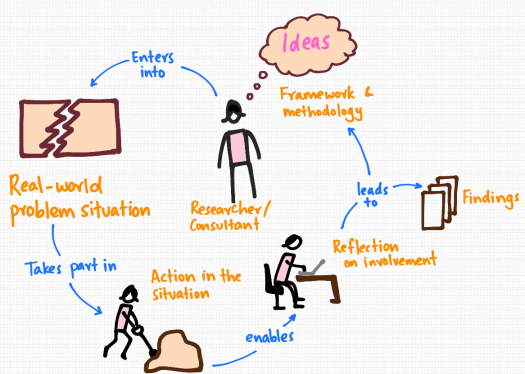
So, as a consultant, you really enter into a real world problem situation carrying some ideas you have, perhaps a framework and methodology that you think you can apply here.

Like the guy learning how to make bread, you also take part in the situation, doing things, working on things, changing things.

The difference between you and everyone else is what happens next.

This action also enables you to reflect on your involvement and learn from what is going on.

Now, you could be an armchair consultant or book writer – advising from a safe distance.

But, almost by definition, what worked for you in another situation is not going to work in this one, because the people involved are different.

You can’t step in the same stream twice.

The Japanese have a view on this – they believe that you learn through direct experience as well as from other sources – learning with your body as well as your mind.

As a consultant, you learn more through experience in the problem situation, because your reflection then lets you pull it all together, perhaps presenting your findings to the company and peers.

Importantly, it also helps you refine your own ideas, framework and methodology, giving you more that you can use the next time.

This model is adapted from Peter Checkland’s writing on action research, and is something many consultants do without realising this is what is actually happening.

Some, unfortunately, are too blinkered to realise that this is how the real world operates and instead try and ram through solutions that are based on reductionist and engineering principles.

Those people… you just have to wait for them to fail and leave.

Real change happens not just with the mind, but when you immerse yourself in reality – the reality of the company you are working with right now.

It’s about being open and prepared to learn, rather than an impartial provider of expert advice.

That’s how you’ll probably fix the real-world problem your client is facing.

Cheers,

Karthik Suresh