What Should You Pay To Get A Customer?

customer-lifetime-value.png

What is a cynic? A man who knows the price of everything, and the value of nothing. Lord Darlington in Oscar Wilde’s Lady Windermere’s Fan

How hard is to get new business?

Quite hard, I’m sure you agree.

It takes time and money to do research, send out cold emails, make cold calls and nurture relationships.

All those costs add up to quite a lot.

Many of us just see that as a fact of doing business.

Perhaps we hire salespeople and put marketing programs in place. Sometimes that works and sometimes it doesn’t – and we’re not entirely sure why.

Marketing can often feel like a bit of a punt – not a science or anything remotely predictable – despite what the experts say.

So it was interesting to learn about the idea of Customer Lifetime Value and follow the thread to see where it led.

In a nutshell Customer Lifetime Value (CLV) has to do with the profit you make from a customer over all the time they’re with you – and thinking this way means you might make different decisions about how you price and sell your product.

An early mention of CLV was in the book Database Marketing and the author, Professor Robert Shaw, castigates marketers for failing to learn key insights and, just not use maths very well.

Now, one of the things is that the maths is probably harder than it needs to be.

For example, A 1998 paper by Paul Berger and Nada Nasr shows you how to calculate CLV in a number of cases.

The definition of CLV is the discounted net profit you get per customer.

That should turn most people off at this point.

If it doesn’t the series formula that follows will.

But it’s not that hard actually.

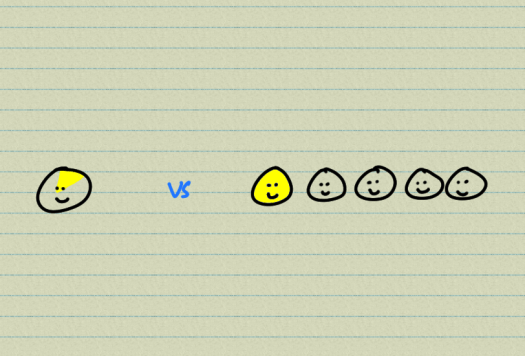
Let’s say a customer spends $100 with you and is probably going to sign every year for the next three years you’re going to make $300 over those three years.

Now if you’re focused on just the first sale you make then you’ll see the customer as worth $100.

You’ll grudgingly give your salesperson a commission of 20%, pocketing $80.

And after you’ve paid salaries you probably won’t have much left.

If, on the other hand, you knew you were going to make three sales you could give your salesperson the entire profit on the first sale and still make money.

Even better, you could probably get better salespeople who will work just for commission because what they make is larger.

The CLV calculation changes the way you look at things – instead of having a single shot you realise that you can spend a lot more to get a customer as long as you keep them for long enough.

And really – that’s entirely in your control.

Getting them in the first place is hard and painful – they don’t know you, trust you or think they need you.

But if, once you’ve shown them what you do, they still leave then you need to get better at delivery.

But that’s something you can sort out.

There are two things here…

First, understanding CLV properly gives you new ways in which to buy customers because the prize is bigger.

And second, the price you pay will be repaid based on the value you give.

As the saying goes, price is what you pay and value is what you get.

Cheers,

Karthik Suresh

Why The Cages That Keep Us In Are First Built In Our Own Minds

gilded-cage.png

Sunday, 8.49pm

Sheffield, U.K.

They makes cages in all sizes and shapes, you know. Bank-shaped some of ’em, carpets and all. – Bert in Mary Poppins

For many of us a job started as something we fell into and then became something we started to depend on and then became something that the people around us relied on.

How about bosses?

For some business owners a sense of feeling responsible for their employees is a very real thing – something that affects how they make decisions about who to hire and keep and let go.

For other owners – perhaps not quite so much.

But what about employees? How many are loyal to the business that has put food on the table for the past several years? How many would just walk away for a little bit more?

And how many stay, afraid that they will never make as much somewhere else – afraid that they would not get another job?

We watched Mary Poppins this weekend and Dick Van Dyke as Bert said to the Banks children that the person he felt sorry for was their father – caged in that cold, heartless bank where he worked.

And, for many of us, has the modern world indeed become one of cages?

The typical day for someone working in an office is effectively a process of prisoner transfer – from vehicle to building and back again.

You might be your own prison office but the results are much the same.

You’re dragged away from your warm cosy space and transported somewhere else at a time decided by others.

There’s something vaguely uncomfortable about seeing things like that. Aren’t you there of your own free will?

You signed a contract – agreed to the corporation’s terms.

You are there in the way that you are because you chose to be.

Isn’t that right?

I’m not sure. I think the conditioning starts early.

Some people suggest it all started with the invention of modern armies that needed well trained recruits – a structure that was equally useful to create well-trained recruits for businesses.

So, is education really all about equipping people to fill jobs? To fit into the openings available out there?

By the time you emerge, blinking, out of school and university in your twenties what most of us have learned is that we need to look for a job.

It takes ten to twenty years to get good at something.

Some of us do – we get good enough to perhaps start our own businesses, create new industries.

Although that can be a whole new learning experience as many of us have never run a business before.

Others reach a plateau and watch with increasing concern as other younger, cheaper, better trained recruits look hungrily at their jobs.

So, what does all this boil down to?

Well, if you were in prison for ten years, what would you do every day?

Me – I’d read and exercise – preparing for the day when I’d get out.

I’d hope that I’d know enough and have enough health to be able to start a second life.

At the start of a working life maybe the next ten years is just a sentence you have to serve to get skills that someone else values enough to pay for.

If you haven’t got those skills then freedom is likely to be cold and miserable.

If you’re in a cage – so be it.

After that you might think about opening the door – it’s been unlocked all this time waiting for you to decide when to walk through.

The question is are you brave enough after all this time?

Cheers,

Karthik Suresh

How Do You Get So Good At Something That You Can’t Be Ignored?

deliberate-practice.png

Friday, 8.49pm

Sheffield, U.K.

It’s hard to beat a person who never gives up. – Babe Ruth

An acquaintance mentioned the other day that he had been out climbing roofs.

Roofs? Like house roofs? Who does that and why?

Not many people, it turns out. He’d been talking about cave roofs – where you climb and then hang from the roof.

Absolute madness, in my view, requiring more abs than I’ve seen in a long time.

Sheffield apparently has some of the best climbing rocks in the world. And this is the sort of thing people get good at.

And people get really good at things like climbing and sports and music – things where you can win or show how good you are.

Researchers studying such people worked out that they had something in common – they spent years and practised their skill in a way that has come to be called deliberate practice.

The way you get good is by doing practice deliberately.

As the saying goes, you don’t just go out for a walk and find yourself on top of Mount Everest.

If you practice something for long enough you’ll get good. And then you’ll hit a ceiling and really not make much more progress.

In fact, in many professions, you spend a lot of time getting to a certain standard and then stop trying – and the only way then is down.

As I read somewhere recently, you don’t rise to the level of your training. You sink to it.

So what does it mean to practice deliberately and how can you do it?

Ericsson et al tell you how in a long paper – but it boils down to three things.

  1. You need to build on existing knowledge.
  2. You need to get immediate feedback on your performance
  3. You need to put the time into trying again and again.

Seems simple – but is it easy?

If you’re on track to be an elite athlete or musician then you already know what to do.

What about the rest of us?

What if you’re trying to become a better programmer or writer or marketer or entrepreneur?

The starting point here is to realise that you’ll do better building on what you know than what you don’t.

If you never used a computer don’t expect to become a whiz at C# overnight. Or, if you’ve written an essay at school, expect to publish your best selling novel next year.

But… you can do those things as long as you climb the rungs in between on the way.

Then there is feedback.

When you watch your kids’ sports teachers do you notice that they have a game where you need to catch a ball and if you drop it you have to leave the game?

How inane is that? The kids that need to spend the most time with the ball learning how to catch it are asked to sit out while the ones who are good get to stay in and practice some more.

What you need is time – time to repeat and try again and again.

As a writer, for example, you’re advised to throw away your first million words.

Those are your learning words.

Now, I’ve not been writing that long – 445 posts, 250,000 words plus another 150,000 in warm up text. That’s 400,000 words over the last couple of years and I still feel like I’m just learning every time I start a new piece.

And I’m prepared to keep feeling that way for the next ten years because I enjoy writing and the only way to get better is to keep trying.

But you also need feedback and that’s where a coach comes in or, if you don’t have a coach, getting tools to help you coach yourself.

That’s easier in some fields. A programmer, for example, gets feedback all the time when a program doesn’t run.

But what about things like business where there are complex things you do that aren’t easily measurable?

But I suppose the point about deliberate practice is that it has nothing to do with the results of your business.

It has to do with your results.

It’s a way to work on yourself to get good at something – something that matters to you and that you care about.

And when you do that you just can’t help getting better every day.

Cheers,

Karthik Suresh

Are There Really Shortcuts In Life To Success?

short-cuts.png

Wednesday, 9.32pm

Sheffield, U.K.

It worries me that young singers think you can shortcut the training and go straight to fame and fortune, and programmes like Pop Idol have encouraged that – Lesley Garrett

I was listening to Jay Abraham’s podcast for the first time and he said something that is obvious and yet clearly not obvious at the same time.

Most businesses, he said, do exactly what other businesses like them do.

You look around and act in the way other people act.

And that’s not surprising. For years we’ve been taught to conform, to do what we are told, to say at the table until we’re finished and do our homework.

So we end up looking to those around us for confirmation that what we’re doing is right.

You see this in financial markets – most fund managers want to be in the middle of the pack. Not the best, not the worst – not an outlier.

In a Goldilocks band of not too hot and not too cold – just right where there is little chance of being blamed.

So what happens after ten, twenty years of thinking like that?

We naturally assume that the way to do it is the way others do it – the way we see it being done around us.

So we see websites that look identical, messaging that is a variation on a theme, everyone trying to stand out by doing much the same thing as everyone else.

Are there shortcuts? Perhaps you get there swinging like a gymnast, flying from bar to bar to the top in one smooth motion?

Of course, you need to be a gymnast first.

For the rest of us the stairs are the only sensible option.

So this poses a problem – how can you stand out if you play it safe?

That’s the point at which a quick response starts to falter.

Jay, for example, talks about what you could do differently. For an audience of real estate agents, for example, you could stress that your list can be found nowhere else – that you have gems that no one else will see first.

That, of course, requires you to corner a market, something which is not easy to do.

Or you could stand out because of who you become – you could wear orange like Joe Pulizzi, swear like Gary Vaynerchuck or get a job as the CEO of Microsoft.

Maybe the reality is simpler than that.

Your competitors behave in a certain way because that’s how buyers want them to act.

What they show is what the market wants – that’s why it’s there in the first place.

No one wants to hire someone with a completely different point of view.

For example, there are Government guidance documents that are plain wrong. Wrong in a way that can be proved mathematically.

But, can you convince someone with a Government job to do something differently?

The fact is people will do what they feel is the lowest risk option – not the best one, not the most exciting but the one that is safest.

We’re wired to hate risk much much more than we love opportunity.

And that’s why shortcuts don’t work.

We don’t trust them.

We value a track record, a demonstrable history of achievement and improvement.

In most things the key is little and often not a lot every once in a while.

As Longfellow remarked, people don’t get to the top “by sudden flight, but they, while their companions slept, were toiling upward in the night.”

Cheers,

Karthik Suresh

Why What You Know Can Get In The Way Of Getting It Done

spaghetti-challenge.png

Tuesday, 9.02pm

Sheffield, U.K.

To succeed in life, you need two things: ignorance and confidence. – Mark Twain

Megan McArdle, in her book The Up Side of Down: Why Failing Well Is The Key To Success, writes about the spaghetti problem – a challenge where teams are given some spaghetti and asked to build the tallest structure they can.

Things kind of work out as expected.

The engineers get it sort of right and build something that stands up.

Business students and lawyers spend all their time arguing about who is the leader and don’t actually build anything.

The ones who get it right are the kids – who crack on with it and figure it out as they go along.

Crucially – they tend to be the ones that ask for more spaghetti – and there’s nothing in the rules to stop them getting more.

They just didn’t know what everyone else assumed – that what you had was what you got.

There’s something common about many successful business people. You often wonder how they got to be so successful – and it certainly wasn’t their smarts.

Sometimes, you can talk to them and think to yourself “If you only knew how crazy an idea that was you’d never get started.”

But they don’t know. And they go right ahead and make a ton of money.

Mark Twain’s comment is tongue-in-cheek but it’s one of those comments that is also literally true.

Industries get turned upside down when someone comes along and creates a new way of doing things – something that everyone thought was impossible.

After all, people once thought there wouldn’t be a need for more than ten or so computers in the whole world.

So, should we cultivate ignorance then? Is not knowing stuff the answer to being successful?

And that’s not the case either. Those successful people are smart – but just not in the traditional way. They’re smart about people, about what sells, about what excites others. They’re smart about getting smart people to work for them.

It’s a kind of smart that’s called instinct.

When that’s paired with confidence those people go far because they’ll do whatever it takes to get the job done while the rest of us play it safe and do the sensible thing.

And there are two other things.

One is luck.

You can’t discount the effect of luck in how many things turn out.

And the second is who wants it more.

The lawyers and the business students want to lead the group.

The engineers want to figure it out.

The kids want to win.

In any situation the people who want it the most are the ones who are going to make the most of things.

So, for those of us who do not have Mark Twain’s qualities it may be useful to act as if we do – to stop letting what we know and the fears we have get in the way of what we could be.

Cheers,

Karthik Suresh

How To Avoid Having To Do Real Work

sharpening-axe.png

Monday, 9.50pm

Sheffield, U.K.

If you have any trouble sounding condescending, find a Unix user to show you how it’s done. – Scott Adams

Sometimes I feel like much of what I write is too theoretical.

It’s all very well exploring ideas but what are you actually doing?

As Jay Abraham writes, people don’t need strategies. They need solutions.

The world is full of solutions – some of them very complex and many of them solve problems that have been solved before.

Take a simple thing – managing a database.

A database, in its simplest form is like a box of index cards.

Each card is a record and you write stuff on it.

Now, you can get very excited about big, complex databases but in the Unix world a text file can be a database where you use a line for each record.

Interestingly, I strugged to find any applications that would let me create a simple personal database that I could use – for example to maintain a contact database or customer relationship management (CRM) tool.

Odd, I thought.

Back when I was young, my dad let me help him create a database for a medical conference. I can remember showing the visiting doctors their data on the screen and checking if it was right.

This was on an old IBM PC/XT using some version of dBase, I imagine.

Anyway… you wouldn’t believe how hard it is to find something that lets you manage a text file as a simple database – that lets you do the basic operations: create, read, update and delete on the files.

Now, of course you can just open the file and edit away, but that’s no fun.

So today’s diversion was to create a small crm. That’s a bit like taking time off from chopping down a tree to work on sharpening the axe.

If you’re being generous, that is.

On the other hand, it’s possibly a complete waste of time, implementing something widely available in a way no one else might ever use.

But here’s the thing.

I’ve found the Internet and the stuff other people have put out there immensely useful in all the work I do.

So, maybe sharing this bit of code, unfinished as it is, may be useful to you as well. Apologies for the formatting – tired of struggling with WordPress!

Cheers,

Karthik Suresh


#!/bin/bash
# Script to manage a simple crm
# It's going to be as terse as ed

crmfile=$1

# Setup file
if [ ! -f $crmfile ]; then
echo "Name:Company:Phone:Email:Next Action" > $crmfile
fi
while [ "$command" != "q" ]
do
read command
case $command in
q)
exit 0
;;

h)
echo "Commands"
echo "q: exit"
echo "a: add record"
echo "r: show records"
echo "e: edit record"
echo "d: delete record"
;;

a)
echo "Full name:"
read fullname
echo "Company:"
read company
echo "Phone:"
read phone
echo "email:"
read email
echo "Next action:"
read nextaction
echo "Write to file? (y/n)"
read confirm
if [ "$confirm" = y ]; then
echo $fullname":"$company":"$phone":"$email":"$nextaction >> $crmfile
fi
;;

r)
cat $crmfile | column -s":" -t | less -NS
;;

d)
echo "Line to delete?"
read line
sed -i -e $line"d" $crmfile
;;

e)
echo "Line to edit?"
read line
sed -n -e 1,$line"p" $crmfile | column -s":" -t
str=$(sed -n -e $line"p" $crmfile)
IFS=":" read -r -a NAMES <<< "$str"
fullname=${NAMES[0]}
company=${NAMES[1]}
phone=${NAMES[2]}
email=${NAMES[3]}
nextaction=${NAMES[4]}
#echo $fullname $company $phone $email $nextaction
echo "Press enter to keep existing values"
echo "Full name:"
read value
if [ "$value" != "" ]; then
fullname="$value"
fi
echo "Company:"
read value
if [ "$value" != "" ]; then
company=$value
fi
echo "Phone:"
read value
if [ "$value" != "" ]; then
phone=$value
fi
echo "email:"
read value
if [ "$value" != "" ]; then
email=$value
fi
echo "Next action:"
read value
if [ "$value" != "" ]; then
nextaction=$value
fi
echo "Write to file? (y/n)"
read confirm
string=$fullname":"$company":"$phone":"$email":"$nextaction
echo "Current entry"
if [ "$confirm" = y ]; then
ed - $crmfile <<EOF
$line
c
$string
.
w
q
EOF
fi
echo "Record changed. Press r to show"

;;
esac
done

How To Understand The Economics Of The Information Business

information-economy.png

Sunday, 9.53pm

Sheffield, U.K.

Information technology and business are becoming inextricably interwoven. I don’t think anybody can talk meaningfully about one without talking about the other. – Bill Gates

Recently a German supermarket removed all non-German products from its shelves – leaving them almost bare.

It was trying to draw attention to just how many products come from outside the country – the result of a globalised economy – and how sparse life would be if we could only have things that were made by others like us.

If you walk down any high street in the UK you’ll see a lot of stuff for sale and much of it is made in China.

You know it is, because it says so on the label.

It’s the information on the product that tells you what to think – whether you see it as an expensive high end gadget or a cheap throwaway.

If you walk through a factory it’s quite possible that you’ll see the same product going into different packaging and being sold for different prices, with one perhaps three times as much, just because of the information content on the packet.

Bill Gates was really focused on the technology part of Information Technology when he talked about its relationship with business.

But what is information doing to businesses around us and how can you make it work for you?

Information is weird – as Wikipedia explains – it’s easy to create but hard to trust. Easy to spread but hard to control.

You or I can now write what we think and publish it without needing agents, publishers, printing technology or much capital.

Whether people read what we write is a different story.

Why should anyone take anything we write more seriously than anything else that gets in front of them.

The fake news industry, with people engaged full time in creating stories with catchy headlines so they can surf the traffic monetisation wave is probably going to beat the pants off you.

Mainly because they give people what they wish was true.

Let’s say you make something using a 3-D printer – now technology that you can have at home.

If you use a set of plans provided by the manufacturer does the thing you make have value?

Could you go down to the market and sell it to someone passing by?

Probably, but not for much, as if you were able to do that others would use the same plans to try and get some of that profit you’re raking in.

So is the value in the thing you’ve made or the ideas and designs you used to make it in the first place?

The thing with ideas is that they don’t really have intrinsic value – not in the way a gold mine does.

Ideas are precious and valuable but it’s not obvious how they are economically precious and valuable.

That’s because once you’ve had an idea it costs nothing to make copies of that idea.

If you give your idea to one person, nothing stops you from giving it to someone else, or for the first person to pass it on in turn.

In fact, once the idea is out in the open, it’s quite hard to keep it secret.

Finally, you could tell someone that you have a great idea but unless you tell them the idea they have no way of telling whether you’re right or wrong.

Ideas then are great to have. When they’re expressed as books and art and music they make society better.

Imagine just how joyless your life would be if you didn’t have music and colour and books.

So, things like copyright law were created, not to protect businesses, but to give authors and artists a way to make money from their ideas.

And that’s a confusing things for businesses and people who have, for a few millenia, made their money from controlling property.

Now property is only worth what you get from the information about it.

A house in a good school area is worth more than one that is not – and you know the good schools and bad schools because of the information available to you.

You start to see the way people are dealing with this as the new titans of the information business emerge.

Tim Ferriss, for example, has written about he stopped worrying about his books being stolen and pirated and focused instead on giving his readers the best experience he could.

It just makes sense because while some people will steal your stuff it costs you nothing. It’s not like they’ve stolen your TV or car. Instead of letting that worry you focus on the tens, thousands or millions of consumers who do business with you.

The challenge for us is being able to figure out a way to work in this new economy where what you do is worth something between zero and a lot.

Cheers,

Karthik Suresh

What You Need To Do To Be Understood

windows.png

Thursday 9.00pm

Sheffield, U.K.

I’m just a soul whose intentions are good. Oh lord please don’t let me be misunderstood. – Regina Spektor

If you could look out of two windows, one dirty and one clean, which would you choose?

Communicating is hard. Even the word “communicating” is long and multi-syllabic and doesn’t really catch the essence of what we’re trying to do.

We’re trying to pour our thoughts into someone else’s mind and we spill quite a lot as we try.

Chris Anderson, the curator at TED talks, says one of the reasons they work so well is that human beings have evolved to listen to storytellers.

That person who tells you stories as you huddle around a fire, your grandmother who tells you stories as you snuggle up together, that’s what you grew up with and what your genes have learned is the way to learn.

But just as important is the fact that the storyteller and you are near each other. She can look at you and tell by how you react whether you are hearing her or not.

Writing, on the other hand, is a relatively new invention. And even if you use audio or video it’s not the same as getting feedback from wide open eyes staring at you.

So, it’s not surprising that most of what we see and read is not easy to understand.

In fact, it’s easy to misunderstand.

And it’s even easier to ignore.

Then again, it’s naive to think that you’ll get it clear the first time you try and express yourself.

Clarity is iterative. It emerges over time, like polishing a diamond.

You start with a lump and end with a sparkling gemstone.

So, how can you get better at being clear?

The first thing is to remember that using big words doesn’t mean you are having big thoughts.

Winston Churchill said shorts words are best and the old ones, when short, are best of all.

You can say a lot with small words and you will almost certainly be better understood.

Being clear is important when you want to explain what you’re thinking to someone else.

But it’s just as important that you’re clear with yourself.

It’s easy to fool yourself about what’s important, what you should focus on and what you should do next.

But the more effort you put into making it clear to yourself about what matters to you and what is the best use of your time, the more likely it is that you’ll be happy at the end of each day.

So, what should you do if you want to be understood?

Try and be clear in everything you say, write and do.

William Zinsser, the author of On Writing Well said that the secret was to get rid of clutter.

Strip every sentence of every word that has no use, that is long when it could be short or passive instead of active.

And that skill comes with practice so the time to start being clear about everything is now.

Cheers,

Karthik Suresh

How To Get Out Of Your Own Way This Year

toolbox.png

Tuesday, 9.00pm

Sheffield, U.K.

Choose your tools carefully, but not so carefully that you get uptight or spend more time at the stationery store than at your writing table. – Natalie Goldberg

Happy New Year.

The great thing about the first day of a new year is that you have a chance to change things at the same time that millions of others are planning to as well.

Clearly, not everyone is going to succeed, but that isn’t the point.

The point is that you ought to at least try.

We were watching a film the other day where a character quoted Dr Seuss, “You have a brain in your head. You have feet in your shoes. You can steer yourself any direction you choose.”

And one of the things that is either enjoyable or panic-inducing is choosing your tools.

I can spend far too much time obsessing about whether I should be doing things electronically or on paper. Whether it’s best to use a software program or code something myself. Whether a reporter’s notebook is better than a Filofax.

That’s just the way I’m wired and, quite probably, many others as well.

That’s why so many rules and resolutions and goals don’t work.

They may have worked for someone else, worked really well, but that doesn’t mean they’ll work for you.

What you need to do is figure out what will work for you and that may be getting organised or getting stuck into the first thing you see.

Trying to get it perfect often means not getting started at all.

Which brings us back to tools.

What is going to work for you this year?

One approach that works for me is to think of having lots of small tools rather than a singe big one.

Sort of like having a toolbox filled with hammers and screwdrivers instead of carrying around a single Swiss Army knife.

If you think of this like writing a computer program – you’re creating a program to follow this year.

The chances are very slim that you know exactly what program to write if you haven’t already got one in place.

So it makes sense to start with what’s important right now rather than what might be important in five years.

The more lines of code you write the more likely it is that the program will fail to run or have bugs when you do run it.

Small programs are best. And small programs that work together are even better.

So, for example, if I decided that I was going to run every day for the next year I’d probably fail in a week or less.

But, if I tried to get my 10,000 steps every day there’s a good chance I could do that and get in the odd run.

How could you combine that with better diet, more rest and better time with your family?

What could you do to make your job more interesting and work on stuff that felt like it was helping someone?

When it comes down to it we live our lives following programs – often ones that have been written for us and downloaded into our brains by parents and society.

The first step, then, to getting control of your life is to start writing your own program.

And today is a good day to get started with that.

Cheers,

Karthik Suresh

How Are You Going To See Yourself In The Year Ahead?

unique-connect.png

Sunday, 9.07pm

Sheffield, U.K.

Diversity: the art of thinking independently together. – Macolm Forbes

The last few days of the year are a good time to reflect and plan.

There’s a natural rhythm to it, just a natural time when you look back and forward and think.

And one of the things that we’re all probably more aware of has to do with diversity.

There are the struggles we have with outward diversity – the diversity that deals with gender and race and choice – but there is also the struggle for inner diversity – of knowing who you really are.

We’ve all reached wherever we are in life because of choices we made in the past.

But, what lay behind those choices? Did you make them because they felt right for you or because they felt like the right choices to make?

I’ve made many decisions because it seemed like the right thing to do – the thing that would help me fit in or do well or get ahead.

The danger with that is by trying to fit in you forget who you are.

And, at some point, it may make sense to try and rediscover yourself – and the end of one year and the start of another is not a bad time to do that.

The point I’m trying to make, I think, is that if you try and be the best at something anyone else can do you’re in for a rather stressful existence.

That’s because you’re always worried that someone else will come along, someone younger, harder working and with fewer commitments, someone cheaper – someone who can replace you.

And that’s no different for businesses. Anyone in a commodity business knows that they only way to survive is to be as efficient as possible – to sell at the lowest margin that allows you to survive.

Anything more than that requires something special – something that no one else has – a moat.

And that moat, whether you are an individual or a business has to come from something unique that only you can do.

The fact is that you have to deal with the world around you – and the world is full of different people.

But – if you try and change to fit in with those people you’ll forget who you are.

The point is about being able to communicate with others, not be like others.

Which brings us back to diversity, in thought and belief and action.

What’s unique about you is the way you think and act – and you show that by having a belief in yourself.

I think in the year ahead one of my goals is to look more widely – search out diverse thoughts and ideas – because it’s by understanding differences that we’re more likely to better understand ourselves.

Cheers,

Karthik Suresh