Customer Acquisition Strategy For Service Businesses

customer-acquisition.png

Friday, 9.25pm

Sheffield, U.K.

Touch your customer, and you’re halfway there. – Estee Lauder

I’ve been thinking about customer acquisition recently.

You know, the process by which you grow your customer list?

Now that’s easy, you might say.

You can follow AIDA – attention, interest, desire and action.

Or perhaps use SPIN selling – describe the situation, talk about the problem, work out the implications and resolve the needs.

But are those processes?

Actually, what is a process when it comes to this sort of thing?

One thing that a couple of sales experts have said to me – a decade or so apart – stick in my mind.

One said that the thing with sales is to always get to the next step.

It’s not about the win, the shower of gold, the big deal.

Instead, it’s one step at a time, just moving forward, getting agreement on the next bit.

If you’re in a hurry or looking for a quick result that can be painful – but that’s what you need to do.

The second said that you’ve got to think about connecting the dots.

What do you need to have to help move the customer along from one dot to the next?

Now those are quite similar ideas, the first looking one step ahead and the second thinking of having everything lined up so you can go through the steps.

And maybe that’s a process that customers can go through but how do you get them in the first place?

So let’s think of that specifically in the context of a service business – something where you have to sell yourself and what you do to a customer.

Now, there are people out there but is there a market?

The difference between a crowd and a market is that you have a chance of doing a transaction in a market, between you, the seller, and a buyer.

So, you should probably ask yourself a few questions about your service.

Of the people out there are there some who need your service?

If so, do they know about it.

And once they know about it, do they want it?

But that’s not really the right entry point.

What you should ask is whether anyone in the market knows about your product.

If they don’t know about it, the other two questions are irrelevant.

So, customer acquisition starts with that contact – the touch that gets them to turn and raise their eyebrows – that quizzical expression that asks who are you and what do you want?

And your customer acquisition strategies are the ways in which you get that contact with someone else – whether it’s face to face, networking, referrals, direct marketing or all the other ways of getting your message out there.

But how do you get someone to actually try out your service?

And the answer, in this day and age, seems to be that you remove all the risk that they might have.

That’s the realm of free trials, money-back-guarantees and pay later if satisfied programmes.

I guess really a customer acquisition strategy has to have two things at the very least.

You need to do things that let you have conversations with people you don’t know well so you can get to know them better.

If you want to have the conversation go well make something they need or better still, something they want.

That gets you halfway there.

And then you’ve got to make it really easy for them to try what you’re selling – at absolutely no risk of loss to them.

That’s the other half.

And perhaps, if you can see that you’re doing those two things, you’re on your way – headed in the right direction.

Cheers,

Karthik Suresh
Why I Was Wrong About Something I Thought Was Obviously Right

being-wrong.png

A long habit of not thinking a thing wrong gives it a superficial appearance of being right. – Thomas Paine

Many years ago I went to a two-day management session for young engineers.

One of the things we had to do was give a presentation on the challenges of developing a product.

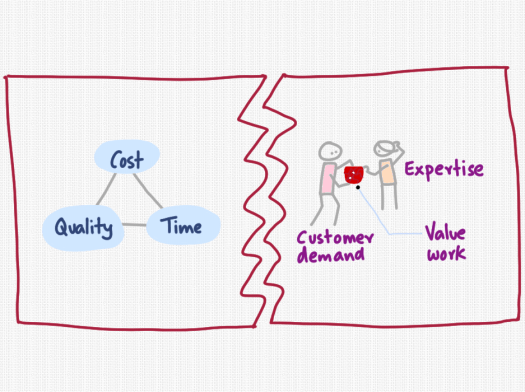
I remember that presentation – our group talked about the iron triangle of cost, quality and time.

As you will remember, if you try and improve any two the third tends to go out of control.

If you want to reduce the cost and improve the quality it inevitably takes longer.

This is not a new idea and, a few decades later, I’m still bringing it up every once in a while.

So it’s a little embarrassing to realise that I’ve been wrong all this time.

Wrong at least when it comes to applying this model to modern organisations.

I mentioned in my last post that I’d picked up a book by John Seddon and I’ve also been watching a few videos.

And what he talks about does make you question these long-held assumptions.

I suppose the iron triangle theory came out of a world focused on manufacturing and production.

At the same time, that’s old stuff really. When manufacturers started to focus on managing variation they found they could improve quality, get things out faster and keep costs down and the iron triangle was relegated to the dustbin of historical theory.

I just hadn’t received the memo.

Anyway, if you work in a service organisation, as most of us do, how should you think about service design.

Let’s take an example.

Let’s say you have a small consultancy that provides environmental consulting services.

When the volume of work coming in gets too much for you to handle you look at recruiting.

You hire an admin person, then another consultant, perhaps some graduates.

Pretty soon you have a team and it seems to make sense to start getting some specialisation going on.

That team can do ponds, for example, while the other one can do rivers and the one in the back room can do marshlands.

Pretty soon you have all these teams doing different things and if a customer comes along who has a pond, river and a marsh you get all three teams working hard on their little bits.

Things get dropped, one team’s priority is another team’s back burner work.

Things take longer, mistakes start being made and people get upset.

So you hire a manager, assure customer that you have SLAs in place, get yourself ISO 9001 certified and sit back knowing that you’ve improved the organisation.

Except, the mistakes keep happening and happening and happening.

The problem is that you try and tell people what to do rather than letting them figure out how to make the customer happy.

All this structure and specialisation and job roles are about control – about you being able to create a system you can control.

But an organisation is not like a car with pedals and a steering wheel – it’s a system that responds to what’s going on outside and inside it.

And that means you need to think about designing your business differently.

What you should start with is the customer and what his or her demand is.

Take a simple example – a customer comes in to your business with a broken pot – that’s customer demand.

What that customer wants is to get the pot fixed – that’s value work.

As a business your role in this is to provide the expertise to fix that pot.

And the entire point of your organisation should be to make that happen cleanly – without making a hash of it.

You might think that it’s expensive to have the expertise there to fix the pot – surely it’s cheaper to do it with someone less expensive or outsource it to someone else?

But what ends up happening is that all those attempts to reduce cost actually end up increasing costs – through breakages and failures and misunderstandings and confusion.

The point is that you can throw away the iron triangle and be able to provide a great service, quickly and cost effectively.

But you’ll need to change the way you think about how you build your organisation – and start to think in terms of systems.

And that’s a topic for a book, not a blog post.

Cheers,

Karthik Suresh

How To Manage Your Way Into Trouble

database.png

Wednesday, 8.53pm

Sheffield, u.K.

I literally have a massive database of cat sounds. – El-P (Jaime Meline)

In my travels through old book stores I came across one titled Systems Thinking in the Public Sector by John Seddon which has the line “Keeping a database is a very inelegant way of designing a lettings service.”

So, of course, I had to buy it and find out more.

The reason for this is that all of us have at some time thought about whether we need a database.

Yes, even you…

Even a to-do list is a database – records arranged in a list for you to mark off.

This may seem like an odd thing to think about – surely it’s something that IT people worry about?

But actually, if you run a business, the choices you make about when to use a database and when not to has a real impact on customers and the viability of your business.

Seddon, in his book, uses the example of government organisations that deal with providing housing to people.

One approach you could take is that whenever a house becomes available you market it, let people apply and give it to the people who most need it.

He calls this approach elegant because it is only started when a house becomes available, people who need it right then are the only ones who respond.

The house manager and tenants don’t waste time because they both need something – a house to be let and a house to live in.

Now, what happens if you ask everyone who is interested in a house to register their interest and enter their details in a database.

Now, you start to build a list of people. Some of these might want a house at some point in the future, some need one right now, some might be trying to make sure they’re in line in case they need one.

All this information comes pouring in, so many forms containing data.

You scoop up this data and stick it in a database – and one thing happens.

Your database gets bigger and bigger.

At some point you spend more time worrying about the data in your database and managing it and sending out emails to everyone on it than you do actually helping the people stood at the door needing help finding a house right now.

Now perhaps you think it’s reasonable to make sure everyone who might have an interest in a house is informed.

But think of estate agents and how they work.

They rarely have to go out and tell all the people registered on their list about properties.

That’s because some people are always searching for houses and others aren’t.

You only want to talk to the ones that want to buy.

The implication is that in this case a database is actually going to cost you business as you stop paying attention to the customer and spend time shovelling data instead.

Now does that happen in any other field?

When you think about it you’ll see it everywhere.

It’s there are the call centres where people follow scripts and take details and don’t get anything done.

It happens at the doctor’s surgeries where the medic spends more time tapping notes into the machine than looking at or talking to the patient.

In many of these cases the right thing to do for the customer is to get rid of the database and the logging and the keyboard and spend your time instead helping them sort out whatever is bothering them.

But this is an age where the cloud holds everything and we are conditioned to believe that data in databases is the only way to manage anything.

But it’s not.

So when is it good to have a database and when is it not?

One approach is to think about whether you’re using data to pull information when you need it or using it to push information to where it isn’t needed.

For example, a good database is probably your contacts information. That’s something you’re going to draw on all the time to connect to people.

What about KPIs and budgets and targets? Should you be collecting that kind of information?

That’s when this question gets hard to answer – because it’s linked to deep assumptions we have about how to get things done.

Like the line “You can’t manage something you can’t measure.”

If you believe that then you have a deep, visceral need to collect and store data to feel like you are making the right decisions.

Others would suggest that the preoccupation with data will lead you to forget the most important person standing there.

The customer.

Cheers,

Karthik Suresh

How Can You Make What You Do Meaningful?

meaningful-work.png

Monday, 9.28pm

Sheffield, U.K.

If one wanted to crush and destroy a man entirely, to mete out to him the most terrible punishment, all one would have to do would be to make him do work that was completely and utterly devoid of usefulness and meaning. – Fyodor Dostoevsky

Dostoevsky is blunt about what happens if you are forced to do work without meaning – in the end you go mad.

But even when you have a choice how do you know that you’re doing meaningful work?

The reason I ask such a question is because of little examples that have come up in recent months.

The most recent was a trip to a well known fast food chain.

When you use their automated order placing machine it gives you a shortcut to a commonly placed order.

When you select that and mistakenly realise that it’s a large rather than regular option the interface has been designed to keep you moving forward.

What I would like to do is cancel the order and start again.

The interface choices aren’t designed to do that – they’re designed to get you to complete the order.

Now I’m sure a very well-qualified person has A/B tested that interface to death – and realised that by a simple optimisation of the words used in the menu choices on what is effectively a landing page they can close more customers who give in and just place the order.

There’s undoubtedly a statistically significant increase in orders through the use of an intentionally confusing screen.

But, is that ethical?

Is that good for the customer?

And is that meaningful work by that designer or programmer?

There are a few other such examples bothering me – including how ethical it is to manipulate people and how open you should be in your dealings with others.

Some people come down very strongly on the side of rights and morals while others are more comfortable with stretching the interpretation of morality and right to suit their pursuit of profit.

And it’s not an easy thing to take a position because logically both positions are justifiable.

Both positions have historically resulted in great good and great evil, after all.

However, if you leave the philosophy to one side and accept that there is no general answer.

What matters is what you want to do – and is there a framework that can help with that?

I found an interesting one, shown in the picture above, in a paper by Lips-Wiersma and Wright.

Their research suggests that meaning doesn’t come from just one place – instead it flows from multiple sources.

Let’s start with the job of just being yourself.

If you aren’t comfortable with who you are, with what you’re doing then you’re not going to be happy.

Many people have experienced the dissatisfaction that comes from being pressured into a high-paying career but hating every day they go to work.

And then there is the job of being with others – your family, work, friends.

Is that going well or could you do better?

When it comes to what you do day after day are you focused on yourself?

Do you climb the corporate ladder, step-by-step, always kissing up and kicking down?

Or is your job to hold the ladder and help others get on – to serve others?

Clearly, if one’s life is situated entirely in any one of the quadrants then unhappiness will generally follow.

The trick, this model suggests, is to find balance.

Balance between finding inner peace and healthy relationships.

Balance between making yourself money and being of service to humanity.

I think if that food chain asked the question at the end of its ordering process “How easy was it to order what you wanted today?” they might drop a few points on the conversion ratio but increase their customer’s happiness a little.

And maybe even make their entire operation a little more meaningful.

Small steps for large organisations – ones they should know they need to take.

Cheers,

Karthik Suresh

When Is Something Really Worth Doing?

additionality.png

Wednesday, 9.09pm

Sheffield, U.K.

Everything that I’ve learned about computers at MIT I have boiled down into three principles: Unix: You think it won’t work, but if you find the right wizard, they can make it work. Macintosh: You think it will work, but it won’t. PC/Windows: You think it won’t work, and it won’t. – Philip Greenspun

I was at the supermarket today picking up a few things and noticing the way technology had infiltrated my life.

I used the self-scan tool at the supermarket, wandering about and scanning purchases as I went and marking them as bought on the grocery list app that we use as a family.

What was interesting about that exercise was that I literally didn’t need to speak to anyone – not even my other half.

Either of us could add items to the shared list, pick them up, notify the other and get on with life.

We now have a shared stock control management system, formed by linking together these pieces of technology.

And that got me thinking about when technology is good and when it’s rubbish.

There’s a concept called additionality which in essence says what extra do you get when you do something new over what you would get anyway if you did things the same way as you’re doing right now.

And I think this is important because we can think an innovation we come up with will result in additionality but it really doesn’t.

It could make things worse, or make such a small difference that it isn’t worth doing.

And a LOT of technology results in exactly those things happening.

Take Customer Relationship Management (CRM) systems, for example.

The one thing you can guarantee when using a CRM is that the amount of time you need to get the job done will increase.

That’s because you now need to log everything you’re doing – make notes and share information. You’re adding to the work involved and what are you getting as a result?

To understand that you need to do four things.

1. Understand the outputs from the innovation

What do you get exactly from this innovation?

Is it a report or some analysis?

With my shopping example what I get is an electronic shared todo list.

The app has more features but this is the only one that we use successfully.

It’s not always clear what the outputs are from something.

Often you’re told they can be anything you want – which now needs you to know what you want – and that isn’t easy to answer either.

2. Can you measure the impact?

If the answer is yes then it’s probably quite a simple innovation.

As the saying goes not everything that matters can be measured and not everything that can be measured matters.

Be careful when you try and measure the impact of anything.

3. Are the outcomes real?

An outcome is a claim that something has improved as a result of doing something.

Let’s say sales improve as a result of implementing something new – can you be sure that there is a cause and effect link there?

On the other hand if you point to a survey that says people are happy you need to check that you aren’t seeing the Hawthorne effect in action.

This is where people who are being asked a question give you the answer they think you want to hear or show you what you’re expecting to see rather than the real thing.

4. Are you controlling for loss

With anything new the chances are that something else starts to go wrong somewhere else.

It’s the unexpected consequences of change – and that can cause all kinds of problems.

Comparing business as usual with the new thing

If all this seems negative it’s because change is not always a good thing.

New things aren’t always better and don’t always result in improved quality.

The bad effects are not always obvious.

When you’re doing something like trying out a shared shopping app the consequences of failure are low.

No one is going to get fired or divorced as a result.

When you try a major infastructure change the impact may be larger.

That doesn’t mean you shouldn’t change – it just means that you should try and get a clearer grasp of additionality – what you really get over and above what you have now.

You may worry less and sleep better when you take a rigorous approach to assessing additionality for any project.

As an aside why did I start this article with a computer quote?

If you work a lot with text, as I do, and are a committed Unix fan, all you need to produce work is a text editor and a terminal.

The application that has truly provided some additionality is Dropbox – with its ability to store files in the cloud.

Almost every other tool degrades my attempts to write.

But that’s my business as usual scenario when contemplating a change.

Your situation will vary and how you make the decision will be very different.

Which is why there is almost never one true way.

There is only the way that works for you.

And the way you choose to go as a compromise when working with others.

Cheers,

Karthik Suresh

The Truth About Divided Communities

segregation.gif

Tuesday, 9.13pm

Sheffield, U.K.

It doesn’t matter. Most things people believe about the world are lies – Olunike Adeliyi in American Gods Season 2, Ep 1: The Beguiling Man

Sometimes you hear a news item and feel a visceral sense of unease – because you know what is seen and what is unseen, but don’t know what could happen as a result.

Take the coverage of a certain politician’s claim that Oldham is a “divided society”, as different races live separately.

The comments get immense coverage – perhaps that’s the point.

Some people dislike them instantly, seeing them simply as overt racism.

Others argue about the substance and accuracy of the statements – and whether the speaker is justified in making them or not.

Either way, emotions run hot.

There are two things that are interesting about the whole concept of divided communities.

The first is that segregation almost seems like a default mode of operation.

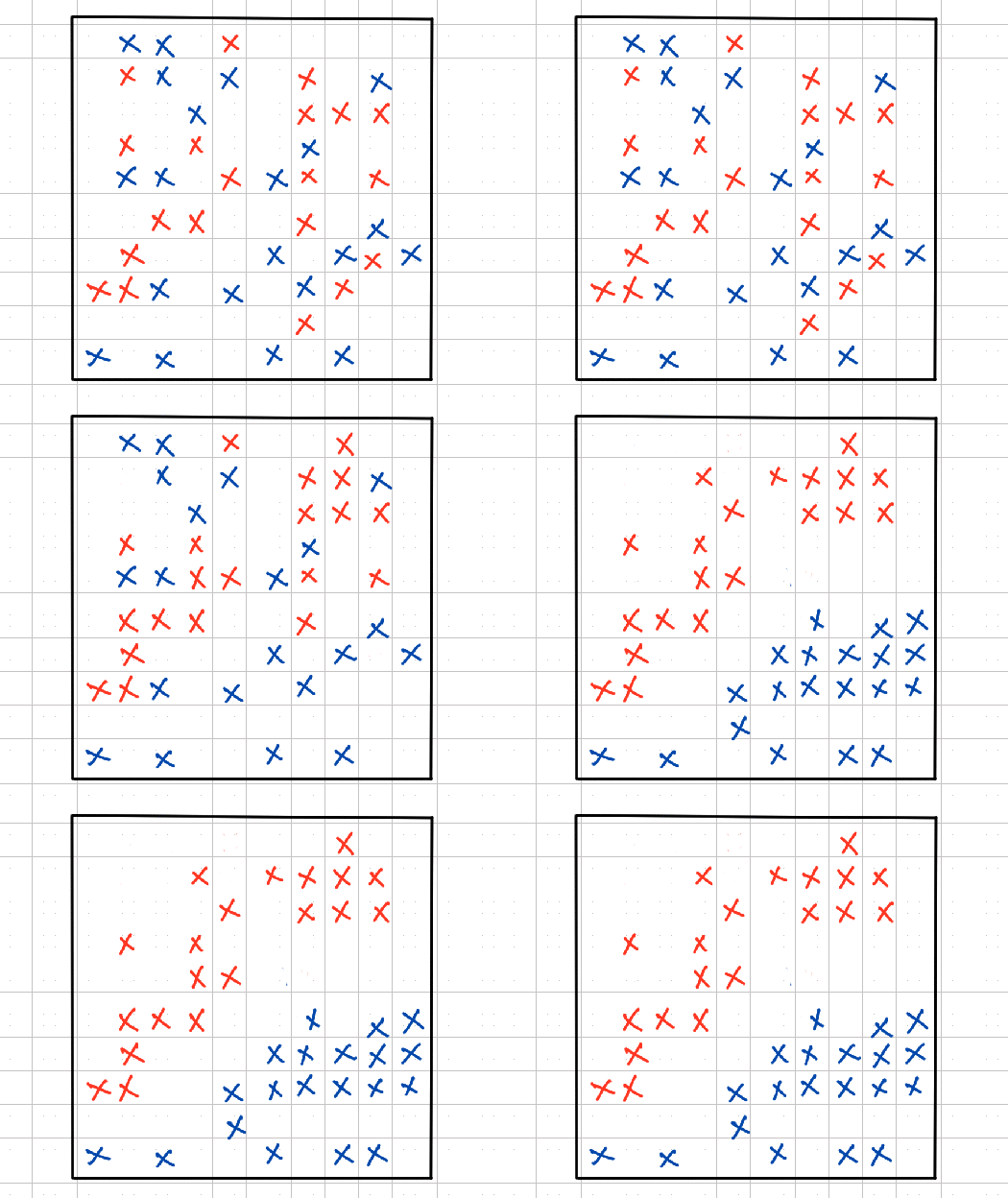
The Shelling Model Of Segregation shows how simple rules can result in a segregated society.

Take the animation above, for example.

You have red people and blue people.

Red people are happy when they’re mostly surrounded by red people and blue people are happy when mostly surrounded by blue.

Say you place red and blue people randomly on a grid.

You then play a repeated game with a simple rule.

If a red person has too many blue people around, then they can move to a square nearer red people and vice versa.

What happens if you do that?

Within a few turns you find divided communities as people migrate to be closer to people like them.

What this model says is that it takes effort to integrate – to have people of different types living together.

If a politician points to that division as a problem – that then is a problem of a lack of effort of the system to encourage integration.

Which in turn is the fault of the politicians – not the people that make individual decisions to keep their families in familiar and safe situations.

But which politician cares about the maths of the situation – they’re more interested in the votes of the people that matter.

Their audience.

Which takes us to the second point.

The sketchnote below is from a talk George Monbiot gave in 2014.

Monbiot-lecture-29-April-2014.png

The important message is in the bottom right.

Let’s say you think the politician and his supporters are wrong.

How do you convince them of that?

The answer is you don’t.

You follow a three step process:

  1. Equip, resource and organise your followers.
  2. Win the undecided.
  3. Ignore the opposition, don’t appease them.

That’s something a particular breed of vitriolic and xenophobic politician understands well.

They feed on fear and mistrust and speak only to those that believe what they peddle.

You’re not going to change that.

The opposition need to get better at playing the same game.

And one can only hope that more people get to know the truth.

Cheers,

Karthik Suresh

How To Construct Scenarios That Help You Change For The Better

possible-futures.png

Monday, 9.01pm

Sheffield, U.K.

The future depends on what you do today. – Mahatma Gandhi

I learned a way to create maps of possible futures today.

It goes something like this.

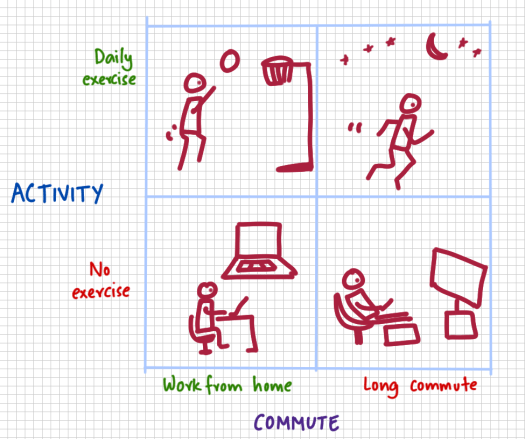
Pick two unrelated concepts.

Put them on each axis of a two by two matrix and select extreme ranges for each concept.

For example, in the picture above I picked activity and the daily commute.

Activity ranges from no exercise to daily exercise.

And the commute ranges from working from home to a long commute to work.

When you do this the nature of scenarios falls out quite naturally.

For example, if you work from home and get no exercise, you’ll get things done but not be particularly healthy.

If you have a long commute and don’t make time to exercise, you’re probably exhausted anyway and just spend the evenings in front of the telly.

Or, if you do make time to exercise it’s when everyone else is sleeping – late at night or early in the morning.

And if you work from home and make time to exercise you’ve got more options – perhaps even the chance to play regular sports.

So how does this help?

It’s easy to spend a lot of time agonising over our lives – worrying about whether we’re getting the work done or why the pounds are piling on.

This approach is effectively a test – an attempt to vary two variables and see what the result looks like.

The thing with variables is that they can take on different values.

What happens when you vary exercise?

If you work at home right now but don’t make time to exercise then you could make the decision to do that.

Of course, it’s not quite that simple – we have to overcome quite a lot of resistance and deal with the objections and excuses that daily life gives us in abundance.

But, in theory, you could build more exercise into your life.

Ditto with the commute – you just have to be willing to put in extra effort if you want to do miles in the car and on the road.

Or, you could try varying the commute – perhaps by getting another job or negotiating some amount of remote working into your existing one.

The point is, I suppose, that you could go from where you are now to anywhere else on the grid.

You might actually be healthy and active but something’s happened this year that’s changed all that.

As I look at this model it feels a bit of a blunderbuss – an unwieldy instrument that threatens to go off in your hand.

Still, oddly you want to press the trigger to see what will happen.

It’s a way of taking a blunt machete and hacking your way through the thicket of life, creating some kind of separation between different parts.

And perhaps the point is that you go from being lost in the woods to seeing which direction you should move in, however dimly.

You can at least take a first step towards the light.

And, as the saying goes, “A journey of a thousand miles begins with a single step”

Cheers,

Karthik Suresh

How To Design Your Life And Business For Flow

flow.png

Sunday, 8.27pm

Sheffield, U.K.

I’m delighted by the velocity of money as it whistles through the windows of Lower East Side… – Allen Ginsberg

What do an old moneylending maxim in India, the bathtub metaphor, gift giving among tribal people and how you run your business have in common?

If you guessed Flow from the title of this post then you’d be right – but it’s probably not the flow you’re thinking of.

Flow has come to mean, in positive psychology, a way of being immersed in what you’re doing.

This has nothing to do with that at all. Instead, this is a more ancient concept but one that we may have forgotten to see although it exists all around us – in fact at this very moment as you’re reading these words.

Let’s start with the bathtub metaphor, using the picture above.

A bathtub is like a tank that holds water. You fill it up and let the water out again.

If you think about what’s involved you have stock – the stuff in the tank and flows – the stuff going through the pipes.

It’s all water, but when it’s in the tank it’s stock and when it’s in the pipes it’s flow.

Why does this matter?

Think of what happens if you leave water in your bathtub for a month.

It stagnates, doesn’t it? It’s not very nice after a couple of days, reeks after a week and you’ve got mould and scum in a month.

I imagine…

Now to those tribals.

I picked up a book called The Gift by Lewis Hyde which, perhaps unsurprisingly, has a chapter called A theory of gifts.

He describes how Europeans were bewildered by the Native American practice of giving visitors to a tribe a gift. For example, a ceremonial pipe.

Later, when another tribe visited there was an expectation that the gift would be passed on.

This annoyed the Europeans no end, as what they really wanted to do was send the pipe to the British Museum, to put it behind glass and have people queue up to peer at it – not give it away to someone else.

In fact, they coined the term ‘Indian Giver’ to describe this practice.

What the Europeans missed was the difference between stocks and flows.

In tribal cultures a gift is something that circulates, not something that stands still.

As Hyde quotes, “One man’s gift must not be another man’s capital”

Let’s say you wander around the world collecting artifacts and bring them home, displaying them in a room.

What happens to them?

They stagnate. They sit there, mounted on the wall or perched behind glass, stripped of productive or ceremonial use.

When they were passed from tribe to tribe they helped build relationships, cement understanding and common purpose.

Now they just are, doing nothing.

They have been turned into capital, a stock, just the same as water sitting in your tank, going nowhere.

What people need to do is open the taps, keep water and relationships fresh and flowing.

To moneylending, then. The term velocity of money, while perhaps not familiar to the moneylenders of India, is something they would understand.

Money is only useful when it circulates. When it is sent out, invested in businesses or productive activity, generates a return and is then reinvested.

The moneylenders invest in businesses, in people they know in the expectation that they will get a return which they will then reinvest in another business.

Money that sits still in a bank account earns little interest. Money under the mattress earns none. The stewards of unused wealth piled high in warehouses are called misers.

Money that stands still stagnates – just like water and just like a gift that has been stopped from circulating.

Hopefully what you’re noticing from these examples is that flow matters – it’s movement that keeps things fresh and dynamic.

So there we come to your business.

Another book I was reading talked about a large business that tried to improve its knowledge management processes.

After every engagement the participants carefully wrote up what they had learned and filed it in a digital library.

You’d think that such a bank of knowledge would be invaluable – but in reality it was hardly used.

The same issue comes up when you try and manage something like sales or account management.

If you’re the controlling sort of person you might want everyone to use a customer relationship management (CRM) system and make notes of everything they do.

But this is only going to work if there is flow – if there are other people who need that information and use the same system and find it helps them do what needs to be done.

If people are asked to use it but then the information doesn’t naturally flow through, then the knowledge system will stagnate, get clogged up and eventually stop working.

If the boss doesn’t need the system to get their job done that’s a good sign that it’s not going to work.

Finally, that note about how you’re experiencing flow right now.

When I write this blog I draw on a number of resources – articles online, books and research. I use open source tools to write and draw what I do.

If I were to use all those resources only for my own benefit – if I were to hoard what I write and try to turn it into stock – then I’m trying to turn gifts from others into stock.

When I read and write and share, instead, what I’m doing is contributing to the flow of ideas and information – like a gift.

And the point about a gift is that it is given with no expectation of a timeline when equivalent value will be returned.

It turns out that often happens – but it doesn’t have to happen.

The entire open source movement is actually founded on a theory of gifts – even if we don’t know it – and that includes the Internet and its role as the ultimate repository of knowledge.

And that means, hopefully, that the future is underpinned by the right principles and optimised for flow.

Cheers,

Karthik Suresh

p.s. Every week I’m trying to write a longer piece – something a little more structured and perhaps academic that tries to pull together theory into a useful package.

The latest piece is on reflective practice – essentially thinking a bit about what has happened so far.

Might be of interest, especially if you think of yourself as a knowledge professional.

You’ll find more of these in the articles section and hopefully the list will grow over the years.

How Do I See What You See?

collaborative-model.png

Friday, 9.58pm

Sheffield, U.K.

Since we cannot change reality, let us change the eyes which see reality. – Nikos Kazantzakis

Once upon a time things like chaos theory and complexity theory seemed very interesting.

They seemed to show so much promise at explaining the world around us.

Chaos, after all, is like the weather – made up of so many unpredictable interactions that it’s incredibly hard to predict what’s going to happen next.

But then, on the edge of chaos, you have complexity.

The space where complex behaviour emerges, like the Mandelbrot set, or like flocking behaviour from the application of simple rules.

But then you realise that such theories only explain some of the physical world around us.

They don’t explain the downright weird behaviour of people…

Or the perfectly normal behaviour of people, seen from a different point of view.

For example, when climate activists shut down London demanding the UK get rid of all carbon emissions by 2025 some people thought that was a perfectly reasonable thing to do.

Others thought it selfish and short-sighted.

Others thought the sentiment right but disagreed with the timescales.

Who is right?

What happens is that people always see things from a point of view, through a lens tinted a particular colour.

And it’s not easy to look at things from a different point of view, especially if you have emotions and identity and belief embedded in a particular one.

The only way to resolve this is through dialogue – once you have realised that you don’t think the same way and regretfully have given up on the idea of simply carting everyone who disagrees with you to a re-education camp.

We probably spend less time on learning how to better conduct dialogue than we should.

A paper by Rousseau, Billingham and Calvo-Amodio sums up the problem.

They say that if you use a term it invokes a concept in your mind – a set of related ideas.

The concept models something in the real world.

And the term refers to something in the real world.

A simple model – and according to some points of view really very wrong.

Take a term like Collaborative Conceptual Modelling (CCM), something that Barry Newell and Katrina Proust have written about.

If you read their material CCM is a way of creating models.

The real world has people stood together creating models – collaboratively conceptualising a model.

Bear with me…

The term CCM could invoke a concept of a model, as shown in the picture.

The conceptual model, however, is not a model of real life because real life is about a group of people standing together creating the conceptual model.

There is a difference.

Okay, this is pedantic, and why does it matter anyway?

It matters because the other thing that Newell came up with was the concept of a ‘Powerful Idea’.

Now, that’s a nice term.

A Powerful Idea is one that can be shared – one that brings together different viewpoint and reconciles them, creating a new, common one.

But it’s wickedly hard to do.

And really easy to get wrong.

But that shouldn’t stop us from trying – because there are a lot of areas in the world now where we’ll only make real progress through dialogue.

And so we’re going to have to try and do it better.

Cheers.

Karthik Suresh

References Rousseau, D.; Billingham, J.; Calvo-Amodio, J. Systemic Semantics: A Systems Approach to Building Ontologies and Concept Maps. Systems 2018, 6, 32.

What Is A Crucial Question To Ask If You Are A Service Provider?

customers-customer.png

Wednesday, 9.54pm

Sheffield, U.K.

The ‘U’ goes before ‘ME’ in Customer. – Janna Cachola

How many businesses can you think of that are pure product plays now?

Natural resources and commodities perhaps.

And of course all the factories pumping out things from shampoo to chocolate.

But many businesses depend on a combination of products and services and when you’re selling to someone else they might be buying your product but they’re taking your service into account as well.

Which makes it useful to study exactly what’s going on when you try and pitch your product or service to someone else.

If you make a box, for example, you could find a prospect and show off your box.

Your prospect is probably stood there with folded arms – she probably already as a box supplier and doesn’t really see what you do differently.

If your box is a service, like management consulting it’s harder to see the point of what you do.

Either she believes she doesn’t need you or already has a provider.

The mistake most people make is to focus on the features and benefits of what they’re offering.

Asked why they’re different – what’s their Unique Selling Point – they talk about their people, how nice they are and how good their product is.

Faced with objections they go on the offensive – ready to “handle” them, brush them aside, tear them down or climb over them.

And that’s irritating – like when someone uses the strategy of agreeing with everything you say so that they can then repeat what they just told you.

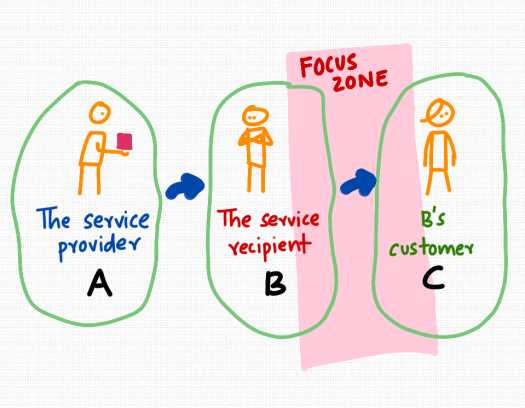
So that’s where a model like the one above, based on the one in Soft systems methodology in action, written by Peter Checkland and Jim Scholes, comes in.

Checkland and Scholes quote Richard Norman who says that the question is not “Who is my customer” but “Who is my customer’s customer”.

If you are the service provider, A, and you are trying to sell to the service recipient, B, and you focus on the transaction between A and B – there you are product in hand facing a reluctant and irritated counterpart.

Yes you could argue that they shouldn’t be like that – that they should be open to salespeople because that’s how they are introduced to opportunities – but people are people and if they don’t like being cold-called you’re not going to change their minds.

However people who don’t like being sold to open up and become much more interested when they talk about how to serve their customers better. Let’s call those folk C.

The transaction between B and C is of vital interest to B. That’s something that matters and anything that makes it better is worth considering.

So, if you want to sell B your service you need to figure out how best you can help B add value to C.

That’s your focus zone.

Now this seems, like the authors say in the book, a simple and obvious model.

But just think back of the number of times you’ve been in conversations where the focus was about A and B and C wasn’t mentioned at all.

The fact is that if you want your service to be considered your attention and the time you have with B needs to be spent on the focus zone – where you think about how the two of you (A and B) can add value to the transaction between B and C.

If you can really add value then you will find B open to the prospect of sharing value with you.

And be warned, value is not always easy to find.

Technological solutions that cut costs for B, for example, rarely raise margins. Instead the savings are passed through to C in the form of lower prices.

Good value, sustainable value comes from adding something more magical – by creating competitive advantage for B and C in some way.

But what is sustainable competitive advantage?

Well… ideas for that are going to come out of your discussions as you explore the focus zone.

But here’s a suggestion – prioritise ideas that are inimitable – hard to copy.

Because that can often be the secret to advantage – doing something no one else can.

Cheers,

Karthik Suresh