How To Focus On The Things That Are Significant

significance.png

Thursday, 9.20pm

Sheffield, U.K.

Understanding variation is the key to success in quality and business. – W. Edwards Deming

I wonder if I have stumbled on a trending genre – historical non-fiction exploring relatively recent technology.

On my reading list, for example, I have Power Play, The Hydrogen Economy and The Quest about the changing energy system, and a few others that talk about software businesses and electric vehicles.

The fast-paced narrative, investigating how these technologies are developing, make for interesting reading, but one has to question how much one can rely on such material – and whether the projections of what will happen matter or not.

Someone said that when you’re too close to events what you’re doing is journalism – reporting on what’s going on.

History requires you to take the long view – to filter out the significant from the insignificant – and that takes time.

The reason this distinction is important is because we face problems at the moment that are perhaps better solved by studying history than journalism.

Take carbon reductions, for example.

Most people agree that we need to move to a world where we put less CO2 into the atmosphere.

I learned recently that trying to do that is like trying to plug a leak in a boat – you also need to bale out the water or you’ll sink eventually as the water keeps trickling in.

We need to emit less carbon and also build the technology to suck it out of the atmosphere – but that’s a different point.

The important point is how you’re going to go about reducing your emissions.

Imagine you’re a big company and the way you operate now means you stick a whole load of carbon into the atmosphere.

You need to do things that bring that number down so what do you focus on?

There is a huge temptation to think you have to measure everything – get your information in real time and with all that information you’ll magically end up going in the right direction.

An equivalent thing here is the amount of effort going into AI research.

What everyone seems to be heading towards is making you the perfect digital assistant – an entity that can manage your schedule and order things for you – you just have to say the words.

However, do you really need a digital secretary?

Is that going to make you more productive – or is the fact that you need that kind of support a hint that your life is busier than it needs to be.

Tinkering at the surface with schedules and reminders is not the same as making deep changes at the core.

And that’s what’s needed to make a difference – whether you want to grow your business, cut emissions or lose weight – real change at the core.

And that change requires you to study history, not the ephemera and noise of right now – of social media and the 24 hour news cycle and whatever else that’s screaming for your attention.

Most of the time most things just behave the way they do because the system is the way it is.

The chart in the picture above is a control chart – a simple way of showing from the data whether something is normal or not.

If you’re inside the dashed lines that level of variation is just normal – it’s what you should expect.

Your weight should fluctuate between those lines.

Your company emissions should track between those lines.

Everything stays stable as long as the system is stable.

It’s when you go outside the lines that things start to matter.

If you go above the top line and stay there – then something has changed – and the same thing applies to the bottom line.

That’s when you should get out your ladder and go and investigate.

This simple model is the foundation of something called the mean-variance framework and it helps you distinguish between what’s important and what’s not important in almost any scenario you can think of.

And it’s not taught – or hardly taught anywhere.

If you’re interested the best book to get started is Douglas Wheeler’s Understanding Variation.

What history teaches us is that systems and technology come and go.

They’re not going to save us.

We’re going to have to do that ourselves – and that starts by learning how to think carefully about what we’re doing and if we’re doing what’s important or not.

Because some of these problems we’re facing are pretty big ones.

Cheers,

Karthik

What Is The Most Important Asset You Can Own?

customer-scenario.png

Wednesday, 9.36pm

Sheffield, U.K.

Don’t find customers for your products, find products for your customers – Seth Godin

In Hit Refresh, a glimpse into the mind of Microsoft’s CEO, Satya Nadella, we see how hard it is to reconcile old and new ways of thinking.

For centuries, millennia perhaps, power and property have been inextricably entwined.

Those with property had rights – and the rest did not.

For example, only those with land had a vote in early experiments with democracy.

As the definition of property expanded from a narrow view of land and fences to a version of the law that allowed you to own mineral rights and computer code, you started seeing the concept of capital – the idea of owning assets.

These days it’s not uncommon to think about everything in terms of who owns it.

But, at the same time, capital is starting to lose value because there is just so much of it.

Once upon a time, if you had access to capital you could build a factory, pay people a pittance and make yourself even richer.

And, perhaps as the world’s only licensed producer of wool or steam locomotives, you were able to control markets as well, dictating terms to buyers.

That sort of business still goes on but in places further away.

These days, however, almost every physical thing you buy lives two lives.

One is as a commodity, with a price effectively equal to the cost of production.

And the other is as a brand – where you pay to feel a certain way.

For example, you can get knock off headphones for Apple devices for very little money or you can pay a lot of money for the official ones.

There’s very little difference in the innards – they’re all made and glued together in the same place – possibly in the same factory.

So what makes the difference – why doesn’t everyone just buy the cheapest product?

A clue is in Nadella’s book where he tells colleagues that what they get to own is a customer scenario, not the code.

Putting aside businesses that make things – this is an insight that service businesses would do well to mull over.

In a service business you depend on a combination of people, process and technology to help your customers.

None of those things offer a sustainable competitive advantage.

The chances are that your people are just as good as everyone else – you don’t tend to find teams where one company somehow has people twice as clever as everyone else.

Having a good process is something you take for granted – if it doesn’t work the customer will let you know by taking their business elsewhere.

And technology is available everywhere – quite possibly for free.

The fact is that there is no shortage of people who can do what you want – all they ask is that you tell them exactly what you want them to do.

And if you do know what you want – then you’re in search of a commodity.

Make a list, ask people to quote and pick the cheapest quote – that’s the way to make sure you buy what you want at pretty much the cost of production.

But if you don’t know what you want – when there are a number of things floating about in your head – what you’re looking for is help turning that into a scenario.

That scenario is the thing that will solve your problem, improve your business or move in the right direction.

From a service provider’s point of view, if they can “own” that scenario they’ve got something that you’ll buy.

In theory then, owing a customer scenario is the best asset you can have – because that’s the value that the customer gets in exchange for the money they give you.

Although, now that I reflect on that, I’m not sure you can really “own” a customer scenario.

The customer owns that.

If you ask them nicely they might lend it to you – so you can show them how you’d go about solving it.

And then, if you’ve built up enough trust, they’ll consider working with you over someone else.

Maybe the real asset you should try and build is your ability to appreciate what other people want.

And then, as Zig Ziglar said, “you can have everything in life you want, if you will just help enough other people get what they want.”

Cheers,

Karthik Suresh

How To Perform Under Pressure

perform-under-pressure.png

Monday, 9.22pm

Sheffield, U.K.

Sometimes just breathing is enough. Marty Rubin

Have you ever felt the pressure to deliver – the weight that comes with expectations – from others or from yourself?

Many of us are uncertain about our ability to deliver time after time.

We’re not sure whether something is a fluke or not.

We all face situations when we’re under pressure – so what happens?

How do we react?

This is the topic Dr Alan Watkins explores in this TED talk and it’s an interesting lesson for those of us in such situations.

Imagine you need to give a talk in front of a group of people – what happens inside your body?

Well, you’re under stress. Even if in your mind you’re prepared and confident, your body is readying itself for an unnatural and unfamiliar situation, one where you’re exposed to a group of others.

The stress signals start travelling through your body, telling your brain that you’re sweating.

Your heart starts to beat faster, erratically, pumping more blood through your system.

Your brain uses goes through a lot of blood – taking in the fuel needed to keep working but when you’re in danger this blood is sent to other parts of your body – your hands, to defend yourself and your legs, to run away.

The brain compensates by shutting down parts you don’t need – like the frontal lobe where your logical and reasoning functions live.

And, like the National Grid, when it loses power, the rational part of your brain blacks out.

This is a perfectly rational response in a world where stopping to think about the kind of animal hurtling towards you, fangs bared, is going to end badly for you.

But in a world where the threat is of a mildly dissatisfied audience this response is a little extreme – but it’s how your body is wired.

So, if you want to do something about it you’ve first got to recognise the signs.

First, your heart starts going faster, your heart rate becomes variable and erratic and you find it difficult to think clearly and start to panic.

Pushing through won’t solve the problem, not will working harder or ignoring the problem or getting upset.

What will help is to breathe.

In particular, breathing slowly in and out in a rhythm.

In Watkins video he talks about breathing in for a count of four, holding for four and breathing out for six.

You’re taught something similar in yoga – breath in for four, hold for four, breathe out for eight, hold for four.

Whatever you choose, the idea is to make it smooth and repeat the pattern.

And, if you do that, you’ll start to get your heart rate acting normally again.

The point is not to bring it down, but to get the variability down – from erratically going up and down to back within a normal range – whether high or not.

As you do that, the signals will go to your brain to turn the frontal lobe back on, and you’re back in business.

So, the next time you find yourself facing something to do and feel a growing sense of panic, take a minute and breathe.

Cheers,

Karthik Suresh

Should You Make The Big Leap To A New Future?

point-of-no-return.png

Sunday, 9.15pm

Sheffield, U.K.

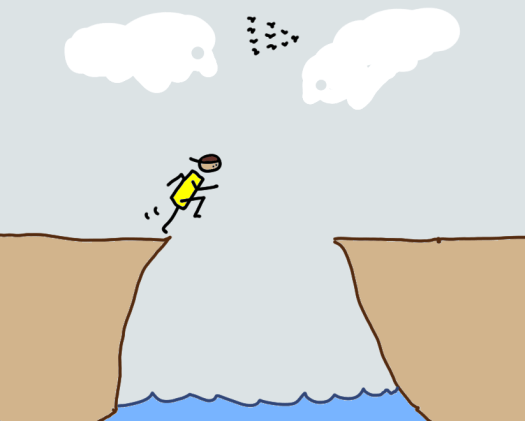
The most dangerous thing in the world is to try to leap a chasm in two jumps. – David Lloyd George

I was watching a TEDx talk by Dr Benjamin Hardy who talked about his research into wannabe entrepreneurs and actual entrepreneurs.

The one difference between the two, he said, was that the actual entrepreneurs had experienced a point of no return – something from which there was no going back, while the wannabes hadn’t.

This is an interesting concept – an appealing one and a dangerous one – a concept you should approach with caution.

On the one hand many of us are in jobs that we’d like to leave.

Maybe we want to start a new business or pursue a different career or talent, and surely it’s only by taking the decision – committing to a new way of life – that you’ll make any progress?

After all, is the only memory you want to have of your life one of regret?

So, if you’re in that situation, don’t you have to believe in yourself – believe in your ability to take the leap and get to the other side?

We read so many stories of just that happening – but at the same time we need to remember that stories are written only about those that reached the other side.

The rest fell, and were forgotten.

Survivorship bias stalks such stories.

Hardy’s research probably controls for this bias but it’s hard to imagine that there are many entrepreneurs who take part in interviews to talk about how they failed time after time.

But then there are other kinds of leaps – after all, not all leaps have to be ones that show up in dramatic announcements.

You don’t have to quit your job, move to Silicon Valley, invest all your savings or mortgage everything you own and go all in on your dream.

A leap can happen just in your mind.

In her book, Thinking in systems, Donella H. Meadows writes about an experiment she does with classes.

She takes a slinky out of a box, holds it from the top in one hand, resting it on the palm of the other.

She them takes away her hand and the free end of the slinky drops, bouncing up and down until it comes to rest.

She asks the class why the slinky behaves the way they did.

The answers come fast – “Because you took your hand away.”

She then picks up the box the slinky came in and does the same thing with that, holding it in one hand, resting it on the other.

She takes her hand away and nothing happens.

Her point is that it’s the nature of the slinky that makes it act the way it does – not the hand.

The behaviour is a property of the system – not of its environment.

And this gives us a hint off the kind of leap we need to make in our minds.

If we want to change things then we have to start by changing ourselves.

Changing things that are outside us amounts to fiddling with the environment.

If we change our jobs, locations or investments, we’ve changed the things around us but if we are no different aside we’re heading for failure – because the chasm still exists when we take the run up.

When we’re ready the chasm disappears – maybe just because we’ve now found where the bridge happens to be.

Cheers.

Karthik Suresh

How To Create Change That Can Be Sustained In An Organisation

sticky-change.png

Saturday, 9.32pm

Sheffield, U.K.

Never doubt that a small group of thoughtful, committed, citizens can change the world. Indeed, it is the only thing that ever has. – Margaret Mead

I’m reading Hit Refresh by Satya Nadella, the CEO of Microsoft, which tells the story of his journey from India to Silicon Valley and his journey to the top of the firm, becoming only the third CEO in its 40 year history.

Microsoft had been left behind – focusing on a lucrative PC business while Google took over the web, Amazon took over the cloud and Facebook took over relationships – and Nadella’s job was to figure out what needed to be done to keep the company relevant.

Imagine you had such a problem to solve – you were the Captain and had to figure out which direction to go in – where would you start?

Nadella’s approach, described in the book, offers a rare perspective – an unusual insight into the mind of a leader raised with Eastern values operating in the trenches of the West – and you get a glimpse of this in the quotes and stories he tells.

For example, he quotes Ray Ozzie, who in a leaving memo wrote “The one irrefutable truth is that in any large organization, any transformation that is to ‘stick’ must come from within.”

It may seem obvious that if you want to create a change that lasts you need to get the people in the business involved, on side and excited about what is going to happen.

Too many leaders, however, think that organisations are like armies, and they can come in, give orders and change everything.

Or, they’ll come in and fire everyone and start again.

Or they’ll come in, create incentives and prizes for performance and get results.

This kind of thinking is exemplified in the trend for incoming CEOs and managers to have a 100 day plan – what are they going to do in the first 100 days.

That approach is centered around them – their ideas – their plans. That has to do with them assuming that they know more than everyone else and will just knock heads together and make things happen.

What they should be doing in those first hundred days is listening.

Nadella says that he had a team of individuals – people that ran things that worked by themselves – in silos.

They felt they were doing fine and didn’t need him coming along and telling them what to do.

So, what did he do?

He writes that he met each leader individually, “taking their pulse, asking questions and listening.”

It would have easy to have a meeting and spend the time talking about his vision – but I imagine that even if he knew what needed to be done – the act of asking questions and listening was what made his leaders realise that he was there to work with them rather than just be the boss of them.

It’s also nice that his team realised that they had to make their cloud service, Azure, support Linux because that’s what startups use – and that’s where the big new digital businesses will come from.

One of the things that you should notice when you see how Nadella approaches change is how important it is to have people who are on the inside working on things.

That means if you’re a consultant you’re going to struggle to get your ideas accepted if you’re on the outside of the team, looking in.

You’ve got to be a participant in the process, someone who is on the same side as the organisation you’re working with.

And that’s not an easy thing to do – if you get a job there then you’re into the politics and less able to give an independent view.

If you’re too far outside you’ll never get started.

Now, there’s no clear answer to this – but there is a difference between the legal and commercial structures involved and the nature of the team.

You’ll get on the inside if you understand the world view of the people inside – if you can see what’s happening through their eyes.

Then, if you have that understanding and you can help the leader get things done, there’s a good chance you’ll be invited onto the team – and the way in which that’s done from a legal and commercial point of view will get resolved somehow.

The point is that you should see consultancy not like a doctor advising a patient, where the patient heads off to live with the disease and the doctor heads home for a glass of wine.

Instead, you should see consultancy as getting on a aircraft as part of the flight crew – with aligned interests with the crew and passengers on the importance of getting back to the ground safely.

The doctor is involved – you’re committed.

And the change you make will stick.

Cheers,

Karthik Suresh

The Right Order In Which To Think About An Important Project

what-who-how.png

I learned to go into business only with people whom I like, trust, and admire. – Warren Buffett

I was listening to a Jay Abraham podcast and one of the speakers said something – almost a throwaway line – that suddenly made sense to me in a way I hadn’t appreciated before.

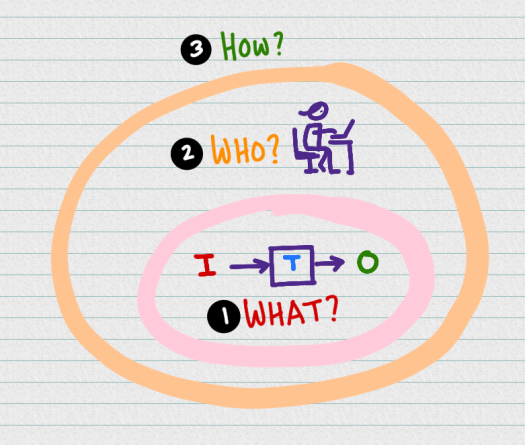
He said something like “When I’m looking at an opportunity I first want to know what needs to be done. Then I want to know who is going to do it. If I know those things then the how is easy – and I just need to find the capital to pay to get it done.”

I’ve written about this before, questioning whether Sinek’s popular model of “why, how, what” makes much sense, and wondering if it should be replaced with a different model that starts with “to what end?”

Still, looking back at this, it’s still not particularly clear what order one should follow.

So, why did this one stand out?

If you’ve read this blog for a bit you’ll be aware of my interest in Soft Systems, a methodology that helps approach “wicked” real world problems.

Wicked problems usually involve human activity systems – the kinds of things we do as a society – ranging from the complexities of government to the way in which the people in a company decides which projects they want to do.

The reason this is hard is because people have points of view – they have a perspective on a situation and express this in the form of a narrative – a story that helps them make sense of reality.

Now, if you have a story in your head about a situation – for example, if you believe that encouraging more cars on the road will add to air pollution and affect children’s health, then you are likely to oppose the building of a new school on the grounds that it will increase traffic.

The people who want to build the school will have views on how it will provide a better education for children in the area and help with regeneration.

Both are valid points of view, but that’s all they are – world views.

They just happen to be incompatible and possibly irreconcilable.

Societies have come up with ways to deal with this – using systems of planning and consultation to do or stop doing things.

The same thing happens, at a much smaller scale, when you want to work with an organisation and have to go through a sales process.

If you want to be successful when selling your services you have to start with where the customer happens to be.

If they have a need it can probably be expressed in the form of a “what” question.

What needs to happen?

Usually, some input (I) needs to go through a transformation (T) and be turned into an output (O).

What you’re describing is a system and if the system is non-human, you talk about its function and if it’s a human activity system you talk about purpose.

The purpose of Soft Systems is to understand “purpose” – it’s a strangely recursive thing, where you use a modelling language to express what’s in people’s heads – taking multiple narratives and turning them into a model that people can agree with.

What happens in practice is that the minute someone knows what needs to be done their thoughts turn to who can do it for them.

If you know that your boiler is broken, for example, isn’t the first thing you think about who you can call?

And ideally, you want to call someone you know, someone who has done work for you before and someone you can trust.

And if you call the right person they’ll know how to do the job and you’ll be fine.

The what-who-how model seems to actually represent what goes through people’s minds in practice.

If you’re selling, then, you should probably stop.

Instead, if you try to help the customer understand what they want then, when they get it, they’ll think about who can help them – and you’ll be right there in front of them, ready to offer your services.

In Jay’s podcast, they put this first bit really quite simply – you have to start with empathy for your customer.

Soft Systems is simply a rigorous way to be empathetic – to see things from the point of view of the person in front of view.

It should come as no surprise that if you have the ability to be empathetic you’ll be a better salesperson.

And you’ll also be the kind of person people want to work with again and again.

Cheers,

Karthik Suresh

Do You Ever Think About What’s In The Basement Of Your Body?

performance.png

Wednesday, 9.20pm

Sheffield, U.K.

The cause is hidden; the effect is visible to all. – Ovid

What is it that makes some people or teams deliver a result when it’s most needed while others falter and fail?

What is it about people that makes the difference between performing at your best and falling apart?

These are the questions Dr Alan Watkins talks about in a TEDx talk and it makes for an interesting listen.

He is a neuroscientist and argues that we now know a lot more about what is going on beneath the surface of our conscious minds.

Take sports, for example.

The Ashes are topical right now and the performance of the Australian batsman and former captain Steve Smith let to him being called the immovable Smith, with this write up by the BBC –

“From 17-2 in the first innings and 27-2 in the second, his fidgeting, flamboyant leaves and nudges off the pads for scores of 144 and 142 sucked the life from England – all this while dealing with constant taunting from the Edgbaston crowd in his first Test after being banned for the ball-tampering saga.”

The same game saw others collapse instead.

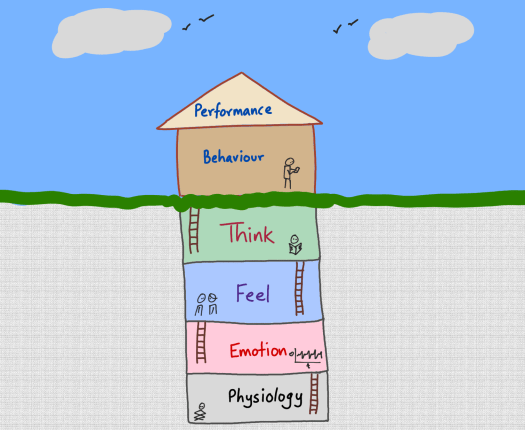
Watkins argues that what we see on the surface is performance – the results – and behaviour – what we see people do.

Many people think that by changing the way they act they will change their results.

The thing is that focusing on just what you can see is not a great plan.

Take sales, for example.

You could put in more effort, make more calls every day, keep driving yourself.

Sooner or later, however, the effort of putting in the effort will wear you out and almost every sales person starts to lose that drive they brought when they first started the job.

Watkins argues that you need to start with the lower levels of the human body and right at the bottom is physiology.

Physiology is simply the signals coming from sensors all over your body, from your heart rate to the electrical signals resulting from touching something.

Emotion, he says, is simply a collection of signals, a little like waves washing up against a beach.

The best example of this is your heart rate.

As you go through the day your heart rate changes, going up and down, responding to subtle stresses in your environment without you being aware of it.

It’s only when you become aware that you realise you have a feeling.

Feeling is all about awareness, while emotion is the swirling mess of electrical and chemical signals floating around inside you.

And then on top of all that you have your conscious mind – the space where you think and where you think everything happens.

The reality is that your thinking mind is a very small layer over everything else that’s there.

If you want to perform, Watkins says, the secret is understanding what’s going on below the surface – and then working out how to get some control over things.

What you’ve got to do is go from having lots of variance – lots of changes in your physiology – to coherence – keeping them within a manageable range.

The point really is that it’s not enough to want to do better, resolve to try harder or push yourself to work longer.

If you want to perform when it counts most you’ve got to get control over the most basic aspects of your physiology.

That means doing things like coming up with routines, forming habits, and practising self awareness – listening to what your body is trying to tell you about your state of stress or relaxation.

If you want your performance to be stable under pressure you’ve got to start by making sure the foundations are sound first.

Cheers,

Karthik Suresh

What Do People Expect To See When They See You?

genre.png

Tuesday, 9.27pm

Sheffield, U.K.

Always remember that you are absolutely unique. Just like everyone else. – Margaret Mead

I was listening to an interview on The Creative Penn and the topic of genre came up.

Genre is something I find hard to understand – and I’ve tried a few times to wrap my head around Shawn Coyne’s words on the topic and always come away with a headache instead.

So, let’s try again.

Coyne writes that “A Genre is a label that tells the reader/audience what to expect. Genres simply manage audience expectations. It’s really that simple. Don’t let the French etymology and pronunciation scare you.”

We’d all like to be appreciated for the unique person each of us is but that’s really too much to ask.

Most people don’t have the time or the interest in understanding someone else all that much.

Eleanor Roosevelt said ““You wouldn’t worry so much about what others think of you if you realized how seldom they do.”

In storytelling the point of genre is to help readers quickly select what they really want to read.

When I have some free time, for example, I read thrillers – books with action and very little real thinking.

It’s the opposite of the kind of stuff I read most of the time – and so it’s a welcome distraction.

Genre is everywhere – it’s really just a form of classification and if you want to be a member of a particular profession you need to learn the genre conventions that apply.

Not in a vague, theoretical sense but in a practical, applicable sense.

With stories, for example, Coyne talks about time, reality, content, structure and style.

Music has genres – from folk to jazz and beyond.

The hardest part for someone looking to stand apart from the crowd and be recognised for their individual and singular contribution is realising that they have to start by picking a crowd to join.

In the beginning, life is about which box you fit into.

In order to be accepted into a group you need to be similar to other members of the group.

If you’ve had the misfortune of having boxes full of microplastic beads you’ll know what happens when the colours get mixed up.

Having red pieces mixed in with the blue beads means you have to get the tweezers out and rearrange things.

It’s like that with most things in life.

You’re probably going to notice things that are out of place – and reject them.

Now – does that mean you should change the way you are to fit in?

It really depends on what you’re trying to do.

For example, if you’re starting a business it makes sense to think about whether your business model fits into a particular genre.

Some businesses are about freelancing. Others might be capital intensive or revolve around a brand identify.

The ability of a business model to deliver what you want is constrained by the characteristics of its genre.

A freelance business is unlikely to make you a millionaire while running a large corporation is unlikely to give you the time to spend six months writing a book on insect psychology.

Of course, none of this is new stuff.

I wrote a few years ago about the five ways your business can increase its earnings.

And this concept becomes really simple when you think in terms of biology.

A baby buffalo that is separated from the herd is the one the lioness takes down.

The secret to survival is to stay in the middle of the herd until you’re big and strong enough to face off a lioness.

First fit in.

Then, when you’re secure, stand out.

Cheers,

Karthik Suresh

What Does It Take To Create Something Useful AND Good?

alone-together.png

Monday, 9.55pm

Sheffield, U.K.

You must exorcise the evil proprietary operating systems from all your computers, and then install a wholly [holy] free operating system. And then you must install only free software on top of that. If you make this commitment and live by it, then you too will be a saint in the Church of Emacs, and you too may have a halo. – Richard Stallman

Do you work best alone or with others?

Do you have a point of view that is balanced or at one extreme or another?

Are you an activist or someone that just wants to get on with the day to day jobs that need to be done?

I recently found my installation disks for Red Hat GNU/Linux from 1999.

The reason we have the choice of systems and software technology that powers so much of the Internet is because of the work done by a small number of people.

And, along the way, we sometimes forget the lessons of history.

For example, if you use one of the popular Linux distributions out there now you will be interrupted by your computer asking to install updates on a regular basis.

If you use a browser from Europe almost every site will not have a pop up that attempts to comply with GDPR by asking you to click a button accepting unseen terms before you can get to the content.

I don’t know about you but I find interruptions unhelpful.

And I like coercion even less – and pop ups that demand you agree to terms before you get access to content are coercive.

So, what can you do?

The first thing is to figure out where the balance of power lies.

I was so irritated by the constant website pop ups that I turned off javascript on Chrome, the browser I use most of the time.

And something magical happened – most websites stopped hounding me for permission and just displayed content.

But Google didn’t – if you don’t turn on javascript you can’t access things like Gmail which are effectively a gigantic javascript program.

But you can enable javascript for certain sites – so that means you either turn it on because you want to or because the site is big and powerful enough to demand that you agree before it will let you interact with it.

It’s an object lesson in the balance of power.

Sometimes, as the user, you have it and at other times, the website has it all.

One way of getting back power is to retain control – to do everything yourself.

The patron saint of this movement is Richard Stallman, who has a fairly uncompromising approach to the ethics of computing.

His solution has been to use the law to protect rights – by creating software under a license that stops anyone from taking away rights from you or asking you to give them away.

The concept of free software – free as in free speech, not as in free beer – has underpinned the modern networked age.

Another individual that epitomises an individualist approach is Derek Sivers, who has been on the Internet for a while, doesn’t trust the cloud and runs his stuff on his own server.

In ages past people that wanted autonomy and control and freedom from oppression might have found it in monasteries and meditation.

These days you can have those things because other people who want the same things have helped to create tools that can help.

Other people, working in groups and organisations, in more traditional businesses have also created tools to help.

But how can you tell if the tools are good?

The simplest approach is to think in terms of utility – in terms of the benefits you get.

Many distributions of GNU/Linux focus on utility – on being useful and making things easier for you.

Platforms and services – from Facebook to Ebay exist to help people do things they never imagined they would need to do.

Isn’t that a good thing?

It probably depends on who you ask for an opinion.

I suppose you never really understand the value of freedom until you’re in a position where you’re unexpectedly deprived of it.

And that is not good.

Cheers,

Karthik Suresh

How To Become More Effective As A Group

learning-advantage.png

Sunday, 9.54pm

Sheffield, U.K.

The ability to learn faster than competitors may be the only sustainable competitive advantage. – Arie P. de Geus

I’ve just finished We do things differently by Mark Stevenson, a look at where things are going right in the world.

In one chapter called The worst school in the country we’re introduced to Carl Jarvis who turned around the school in question.

Before we look at how he did that, take a minute to consider what normally happens in organisations – the loop marked 1 in the picture above.

Leaders in an organisation start with an ambition – they want to achieve something and do well. That inevitably means coming up with activity targets – turnover and profit for the year, Ofsted results, sales calls per day and so on.

If you have more than one person doing such activities the natural next step is to compare how everyone is doing – carrying out a benchmarking exercise.

You find that some are below average and some are above average.

Oddly, it always seems to be around half on either side…

In any comparison you get winners and losers – people who do well on the metrics and people who do poorly.

Because we want people to do well we try motivational tactics – carrots such as payment of bonuses, for example.

Or we bring out the sticks and punish poor performance.

Firing the bottom 10% of the company every year used to be, and perhaps still is an approach used by some.

Either way, the winners are motivated, the losers tend to be demotivated and the net result is what shows up in the activity statistics.

The thing to notice is that winners push the numbers up by more and losers by less.

If the same people are there over time – this will end up with putting out numbers that vary within a predictable range most of the time.

In other words, you have a stable system in such an organisation – one that stays where it is but that cannot grow.

Surely you just get rid of the losers, you say – and keep the winners?

You could do that – but variation has a nasty way of evening the score – with one year’s losers going on to be next year’s best performers and vice versa.

All this work, however, misses the point.

The point of an organisation is not to create winners and losers but to get people working together well.

That’s the only reason to work with someone else – when together you can do more than either one of you could do individually.

The reality is that in most organisations you could do a lot more by yourself than working with anyone else.

And that’s a problem – because it makes a mockery of all the time we spend at work.

This is the thing that Carl Jarvis saw as he looked at his group of teachers.

Stevenson writes “Carl realised that his teachers. like many in the profession, had become atomised. They didn’t collaborate or feed back on each other’s work. They never saw each other teach. They didn’t discuss the impact they were collectively having on students and how they might work better together to improve it. In short, and with no small dose of irony, they were teachers who had stopped learning. They weren’t acting as an organisation but a set of individuals.”

Now, you can spend a lot of time thinking about what competitive advantage looks like for organisations.

The best one is actually having barriers to entry – having a monopoly on your business.

But the next best one, as in the quote that starts this post, has to do with your ability to learn.

Take the loop marked 2 in the figure, for example.

This is a thinly disguised version of Deming’s Plan, Do, Study, Act model.

Again, leaders can start with an ambition – a plan – but the next thing to do is look at what activity is actually going on.

Then, you study what you’ve found, perhaps alone but it’s better with others because you’re more likely to learn something new as you discuss things together.

Then you try doing something – taking action that might help and see the impact it has on activity and go around the loop again.

Unlike a loop that leads to motivation or demotivation – this loop leads to learning – and a learning loop is a positive one because whether things go well or badly, you have the opportunity to learn something from it.

As group participants and leaders, then, we have to let go of familiar instruments like criticism and contempt and reach for less natural ones like praise.

Stevenson writes about Carl – He spent weeks tirelessly observing and encouraging his teachers. “I told them they were all amazing, all the time. Even if the teaching I saw was terrible, I would pick on some small thing that was OK and praise it. I went over the top, but I had to, because I had to get them to believe in themselves again. I spent the first six months not in my office but in classrooms, watching things get better.”

It’s one thing saying that we need to create learning organisations – but it’s another creating them.

You’ve got to relentlessly, as the song goes, accentuate the positive.

Cheers,

Karthik Suresh