What Kind Of Working Model Makes You Most Productive?

collaborate.png

Friday, 7.53pm

Sheffield, U.K.

I like working with people. I believe change can only come through collaboration. – Alain de Botton

Quite by coincidence I’ve been watching the series “The last man in the world” at about the same time as hysteria sweeps the world about the Coronavirus.

The story, in case you aren’t familiar, is about how there is one man left on earth after a virus strikes and… well, the story goes from there.

There interesting thing about this particular virus is not that it’s spreading, but that the information about it is spreading faster than any virus before it.

We are all so connected that once the news started spreading everyone became aware and then started changing behaviour – probably hoarding and stockpiling.

In fact, the supermarkets shelves are showing gaps – and it really looks like people are panicking a little and laying down supplies.

When thing look like they’re going bad we start preparing for the inevitable fallout and all out conflict.

The fact that we regress so quickly to such behaviour tells us that flight or fight is an accurate depiction of our underlying humanity and one or brain’s biggest tasks is to override our evolutionary conditioning.

And it’s hard.

Take collaboration, for example.

You would probably agree that it’s the best way to work with someone else – to find a way to be open and honest and create value for each other.

The reality of work, however, is far from that.

All too often we have misunderstandings and power struggles, politicking and whinging.

While our brains have developed the ability to be rational when we’re in a safe space we still are some way from having the tools we need to help us work better together.

Although you could argue we’ve had them all the time – our ability to listen and talk and draw.

Collaboration is something that has to come from the lack of fear.

If you go into a meeting afraid you’re going to lose your job, afraid you’re going to lose the sale or afraid that you’re going to lose something you have then that fear will permeate everything – and it will make the other person uneasy as well.

It’s like the high pressure salesperson – you can tell desperation and it’s not nice.

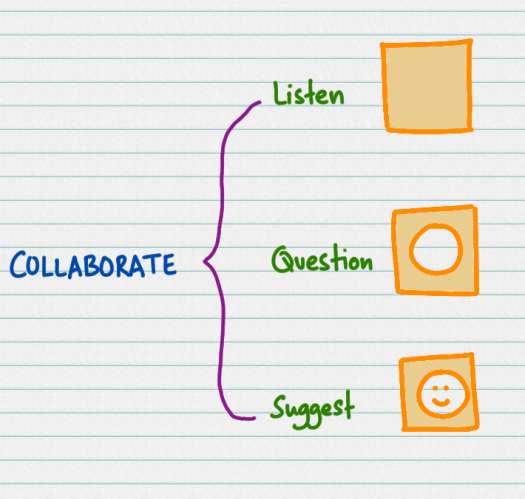
When I look at collaboration these days I think you need to get better at doing three things.

First you have to listen.

Whether it’s your kids or coworkers, whether it’s your boss or a customer, the essential skill to develop is the ability to listen.

When you listen you start to get a feeling for the shape of someone else’s thoughts – how they see the world.

To understand them better you ask questions.

Questions help you find the gaps, discover connections and see possibilities.

And then, when you’ve done those two things you can offer suggestions – possibilities for what you could do together.

And you will, in turn, hopefully be listened to and asked questions.

Just like that you’re collaborating.

Simple. Yes.

Easy. No.

But essential.

Cheers,

Karthik Suresh

What’s The One Thing You Have To Do To Succeed?

close-the-loop.png

Thursday, 8.41pm

Sheffield, U.K.

String theory is an attempt at a deeper description of nature by thinking of an elementary particle not as a little point but as a little loop of vibrating string. – Edward Witten

I know nothing about string theory but this Witten quote makes perfect sense when it comes to the basic nature of everything we do.

Think of some of the people you’ve worked with, some of the people you know.

They might be old or young, experienced or new to the world of work, different genders, races, backgrounds.

Now, what kind of impression do you get about the way in which they seem to operate?

Some might be dots or spots – contained patches of ink that encapsulate what they are.

Perhaps they’re artists or lawyers or doctors or police or firefighters – defined roles that you see in children’s books of what jobs people have.

Perhaps they see themselves the same way, as people with a singular passion or focus – either one that really does fill them up or one that they have adopted because it works for their business.

If you do a search starting with the string “I’m passionate about” you get a bunch of results that tell you how to answer that question in the context of an interview.

And that’s because when you’re really passionate about something you don’t talk about it – you just do it and talk about it – and people see how passionate you are.

So, if passion is a dot what might a line be?

A line, I think, is someone that has a job – someone that does a certain task.

They might process things, file things, analyse thing – but generally they start at one point and traverse a line and end at another point.

And a lot of people see this as a thing – if you do process maps or flows this is the kind of way you represent what’s going on – starting here and ending there.

With spots and lines you’ve probably captured the ways in which most people think about work.

But, when they actually start doing work the lines no longer seem quite that straight.

Actually where you end up seems to be related to where you started – and so you find yourself turning back and heading to where you were at the start.

For example, if you are in charge of a project and you send an email requesting information then in the world of lines you’ve done your job.

If you don’t get a response, however, you’re starting to look back at that email you sent and wondering what to do next.

Many people think that they’ve done their job – they’ve sent that email and that’s it.

If they’re asked later why things went wrong they can always say, “Well, I did my part!”

That gap – that failure to close the loop between starting something and making sure it’s finished makes the difference between success and failure in most situations I’ve seen.

You go out and meet someone and fail to connect in some way so you can follow up your discussion.

That’s often my big problem.

A bigger one, though, has to do with all those tasks where you should really chase and follow up but you just don’t.

When people succeed it seems to be because they make the effort to close that gap, to make sure they close the loop and them move on.

Now you might not do this with everything but if you do it with the important stuff then you start to create little success circles – closed loops that mean stuff gets done.

And then, if you decide that string theory is for you – you can think of those success circles as the elements of business, the elements of what you do.

Instead of seeing them as static, once done and then forgotten things, you can see them as vibrating string loops – with the energy and passion you have emerging from that work you’re doing.

And really when you get the fundamental building blocks of reality on your side is there anything you can’t achieve?

Cheers,

Karthik Suresh

What Is The Real Message Of Minimalism?

minimalism-revisited.png

Tuesday, 9.46pm

Sheffield, U.K.

Whereas a lot of Buddhism concerns itself with stages of enlightenment, various precepts and moral codes, and even power structures and hierarchies, Zen is just like, ‘Shut up, sit down, and observe your thoughts – oh, and by the way, what you perceive as you’ doesn’t actually exist.’ I loved the minimalist approach of it. – Mark Manson

I’ve been thinking a little bit about the things that matter recently – and it caused me to take another look at minimalism.

There are people for whom material things are very important – they are a symbol of status and achievement and power, or they are just things that they like to have and believe they deserve because they’ve worked hard for them.

The thing with stuff is that it weighs you down in a way that other things don’t.

Take learning the guitar, for example.

Once you’ve learned how to play the guitar that’s something you take with you – and you will always be one of those people that can sit strumming the instrument with a circle of people listening to you.

The things you learn, the skills you develop have no weight at all – they stay with you as long as you have your faculties.

So while there is no limit to what you can learn and how you can develop yourself – that’s not the case with stuff.

The more you have, more it has you – you have to deal with it and move it and clean it and maintain it and upgrade it and suddenly you spend all your time being a servant to your stuff.

Or maybe not.

So I went back online to see what people were saying and not much had changed.

One set of voices link minimalism with having less stuff – to the point where you have 100 things or less, 50 things or less.

Or you have less but better or some variation on that theme.

But it comes down to quantity and volume and generally just spending your time counting.

The other side of this coin is that you keep things that make you happy – things that spark joy according to Marie Kondo.

Which is a nice term and obvious to some and airy-fairy to others.

But you’ve got to remember that minimalism as a term probably originated in the art world – as artists tried to strip things down to the essentials – keeping only what mattered and creating sparse works.

Or, if you wanted to be more prescriptive about it limiting themselves to simple shapes and geometric patterns.

In the midst of all this you have a few furious Guardian columnists who denounce all this as a fad for the rich.

And they have a point.

There does seem to be a tendency among people to turn everything good into some kind of competition or formula.

They focus on the act rather than the intent and in doing so what they end up making are empty gestures.

And this leaves them open to accusations of being stereotypes.

For example, minimalism is a thing that men do because women are the ones that like fluffy stuff – how many men go out and buy throw cushions or whatever those things are called that litter every surface you want to sit or lie on.

It’s a form of shaming – isn’t it?

And it’s also something only rich people can choose to do – you can live without money only if you have enough.

When you don’t, life is too hard.

And all these are valid criticisms but I felt they missed the point.

Which is what?

Well… it seems to me that the only reason you would get stuff or get rid of stuff is to become free?

Free from what?

The Buddha probably got it right there.

Freedom from Suffering.

The actual word is “Duhkha” – and it’s not suffering in the sense of a wound or a sore, but the opposite of happiness or comfort.

It’s the opposite of what Pirsig terms “Peace of mind” in Zen and the art of motorcycle maintenance.

Wikipedia says the word originated as an axle hole that isn’t in the centre, and so the cart bumps along giving you an uncomfortable ride.

And how do you solve this?

By becoming more aware of yourself and what you really need.

Because that understanding is what matters – and it may or may not lead to a more minimalist lifestyle.

But it may lead to one with more “Sukha”, or happiness.

Cheers,

Karthik Suresh

5 Things You Have To Get Right To Be Successful In E-Commerce

e-commerce.png

Monday, 9.15pm

Sheffield, U.K.

Retail is a customer business. You’re trying to take care of the customer – solve something for the customer. And there’s no way to learn that in the classroom or in the corner office, or away from the customer. You’ve got to be in front of the customer. – Erik Nordstrom, President, Nordstrom Direct

I was invited to go to the Retail Without Borders conference recently where I learned much that I didn’t know about the world of e-commerce.

Or, at least, I had my eyes opened to how hard it is to do the simple stuff well.

For example, the five points in the image above are a mix of points made by different speakers – and if you are in e-commerce it’s worth checking how many of these you get right.

First, you have to start with enriched content.

That means going beyond having basic listings with text – the more useful detail you put on there the more people trust what you are selling.

Pictures help, as do videos – the trick is making sure you have as many as needed.

Then you have to make sure how have the highest retail standards possible.

This means getting your stuff out to the customer as quickly as possible – promising three days and getting it there in two, for example.

If you’re big enough then same day delivery or next day delivery helps you stand out.

Before you do that, however, you have to get payment services that work for the customer.

That means giving them options to pay – using methods like Paypal and credit cards – but also others that work in the regions you’re service.

More on that in a bit.

Now, you’ve also got to make sure that you’ve got inventory under control.

There’s few things that make customers more unhappy than finding what they’ve ordered isn’t in stock or that they have to wait twice as long.

And while we’re talking about customers make sure you have an engagement plan for them – how you talk to them and build a community of customers.

Now, if you live in a developed economy – especially the UK or US – all this seems obvious to you.

These countries lead the way when it comes to digital commerce and the services are pretty slick on each of these points.

In fact, you’ll find it hard to compete if you don’t have all these things sorted for customers in these regions.

Take payments, for example.

If you offer Paypal and credit cards then you have 100% – that’s right – the entire target population pretty much covered.

But once you go further afield it gets more complicated.

People in many countries still prefer to pay cash on delivery – COD.

They don’t trust cards or aren’t allowed to make international payments with the cards they have.

The logistics of shipping to different countries can get frighteningly complex very quickly.

Your goods can be stopped or lost at customs and there’s no way of getting them back.

And if you’re looking at non-English speaking markets then you need to think hard about localisation issues.

Are you using the language that people use – are you using the right dialect.

You can lose a lot of sales if you use only one language.

To some extent this checklist is for product sales but it works pretty much the same way for services – with the exception perhaps that your logistics gets easier if you have no inventory and can email your product.

The basic principles still apply.

But all this is really just about hygiene – about getting the basics really really right.

The thing that really matters is whether you’re giving the customer something of value.

This list helps you deliver it better.

Cheers,

Karthik Suresh

Why We Need To Work Hard To Do What Children Do Naturally

doodles.png

Thursday, 9.49pm

Sheffield, U.K.

You need to say, ‘This is a period of time in which I am going to try and make something.’ If you don’t do that, then how are you going to make anything – John Burgerman

Life is, in essence, really quite simple.

You sort of have to do certain things – eat, sleep, move around.

And the rest of the time you spend just being interested in things.

For children, almost everything is new, so they spend their days in a state of perpetual wonder.

This evening, my youngest saw the moon and was amazed at how it looked – and he spent the drive back looking for it everywhere.

The elder would have ignored it, with more important things already crowding out moonlight in his mind.

If I’d been in the car on my own I’d have noticed – because I like things like that – but with someone else we’d probably have talked about something else.

And as we grow into adults wonder becomes a rarer and rarer experience.

We get used to what is around us and we ignore things like the night sky much of the time.

And that’s a pity because time passes by so quickly, so inexorably, that all too soon another year has passed.

So what is it that children see and we don’t?

I picked up one of the kids books on doodles and tried my hand at a few.

Now, the drawings are clearly done by adults trying to create shapes that kids can try doing for themselves.

And when you first try them they’re hard – they really are difficult to get right.

But that’s the point – nothing is easy straight away, we are unlikely to be naturally brilliant at most things.

A child can fill a book in a day with doodles – just scribbling away all the time.

Most adults probably don’t think about drawing anything most days – they’re too busy with work and telly and everything else that has to be done.

In today’s world the thing that makes life complicated is all the distractions.

If you had nothing to do, no television, no mobile phone, you’d notice a lot more.

You’d read, look out the window, doodle – exercise your mind and senses just naturally.

These days the virtual worlds we have are so much more addictive and we get drawn into them – or we spend more time than we should on work that really should not have to be done.

If you want to do something about that state of affairs it starts by putting aside the time to do something creative every day.

Write. Draw. Sing.

Do something.

Because if you have children they’ll do what they see you doing.

And the best thing you can do for them in the world they’re going to grow up into is to encourage them to be creative.

Creative people will be able to live a life that is interesting.

And isn’t that all you want for them – and yourself?

Cheers,

Karthik Suresh

Is Most Of What You Do At Work A Waste?

knowledge-waste.png

Wednesday, 9.02pm

Sheffield, U.K.

What is needed is a total management system in which human ability is drawn out fully to enhance the fruitfulness and utilize the facilities and machines well, performing the work with absolute elimination of waste. – Taiichi Ohno

I’ve been thinking about waste in recent days – especially when it comes to knowledge work.

But what really is waste, and how do you start to think about dealing with it?

Taiichi Ohno is well known for his work on the Toyota Production System and his concepts around eliminating waste.

What that means is getting what you need in the amount you need it when you need it.

Most of the world still operates on a “push” principle – you try and get people to buy what you are selling.

A “pull” method creates things when people want it and that’s actually a really hard thing to get your head around.

Think of the business you are in right now – how do you go about marketing and selling your services?

If you’re like most people you think about new sales – about the people you need to bring in to get your numbers up.

And it’s hard work selling to new people – it takes time and effort and money.

What would be a much better situation is if people pulled your services when they needed it – when they’re looking around for what you offer.

Now I know there are businesses who are very good at getting their marketing right, whether online or offline.

But for every one of those businesses there are hundreds of thousands, perhaps millions of others who struggle.

That’s partly because tactics only work as long as no one else knows how to use them – as they become more successful more people copy them and reduce the impact of the tactic.

There was a time when spam email worked – but for most of us that kind of approach is unlikely to cause us to respond.

If we do want to grow our businesses the thing we probably need to do is understand our existing customers better – and try and eliminate waste in the way we serve them.

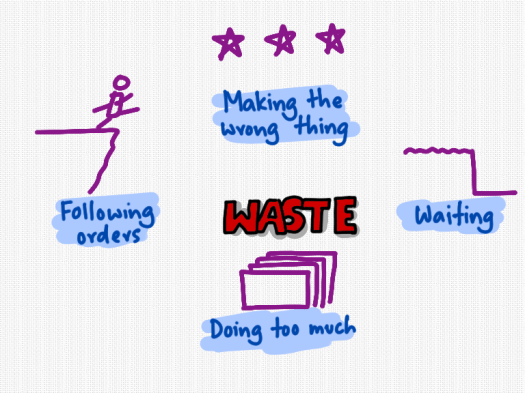
For example, how often do you end up making the wrong thing for a customer because you didn’t take the time to really understand what they needed.

All too often people try and guess what others need rather than taking the time to ask them and then write down what they say in their own words.

The minute you start to change the words they have uttered a game of “Chinese whispers” starts and you end up very quickly with something very different to what you started with.

Then there is the waste involved in waiting for something – you send an email and then because no one responds you don’t follow up.

After all, you’ve done your job so that’s ok right?

Equally wasteful is doing far too much for a customer – creating a ninety page powerpoint when a three page one would have done.

In knowledge work another kind of waste is the kind that happens when a leader issues orders.

A leader’s views will be implemented by subordinates no matter how wasteful they are – and they can be very wasteful indeed.

The thing that I’m starting to realise is just how much work is done by well meaning, driven and conscientious individuals that they do very well – but should not be done at all.

In an ideal world you would take the time to listen closely to your customer and build them exactly what they needed.

And by doing that, by eliminating the wasted activity that’s usually involved in businesses, you would give them the best product or service possible at the lowest possible price.

Because the thing about waste is that someone is paying for it.

Either you’re paying for it out of your profits or your customer is paying for it in their price.

Either way someone is losing.

And that’s a waste.

Cheers,

Karthik Suresh

Why Doing The Wrong Thing Better Is Not A Good Plan

wrong-thing-righter.png

Tuesday, 8.38pm

Sheffield, U.K.

The more efficient you are at doing the wrong thing, the wronger you become. It is much better to do the right thing wronger than the wrong thing righter. If you do the right thing wrong and correct it, you get better. – Russell L. Ackoff

A few weeks back I wrote a paper on getting started with visual thinking, reflecting on methods I use and the way in which they help in different situations.

Part of the reason I thought it was worth doing was because of the plethora of visual thinking methods out there – methods that I quite liked when I first came across them.

Take Dan Roam’s “Back of the napkin”, for example.

It makes a lot of sense – use pictures to help people understand your point quickly.

At the end of the book, however, Roam introduces a complicated way of picking and choosing what kind of pictures to use to tell a story – and in doing so I think he loses sight of the point that we’re trying to make it easy for someone to understand what you’re trying to say.

And then you have modern visual thinking or visual facilitation methods.

I found Mike Rhode’s sketchnotes principle very useful when taking notes in class – I could condense three hours worth of points into a single sheet of A4.

That perhaps tells you more about the content of the class than about my note taking skills…

A sketchnote is, however, a work of art – and it’s clearest to the person who took the note.

After all, if you’ve made those marks you probably remember what the points were because your brain is relying on additional data points – your physical movements, the spacial positions of content and the bits you added to highlight important things and make them more memorable.

A sketchnote on a big board becomes a visual facilitation exercise – which looks amazing when done but… what use is it?

Most of the time it’s a product, an output from a session that then sits there.

In some cases, it’s framed as a memory of the event, but I’m not sure how often it flows into the next step – where it informs some kind of action – or if there is even a next step at all.

This may seem a little all over the place – after all this blog is based on the idea that drawing things makes it easier to understand and talk to others about something that might be complex or difficult to “get” in the normal way.

But I think that often the focus of activity shifts from helping you to understand to creating something that is visually appealing – something that is pretty and makes you go wow.

And that is a problem.

Websites do this – the useful textual content on most websites can probably be put on two sides of an index card.

The rest of it is visual waffle, elements that are pretty but add no real informational content.

What seems to happen is that an industry quickly develops around any new idea.

It happened with websites, it’s happening with visual representations of ideas and events, and it happens with everything from Agile to Lean to the Business Model Canvas.

The central idea is often simple and useful.

But you can’t profitably sell simple and useful – so you have to make it complex and proprietary to make money.

Which is why something like Bikablo – which is a visual library of sorts that helps you create better pictures – leaves me with an ambivalent feeling.

On the one hand, it looks so good.

On the other, so what?

Maybe I’m just jealous because I can’t do it yet – you’ll see examples of that style soon as I start having a go – and then I’ll stop complaining.

The point I’m trying to make is this.

You need to know what problem you’re solving.

If you want to get better at communicating complex ideas or help a group of people work through their situation and come up with a way to improve things then you’ll need some basic skills in visual facilitation – but you don’t need to be a full-blown artist.

In fact, if you’re too slow getting everything perfect you’ll probably focus on the picture and not on the situation – and create a very pretty depiction of the wrong problem.

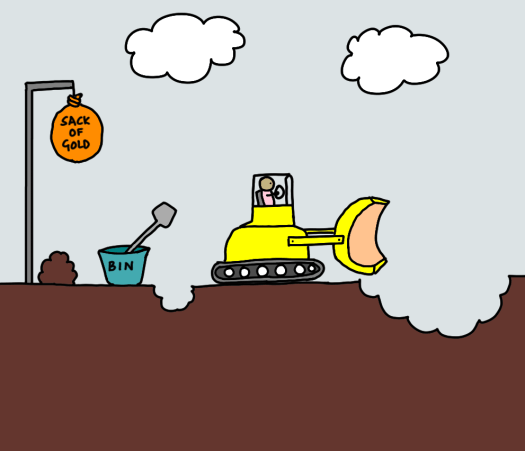
If you’re looking for gold that’s hanging from a pole you won’t improve your chances by throwing away your spade and getting a digger instead.

You’ll dig more ground more effectively and efficiently and be amazingly productive.

Without a result.

And what matters is the result – everything else is simply what you do on the way.

But as the saying goes you sell the sizzle, not the steak.

But… what do you end up eating?

And is it what you wanted?

And of course, if you do the right thing righter – solve the right problem and make it look amazing – then you’re untouchable.

Cheers,

Karthik Suresh

How Easy Do You Find It To Do Things In Life?

juggling.png

Monday. 9.02pm

Sheffield, U.K.

Thirty years ago my older brother, who was ten years old at the time, was trying to get a report written on birds that he’d had three months to write, which was due the next day. We were out at our family cabin in Bolinas, and he was at the kitchen table close to tears, surrounded by binder paper and pencils and unopened books about birds, immobilized by the hugeness of the task ahead. Then my father sat down beside him put his arm around my brother’s shoulder, and said, “Bird by bird, buddy. Just take it bird by bird. – Anne Lamott, Bird by Bird: Some Instructions on Writing and Life

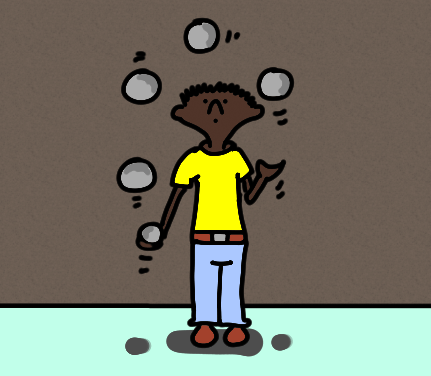
Do you ever find that you’re juggling all these balls, trying to get things working for you but they just keep falling – and you don’t seem to be going anywhere?

We live in a world where people “make it” all the time.

Are they unique and special?

Were they lucky?

Or did they work ten years to then get an overnight break?

There are probably variations of every story – and it tells us little about what to do other than things happen in the way they happen.

I wonder sometimes what makes the difference between two people – who ends up being the sociable centre of a group and who ends up being on the sidelines.

Some people are just born with the right combination of personality characteristics to get on with other people.

Others find it harder and aren’t fully in tune with how others respond or react in social situations.

And I suppose we learn through experience and by doing it wrong what works and what doesn’t work for us in the situation we are in.

And along the way we experience lots of feelings – feelings of not being good enough, of not being popular, of not being liked by anyone.

And there isn’t much point in telling someone who is feeling that way that the chances are that it’s the environment rather than them that’s the issue.

People don’t really appreciate being told that they’re committing a fundamental attribution error – focusing on personality and disposition based explanations rather than ones based on the situation.

And it doesn’t change as we get older.

You probably juggle a whole bunch of thing now – work, home, kids, health, money, family.

And there are probably times where you’re dropping the ball on each of them, perhaps dropping the entire lot every once in a while.

If you want to change something – for example if you want to lose weight or spend more time helping your kids socialise better at school, you could focus on personality factors.

You’re not clever enough, you’re greedy – and so on.

Or you could realise that the situation you’re in is just too busy, you’re doing too much or being asked to do too much.

I suppose when it comes down to it – the point is not whether you find things easy or hard.

In most cases it makes senses to arrange your life so you spend time doing things that you find easy – because they’re probably easy for you and so you can make a living with those skills.

And then, put time aside to work on those things that you don’t find easy.

You’re not going to lose fifty pounds overnight or learn to do stand-up comedy in a few months.

In fact I picked up a book that had a title on those lines – something about going from an introvert writer to stand up comic in three months.

Except, in the first chapter, the writer talked about how he had always found it easy to be funny – how that was what he did back in school.

So really, his journey was about becoming a comic in twenty years – which is less catchy a title, I suppose.

I think the point I’m trying to make is that it’s easy to get discouraged when things aren’t going well in whatever you’re trying to do – when you keep dropping the ball.

Some things aren’t important – and maybe you should just leave those balls on the floor where they belong.

And for the others – it’s not about you but about your situation – most of the time.

And the trick there is just getting started.

With the first thing, with anything.

Getting started is half the battle to doing anything in life.

Cheers,

Karthik Suresh

What Is The One Thing Standing In Your Way When You’re Trying To Work?

hobbled.png

Wednesday, 8.53pm

Sheffield, U.K.

From this moment, you will conform to the identity we give you. You will dress only in MIB Special Services attire. You have been trained in the use of MIB-sanctioned technology, vehicles and weaponry. – Men In Black International Movie Script

The other day I went for a walk and, for no particular reason, the words above from the Men In Black films popped into my mind.

And as I thought about them I started to become aware of just how problematic such an approach is when you’re trying to build a responsive and agile team.

We imagine that a large organisation is a like a well oiled machine, a smoothly operating unit, a skilled team that goes in, does the job and gets out.

I remember reading about a particular businessperson who specialised in buying companies and turning them around.

He would send in a team of “crack” accountants who arrived in a fleet of black cars and when you saw that lot pulling up you knew the A-Team had arrived and things were going to get better.

Although, the real A-Team, if you go with the film depiction, is on that has a group of misfits who come together with unique skills and use whatever there is to hand to get the job done.

Now, we’re talking entirely about made up characters here but who would you rather have on your side – the MIB folk with their sanctioned equipment or the A-Team who would probably grab the kit off the MIB team and beat them with it.

Speed always wins.

If you’re twice as fast as the other guy you can figure out what they’re going to do and head it off before they do it.

The point I’m trying to make is that many organisations try to create standards and processes for their people to follow.

They give them IT equipment that is locked down, ask them to work in offices that are open plan and loud and don’t give them enough time to put their feet up and think or meet and collaborate with possible like minded people.

Many knowledge workers I know spend as much time trying to get their “sanctioned” equipment to work as they spend doing any actual work.

And because they don’t have the training or their IT teams have frightened them into using nothing but the most basic technology they either resort to mind-numbing tedium or chase after magic bullet solutions that rarely deliver anything useful.

All the time people who don’t have these constraints are busy creating and delivering work and getting more business.

On the magic bullet point, here’s a thing.

If you ever try and build a software product to solve a problem before you figure out if you can simply dissolve the problem by redesigning your system then you’re going to end up losing a lot of money.

Most business problems don’t require new technology or new systems.

Many organisations have all the technology they need and get a lot more for free if they open their minds to free and open source alternatives.

But they don’t know how to use what they have and the certainly don’t have the skills to change to some of the alternatives.

Now, if you’re a large organisation and you have resources that you can throw at the problem – and if you can convince someone else to pay for this – then you can create a solution.

The work that goes into creating such a solution is about as pleasant as having to climb a hill with your hands and feet tied.

You can do it, but you’ll need to expend a huge amount of energy along the way – and it’s really not fun.

But there is a market for such solutions and so at least you get paid.

The thing is that for most people the thing that gets in the way of them doing their best work is the organisation they work for.

You don’t have the same problem in a startup – because everyone needs stuff doing as quickly as possible.

If you want a really good strike team you should give them some basic kit and get them to forage for everything else when they’re there.

Elite armed forces carry as little as possible – there are certain things they have to have – thing that will help them operate quickly and with devastating effect.

There is clearly a balance – you need a certain amount of equipment to get started on any project.

But after that what you need is for the organisation and the technology and everything else to just get out of the way so you can get some work done.

But big organisations, in particular, don’t work that way.

Which is why you have some big organisations and some old organisations.

But there are few big, old organisations.

The Dow Jones Industrial Average listed the 30 largest companies of the day.

Of those, GE is the only one still around.

And it’s fallen out of the index now.

And the thing that did for many of those organisations wasn’t the competition.

It was their failure to change as things changed around them – they stuck with their markets and products and processes when they should have been learning and changing and adapting.

And if you’re in a position where you’re working with those kinds of constraints you may want to think about how you can wriggle free.

Because you’re the only one who can make sure you’re still moving when the organisation isn’t.

Cheers,

Karthik Suresh

How To Tell The Difference Between Hopes And Reality

reality-vs-plans.png

Tuesday, 8.43pm

Sheffield, U.K.

Life is a series of natural and spontaneous changes. Don’t resist them; that only creates sorrow. Let reality be reality. Let things flow naturally forward in whatever way they like. – Lao Tzu

I was browsing through titles and stopped at Art is a way of knowing by Pat B. Allen, a book about using art to know yourself.

The book addresses questions I have been having recently about the way in which so much around us is stripped of its soul, it’s essence.

I don’t know if it’s a peculiarly Western thing or if it’s common to all people but it’s a problem.

There seems to be a desire for people to reduce everything to method – to take something which is new and good and useful and boil it down to nothing.

It’s like taking fresh, green garden peas and reducing them to dull, drab, grey mush.

Let’s put this in context.

It’s good to reach out to people, no?

It’s good to be social, to communicate, be friendly, be approachable, be open?

So that is what you do on social media – you make an effort to be all those things.

Then, just to make sure everyone sees how social you are you get into a routine of posting – create a method to increase engagement.

That means hacking the system, perhaps posting the same content several times a day to make sure everyone gets it when they turn on their phones.

And then there are a myriad other tips and tricks and hacks and shortcuts that boost engagement.

But do they create a connection between you and someone else?

Do you make a friend?

Allen describes how this happens with art, as it professionalises and is measured, judged, approved or not by others, and how artists then contort themselves to fit with this thinking or flee somewhere else.

And a lot of this, I think, comes down to people just not understanding the difference between method and practice.

Method is something you do.

Practice is something you do.

And yet, they are not the same thing.

For example, any business course, book or guru will tell you the method to success; that you need a plan, you need to set goals, objectives, have a vision and a mission.

If you don’t have those things you have nothing.

I feel like these things are like differently shaped blocks piled on top of one another balancing on the head of a pin.

They may be stable in the seconds after you build the tower – if you’ve got the balance right.

But the slightest tremor, the lightest breeze can knock them over.

As the saying goes, no plan survives first contact with the enemy.

How would you depict reality if you could only use colour and not these plans?

For me, it’s a landscape – rocks, greenery, pits, lava.

There are no boundaries, nothing demarcated in nature – just what is and how it’s arranged itself – and it looks different depending on how you see it.

How would you navigate through such a landscape?

If you’re afraid of the black bits or the brown bits or the red bits – then you’re going to stop – move no further.

But if you want to go forward you have to try out routes – try and see where you can move.

If you look around, pay attention, then you’ll start to see safe spots and dangerous spots – start to see where it might be possible to move.

There are no guarantees, just because you can see doesn’t mean you will do anything.

But when you see things you start to learn and you start to see patterns.

And once you see patterns you can make other decisions and see if the patterns spoke the truth to you.

Reality is messy and real and doesn’t really give a damn about you and what you want and what your hopes and plans are.

You just need to move through your reality taking whatever route opens up to you that seems like it’s going to keep you moving.

And eventually you’ll tread your own path – one that seems like you could really have done nothing else with your life.

And you really won’t be able to tell whether you did well or poorly, whether you won or lost until it’s all over.

All that matters, in reality, is to enjoy the journey.

The practice.

Cheers,

Karthik Suresh