Plaiting Fog – The Thesis Writing Experience

2024-12-07_plaiting-fog.png

Saturday, 4.43pm

Sheffield, U.K.

In my Ph.D. thesis, written in 1989, I discussed the fact that when a civilization develops the technology to prevent catastrophic asteroid impacts, it marks a significant moment in the evolution of the planet. – David Grinspoon

August 2022.

That is the only month since June 2017 when I didn’t post a single article on this blog in a month.

It’s hard to remember what I’ve written in that time.

Reading old posts can be surprising, it’s like coming across a new writer for the first time.

And then you realise it’s you.

I’m feeling a bit like that as I tackle my PhD thesis again.

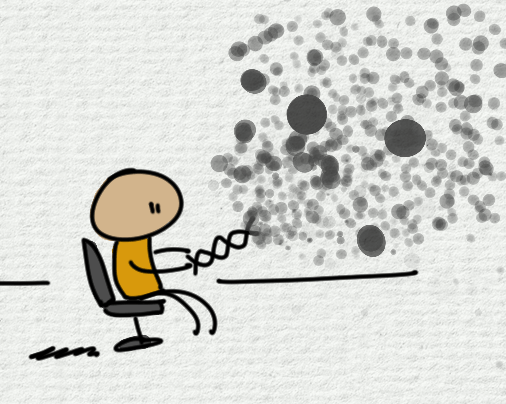
I had this idea that writing a thesis is a bit like plaiting fog, trying to get these ideas into some kind of order and make sense.

But it’s not really like that.

I don’t think there’s a right way to do this work.

Some fields have conventions they expect you to follow.

In the hard sciences you have a hypothesis and you test it and if your results support your hypothesis, when you’ve got something to talk about. If what you’ve discovered is sufficiently novel, then you’re good to go.

But outside that little bubble of “proper” science it all gets a little messy.

Actually, that’s not true either.

Whenever you write something you go through three phases.

First, you write a draft to discover what you think.

This is usually not very good.

Second, you rewrite your draft to get others to understand what you think.

This is much better.

Third, you rewrite your draft so it’s acceptable to the people in power.

This one is usually shit.

I mean, you have to play the game but this is why a good manager will hire a good sales writer and then use what they write without trying to make changes.

The writer is writing to sell off the page.

The manager is editing so that their manager will not be unhappy.

So they add extra words and clarifications and technical terms and generally ruin everything.

I think this happens with academic writing as well.

You write something.

Then you rewrite it to make the reviewers happy.

This is not a bad thing. The point of peer review is to make your paper stronger, and in many cases the feedback you get does make it stronger.

But, the nature of the academic publishing system means that you are probably going to have to pander to power to get your work published.

Everyone who publishes in academia is pretty open about that.

So, here’s my recipe for writing your next thesis.

First, write to understand.

Second, write to be understood.

Third, try not to screw it up.

Cheers,

Karthik Suresh

Why LLMs Are Like A Chainsaw For Your Mind

2024-11-30_chainsaw.png

Saturday, 8.24pm

Sheffield, U.K.

Supposedly, some writers work in rowdy coffee shops or compose whole novels to Megadeth, but when I write, I wear a pair of chainsaw operator’s earmuffs. – Anthony Doerr

I don’t know what you think about LLMs and this new breed of AI tools.

Some people that I follow on social media hate it. Viscerally. They see it as a large scale theft of intellectual property made in broad daylight. Piracy. Simple as that.

There is a specialised world where that is perhaps not quite as straightforward.

The world of Free/Libre/Open Source Software (FLOSS) has put code into the world for years, because of the stubborn belief of a few people that code was too important, something that mattered too much, to be locked away.

It deserved, it needed to be shared.

If you take this massive dataset of open, working code, and then develop the tools to generate new code is that ok?

Especially when many of those tools themselves are open source?

So, we’re not losing control, no one is taking over, we still have the ability to benefit from these models while having control because of the freedoms that come with the code.

Now, I’m not really arguing the legalities or opinions on the matter – I’m not really that interested in those.

I’m interested in the practical matter of what this means for you and me.

Many years ago I had a car, a Citroen ZX. I was doing a mechanics course at college as a evening thing – I wanted to learn how to fix cars. And I learned something about the brakes.

This was a long time ago, so I don’t remember much, but the essence of it was that you needed a seal to keep the brakes working properly.

I went into a garage and asked if they stocked a brake repair kit – the seals and things that were required.

The owner looked me up and down and told me that no one repaired brakes any more. It took too long and wasn’t worth the money. You just swapped them out and put a new unit in.

He said if I was ever looking for a job he’d be happy to take me on.

I guess being interested in the details of something like that was indicative of a worker that might be useful.

Instead, I spend a lot of time with computers getting them to do what I want them to do.

You can look at code in the same way as I looked at that brake repair job – we want to do everything from scratch and do the fix properly.

Coding was, until last year, one of the few hand crafts – something where every line was tapped out by a human.

Now, that isn’t the case anymore.

Last year I wrote something. I made a thing. And, I kept a little journal of how I got on.

It took me from the 23rd of November to the 13th of December to work out the kinks and get something working.

What’s that, 20 days?

Recently, I did this job again. Now, I knew what I wanted to do, but I was coding everything from scratch.

Or rather, I was getting an LLM to code what I wanted.

I was thinking about the structure of the code and then filling in the bits I needed using ChatGPT.

And I got this version working in 2 days.

And over the last 12 months I’ve used ChatGPT to help me create analysis work in R that would have probably taken me months to do if I was starting from scratch.

So, I’m starting to think of this as the shift from one level of coding, where it’s handcraft, to the next level, where it’s working at the level of blocks or units, and it’s not important to create every bit yourself.

You still need to know how to write it if you needed to, and understand what’s going on so you can debug it and all that.

But… you just don’t need to write every last line of code.

It’s like going from using a saw to a chainsaw.

A chainsaw for your mind.

I’m the kind of person that likes the idea of old tools, I’ve written about using dip pens, for heaven’s sake.

But an 18 day saving in time is something else too.

Now, where will this take us?

One thing is that we will not need as many people doing the jobs that are there now – you’ll need fewer coding jobs in these big firms because the coders will jobs will be more productive.

Of course, the world runs on code, so you probably need more people who can do that, so you might end up with many, many more coders and a huge increase in productivity, and the ability to use all this capability to transform our economies into lean, green ones.

That could happen too.

And some people will suffer.

If you know anything about India, you’ll have heard about Gandhi and his spinning wheel.

His idea was one of self-reliance, of making your own cloth rather than buying expensive, imported cloth.

If you use FLOSS software you’re using a spinning wheel, not going to a mall.

FLOSS software makes you self reliant, but only because so many others out there have put in the time and effort to make that possible.

So, if you have a spinning wheel, what can you do with it?

I think that if you’re a person that works in an industry affected by these models – coding for starter, but perhaps writing, or music, or design – if might be wise to consider what you’re competing against now.

I’ve heard sayings on the line of countries don’t fight, economies do. Or, companies don’t compete, supply chains do.

I think in our world it’s going to be people don’t create value, workflows do.

Something on those lines.

It’s less about you and a job and more about the workflow you manage and what the results are.

If you can get a set of tools together that creates an outcome that is valuable, quicker, cheaper and better than the competition, then you’ve got something to sell.

That’s not going to change.

These tools will change jobs, but they won’t change humanity, and the way we interact.

We just need to figure out how to go to work now.

Cheers,

Karthik Suresh

Why Rigid Specification Is Needed For Creativity And Flexibility

2024-11-08_toyota-four-rules

Friday, 6.22am

Toronto, Canada

Let’s say intelligence is your ability to compose poetry, symphonies, do art, math and science. Chimps can’t do any of that, yet we share 99 percent DNA. Everything that we are, that distinguishes us from chimps, emerges from that one-percent difference. – Neil deGrasse Tyson

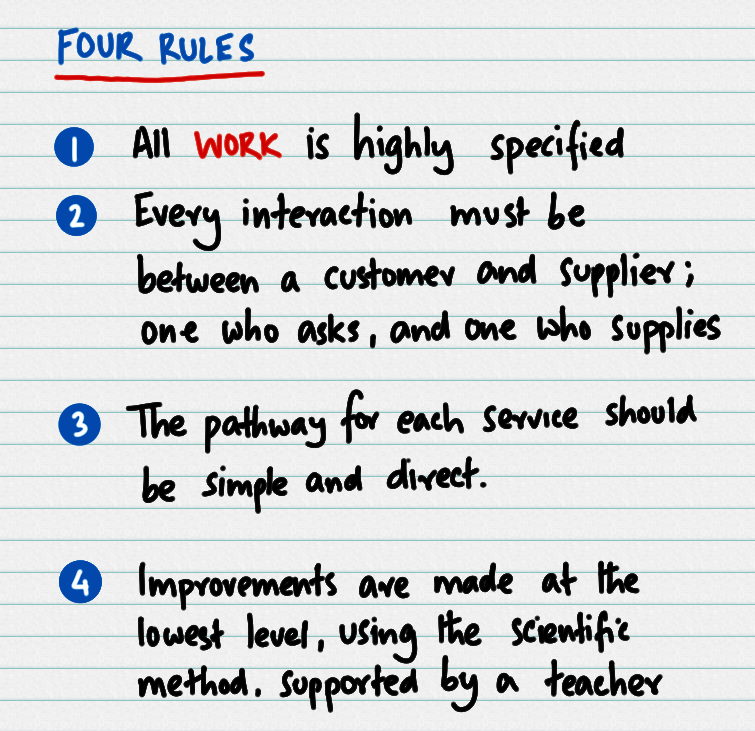
A 1999 paper by Steven Spear and H. Kent Bowen set out to decode the DNA of the Toyota production system – and seek out what made it work so well and at the same time so hard to imitate.

They argued that there were four principles, four rules, that grew over time that even the workers themselves could not articulate – they were just built into their way of working.

Let’s have a look at what they are and how we might use them as we continue to consider Lean Service design.

1. Specify work

Let’s start with what work and isn’t.

Certain things are not work.

I have a post about this somewhere and I can’t remember this exactly but I think the essence of it was that work is something you wouldn’t do if you weren’t compensated.

If you’d do it anyway, it’s not work.

Why would this definition be helpful?

Well, let’s limit it to the context of you’re a leader in a firm, someone who has a wide, creative role, who works with customers and develops services and enjoys the intellectual challenge of bringing something into the world.

You may be very well compensated for this.

But there is something that you don’t want to do. Something you need someone else to do. Something you are willing to pay someone else to do.

That’s work.

As you get closer and closer to the front line of where value meets the customer, figuring out what work is becomes easier and easier.

And this is when you must fully specify what the work is that you want someone to do.

What this means is systematically setting out, step by step. what needs to be done.

There are a number of approaches to do this, from Toyota’s own approaches to Crawford Slips, but they key is that there is a written specification of the work.

Now, when you ask for more resources and someone asks “for what work?”, you can provide your specification and say this is the work they need to do.

Most people will find this off putting, perhaps overwhelming, and file it in the too hard category.

2. Ask and you will get

The second principle is that every interaction is between a customer and supplier.

This is about a role, not about actual customers and suppliers.

In one case, your boss may be the customer and you the supplier.

In another instance, you may be the customer and the boss the supplier.

The point is that in each case, one person asks for something clear and unambiguous and the other provides something that is correct and complete.

This is about working on communication.

3. Follow the yellow brick road

The third principle is that of the path, each product or service should move along a simple or clear path.

First one thing happens, then the next and then the next.

Each action is a single piece of work that either does the work or puts it clean into flow so the next job can be done.

This is the service design work, working on getting each step working as well as possible.

4. Improvements done by the people doing the work

Train your teams and support them in making what they do better as they aim for continuous improvement.

All too often “improvements” are done elsewhere, in silos, and then imposed on people doing the work who then ignore it or find that it doesn’t do what they need it to do.

I have made this mistake and I need to learn when to recognize it – it’s hard to build something to make something easier for someone else.

You have to learn to see the world from their point of view and then start to work.

But if you’re the person doing the work you have an incentive to make it work better, more reliably, create less stress for you.

But you may not know how, so you need to pull support and guidance to get this done.

The takeaway

If you can’t do all this don’t be surprised.

The paper starts with noting that the approach is very hard to imitate.

It takes work to make the system work to do better work.

And Totyota has been working on this for decades.

One of the things you learn when you are exposed to critical thinking is that there are multiple ideas out there rather than one true idea.

Your job is to consider these ideas and weave together the ones that make sense to you.

Then you can apply what you’ve learned to your particular situation which is unique and different and requires careful thinking.

Or you can decide it’s all too hard and use some other form of management like command and control.

This approach was born in a factory and addresses products and services in that context of factory work.

There are other contexts like data work, or research work, or construction work, where you will need to develop approaches that are based on the principles and see how you do.

Now, I’m going to go and think about how to apply these principles in the work that I need to get done.

Cheers,

Karthik Suresh

Dealing With Conflict In The Real World

2024-11-06_conflict

Wednesday, 4.13am

Toronto, Canada

Peace is not the absence of conflict but the presence of creative alternatives for responding to conflict – alternatives to passive or aggressive responses, alternatives to violence. – Dorothy Thompson

As I consider the ideas associated with Lean Thinking I am struck by the bias towards a logical and machine-like approach which addresses but doesn’t embrace the complexities of real-world conditions.

I read somewhere that from the eighteenth century onwards the tech bro equivalents were lawyers – human society was becoming more complicated and brute power and hierarchy weren’t enough to manage evolving social dynamics.

The answer was contracting – agreeing between people what they would do – and putting a system in place that would enforce such agreements. Of course, that had been in place earlier. As Terry Pratchett observed, rich people found it was much easier to accumulate wealth and protect their hoard with the point of a pen rather than the point of a sword.

Most situations that have even a whiff of difficulty have social contracts at the heart of them, written or unwritten. The breakdown of an employee-employer relationship, for example, has as much to do with a breach of the implicit contract they have as any overtly agreed contract, which will always be subject to power imbalances.

Conflict is everywhere these days. Many countries are going through instability and pain, and responding with tribal reactions of fear and anger. Human beings cannot remove these instincts from themselves, and the inevitable result is conflict.

Unless we have tools to avoid a situation escalating to that point.

Coincidentally, there is something big taking place in a rather important country and CNN has some advice on conflict resolution, that we can apply to a range of other situations as well.

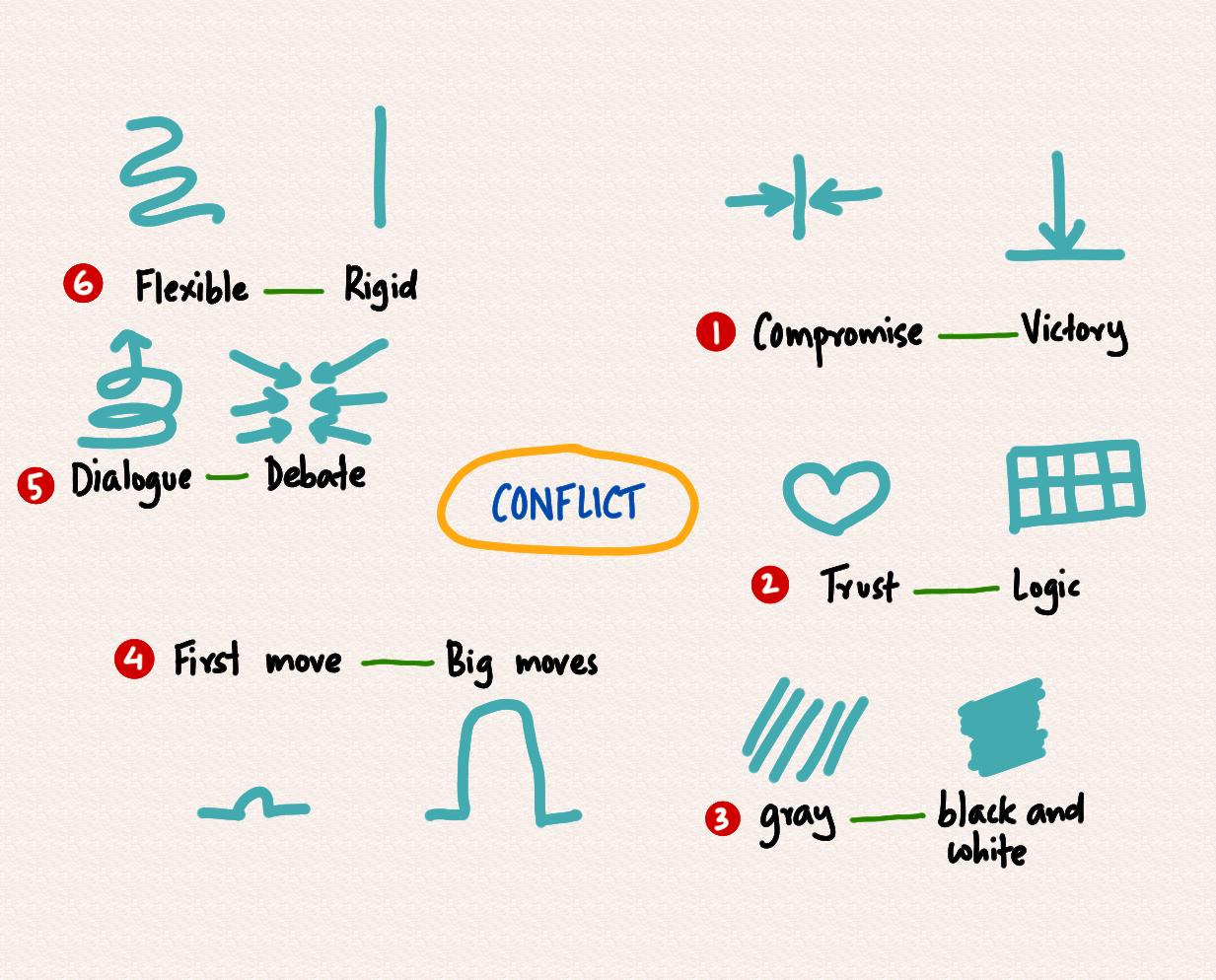
There are six points to consider.

1. Compromise or Victory?

Colin Eden’s SODA method is based on a two poles theory. Each thing you think about can be expressed in terms of two opposites. Articulating them this way helps you to see the range of what’s possible and try and see where you are on that line.

So the first thing you have to consider is whether you want victory rather than compromise. An all out push for victory is going to lead in one direction. All out compromise will lead to another. And there are plenty of examples of both leading to hubris.

The parties involved have to feel out where the situation is between these two extremes.

2. Trust or logic?

The potential for compromise can only exist if there is a chance of building trust. Logic does not work, few people are persuaded by logic. For example, you may subscribe to a philosophy that asserts that it is perfectly acceptable to act as if you are acting in a trustworthy way because the outcome you want is victory, and therefore lying is a logical approach to take if you have to in that situation. Get the other person to trust you and let down their guard and then go ahead and …

In turn, I logically know that regardless of how you act I cannot trust you.

We build trust over time, through conversation and trust-building actions. Again, it’s complicated. Sometimes you can see it in action, as when someone invades someone else’s territory. Sometimes it’s harder to spot, as when someone intrudes on someone else’s turf accidentally on purpose.

3. Gray or black and white?

Nothing is ever simple and clear and black and white.

I don’t need to go on about this, you know that when you look closely at anything it becomes more complicated and confusing.

There’s always something that led to something that led to where you are now.

And tracing it back can unearth generational trauma, passed on time after time.

Either you’re prepared to dig in and understand the layers or you’re not and want to just look at the surface level – and that decision will have an impact on how you approach the situation of conflict.

4. First move or big move?

Few things are better done fast, especially when it comes to important things. Everyone wants to move ahead quickly, and make a big change. But real change grinds slowly and you have to decide what you’re willing to do in the situation.

In the UK, for example, the Liberal Democrats, excited by their status as a junior partner in a Coalition government, naively reneged on their campaign promises and put up tuition fees for students.

A big move.

And they were nearly obliterated as a party when it came to the next election.

They should have stalled on that one – refused to budge without the support of their voting base.

Big moves require big agreement – and that takes time to build through a series of small moves.

The Paris Climate agreement in 2015, was the result of decades of slow, patient work building the science-based argument for action.

5. Dialogue or debate?

This one overlaps with some of the other points – dialogue is about exchanging ideas while debate is about winning, dialogue takes time while debate is about making your points and moving to a vote, dialogue is about consensus building, debate is about gaining power.

Which one do you think will make a situation better?

6. Flexible or rigid?

This one comes down to you and your personality. I’m flexible, perhaps too much so. I have friends who are rigid, perhaps too much so. And the potential for a good compromise is somewhere in the middle.

If I flex too much I will sign up to something that I will be unhappy with in the future, and I have to learn not to do that. If my friend is too rigid then no one will work with them and that’s not good either.

The takeaway

These points are thought-provoking and important and relevant whether you’re running a country or managing a home renovation, running a non-profit or a global business.

When two humans encounter each other there is the potential for conflict.

The fact that we have survived is because we have learned to manage it.

Cheers,

Karthik Suresh

How To Draw Maps To Help You Improve Your Business

2024-11-04_mapping.png

Monday, 6.36am

Sheffield, U.K.

There’s no map for you to follow and take your journey. You are Lewis and Clark. You are the mapmaker. – Phillipa Soo

In my last post we looked at waste and how the next step to improve things is to use mapping techniques.

Let’s just take a step back and look at what “mapping” involves.

A map is traditionally a diagrammatic representation of an area of land or sea showing physical features such as roads and cities.

When you go somewhere new, the first thing you have to do is look at a map – or these days pull up the maps application on your phone.

On a short trip earlier this year I used up all my roaming data and couldn’t access my maps app. That was terrifying. I had to ask people for directions! They, in turn, pulled out their maps apps and I took a photo so I could start to figure out where I was.

We are blind to the bigger picture without maps.

In physical spaces, then, we start with a blank space in front of us, because we don’t know where things are, and we reach for a map someone else has drawn so we can figure out where we are in relation to where we want to be and plot a route between the two.

This mapping metaphor does not translate cleanly from the physical world into the mental world.

The terrain of our mental worlds are not static and unchanging – they are constantly shifting and rearranging.

But we still use the term “mapping” when we try and understand a situation, so the first thing we have to do is reframe how we approach mapping – rather than it being something you reach for, it’s something you construct.

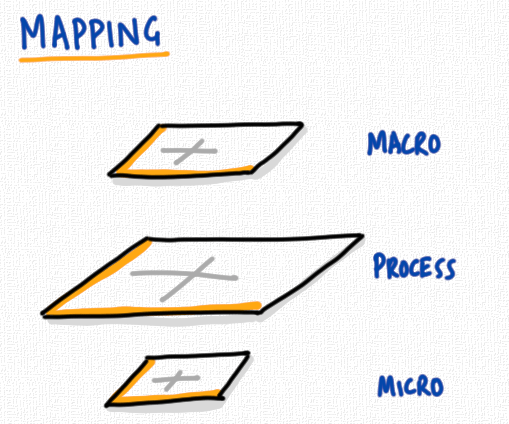
We have to learn to see the situation and map it at different levels.

The first level is the macro or systems level. This is where you look at the bigger picture and see how things fit together.

A technique for drawing a high level map is Rich Picturing from Peter Checkland’s Soft Systems Methodology.

There’s not enough space in this post to talk about Rich Pictures but have a look at this link and this one to get a sense of what’s required.

I created Rich Notes to help with this, but that’s also useful for mapping at the other levels.

At the macro level you’re looking at the landscape in front of you and identifying the mental equivalents of mountains and trees and streams and roads. The things that are in your way, the paths that already exist, the obstacles you need to ford.

Once you represent that situation on paper – in some kind of drawing that we call a map, you begin to see what sort of route you can take.

The most important thing with a journey is to see what the obstacles are and try to either avoid them or overcome them.

If you have a very high mountain in front of you, perhaps you need to find a way around it. If you have a river, can you build a bridge?

The obstacles you face lead you to decide the things you need to do – and now you can come down to the next level of mapping, which has to do with process.

In process mapping you look at the steps to follow.

As someone once said, “Life is one damn thing after another”.

A process map is about getting those damn things down on paper.

Start to finish, beginning to end, break down what is happening step by step.

A common technique is brown paper mapping, where you tape a long strip of brown paper to the wall and use post its and markers to step through the process.

These days it’s probably easier to use a spreadsheet or online tool.

Process mapping helps you see what is being done, or map out what should be done – and as you do this you’ll see areas of waste, where there is repetition or rework or delay.

And once you see waste, you can start to think about ways to remove that waste.

The bottom level of mapping is the micro level – which looks at the details of what needs to be done.

If you think of the macro level as the way things fit together and the reasoning behind what we’re doing, and the process level as the plan that we should follow, then the micro level is executing the plan, where action takes place.

And we need to lay that out, list the steps that need to be done and create tools to help us, like standard operating procedures, instructions, checklists and tests.

It does take some time to learn and practice mapping techniques at these levels, but one thing you should think about is who is doing the mapping.

Are you going to do it with your business – take hold of the pen and talk to people and map what they tell you?

This is what I do a lot of the time.

But you can also give them the pen and ask them to work through the situation in a group.

That gives your team the opportunity to get involved and think through what they do and what the bottlenecks and issues are with the process.

The thing to remember is that at the micro level your teams are often asked to follow the approaches imposed by management, whether they improve the customer experience or not.

If you are a manager you have the power to change the system – your workers don’t – and so once you see what the issues are it’s up to you to figure out how to make things better.

Hard work is not the answer, better systems are.

I came across a pointer to Miriam Suzanne’s post We don’t need a boss, we need a process, and that’s sort of the thing I’m going for here.

Think of mapping as a way of getting down what’s in your mind on paper – it’s just a representation, not reality.

It’s a tool to help you get what’s in your head and other people’s heads down on the page so that you can empty your mind and have the brainspace to focus on what to do next.

And that’s the point of a map, to help you on your way.

Cheers,

Karthik Suresh

How To Spot Waste In Your Business

2024-11-03_waste.png

Saturday, 7.53am

Sheffield, U.K.

Let him who would enjoy a good future waste none of his present. – Roger Babson

This is a continuing post series, the fifth one, as I read John Bicheno’s “The lean toolbox for service systems”.

Today we’re going to look at waste.

Bicheno says that we should approach this indirectly, not as a checklist for finding waste.

As always, we have to go and see what is happening for ourselves, trying to go from abstract ideas of what should be happening to specific things we can do to improve the way in which we serve our clients and customers.

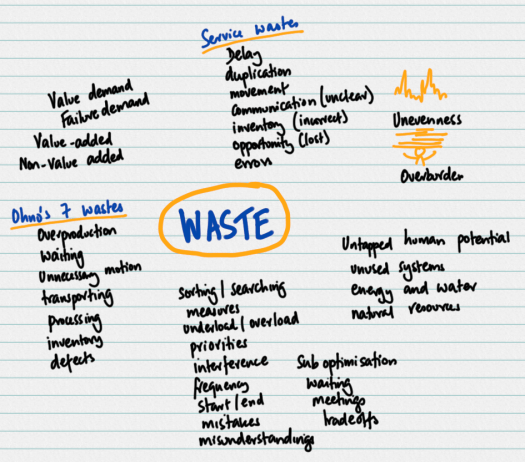
The picture above has a big list of wastes, some of which overlap – but let’s try and see what sort of things we might find.

Let’s start with the people you work with – are you benefiting from their full potential?

Working with others is challenging. We are social creatures and there are issues of hierarchy and control and relationships that have to be navigated.

How do you treat your employees or direct reports? Do you treat them like children – telling them what to do? Do you treat them like colleagues, working together? Do you trust them to do things right?

I have found that the hardest thing is to have a good working collaboration with others – it takes time. You cannot expect it to happen without effort, management tools and performance appraisals won’t make it happen, neither will silly bonding sessions or social occasions.

You need to spend time with the people you work with, talking about the work and figuring out how each person can contribute effectively.

People are often the biggest cost in a business and if they don’t bring their brains to work you’re missing out on the biggest return you can have.

Once your team is thinking together about what they’re doing and how they’re providing value you can start to dig a little deeper into the actual work that’s happening.

And the concept of value demand and failure demand come into play.

Value demand is when you work on what the customer wants.

Failure demand is having to fix the consequences of failure.

For example, if you’ve ever done a construction project you will find tradespeople will make choices to take shortcuts rather than do something in a more detailed way.

One example is whether they run cable in plastic sleeves they nail to the wall or if they chase the plaster and put the cables in the wall.

If they don’t do what you want and have to repeat the work because you don’t like the look of external wiring, that work is failure demand – you’re fixing something you’ve already done because it isn’t right.

A good percentage of service work can turn out to be failure demand – just not doing the job the customer needs.

These are two big sources of waste right there – not using your team effectively, and not taking the time to understand what the customer needs before doing the work.

I suspect, without evidence, that these two areas account for 80% of the waste in a service business.

The remaining 20% comes from stuff you can control but that people often just don’t do well.

Stuff like:

  • Not having a filing system for material that makes it easy to retrieve.
  • Underloading or overloading people or stages of your system
  • Moving things around too much, too many touches
  • Unnecessary processing

All these and more are issues to do with failing to create a flow of work, something that is even rather than uneven, and not distributing tasks well, loading different areas differently.

From a management perspective two things that don’t help are interruptions and meetings.

Interruptions kill work in progress, knowledge work in particular.

And meetings, in the standard sense, can be time sinks.

In my practice, I try and combine the two – by having regular meetings that are in the diary so I don’t need to interrupt someone in the middle of their work.

Ad-hoc calls are just not a thing anymore.

And meetings are used to go through and ideally do the work – they are working sessions where we collaborate rather than talking sessions where we talk about what needs to be done and then have to find more time to do it.

Online meetings can be hugely productive if you know what you’re doing but judging from my LinkedIn feed not many people know how to do them well.

That may be a post for another time.

Once you go to where the work is being done and start to get a sense of the waste in the system you can start to think about how you can improve it.

This starts with a mapping exercise, which is what the next chunk of the book is all about.

Having flipped through it, I don’t fully agree with some of the ideas – or, perhaps more accurately, I think they’re not enough to deal with the richness and complexity of real-world situations.

So we’ll dig into that next.

Cheers,

Karthik Suresh

The Principles Of Lean Thinking

2024-11-02_activities.png

Strive not to be a success, but rather to be of value. – Albert Einstein

In my last post I introduced Rich Notes, my approach to understanding a system.

Once you understand a situation, you can start to do something about improving it.

But what are you trying to do – what does improvement look like?

It’s worth taking a step back here and looking at what you do as a whole and what “better” might look like.

Let’s start with your customer – your purpose as a business is to improve her experience.

You do that by providing value.

The lean literature talks about value as being provided by a value stream.

I find this term hard to visualise but I think it’s very similar to what I would see as “activities” in Soft Systems Methodology.

A stream is a flowing thing, something that is linear and step by step.

Activities are a little fuzzier, sets of steps that follow on, but that also split and join in different ways.

This is a little pedantic, so as long as you see that value emerges from the value stream or the activities we do you get the picture.

The activities are where we spend most of our time.

For example, if you’re a consultancy one of the activities you will spend a lot of time on is writing proposals.

Early in my career we used to write huge proposals – 70-100 pages was not uncommon.

I think we thought that the more we put in front of the client the more impressed they would be.

Later, I worked with a law firm that sent me a simple 4 page proposal.

The first page was a letter, the second page was a list of bullet points of the work they would do, the third page was pricing, and the fourth page was a signature sheet.

You had some boilerplate terms and conditions at the back but the essence was in a page – what we’re going to do for you.

Adopting this process took proposal writing time from weeks to half an hour.

And, I think it provided more value. Clients want to know what you’re going to do for them and a rambling document makes them do more work and is really not as impressive as you might think.

Clarity and economy of thought is.

In the image above you’ll notice five elements – these are the five lean principles.

We’ve talked about value and the value stream.

Next comes flow – sequence what you do so that one step naturally flows into the other.

Don’t introduce non-value adding steps that slow you down or make the experience for the customer worse.

Do those in parallel, focus on keeping things moving.

Again, in service, a simple example is that once you’ve had the conversation get the proposal out the next day.

What’s important is that the client has an idea of what you can do.

If you wait for legal approval before issuing each proposal then that introduces a delay – you need to do that anyway so do it once the client indicates they are ready to go ahead.

The next principle is pull – do things once they are needed.

I cannot tell you the number of times we have done analysis and created material “just in case”.

This happens if you go into a meeting and the client asks for more information – you should always direct them to something you have done already.

Doing anything new, or spending time on stuff is work – and should be done if you are being compensated.

There are exceptions, of course, stuff that you would reuse, the first versions of things that you need.

But you shouldn’t do free work – and the client needs to see that value is being created when they ask for it – but only when there is a commercial relationship in place.

Now, once you have these four elements in place you will have a system that works better – for you and for your clients.

So now you can work on perfecting the system, making it better.

That involves identifying common weaknesses and starting to fix them.

Let’s look at that in the next post.

Cheers,

Karthik Suresh

Rich Notes – My Way Of Understanding A System

2024-10-29_empty-mind.png

He listens well who takes notes. – Dante Alighieri

Tuesday, 8.18pm

Sheffield, U.K.

This is the third post as I work through ideas in John Bicheno’s “The lean toolbox for service systems”.

And the idea in this post is a particularly big one.

What do you need to do when you first encounter a system?

You need to understand it.

Let’s unpack that.

My 1,708 page “Concise” Oxford dictionary defines “understand” as perceive the intended meaning of words / the significance, explanation or cause of.

“Perceive” is the important one there – and it in turn means to “become aware of or conscious of”.

You have to learn to see what is there, not what you think is there, or what you want to be there, but what is actually there.

You have to enter a situation with what the Zen folk call beginner’s mind.

Or perhaps even, empty mind.

The problem with knowing even a little about something is that you are tempted to go in with assumptions about what is wrong with the system and what needs to be done to fix it.

Watch people the next time something comes up that’s an issue – see how quickly they jump to offering solutions.

What they find hard to do is take the time to understand what is going on.

Bicheno refers to this as the “check” phase and points to John Seddon’s six stages of check as being vitally important.

These stages are:

  1. Understand the purpose of the system.
  2. Understand demand.
  3. Understand the capability of the system.
  4. Understand flow.
  5. Understand system conditions.
  6. Understand management thinking.

I want to focus on number 2 in this post.

Seddon says that you don’t ask for requirements, instead listen for demands that your clients place on the system.

This is a big shift in emphasis, in case you weren’t noticing.

Never ask someone what they want. Instead, listen for what they need.

There are a number of techniques out there which are supposed to help you understand how you find product market fit.

Most of them are based on asking – complete a survey, answer these questions, participate in a focus group.

Listening requires you to be open to the possibility that what you have to sell is not what the customer is interested in – and you’ll never find that out if you insist on bringing up what you do.

How do you listen better?

That’s a big topic in itself, but let me tell you how I do it.

I take Rich Notes.

What are those, you ask?

Well, hopefully in the next year or so I’ll be able to point you to a paper that introduces this to the world but for now, Rich Notes are digital notes that I take during conversations.

I start with a blank page – literally beginner’s mind – and we talk about the situation and I take notes.

The notes are non-linear and help me explore and understand the situation, seeing it from the points of view expressed by the participants in the meeting.

When we have finished talking I know more about the situation.

In fact, we all know more about the situation and are usually starting to converge – come to a consensus on what needs to be done to improve the situation.

That’s quite a good place to be – we understand what to do next.

We’ll pick up what that means in the next post.

Cheers,

Karthik Suresh

How To Think About Value In A Service Firm

2024-10-24_value.png

A satisfied customer is the best business strategy of all. – Michael LeBoeuf

In my last post we talked about “purpose” in a service firm and John Bicheno’s view that “the common purpose of everyone, top to bottom, is to improve the experience of the customer.”

Let’s start with this idea – that we are all working to improve the customer’s experience – how do we do that?

We improve their experience by delivering value.

But what does that mean?

I like Warren Buffett’s definition that “Price is what you pay, value is what you get.”

Value is a tricky thing to pin down – you know it when you see it and you know what it isn’t.

Value is an emergent property – it is created when you do things right. Things that the customer needs you to do.

As you know from the last post, this series is about reading the “The Lean Toolbox For Service Systems”.

One of the concepts in there is that of the value stream.

The value stream is where the customer gets value.

I find this hard to visualise – what is this stream? Is the customer dipping into it somehow? What are we trying to say here?

I think the reason we talk about streams is because the idea of flow is a big thing in lean – so I might come back to that.

But at this point, I think a more useful way to view how the customer gets value is thinking of value as emerging from carrying out a set of activities.

In other words, services are activities that provide value to a customer, rather than things that they get or use.

If I run a dry cleaning business, for example, value is created when the customer drops off dirty clothes and gets them back clean.

There are a certain number of activities we carry out in businesses.

  1. Manufacturing or construction.
  2. Field services or repair such a break-fix (the boiler is down, please fix it).
  3. Runner activities – the things we do every day.
  4. Repeater activities – regular or semi-regular tasks
  5. Stranger activities – things out of the ordinary, non-routine.
  6. Waste activities.

The ideas about customer experience, value, and activities are captured in the top part of the image above.

Let’s look briefly at the nature of the organisation that delivers this value.

In a service firm, the front line is closest to the customer.

When you buy a car, you’re unlikely to meet the person that finished your car door.

But you will have an interaction with the person that serves you your order at a takeaway counter.

People often think of the front line as being at the bottom of the pile – our lowest paid and most junior staff.

We should really invert this idea and see the front line as the most important people in the business when it comes to customer value.

However, it’s an inverted pyramid and their ability to serve the customer depends on how they are supported by management.

Ideally, everyone in the business will think about how to support the front line directly and indirectly.

They will be customer focused.

Often, the politics of work means that everyone is focused on what their bosses want, and end up looking away from the customer and inwards down the pyramid.

They are corporate focused.

It will not surprise you to learn that every service organisation, big and small, is bumbling its way towards figuring out how to make this structure work.

So, this is what’s happening. How can you make things better?

The first step is to understand what’s going in.

We’ll talk about how to do that in the next post.

Cheers,

Karthik Suresh

What Do We Owe To Each Other?

2024-10-19_purpose.png

Saturday, 7.36am

Sheffield, U.K.

I sit astride life like a bad rider on a horse. I only owe it to the horse’s good nature that I am not thrown off at this very moment. – Ludwig Wittgenstein

I realised recently that I need to do some more reading.

So I’m going to do a post series where I work through John Bicheno’s “The lean toolbox for service systems”.

I’m trying to understand the core elements that help us create better services for those we work with.

I’m also watching, for the nth time, “The Good Place”, which is where the title for the post comes from.

I want to explore this idea of service as something we do for others, something valuable rather than extractive.

What does good service look like?

In Bicheno’s book, we start with the big picture, zooming out and taking a systems level look at what is going on.

But what does that mean?

When trying to understand anything – an entity, a service, we start by asking “What is its purpose?”.

This is a surprisingly hard question to answer because it depends on who answers the question.

Let’s say you run a business offering consulting services, how might the members of your team answer this question?

With my technical head on, the purpose might be to carry out a series of complicated activities quickly and efficiently.

From my customer’s perspective, the purpose of the service might be to meet the requirements set out by the board.

From my boss’s perspective, the purpose might be to maintain a gross margin of 60%.

Narrow points of view lead to narrow definitions.

But what really matters in a service model is the customer.

Bicheno says that “the common purpose of everyone, top to bottom, is to improve the experience of the customer.”

That’s what the rest of the book is about.

See you in the next post.

Cheers,

Karthik Suresh