How to set up a knowledge work space

5S-method.png

The 5S method is a way to organise work spaces in manufacturing – and is a core part of the concept of lean.

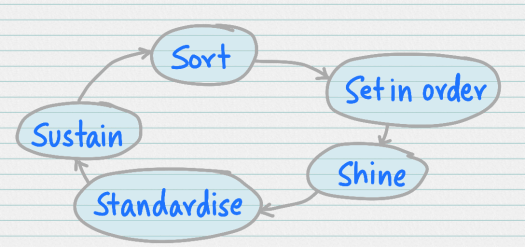
It uses 5 Japanese words: seiri, seiton, seiso, seiketsu and shitsuke. They can be translated as sort, set in order, shine, standardise and sustain.

It’s easy to see that having an organised workspace makes a difference in physical work.

But what about knowledge work? Can it be used there as well?

Bradley Staats, David Brunner and David Upton looked at whether lean principles could be embedded into a software company.

Staats and Upton write in the Harvard Business Review that lean projects don’t necessarily produce better quality work but do come in on time and under budget.

Knowledge work has specific aspects that make it different from manufacturing, such as uncertainty over the tasks that need doing, the fact that a lot of knowledge may be inside people’s heads as tacit understanding and that how things are done may change during the projects as requirements evolve.

In manufacturing, we usually know what we need to do, how to do it and in what order we should do it.

An assembly line designed to make cars doesn’t usually end up producing pizzas. But that seems to happen quite often in knowledge work.

So, how might we apply 5S in knowledge work?

Sort is all about removing obstacles. It means getting rid of piles of paper, books that we are never going to read and clutter that gets in the way.

The things that are in front of us or on our desks should be the things that we use every day. Everything else should either be discarded or be put somewhere where we can get them when we need them.

Set in order is then about arranging things in the way that makes it most efficient for us to use them.

For example, if you are right handed and your office phone is on your right side, the chances are that you’ll pick up the phone in your right hand, and then move it to your left to take a note.

When you put the phone down, it will probably introduce a kink into the cord – and that’s why so many office phones have such twisted wires.

Putting the phone on the left should sort this out.

Shine is about keeping our desks and workspaces clean.

Standardise is about doing things in a particular way – that’s crucial in manufacturing so that variation is minimised and everything comes out the same.

In knowledge work this is sometimes taken to mean that everything should be documented and made explicit so that people can follow a set of instructions and do things.

This is something I disagree with. If you can make something into a procedure then it should also be possible to automate it and remove the human element.

Instead, standardise in the context of knowledge work should be more about getting ourselves in the right frame of mind to do creative and innovative work.

We should aim to set ourselves up to get into flow with what we are doing, so standardisation should really mean things like checking email at set times, doing timed pieces of work, creating spaces for deep work without interruption and so on.

Finally sustain is about what we do every day.

Because knowledge work is so intangible, it’s easy to get bogged down in day-to-day firefighting and forget that we also need to innovate and create.

And that takes time and energy.

Which we might be able to create if we use the 5S method to address the things around us getting in the way and grabbing our attention.

How to build something that is actually useful

lean-canvas-example.png

What should we do when we’re trying to start something new – whether it’s a new product line within an existing business or a startup dedicated to the idea?

All too often, we can come up with ideas for products and services and go quite far down the track of designing and creating them before finding out that the market isn’t that interested.

Alexander Osterwalder came up with the Business Model Canvas – a way to model a business using a one page framework.

This was much simpler than writing a 50-page business plan, and was enthusiastically adopted by the startup community.

A variant of the model by Ash Maurya is the Lean Canvas.

While the Business Model Canvas is designed to address all aspects of a business, the Lean Canvas focuses specifically on new product development.

The Lean Canvas retains five components of the Business Model Canvas:

  • Value proposition: What does the customer get?
  • Customer segments: Who is going to want this product?
  • Channels: How are we going to get to speak to them?
  • Revenue streams: What will they be willing to pay?
  • Cost structure: What will it cost us to deliver the product or service?

It adds four new components.

First – what is the problem we are trying to solve for a customer?

As Theodore Levitt said, People don’t want to buy a quarter-inch drill, they want a quarter-inch hole.

If the product doesn’t address a real problem that potential customers have then it’s hard to justify its purchase.

Then, what is the solution we are proposing?

The solutions needs to be simple – easy to understand. That doesn’t mean it has to be easy to do – or the customer could just do it themselves.

It must be possible, however, to see how the solution solves the problem.

We then need to look at two more components – metrics and unfair advantage.

Success or failure needs to be measured in an objective way and for that we need to select metrics.

Selecting a metric directly influences the activities we do in order to improve our score on that metric – so it’s important to select a few and important ones.

Finally, there isn’t much point spending time and money developing a solution if it can be easily copied or bought from someone else.

We have a competitive advantage only when it is hard for others to compete with us.

So, in summary, in order to build something useful, we need to start with a customer’s problems, come up with a solution, make sure we are doing the right things, and make sure that what we do is unique to us.

An easy list to write – but not a simple one to do.

How can you use analytics to create value?

path-to-analytics-value.png

It’s not clear for many of us exactly how we can use the data we have to help our organisations.

The systems we have are collecting more data than ever before – from customers, operations, sensors – and there is data being collected around us in social media platforms.

Many organisations are good at looking back – they can tell what happened and to some extent why it happened.

Fewer can see what is happening right now and what could happen next and what they should do as a result.

Some organisations use real time data to increase sales

The recommendation engines used by Amazon are designed to increase sales by showing you what else you might like – and the way in which google or Netflix present related information is designed to keep you using their platform.

But, what should the rest of us do to get started?

The advice from an MIT study is a perhaps a good point to begin.

There is more data around than we probably have the resources to deal with, so the starting point is to go after the big problems – the 20% of things that have 80% of the impact or cause the majority of the problems.

It’s hard to get people to give up personal decision making and rely on data.

Linking the analytics work to big, important things in the business and showing how data can help with those decisions has a better change of getting new methods into general use.

Then, it makes sense to start by asking questions instead of getting lost in the detail of analysis.

We can spend so much time getting data and starting to cut and analyse it that, all too often, there is no time left to see where it can help.

If we start with the big things that the company is interested in – often set out in their goals and objectives, we can then ask questions about what information would be useful to reach those goals.

Those questions will then let us explore what we can do to get answers and start to define the kinds of data and analyses we need to carry out.

The things organisations say are most important to them right now are trends, forecasts and standard reports.

The things that are likely to also become important are dashboards, simulation and scenario analyses, business process analytics and advanced statistical techniques.

We should try and make sure that what comes out of the analysis we do is business friendly and can be layered with other pieces of information and intelligence to make decision making easier.

Next – we build on what has been done before.

All too often, vendors are dismissive of spreadsheets.

In any room, however, it is likely that the vast majority have used and are comfortable with spreadsheets while advanced analytics tools have a steep new learning curve.

Good information systems design will keep what works and build more – perhaps with advanced analysis automated as much as possible or centralised within a support unit with experts that can help.

Finally – we should have some kind of a plan when building our information systems.

An information agenda, signed off by management, is a good way to oversee the process of sharing and using data better.

The study says that top performing organisations use analytics five times more than low performers.

For the rest of us, we should begin by understanding how to get started.

How can our information systems help us be more productive?

delone-mclean-is-success-model.png

Productivity is defined as output per hour by workers – and it has flatlined in the UK over the last ten years.

Our output depends on the tools we work with – and information systems are a vital part of that toolkit.

There are some who argue that we have not invested enough in technology while others think that recent technological changes have less potential to transform productivity.

So – how can we select and implement information systems that will improve productivity?

William Delone and Ephraim McLean came up with a model to measure the success of information systems in 1993, which they they revised in 2003, called the D&M IS Success Model.

It remains one of the most influential theories in the field, cited in in thousands of papers, and is a useful one to keep in mind when looking at a new system.

The model has 6 dimensions that are linked together with process flows and feedback loops. They influence each other, and in turn some elements are influenced by others.

The model begins by looking at quality – and sees quality as having three dimensions: information quality, system quality and service quality.

Information quality is all about what the system stores, delivers to the user, and produces for the user.

System quality relates to how the system works – does it do what is needed quickly or not?

Service quality depends on the organisation behind the system – are they helpful and is there guidance that is easy to follow or not?

These dimensions need to be looked at independently to assess quality fully.

The next two dimensions are user based.

First there is the user and the system – and this needs to be looked at from two angles.

How does the user plan or intend to work with the system?

How does the system actually use the system.

The quality of the system directly affects these user choices – we may intend to use a system, but if it is of low quality or the information is not good enough, we probably won’t.

We can measure user satisfaction based on their experience of using the system and their feelings about quality.

The last dimension looks to measure net system benefits.

These need to be some combination of saving money, saving time, increasing productivity and increasing sales.

The D&M IS Success Model seems deceptively simple – but it is a “parsimonious framework” that organizes many of the success metrics from research.

If a system scores well on these six dimensions then it should help us be more productive.

Can you pick a winner?

picking-winners.png

Is it possible now, given all the information we have, to predict which sectors and organisations are going to succeed?

Take crypto-currencies, for example. What’s going to happen with them?

There is a proliferation of Initial Coin Offerings (ICOs) taking place – moving from pure currencies to valuing virtually anything, from content on platforms like Steemit to studies on tracking tuna fish.

The big choice many of us face is how to engage with a world of applications that start to bring some of these technologies together.

Software, for example, is increasingly sold only as a service, accessed through a web-browser or API with a sprinkling of blockchain to prepare for the future.

This creates a problem for buyers of such technology – especially ones that are expected to be transformational.

The first is that we don’t know which one will be the next google or facebook.

When it comes to a product designed for everyone – the more people that use it, the more we feel like we need to use it to connect with the others on there.

It’s not like we choose between competing platforms.

Once one platform is ahead, it dominates the space in a winner-takes-all way because there is no physical capacity in terms of the number of users it can serve in the way an airline only has a certain number of seats at any one time.

Warren Buffett, writing in 1999, described two industries that were expected to be transformational as well.

Cars and planes have changed people’s lives. Yet, during the course of the last century, there have been over 2,000 car makers and 300 airlines.

We are now down to a few global car makers – with Tesla being the first major disrupter of the status quo in a long time.

Airlines, at the start of this century, may have made a grand total of zero money between them.

Clearly – technology benefits us. It makes us more productive and transforms the way in which we do things.

The challenge is working out which technologies are going to do that – it’s based on survival of the fittest and the luckiest.

The lesson we should take, according to Buffett is this:

The key to investing is not assessing how much an industry is going to affect society, or how much it will grow, but rather determining the competitive advantage of any given company and, above all, the durability of that advantage. The products or services that have wide, sustainable moats around them are the ones that deliver rewards to investors.

Beauty in time: The Japanese aesthetic of Wabi Sabi

wabi-sabi.png

Wabi Sabi cannot be explained, Marcel Theroux found when travelling in Japan. It is ingrained in Japan – hard to disentangle as a concept.

Then again, perhaps it’s not that hard to get really.

What really matters?

Is it the next shiny new thing? Or is it the thing that has memories and history and feelings baked in?

Being attached to material things is at once the source of prosperity and anxiousness.

The more we have, the more we want – and the more we have the more we fear losing them.

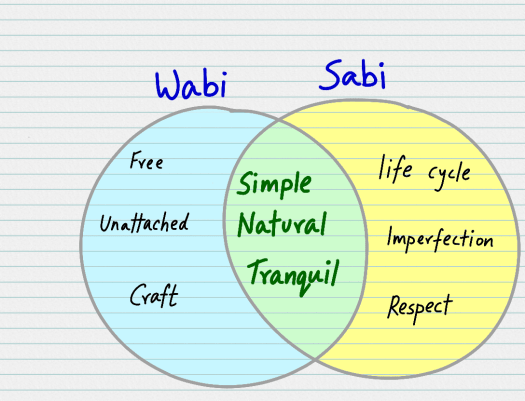
The Wabi part of Wabi Sabi has changed over time from meaning the desolation of poverty to the freedom that comes from being unattached.

Some of us can now have so much, that to truly appreciate things we must select only those things that truly matter to us.

When we are not attached to things, even the things that we have made ourselves, then we can focus on craft – getting satisfaction from the act of doing rather than the fact of owning.

The Sabi part of Wabi Sabi is the concept of a life cycle – how time adds meaning to things.

Something when first made has no history yet.

No one has used it, infused it with memories and given it meaning.

The act of using creates memories and imperfection.

A tea cup may get chipped over time – but it will also be associated with the memories of when we used it and so we treat it more carefully – with respect.

The concepts put together create a spare, austere philosphy that realises that happiness comes from creating value over time – whether in objects, relationsips or work.

It doesn’t need to be perfect – it does need to have meaning.

Perhaps the current buzzword of authenticity is trying to reach the state of Wabi Sabi – a simple, natural and tranquil existence that comes through in what we have and what we do.

Maybe we should aim to have less, that we value more, and appreciate better over time.

Should families have regular meetings?

family-meeting.png

How can we raise a happy family?

Modern families are often overwhelmed by the amount things we have to do – it often feels like are out of control.

And, according to Brice Feiler, the author of The Secrets of Happy Families, our children sense that is the case.

The way to make things better, it turns out, may be to bring some practices from work into our homes.

Many organisations, whether they realise it or not, are having to become more agile – a way of working that involves small teams working for short periods of time on small elements of projects, with a focus on making real, tangible progress.

These teams use tools like checklists, daily updates, weekly reviews and feedback.

An agile approach shifts power from executives directing work to teams that work towards a goal and increasingly manage themselves.

In this TED talk, Feiler says that when some families tried to use this approach in their homes, their children loved it, it helped reduce stress, increase communication and made them happier.

Everybody likes checklists. Children really like them.

If they have checklists of things to do in the morning, they quickly get into the habit of doing things on the list and checking them off.

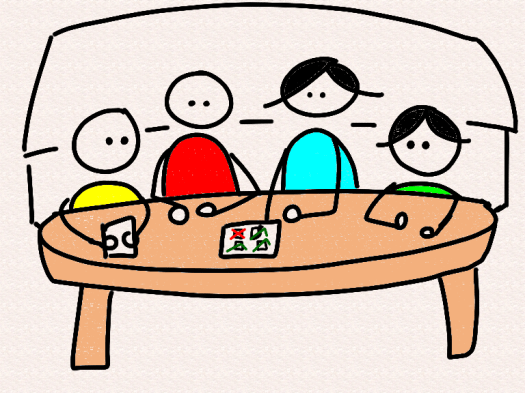
But to make a real difference, we need to sit down and talk together.

During weekly family meetings, which don’t need to last more than 20 minutes, we should asks things like what worked well this week, what didn’t work well and what shall we agree to work on next week.

The agile manifesto sets out the principles that underpin agile work – highlighting the importance of face-to-face communication, adaptabilty, self-organising teams and regular reflection as a group.

As parents it’s instinctive to want to tell our kids what to do.

That is not going to prepare them for a job market where they will be valued more for their creative ability than their willingness to follow orders.

Instead, Feiler says, we should try and empower our kids – helping them practice how to make decisions, come up with consequences for their actions.

If we help kids set their own goals, make plans to achieve them and teach them how to reflect on how things are going and how they should adjust their own actions – we may raise children better prepared for the changing world of work.

And, more importantly, we may be able to build a happy family that feels like it’s a close knit team.

How ideas spread and go viral

how-ideas-spread.png

What makes a video, business concept, blog post or social media update go viral?

How much does it have to do with how good the work is, how inspiring the message may be or how insightful the comment turns out?

Less than we might think, it turns out.

The network effect has been around before the internet, and offers perhaps the best explanation of how ideas spread.

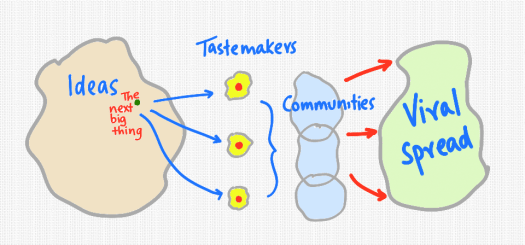
Kevin Alcoa explains in this TED talk that on YouTube the thing that may lead to an idea going viral is to be picked up by a tastemaker.

Tastemakers are people with large communities of their own – they are well networked and when they share something it can go out to a large audience.

Tastemakers sit at the centre of their network. What they see and share is what their community is exposed to.

This means that instead of finding the next big thing, tastemakers are in the business of creating the next big thing – whether they know it or not.

Their act of observing the world of ideas results in them selecting ideas that may then go on to be successful.

This happens when the community of people sharing the idea starts to intermingle and becomes a large enough group.

At that point, the idea is on the cusp of going viral, and after that it can spread through the rest of the population like a self-sustaining infectious disease.

Tastemakers have another advantage. When you have a large enough network, the ideas come to you – and so your task is to select what you think is going to appeal to your network.

Marketers know this, and so are increasingly investing in sponsoring people with large networks to get their ideas out – a more effective method than mass advertising for many products and services.

This is not new – it’s been applied in regular business in niche areas as well.

Warren Buffett simply places a small note in his shareholder letters asking people who want to sell business to get in touch and listing out his criteria – and this method has helped him build a collection of companies with market beating returns because so many people read it every year.

The difference now, with the Internet, is that rather than being a niche approach, this way of spreading ideas is going mainstream.

The implication, however, is that the thing that makes an idea successful is not how good it is, but whether it gets picked up by the people at the centre of a network of their own.

How to develop a new product or service offering

product-offer-cycle.png

Mark Brinda, David Mortlock and James Dixon of Bain and Company write in this article about how forward looking tech firms are moving to a customer-centric approach to delivering new products and services called Offering Management (OM).

The line between products and services is blurring. Is it a product? Is it a service? Or is it both?

Perhaps it’s simpler to call everything an offering.

The basic principles of creating a new offer, however, are simple.

We design an offer, work out how to deliver it to customers and then get feedback and respond, improving the design of the product.

Traditionally, organisations worked out what they could do well, packaged that up into a product or service, and marketed that to customers.

This requires a combination of systems, processes and training – a number of individual pieces that need to be brought together.

All too often, however, we end up with a collection of pieces that don’t actually deliver an experience that the customer values.

The problem with this approach is that it starts with thinking about what we do first and of customers only later on in the process.

Offering Management tries to change that.

It keeps the same Design-Deliver-Respond development cycle, but asks product managers to engage with users much earlier in the process.

Rather than first making something and then asking whether a user likes it, this process suggests that we talk to users, find out their needs and then design the offer around meeting those needs.

It seems obvious, really, but many organisations just don’t do this.

They stick with the mousetrap fallacy – build a better mousetrap and the world will beat a path to their door.

The Bain study shows that organisations that manage their offerings well outperform their peers on a range of measures.

Organisations like IBM are establishing new roles and practices to create Offering Managers – individuals with responsibility to drive not just design but the entire customer experience cycle, from managing how the offer is going to be delivered and collecting and pushing for revised designs based on feedback.

The acid test for a new offer, according to the authors of the study, is whether we are gaining market share.

If we have successfully designed an offering around customer needs, we’ll see it in the numbers signing up for it.

A very simple model for innovators

how-innovation-works.png

Once upon a time you needed to be a big company, with research and marketing departments and lots of money in order to find out what people wanted and give it to them.

That’s not the case any more.

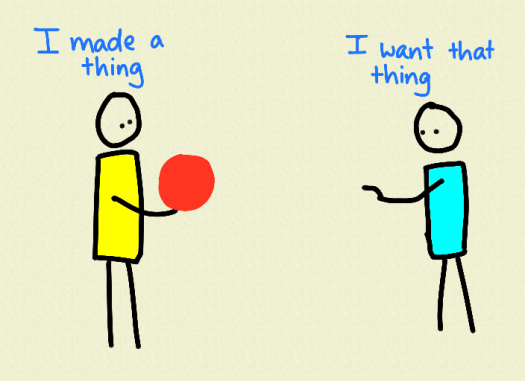
The big companies that sat between creators and consumers are disappearing, as the internet makes it easier for people who want a thing to find the people who make that thing.

But, we still have barriers in many places.

Take innovation inside an organisation, for example.

If someone wants to improve a process or a particular way of doing things – can they just do it, or do they need to go through other people first?

How many layers are involved? Does IT need to install the software needed? Does a manager need to approve time to work on the idea?

Approval processes and managers rarely come up with cool new things. IT departments, which should be enablers, often become blockers.

People messing about with ideas and trying to make them work do.

There is a very simple test to see if an innovation has potential.

And that is – does someone else want it?

Whether we’re trying to improve an excel application, create a new product for our customer base or set up a new startup – if we make a thing that someone else wants, then we’re on the track to somewhere.

Will we make any money?

Possibly – perhaps not in the way many people think.

New revenue models are popping up all the time. For creators, Jack Conte created Patreon, a platform that allows people that make stuff to get paid through membership subscriptions.

He did that because money from adverts on platforms like YouTube were plummeting.

So.. if someone wants the thing you make, there is probably a way to make money from it.

At YCombinator, the startup incubator, this idea has become a mantra.

Make something people want. Don’t worry too much about making money.