How To Pull Together A Story For A Killer Presentation

problem-resolution-example.png

Thursday, 9.15pm

Sheffield, U.K.

In my previous post I wrote about taking your audience on a journey using a story. How can you use a story to make a more effective presentation?

To start with, what do you think is a good outcome for a presentation that you make?

Is it silence? Is it applause? Is it a barrage of questions?

If it’s silence – perhaps you were completely clear and everyone understood everything. Or perhaps they didn’t but you sounded so confident that they were too intimidated to ask anything in case they looked foolish. Or you were so boring they spent all the time checking their emails under the desk.

If it’s applause – perhaps you came across well. But, what did they remember from your presentation?

If they have lots of questions – is it because they understand what you’re saying well and want to show how clever they are in front of their colleagues? Or is it because you didn’t get the most important points across? Or were you vague and evasive and they’re trying to pin you down?

Going back to Andrew Abela and what he says about – a good outcome for a presentation you do is when your listeners start talking and discussing what you’ve said between themselves – seemingly almost forgetting that you’re in the room.

This is a great point to reach. I’ve seen this. You’ve made your points, and now everyone is nodding and talking and gesticulating. They’re buying into what you’re saying. You’re on your way to making a sale.

How do you do this, what’s the secret?

The problem with most presentations is that they start from the presenter’s point of view and work through the points that the presenter thinks is important.

Usually, this is with an introduction to who they are, some scene setting, then some meandering through whatever seems important, then a discussion about what this means for the audience, then next actions and any other business.

By which time everyone is asleep or bored or zoned out.

Instead, you need to think about your presentation from your audience’s point of view. You need to start by getting their attention.

You’ll do that by saying what they’re going to get or learn or see during your presentation that matters to them. For example, I started this post with the idea that you could use a story format for your presentation. So that’s what you’re expecting to find.

You read articles and ads and flyers because the headline gets your attention. Newspapers have headlines for that reason – so you can find the stuff that interests you quickly. It’s the same with presentations – you need to start by getting their attention.

Let’s say you’re a small business owner and you’re about to sit through a presentation on webinar services. How would you respond to two slide titles below:

  1. Introduction to ABC Webinar Marketing Services
  2. Can a single webinar increase sales by 30% next month?

The first one is the kind you see at the start of presentations all the time. The second is not.

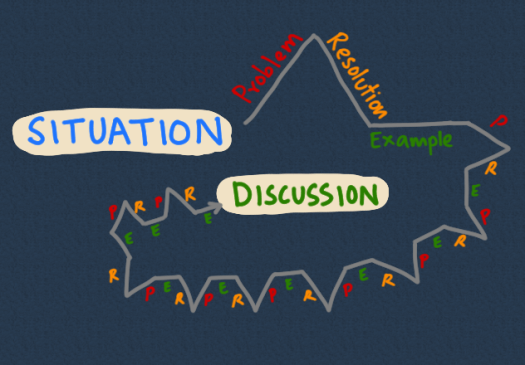
The second gets your attention because that’s something that interests you. So, your first task as a presenter is to set out the situation – the context for what you’re going to do – the promise of what you can deliver to your listener.

You then lead into a story format – which is really quite simple. In most stories, there is a problem and a resolution repeated again and again. You put a man up a tree, throw stones at him and then get him down again.

Watch for this the next time you see a film. The tension in a story is created by putting things in the way of the protagonists. We need them to stumble and fall and then pick themselves up again.

In a consultative sale, the stumbles and stones are objections. They’re the thoughts that come to mind when you are exposed to something. It’s just natural to be sceptical – that’s human nature.

What you need to do is look at your situation and think of the first objection or objections that come to mind.

For example, following the webinar intro slide, perhaps the objection is “We don’t really have these in our industry – the bosses don’t sit at computers and join webinars”.

Rather than waiting for the audience to bring up this problem – address it head on in your next slide title – “Are small business owners too busy to attend webinars?”

Hopefully, you have a good answer to this question. You have a resolution to this problem. Perhaps you have research that says most bosses ask an intern to find out about marketing options, and the interns often jump on webinars for a quick intro.

So, you have a resolution trotted out. But just because you say so doesn’t make it so.

What you need next is an example. Something that shows what you say is real. It can even be an anecdote – it’s surprising how powerful an example can be of even one person that’s experienced what you’re saying can happen.

The example also lets your listener take a breath and process your point. It gives them time to get it. Right – I know the problem, it looks like this person can solve it – and it’s worked somewhere else.

Great. Onto the next problem.

“Aren’t webinars expensive?”

There’s a resolution to that. No – the technology is getting cheaper all the time.

And an example. My last client did six webinars last year and spent less than $5,000.

And on and on. Each objection will naturally lead to another one and another one. You’ll be able to think of them quite organically as you stop focusing on trying to sell what you do and focus instead on the problems people can think up about why it won’t work.

If an objection is particularly hard – if you can’t answer it – you need to stop and work on that until you can. If you can think it up, the audience can.

How many problem-resolution-example sequences do you need? As many as are needed to address all the objections that can come up. Address them yourself, do it before the audience can and you’ll see something wonderful happening in front of your eyes.

You’ll be talking to them, making your first point. You’ll see polite attention, some furrowed eyebrows, some sceptical looks.

Then, you’ll say the objection that they’re thinking out loud and see a flash of recognition in their eyes. They’ll sit forward and start to pay attention as you talk about how you are going to resolve it.

When they hear your example, the cogs in their brains start turning, processing what you’re saying, putting it in their own words.

As you carry on, they’ll get more and more engaged. You’ll be going through all the problems they have and coming up with answers before they can ask questions. They might even smile and say something like “I was just going to ask that…”.

When you’re done, you might get some nods. No questions, probably, if you’ve answered them all. Instead, someone will say something like “We could try this out with the XYZ product line”. And then someone else will join in with a supporting statement.

You’ll lean back, and watch as people start to talk about how they can use what you’ve talked about. All the time you’ve spent addressing objections means that they can now think about how to do things rather than whether they should do things.

That discussion is your goal – your signal that what you said has been processed and internalised and is now part of the way your audience looks at the world. That you’re on your way to making the sale.

Cheers,

Karthik Suresh

ps. As a reminder, this is the thirteenth post in a series that I’m planning on eventually collecting into a book on Consultative Selling. If you are reading this and are interested in this topic, please let me have any feedback, good or bad, so I can make this as useful and easy to read for you as possible.

How To Get Started With A Killer Presentation For A Consultative Sale

from-to-think-do-matrix.png

Tuesday, 8.54pm

Sheffield, U.K.

People don’t want quarter-inch drills. They want quarter-inch holes. – Theodore Levitt

Is the consultative selling process about persuasion?

Are you trying to bring someone round to your point of view? To get them to change their mind?

Or is it more complex than that?

Think about the last presentation you did or saw. What was it like?

The chances are that there were a fair number of slides. They went through the history of the company, what they do, how things work. Lots of stuff.

But… how much of it was useful? And did it get you to change your mind?

Well, to find out if something was useful or not, you need to start by asking what it is that you want in the first place.

I’m betting you haven’t really set that out. After all, who sits through a presentation if they already know what they want. You’re there to learn and see and make up your own mind.

Ah… there is a clue. What you want is to be able to make up your own mind. To make an informed decision.

I think that’s the point of a consultative sale. It’s not really about persuasion. It’s about informed decision making.

But what does that mean. How do you make an informed decision?

Well, an informed decision is not necessarily right or wrong. We usually can’t tell whether something will work out or not in advance. What we’re tying to do is arrange the facts we have in a way that makes sense – and tells a story that we’re comfortable with.

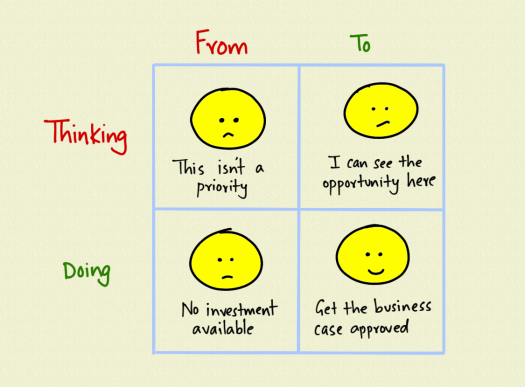
There are very few good books on creating good business presentations. Dr Andrew Abela’s is one. He is the author of Advanced Presentations By Design and has a free ebook on his site, where the matrix above comes from.

In any presentation situation, you need to figure out what you’re trying to get from the audience. What’s the result you want? What’s the end game?

Let’s say you’re trying to pitch your consulting service which helps companies design and deliver webinars to help with brand awareness and lead generation.

You know all about why companies should use this approach. For you, it’s a no-brainer and it’s hard to believe it when a prospect just doesn’t get it and why it’s worth the money.

That’s frustrating.

Can you do anything about it? Can you create a pitch that will help people understand why this is such a great thing?

The answer to that is yes – and it starts by working your way through the matrix.

Think of a prospect that you’re trying to sell to right now. Perhaps it’s the owner of an office furniture provider. Someone that supplies desks and drawers and chairs to companies. Let’s assume it’s a “he” and has been in the business thirty odd years.

This person is not going to take to your product naturally. Perhaps he’s never been on a webinar himself. Maybe he knows what one is, but thinks it’s something only new high-tech businesses do. Not something for him.

What he’s thinking right now is that what you’re selling isn’t a priority. He doesn’t need it and can get along quite happily without it.

He’s even made the decision already as he’s listening to you – this isn’t something for him. There is no investment available.

So, what you’re using the matrix to work out is what he is thinking and doing right now. That gives you a clear understanding of where he stands on the issue.

If you just try and close for the order the chances are you’ll get a no. Or be thrown out. Depends how much patience he still has left.

Before you can go for the close, you need to get him to see the opportunity that’s out there. The one that he’s missing out on.

You need to take him from thinking this isn’t a priority to thinking that he can see what’s in it for him.

When he can see what’s in it for him, then he’s going to be more open to the idea that this is worth investing in.

And that might get him to open up his wallet. To ask you what he needs to do to sign up and buy what you have.

The starting point for your presentation, then, is not the last one you did or the bunch of slides you always use.

No, the starting point is for you to work out what you want your prospect to do.

Then, you need to get clear on what he’s thinking and doing right now. You need to know that because that’s where you’re going to start. By stepping into his shoes.

Then, you’re going to take him on a journey. A journey that will end with him thinking differently about what you’re putting in front of him.

So, how are you going to take him on that journey?

You’re going to do it with a story – and that’s the focus of the next post.

Cheers,

Karthik Suresh

ps. As a reminder, this is the twelfth (or thirteenth) post in a series that I’m planning on eventually collecting into a book on Consultative Selling. If you are reading this and are interested in this topic, please let me have any feedback, good or bad, so I can make this as useful and easy to read for you as possible.

Why You Need To Focus On Serving Your Customer, Not Trapping Them

freedom.png

Sunday, 8.58pm

Sheffield, U.K.

If you’ve been following the last few posts, you’ll know that I’m pulling together some thoughts about consultative selling.

Except it’s sometimes not really about selling. And it’s sometimes not really about consulting.

It’s more about you. What you stand for. What I stand for.

Sometimes when you look at the world it’s like facing a featureless wall. A wall that you can’t scale. A wall that stops you where you stand.

Some of us don’t see things that way. They see a wall as something to be torn down. Most of us, however, keep our heads down and say nothing.

We get on with the important stuff. The really important stuff. Like raising our families and staying alive and getting ahead in the world.

We’re not activists. We’re realists. We deal with the world as it is.

Let others do all the protesting… that’s not for us.

To be fair, there does seem to be a lot of that going on.

In Copenhagen, there is a place called Christianhavn – which hosts Freetown Christiania – a little enclave of rebellion in an otherwise ordered and stylish city.

Walking around there, you see signs of entrepreneurship all around you – ranging from a blacksmith to jewellery and pottery.

And then there is the weed.

On stands made from a stack of three packing crates are plastic bags, full of weed. And people stood behind the stands. Selling.

Just like any other business…

Of course, it’s illegal and the police are in to do a raid shortly after.

The point is not really about what they’re selling – it’s about the fact that people there are making a stand for what they believe in.

And that’s the thing that’s missing from most business cases. Belief.

I’ve been reading some of Richard Stallman’s essays again. I wouldn’t be able to write these words in the way I’m doing right now without what he created.

Stallman believes that software should serve you – it should respect your freedom and community. It should be free – free as in freedom and not free as in beer.

Why does this matter?

It matters because there is always an uneasy truce between control and service. Businesses exist to serve their customers. They’d much rather control them, given a choice.

The best kind of customer is one that doesn’t have a choice. A customer that is addicted to what you provide.

Unsurprisingly, the central strategy of most companies now is to figure out how to get you addicted.

Addicted to your phone, to social media, to the software you use. To make it sticky, to make it hard for you to change or get away or do something else.

And this is where, as a consultant, you may need to decide where your loyalties lie.

Is your intention to have a captive customer base. Or is your intent to serve your customers.

If it’s the latter, then you must respect their freedom.

But how? For what?

First, just read the definition here to get started to understand what free means in the context of free software.

Then let’s think about the world of consulting for a minute.

Where do most of the ideas and concepts that are used by organisations come from?

They usually stem from the scribblings of an academic. They are created through publically funded research.

Then they’re made more lay person friendly. Sometimes they’re given names – A/B testing, Lean, Business Models.

People try and make what they have special – usually by trying to create a brand and product and set of ideas around a concept to set it apart from other concepts.

For example, I came across Edamame beans recently – exposed to the marketing push about how great it was.

I didn’t know anything about Edamame beans – I assumed they were a little known kind of vegetable, harvested at great cost and effort from the depths of some strange rainforest.

Of course, you know that they are baby soybeans. But Edamame is still a brilliant piece of marketing packaging. Still beans though, whatever you call it.

Okay.. now what if you came up with an approach, a way to solve a problem – and then made it free as in freedom.

You’d simply be following that old proverb give a man a fish and you feed him for a day; teach a man to fish and you feed him for a lifetime.

So, is my argument that your job as a consultant is not to do a job for a client but to teach him how to do it?

No. Not really.

I’m just saying that if you want to serve your customer, you’ll choose the best way to help them, whether that’s doing the work for them or teaching them how to do it.

Any way other than that – any way that doesn’t put your customer’s well-being first – is one that tries to trap them rather than serving them. The way app companies try and increase the amount of time you spend on their platforms.

And if you do that, in what way are you different from those drug dealers in the Freetown?

Cheers,

Karthik Suresh

ps. As a reminder, this is the eleventh post in a series that I’m planning on eventually collecting into a book on Consultative Selling. Although, after this post, it might go in a different direction and just be about consulting. If you are reading this and are interested in this topic, please let me have any feedback, good or bad, so I can make this as useful and easy to read for you as possible.
How Do You Find Out What People Really Want?

finding-what-people-want.png

Friday, 10.24pm

Sheffield, U.K.

I’ve been thinking a lot about this whole idea of having goals and going after them.

I was listening to a podcast where the person being interviewed said that the purpose of their company was to help people do something on Instagram intentionally.

Then there’s the news story about Big Brother in the UK – and how the first few seasons of the show were about real people – an authentic portrayal – and then as the series went on it got more and more artificial, with the participants doing what they were expected to do for the camera.

I’m not a big fan of selling. No one really is, I think.

But it’s easy to think that’s what we have to do, that’s how the world works. We have something of value to offer. You have money. And my sales job is to help you exchange your money for my value.

And then I started reading a book about design patterns in user interface design.

It says if you want someone to use a tool you create, then you’re going to have to understand them first.

No one uses a tool because they want to use a tool.

Take a spade, for example. You’ll pick up a spade because you want to get your garden sorted. You want to get your garden sorted so you’ll have somewhere relaxing to sit during the summer with a cool drink.

You’re using the space because you really want to put your feet up and relax.

And this is something we all need to spend some time thinking about.

Let’s say you’re starting a management consultancy that is going to do some clever data analysis.

So, you can crunch data and create pretty pictures and send them to your customer daily.

Is that what she wants? To print off all your charts and cover her walls with them?

Or is she in charge of procurement and is responsible for cutting costs – and she only looks good to her boss if she cuts costs year on year.

So is your analysis going to help her reach that goal of cutting costs or, more importantly, warn her when she’s in danger of actually letting costs go up?

So, going back to the pattern book, we need to put our customers under a microscope.

We need to figure out what their real goals are. What’s their equivalent of cheese that will get them sniffing the air?

We need to think about how they will go about things. Can they make decisions right now? Does everything need to be in a budget first? What route will they take?

How do they talk about what they want? There’s not much point talking about vitreous structures of patent fragility when they think in terms of glass houses.

How familiar are they will what you do? Do you need to spend a lot of time educating them, or will it be obvious how you can help them?

What do they think about what you do? For example, I once called someone who managed a metals warehouse about commodity prices and got a long lecture on how they did nothing with markets and that was only for fancy chaps that drove Ferraris in London.

Even though the warehouse manager was sat on inventory of several million that went up and down in value all the time.

This is why scattergun or spray and pray approaches don’t really work.

You can’t really sell someone. Not for the long term anyway.

They have to make their own minds up about what you offer. The challenge for you is getting in position so they can see you when they’re ready.

It’s all about being discoverable.

And perhaps the best way to do that is to get out there and start talking to people. Not to sell them, but to understand them better.

Then, if they need you, they’ll know where to find you.

Making Sense Of It All – Is It Even Possible?

sense-making.png

Thursday, 9.21pm

Sheffield, U.K.

Have you ever noticed that when you sit at your table and look at your glass – I mean really look at it – it turns out that it isn’t there at all?

Of course you haven’t, because glasses don’t act that way.

Electrons do.

You’ve probably heard of the Heisenberg Uncertainty Principle. It’s the idea that you can’t tell where something is and how fast it’s moving at the same time.

With an electron, if you try and look for it – that action will give it some energy, a boost, and it will end up speeding somewhere else. If you get its speed right, it will now be in a new place.

So you end up with this idea that an electron is everywhere at the same time, a sort of cloud rather than something precise.

And this is seems like a passable metaphor for society if we want to make sense of it all.

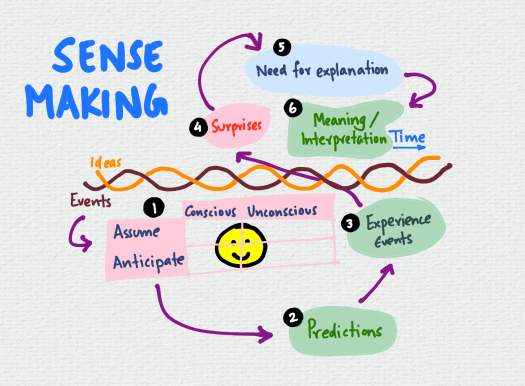
So we start with a flux of events and ideas, the braided rope of everyday life.

How do we make sense of what’s going on?

Take an approach that Meryl Louis set out in 1980.

She says that we the events we experience result in us making conscious and unconscious assumptions and anticipations.

What these let us do is make predictions.

Then… we experience events as they happen, as they unfold with time.

Some of them turn out like we predicted – but sometimes they don’t. We’re surprised.

That results in us needing to come up with an explanation – something that in turn helps us interpret and attribute meaning to the surprise we’ve just had.

Something that helps us make sense of it all.

So far so obvious – what’s the point of this all?

Well, one point is kind of screamingly obvious. All this happens in our minds. The actual flux of events and ideas doesn’t really care about any of this.

The second is that sense making is closely linked to surprise. We need to be jolted out of the everyday to see and discover something new.

Let’s say you do the same thing every day. You go to work, drive the same route, sit at the same desk, follow the same routine. How likely is it that you’ll experience something different?

Probably quite low.

It’s nice to have a simple life – one with routines. But if you’ve got too much of that, you need to get restless, a little worried, a little angsty about it all.

It’s very easy to assume that what you do is not very good, no one else will hire you, you’re not very marketable or sociable or attractive.

And if you’re in an environment (which you’ve constructed by the way with the decisions you’ve made over time) where your predictions about how things will happen come true all the time – then you’ve created a version of meaning, of sense as a result.

This can happen to individuals, to organisations, to families.

The antidote to the everyday is to get some surprise into your life.

And the thing is you don’t know where that will come from – you just need to create the opportunity for more surprises to enter your life, surprises that force you to re-examine your existing ideas and come up with new ones, ones that have a different kind of meaning.

Perhaps this needs an example. Perhaps not.

Here’s one. The fallacy of centrality.

This is the assumption that if something is important, then you’d know about it. And you don’t, so it’s not.

That leads to all kinds of problems.

Have you ever experienced a situation where someone new came in, promising to sort everything out. You put forward an idea for something that would make things better, but that person ignores you. They’ve never heard of this approach, so it clearly can’t work.

Except they then fail – and your approach works.

The problem is that the way in which they made sense of things failed when they experienced the events you did as well. Perhaps they were surprised, perhaps they learned from it. Perhaps not.

What this means for us is that the world is complex. For us to make sense of it all, we need to be alert to surprises, because that’s how we learn.

And if you’re not being surprised enough, you need to change something. Now.

Cheers,

Karthik Suresh

What Does It Mean To Be A Consultant Or Real-Life Researcher?

action-research-human-situations.png

Sunday, 6.13pm

Sheffield, U.K

There’s a story about how a Japanese company invented the first bread maker that you could use at home to make one loaf at a time.

No one had managed to create one so far. The way in which bread was kneaded by human hands seemed impossible to replicate with a machine. Perhaps it was just impossible.

So, one of the engineers at the company went to work for a bread maker for several months. He learned how to make bread and spent his time learning all the steps – the mixing, the kneading, the rising and everything else that goes into making the perfect loaf.

Then he went back and came up with a design. In the 1986, 84 years after Joseph Lee patented the first bread machine, the first bread makers for home use were released.

This little story illustrates something about how modern organisations work in real life that we often miss.

On the radio a few days back someone described how all organisations are now information processing machines. That isn’t a new concept, however. The Western approach has always seen companies as machines, as things that can be directed and programmed and controlled.

This is because of how much the scientific approach has influenced everything we see. The success of science in dissecting everything around us and explaining how things work according to laws and rules has made it the natural way to think about things.

Which is why you hear people talking about hypothesis and experiments in the context of startups and businesses. That’s straight scientific thinking. Reductionist and absolute and on a search for truth.

So, when you get consultants, especially those with a scientific or engineering background, coming into an organisation to improve things – you get a very strict, scientific approach to things.

I’m guilty of this. I saw many problems as technical ones – ones that could be solved with the right application of logic, mathematics or programming.

The thing that people like us miss is that human situations are not like scientific ones, especially stuff like physics.

The difference is that when you come up with a theory about how the earth and moon move around the sun, the sun, earth and moon don’t really give a damn what you think and don’t change how they act.

When Trump comes up with a theory about how to solve the U.S trade deficit, you get a global standoff that turns into history in the making.

The difference is what happens when people are involved.

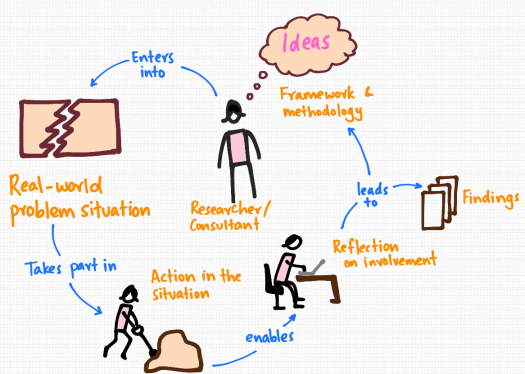
So, as a consultant, you really enter into a real world problem situation carrying some ideas you have, perhaps a framework and methodology that you think you can apply here.

Like the guy learning how to make bread, you also take part in the situation, doing things, working on things, changing things.

The difference between you and everyone else is what happens next.

This action also enables you to reflect on your involvement and learn from what is going on.

Now, you could be an armchair consultant or book writer – advising from a safe distance.

But, almost by definition, what worked for you in another situation is not going to work in this one, because the people involved are different.

You can’t step in the same stream twice.

The Japanese have a view on this – they believe that you learn through direct experience as well as from other sources – learning with your body as well as your mind.

As a consultant, you learn more through experience in the problem situation, because your reflection then lets you pull it all together, perhaps presenting your findings to the company and peers.

Importantly, it also helps you refine your own ideas, framework and methodology, giving you more that you can use the next time.

This model is adapted from Peter Checkland’s writing on action research, and is something many consultants do without realising this is what is actually happening.

Some, unfortunately, are too blinkered to realise that this is how the real world operates and instead try and ram through solutions that are based on reductionist and engineering principles.

Those people… you just have to wait for them to fail and leave.

Real change happens not just with the mind, but when you immerse yourself in reality – the reality of the company you are working with right now.

It’s about being open and prepared to learn, rather than an impartial provider of expert advice.

That’s how you’ll probably fix the real-world problem your client is facing.

Cheers,

Karthik Suresh

What Do You Do When Things That Are Obvious Are Also Wrong?

obvious-is-wrong.png

Friday, 8.48pm.

Sheffield, U.K.

I’ve been having a few thoughts about the purpose of this blog.

Why do I write it? What’s the point? What am I trying to do or sell or achieve or become?

The sensible answer, the one that is most Zen, is that writing is a practice. A practice like meditation or learning to play an instrument, or running. When you’re doing it, there is just you and the words and nothing else really matters – not the world, not readers. You write for you.

A different answer is that some of us just have to write – we just do. Anne Lamott, in her book Bird By Bird, writes about famous writers and why they write – because they want to, because they’re good at it – because God made them that way. Whatever works for you.

And then there is another reason – sometimes it’s by writing that we figure out what we think. And it’s by reading other people’s writing that we learn new things. And this whole writing and sharing thing just helps us all get better at dealing with the world around us.

Because… not everything we think is true is.

Like I found out today.

The kids, let’s call them A and B, were arguing over a toy. B had the toy all day and A wanted it now. So, one grabbed it from the other, the dispossessed screamed, there were tears and fighting and lots of noise.

All very normal really.

So, what would you do to make things right? Well… get them to share perhaps? Read both the riot act and tell them that they’ll each get it for a set amount of time and that’s that. Get the timer out and on.

I’ve done that before. Several times.

But, there has always been something odd about the result of this approach. They don’t seem too happy about it. A, in particular, has always been really unhappy about using a timer.

And I wondered why – surely it’s the obvious and fair thing to do – what other way would you go about doing this?

So, I typed these words into Google “why don’t some children like sharing toys using a timer” and came up with a blog article by Heather Shumaker called Throw Away your Timer: Why Kids Learn More when they Don’t “Share”.

Here’s what happens when you tell a child to give up a toy that he or she is playing with because the timer has gone off.

You’re forcing them to give up something when they’re not ready to do so. The good act of sharing that you’re trying to teach is associated with feeling bad as they lose something when they’re not ready.

It’s obvious really. You’d feel cross if someone took something away from you before you were ready to give it up. It’s like being mugged. Hardly a pleasant experience.

Heather says that what you should do is let the child that has the toy keep it until he or she is done with it. Wait till they are ready to give it up willingly as they move onto playing with something else.

The other child will need to learn to wait – and that doesn’t feel great either. Waiting – or deferred gratification – is, however, one of the most useful skills you can teach your child.

That’s the basis of the marshmallow test where kids that could wait when they were small went on to achieve much more later.

So, rather sceptically, I tried this approach. Kid A, who hated timers, was happy with this and let B play with the toy – although a little sad and convinced B would never give it up.

Ten minutes later, however, the two were sat playing happily together and A had the disputed toy.

So… in this experiment this approach worked. And it worked better than the sharing approach which seemed like the obviously correct way to proceed.

So back to the purpose of this blog.

The articles are about stuff that is interesting – to me anyway. Sometimes it’s management, sometimes it’s marketing, sometimes it’s about parenting skills.

There’s a lot of pressure in this world to be defined, to have clean edges, to be very specific about who you are and what your brand is all about.

But the real world isn’t like that. It’s messy and there are weeds and cracks and all kinds of unstructured, undefined and generally messy things.

IBM on LinkedIn said something like 80% of all data will be unstructured by 2020. Well, duh, the vast majority of data must be unstructured now. Think of all the words ever written and films and poems. Structured data is probably a minority of what’s actually out there.

Life is complex and obvious things are not always right.

And I think this blog is just one way to help me figure things out.

And if I’m lucky, like Heather’s article, it might help other people if they happen to have a similar question one day.

Cheers,

Karthik Suresh

Are You Preparing For The Changing World Of Work?

HR-IT.png

Thursday, 9.24pm

Sheffield, U.K.

Of course you are. Why wouldn’t you be?

If you’re running a large organisation, putting the systems in place to help your team work anytime anywhere has been a top priority for your IT team.

It’s also been the priority for the last tech giants for the last decade. And now you can run your entire business from the cloud.

If you’re a newish company, that way of working must just seem natural.

But here’s the challenge, as I see it.

A Google funded study in 2010 found, perhaps unsurprisingly, that collaboration and innovation are closely correlated.

So, encouraging the first should help with the second.

So, how do you go about that? Well, you start by providing the tools that organisations like Google sell – according to them anyway.

And that raises other issues, and perhaps some of these are familiar to you as well.

In most organisations, the balance between having room to create and innovate and the need to be secure and locked down usually ends with everything being locked down.

You’re free to do anything you want, as long as it’s in Microsoft Excel or Google Docs.

And that is increasingly not very much. In the online version of Excel, for example, you can’t really do much with macros or automation. Getting started is harder in Google docs.

Many employees in companies are probably frustrated.

Frustrated because they know what good should look like, but they’re working with tools that are so limited for security reasons that they might as well be working with a typewriter for all the increased productivity they get.

Now, that’s not an easy circle to square. Yes you’d love to give all employees a free rein to do whatever they like. But you don’t want your system crashed or open to anyone, especially someone who decides to delete all your data because they have a grudge.

I know of many organisations that still struggle with simple tasks – like doing a mail merge. They still have to edit and send out documents one by one.

At the other extreme – you have some who say that what you need in a company to be innovative is people that wear t-shirts that say things like “Safety third”.

The first time someone actually has an accident, however, the lawyers will come in and close everything down.

It may be that we’re in the middle of trying to reconcile and understand this new way of working.

Or – more likely – we’ve simply had this problem all the time. How do we get people and machines to work better together.

And the place to start is – we don’t.

Machines are good at repetitive, mechanical tasks.

People are good at creative and social tasks.

We should start by getting machines and people to do what they are good at.

It’s only when we have to get machines and people working together that we should, very reluctantly, put them together.

Does that sound bonkers. Completely unreasonable?

Well… let me ask you this.

If you weren’t able to get to your mobile phone all the time – perhaps you left it at home – just how much more work would you get done without being interrupted?

Cheers,

Karthik Suresh

What Do You Need To Know To Be A CEO?

ceo-questions.png

Wednesday, 9.42pm.

Sheffield, U.K.

Would you want the top job – to be in charge – to be the one with the responsibility?

Shakespeare said it best – Uneasy lies the head that wears the crown.

The thing is… even if you never want to be the CEO of a massive multi-billion dollar organisation, you’re still the CEO of something. Your own life. Your family – even if it’s a joint role.

And it’s worth taking the effort to think like a CEO – to think like a person who has the responsibility for making decisions, allocating resources and deciding strategy.

Because… as the saying goes, you’re either working towards your own goals, or you’re working towards someone else’s goals.

So, what are the key things you need to know – distilled from this McKinsey interview guide?

1. What’s your direction of travel?

All strategy comes down to this question – which path are you going to take, which road will you follow?

Is it the one with the footfall, or the one less travelled by?

You can dress this up as vision, mission and lots of other buzzwords, but the first decision you make is to look around and point in the direction that you think is the right one.

2. Where did you start?

You’ve heard the saying, if you don’t know where you’re going, how do you know when you’ve reached there?.

Well, if that’s point 1, the point following closely behind is knowing where you started from.

The ambition of the vast majority of professional managers is to manage their numbers.

They need to set and meet targets – they’re under enormous pressure from the markets and investors and stakeholders and those kinds of people.

Beware of people who always make their numbers. As Warren Buffett wrote, people who always make their numbers will at some point be tempted to make up their numbers.

If you want to make real, meaningful change, you need to be clear on where you started.

That’s your baseline. And that is fixed. Although, as we know from painful experience, nothing is really fixed. A number can be anything you want it to be.

I read a story of a young person who went to his family accountant to be trained. He did the accounts as the rules said, and showed them to the accountant.

The accountant laughed, called his uncle and asked how much profit they wanted to report this year. Then, the accountant reworked the numbers to make that figure work, staying within the rules.

So, perhaps it’s best not to worry too much about accounts.

Cash flow, on the other hand, that’s another thing altogether.

3. Culture – what’s that?

Well, chasing point 2, culture is about the belief system that builds around you as the CEO.

A CEO that encourages gaming, like in the accounting example below, will end up creating an organisation where gaming is considered a normal way of operating.

Bernie Madoff anyone?

On the one hand, creating a good culture is pretty easy – just treat people as they would like to be treated.

On the other hand, it’s a chaotic and constantly evolving function of social groups, and organisations are more about politics than about achieving any real rational purpose.

And because most of us know what we want but find it hard to appreciate what others want, we’re sort of blind to what needs to happen.

But that’s something you can learn by simply opening your eyes and ears. As Yogi Berra said, you can observe a lot by watching

4. Then, it’s all about you

This is simple. What skills are needed to do the top job.

Then, do you have those skills?

5. What do you need if you’re not going to fail?

Many people think that being the CEO is about being the boss – having final say in everything.

That only happens when you also have control – when you’re the founder or have a controlling share or both.

The rest of the time you have people breathing down your neck. You’ve been hired to fix things, or grow the business, or make money. So why aren’t you?

You need to be clear on the non-negotiables, the red lines of your career as the boss.

Do you want final say on hiring? Do you get to tell the Chairman that his or her kid can’t just get a senior job?

You need to be clear on what you need to get the job done – no questions asked.

6. Are you going to make friends with everyone?

As the boss, you’re going to be the face of the company, inside and outside.

You’ll need to be friends with the cleaning crew, the administrators, the consultants, the contractors, investors, shareholders… the whole bunch of people that all want some time or attention from you.

Are you the kind of person that likes that? Or can at least cope with that? Or be really good at that?

You really need to be the kind of person that goes and sees what’s happening at the front line. That mucks in. That has facetime with as many people as you can.

They won’t come to you – you need to go to them. At least that’s what you need to do if you see your job as CEO as serving and enabling your team to do their best work.

Because… when it comes down to it you don’t actually do anything as the CEO – whether you succeed or not depends on whether everyone else around you has the tools and ability and drive to do their best.

So, perhaps the most important thing you should do as CEO is remove the things that get in the way of the people you rely on.

Cheers,

Karthik Suresh

Why Trying To Respond To What’s Going On Is A Bad Idea

social-proof.png

Monday, 9.25pm

Sheffield, U.K.

It’s easy to fall into the trap of thinking that what you do is unimportant – to get intimidated by the very visible success we see others having all around us in a connected world.

Let’s say you’re starting a business and it’s in a pretty competitive industry like software development? How are you going to compete against everyone else out there?

You see this all the time, especially in new areas. For example, there is an emerging literati of blockchain, big data and machine learning specialists that seem to be doing very well, if you look at their presence on social media.

And you inevitably get marketers who come along and ruin everything.

Take reciprocation, for instance. That’s the idea that if you do something nice for someone else, they’ll feel obligated to you and do what you ask.

The basic idea is a sound one – be a nice person. Do things for others without being asked.

What this turns into is a series of posts that tag an influencer, praising them, with the aim of getting the influencer to thank the praiser and lift them into the limelight.

You’ll find a number of methods like this that promise to help you “growth hack” your way to success. Need content – just reach out to a hundred influencers, get their thoughts on the subject, compile that into a book and you’re on your way.

There are two fallacies at work here, and a knowledge of investing principles will help you identify and step around them.

The first is this – if you’re finding something out for the first time on the internet, the chances are that you’re too late to profit from it.

Many people invest in stocks the wrong way.

They see a stock going up and up, and get excited. They see it being covered in the paper – on the news – in tips in newsletters. They pile in, eager to ride that baby up.

Then, it turns and sinks. They’re sitting on a loss, panic and sell.

Buying high and selling low is not a good investment strategy.

But somehow it becomes the default strategy of many people.

If you don’t think you’re one of them, check to see if you sell much on Ebay. Do you buy (or does someone in your house buy) lots of nice things that they never wear and then sell them on Ebay later?

Do they calculate the loss they’ve made on buying new stuff and selling it second hand? Or are they overjoyed over the amount they’ve made selling on Ebay?

If it’s the latter, perhaps you shouldn’t let them manage your investment portfolio.

The point here is this. By the time the general public realises that something is happening with a stock, the thing that is happening is well on its way and close to petering out.

For a dramatic demonstration of this, just check out what happened to crypto last year and then what’s happened this year.

Most of the stuff on the Internet tries to get you to empty your wallet in return for learning how to make money on the Internet.

All the hacks you’re picking that rocketed others to success are ones that are unlikely to work as millions of others like you try and take advantage of them as well.

As Warren Buffett wrote about poker, “If you’ve been in the game 30 minutes and you don’t know who the patsy is, you’re the patsy.”

Don’t be that guy.

The second fallacy is thinking that you can predict the future and call the next big thing.

Many investors try and call sectors. Blockchain is the next big thing. A VC is going to raise a $50m blockchain fund. A startup has raised $30m in 31 minutes. So, it must be hot and worth investing in.

It’s incredibly hard to outperform the general market. You’re going to fail over 90% of the time.

Yet people persist in trying to do that. They argue that active investment adds value, even though the majority of active managers lag the market once their fees are taken into account.

The only people who get wealthy from actively managing your money are the managers.

So, what can you do to hold on to your money?

Most successful strategies are a variation on sticking to your knitting. Buy the whole index. Put the same amount of money in each month. Keep it simple.

Focus on your behaviour – not on what the market is doing. The market is there to serve you, not to guide you.

Okay… so what does that mean for me?

The point is that you can look at what’s happening around you and decide that the way for you to succeed is to do what other people are doing.

But – the chances are that kind of thinking isn’t going to work.

It isn’t going to work because by the time you see how the trick is done, the magic is gone.

Instead, you’re better off focusing on the work – the stuff you do that makes you feel like you’ve had a good day at the office. Or the workshop. Or the shed.

If you focus on the work, then one day it may lead to people getting to know your work, appreciating your work, spreading the word and eventually result in a raving fanbase who follow your every word.

If you try and build the fanbase without putting in the work – by trying to do stuff that you think will appeal to them – you’ll end up creating a shallow and insipid copy of someone else’s magic.

Real investors don’t chase trends.

They get in position, do the research and get ready. And then a trend comes along and lifts them up.

Do work that matters to you.

Then it won’t matter whether you get anything else. It’ll be gravy.

Cheers,

Karthik Suresh