How Do I See What You See?

collaborative-model.png

Friday, 9.58pm

Sheffield, U.K.

Since we cannot change reality, let us change the eyes which see reality. – Nikos Kazantzakis

Once upon a time things like chaos theory and complexity theory seemed very interesting.

They seemed to show so much promise at explaining the world around us.

Chaos, after all, is like the weather – made up of so many unpredictable interactions that it’s incredibly hard to predict what’s going to happen next.

But then, on the edge of chaos, you have complexity.

The space where complex behaviour emerges, like the Mandelbrot set, or like flocking behaviour from the application of simple rules.

But then you realise that such theories only explain some of the physical world around us.

They don’t explain the downright weird behaviour of people…

Or the perfectly normal behaviour of people, seen from a different point of view.

For example, when climate activists shut down London demanding the UK get rid of all carbon emissions by 2025 some people thought that was a perfectly reasonable thing to do.

Others thought it selfish and short-sighted.

Others thought the sentiment right but disagreed with the timescales.

Who is right?

What happens is that people always see things from a point of view, through a lens tinted a particular colour.

And it’s not easy to look at things from a different point of view, especially if you have emotions and identity and belief embedded in a particular one.

The only way to resolve this is through dialogue – once you have realised that you don’t think the same way and regretfully have given up on the idea of simply carting everyone who disagrees with you to a re-education camp.

We probably spend less time on learning how to better conduct dialogue than we should.

A paper by Rousseau, Billingham and Calvo-Amodio sums up the problem.

They say that if you use a term it invokes a concept in your mind – a set of related ideas.

The concept models something in the real world.

And the term refers to something in the real world.

A simple model – and according to some points of view really very wrong.

Take a term like Collaborative Conceptual Modelling (CCM), something that Barry Newell and Katrina Proust have written about.

If you read their material CCM is a way of creating models.

The real world has people stood together creating models – collaboratively conceptualising a model.

Bear with me…

The term CCM could invoke a concept of a model, as shown in the picture.

The conceptual model, however, is not a model of real life because real life is about a group of people standing together creating the conceptual model.

There is a difference.

Okay, this is pedantic, and why does it matter anyway?

It matters because the other thing that Newell came up with was the concept of a ‘Powerful Idea’.

Now, that’s a nice term.

A Powerful Idea is one that can be shared – one that brings together different viewpoint and reconciles them, creating a new, common one.

But it’s wickedly hard to do.

And really easy to get wrong.

But that shouldn’t stop us from trying – because there are a lot of areas in the world now where we’ll only make real progress through dialogue.

And so we’re going to have to try and do it better.

Cheers.

Karthik Suresh

References Rousseau, D.; Billingham, J.; Calvo-Amodio, J. Systemic Semantics: A Systems Approach to Building Ontologies and Concept Maps. Systems 2018, 6, 32.
How To Round Out Your Thinking

rounded-thinking.png

Thursday, 8.49pm

Sheffield, U.K.

Abstract thinking leads to greater creativity… But in our businesses and our lives, we often do the opposite. We intensify our focus rather than widen our view. – Daniel H. Pink

We’ve all met practical people – people who want to get on and get the job done.

Perhaps you’re one of those people.

A no-nonsense, down-to-earth sort of person.

You know what you know and believe in the value of experience.

If you don’t know how to get it done you’ll find someone who does.

In the process, you’ll surround yourself with good people – a team – and your business will do well.

Or maybe you’re a restless risk-taker – some always looking for the next opportunity.

Someone ready to experiment and invest in the new. A Richard Branson type who starts an airline because he’s delayed on a trip and figures he can do better.

It can seem like those are your two options for how to go through life.

Either be someone who actively experiments and changes the world.

Or be someone who is solidly planted in the real world.

Be a river or be a rock. Those are your choices.

Or are they?

An article by Beverley Kaye in the book Learning Journeys is an interesting example of how to think about this.

Dr Kaye writes about her experience defending her doctoral dissertation.

She was a checklist sort of person, a get it done sort of person.

She was prepared and ready to check off the defence of her dissertation.

Except, she ran into trouble.

She was operating from her flat side, she was told and needed to get more rounded.

But what did that mean? And how could someone so practical and in the real world get their heads around that?

And it’s not an easy thing to do.

You know the story of the unreasonable person.

Reasonable people adapt to the world around them.

Unreasonable people adapt the world to themselves.

All progress, therefore, depends on unreasonable people.

Those hard-headed business folk, whether rock solid or fluid experimenters are unreasonable people and have given us products and services that have changed lives.

Externally anyway – not so much internally.

We’re stuck in a consumer society and many people, although they are technically among the wealthiest in the world don’t seem particularly happy.

What’s lacking is inner change.

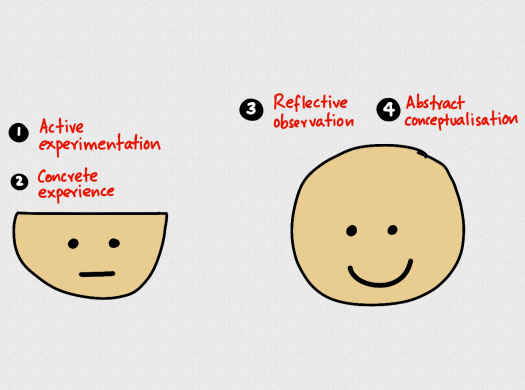
The Kolb Cycle says there are four ways to learn: active experimentation, concrete experience, reflective observation and abstract conceptualisation.

The first two are easy to recognise – we all start with flat heads.

The ways that round us out are harder to understand.

Can you look back at your life, at the days you spend – just look at them without criticism or judgement and try to see them for what they are?

How did that last meeting with a prospective client go? What worked, what didn’t – was she happy, difficult, neutral?

If you were someone else looking at your life what would you see, what would you think?

And what would you think was going on – how would you conceptualise the situation?

Or, more simply, how would you explain what’s going on?

To see things for what they are and come up with an explanation for why they are what they are is an attempt to round out your thinking.

To try and see without filters, blinders or anything else in your way and to try and look for explanations that are clear and plausible is the way to get started.

And then, if Dr Kaye’s experience is anything to go by, then one day you’ll just get it.

Cheers,

Karthik Suresh

What Is A Crucial Question To Ask If You Are A Service Provider?

customers-customer.png

Wednesday, 9.54pm

Sheffield, U.K.

The ‘U’ goes before ‘ME’ in Customer. – Janna Cachola

How many businesses can you think of that are pure product plays now?

Natural resources and commodities perhaps.

And of course all the factories pumping out things from shampoo to chocolate.

But many businesses depend on a combination of products and services and when you’re selling to someone else they might be buying your product but they’re taking your service into account as well.

Which makes it useful to study exactly what’s going on when you try and pitch your product or service to someone else.

If you make a box, for example, you could find a prospect and show off your box.

Your prospect is probably stood there with folded arms – she probably already as a box supplier and doesn’t really see what you do differently.

If your box is a service, like management consulting it’s harder to see the point of what you do.

Either she believes she doesn’t need you or already has a provider.

The mistake most people make is to focus on the features and benefits of what they’re offering.

Asked why they’re different – what’s their Unique Selling Point – they talk about their people, how nice they are and how good their product is.

Faced with objections they go on the offensive – ready to “handle” them, brush them aside, tear them down or climb over them.

And that’s irritating – like when someone uses the strategy of agreeing with everything you say so that they can then repeat what they just told you.

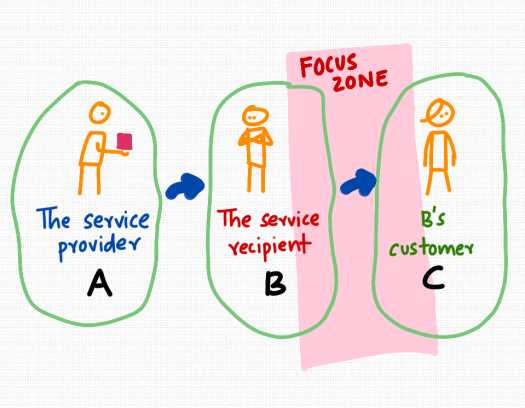
So that’s where a model like the one above, based on the one in Soft systems methodology in action, written by Peter Checkland and Jim Scholes, comes in.

Checkland and Scholes quote Richard Norman who says that the question is not “Who is my customer” but “Who is my customer’s customer”.

If you are the service provider, A, and you are trying to sell to the service recipient, B, and you focus on the transaction between A and B – there you are product in hand facing a reluctant and irritated counterpart.

Yes you could argue that they shouldn’t be like that – that they should be open to salespeople because that’s how they are introduced to opportunities – but people are people and if they don’t like being cold-called you’re not going to change their minds.

However people who don’t like being sold to open up and become much more interested when they talk about how to serve their customers better. Let’s call those folk C.

The transaction between B and C is of vital interest to B. That’s something that matters and anything that makes it better is worth considering.

So, if you want to sell B your service you need to figure out how best you can help B add value to C.

That’s your focus zone.

Now this seems, like the authors say in the book, a simple and obvious model.

But just think back of the number of times you’ve been in conversations where the focus was about A and B and C wasn’t mentioned at all.

The fact is that if you want your service to be considered your attention and the time you have with B needs to be spent on the focus zone – where you think about how the two of you (A and B) can add value to the transaction between B and C.

If you can really add value then you will find B open to the prospect of sharing value with you.

And be warned, value is not always easy to find.

Technological solutions that cut costs for B, for example, rarely raise margins. Instead the savings are passed through to C in the form of lower prices.

Good value, sustainable value comes from adding something more magical – by creating competitive advantage for B and C in some way.

But what is sustainable competitive advantage?

Well… ideas for that are going to come out of your discussions as you explore the focus zone.

But here’s a suggestion – prioritise ideas that are inimitable – hard to copy.

Because that can often be the secret to advantage – doing something no one else can.

Cheers,

Karthik Suresh

How Do You Get Started When Thinking About A Problem?

problematic-situation.png

Tuesday, 9.20pm

Sheffield, U.K.

If you break your neck, if you have nothing to eat, if your house is on fire, then you got a problem. Everything else is inconvenience. – Robert Fulghum

I think I wrote something a while back about experiencing a block when trying to think about a business problem.

This particular one had something to do with organisation structure.

When you look at how organisations are structured you find that you can classify them in different ways.

For example, you could look at them as highly centralised, silos, networks and so on.

So, you’ve given the organisation structure a name – now what?

That was the problem I came up against – saying you think something is something simply says you think A = A.

It says nothing more about whether A is good or bad or what you should do to make A better.

It’s like being frustrated by someone and swearing at them.

It doesn’t really change anything about the situation at all.

The point is that we’re in the vicinity of a problematic situation and how we think about it is going to affect what we do next.

For example, say you’re married and have children you probably face quite a few problematic situations.

You’ve got the situation in the morning, getting everyone ready and fed and off to school and work.

You’ve got the situation around homework and the balance between letting kids play, spend time on screens and getting enough sleep.

Problematic situations often overlap with other problematic situations.

Your employers may want you in the office at the same time that you need to help with getting the kids to and from school.

Then, of course, you have any number of problematic situations at work.

These range from getting sales numbers up to recruitment and retention, keeping clients happy to getting new equipment for the office.

On the whole we just get on with these situations – many of them can be solved with planning, preparation and some shouting.

But others can’t.

Especially ones that involve more people, more situations, more moving parts.

At this point, you’ve got to figure out where you are on the map in relation to the problematic situation.

Are you in the middle of it, enveloped by it and flailing about?

Are you outside, looking on with interest but without involvement, feeling or fear?

For example, let’s say your company has set sales targets.

Is that something that affects you personally?

You’re worried about what you’ll miss out on if you don’t hit the numbers, excited by what you could get if you do?

Or is sales something someone else does while you get on with the job in front of you?

Or are you a consultant, desperate to get involved and show how clever you are?

Well, from my experience, when you’re on the outside your experience isn’t worth as much as you might think.

That’s because the models you have – the sales boards, targets, mission statements, CRM systems and all the other tools you’ve used successfully are the kinds of tools others know about as well.

On the other hand, when you’re inside the organisation you might not know as much as you think you do.

That’s because you only have the one experience – perhaps a few others – but in the main the one you’re having right now.

And it’s hard to step back from that experience because you see what is going on so clearly – you see the people and the politics and the culture all working together. Not working well, perhaps, but working nonetheless.

So, to change things you need to move closer to the edge from wherever you are.

If you’re too close you need to step back so you can start to see the bigger picture.

If you’re too far away you need to step closer to see the detail.

You’ve both got to take some steps on the road.

The further apart you are the bigger the difference in what you’re seeing – in your points of view.

You’ve got to get closer and so the first job for anyone trying to work together to improve a problematic situation is to get to a point where you’re both looking at roughly the same thing in roughly the same way.

And then you can make a start at talking about the problem.

Cheers,

Karthik Suresh

How Do You React To Questions Or Suggestions?

reactions.png

Sunday, 9.26pm

Sheffield, U.K.

Think twice before you speak, because your words and influence will plant the seed of either success or failure in the mind of another. – Napoleon Hill

There are two ways to deal with the world: scientists try to explain it and artists try to see the value in it.

In other words, scientists try and interpret it while artists try and appreciate it.

But why is that? Is it just natural to look at things that way or is there some reason why artists resist explanations and scientists resist any attempt at being less than completely objective and value free.

These types of questions led David Cooperrider to look again at how organisations functioned and suggest that you could stop thinking in terms of solving problems and more in terms of appreciating mysteries – something he called Appreciative Inquiry.

In other words, stop trying to solve your problem. Instead, appreciate the nature of your situation.

This attempt to reframe the discussion apparently did not go down well.

And one reason for that is the way we react to suggestions – the way in which we react to words.

Before we look at what that means we need to remind ourselves that the things we see in the world didn’t come into existence fully formed and perfect.

Although you now see institutions everywhere – companies, courts and senate halls among them – there was a time when they didn’t exist.

It’s easy to see this if you’ve ever tried to arrange a trip with friends or planned a startup.

The trip or the startup didn’t exist before you started that first conversation with your friends.

The words you spoke to each other, the shared meaning you created and the agreements you made resulted in creating the trip or startup that then emerged.

In essence, the words you spoke had real power – although simply vibrations in air they caused something new to come into existence.

This way of thinking about things is a social constructionist approach – the idea that the world around us is created from the conversations we have.

And that makes the words you say important.

Very important.

This can be hard for someone like me, who believes themselves to be rational and relatively unaffected by the emotional content of words, to appreciate.

But you can see the impact of words every day – probably every time you have a conversation at work or with friends.

Let’s say you want to start a business – a new agency.

There will be people who will be negative about the whole thing. They’ll tell you it’s a bad idea and list all the things that could go wrong, believing that they are being helpful.

Or perhaps you want to marry someone from a different religion.

Your family may simply say No! Not if you want to remain a part of their family.

There are those people who find problems everywhere they look.

They may agree that things should improve, we should take action but here are the reasons why it needs to be thought through or slowed down or checked over.

These are people who like committees – where good ideas go to die.

Then you have people who are both helpful and positive, people who say yes, and give you more suggestions on what you could do and how you could avoid risks.

Some people believe that what needs to happen is that problems need to be solved – we need to find out what’s wrong and what needs to be done to fix things.

The appreciative inquiry approach tries to use a different approach – a positive one that uses questions and stories to look towards a better future.

Although, it isn’t just supposed to be a way to go to your happy place.

Appreciation is about seeing the whole for what it is, warts and all.

Seeing the beauty of what is as well as noticing the cracks that mar its surface – and then taking steps to touch up or improve its appearance.

But the secret is that the way to creating that new future starts not with decisions, resources or actions.

It starts with words.

And it’s limited only by what you agree to do together.

Cheers,

Karthik Suresh

How To Make A Real Difference – For You Or For Society

praxis.png

Saturday, 8.34pm

Sheffield, U.K.

In theory there is no difference between theory and practice. In practice there is. – Yogi Berra

I learned a new word today – praxis.

It has a long history – back to Aristotle, it seems.

Aristotle said the work we do results in theory, produces something or is practical.

The reason they are different has to do with the why question – why do we do each type of work?

What’s the purpose behind each one?

If you study maths, say something like number theory, you do it for the sake of the knowledge itself.

For example, the mathematician Srinivasa Ramanujan once explained that the number 1,729 was a very interesting one.

It’s the smallest number you can get to by adding two cubes in two different ways.

Now – you’d want to know that really only for the sake of knowing it.

Although, number theory turned out to have quite a few applications later on – at the time mathematicians like Ramanujan were interested in it really because it was interesting to them – and that was all there was to it.

They’re the folk, I suppose, that contemplate on top of a mountain, and think their way to truth.

At the foothills, you find another sort of folk – productive ones.

People who work close to the earth – making things.

They use techniques – methods that result in something predictable.

Like pots, or washing machines or asphalt.

But then there’s another sort of person – the type Aristotle calls practical, which sounds quite similar to productive but is not the same thing.

The productive person knows what the end goal is.

The practical person doesn’t.

Instead, they face situations – situations where there is no clear answer, no one true way.

They have to use judgement and thought and feel and the kinds of things that aren’t easily expressed clearly as a theory or as a technique.

One way to think of it is as an oscillation, or more visually, a route march from theory to practice and back again.

For example, you might start a new job in a fast growing company.

Experience the joys and stresses of the early days.

And the predictability, higher income and maddening bureaucracy in later years.

All these are experiences that you get while doing productive work.

But do you know why you feel good or bad?

Why you like your job or hate it?

There are simplistic explanations – like most poople leave bosses, not jobs.

And that what’s going on is institutional discrimination.

But then if you get a chance to actually study the theory – you might be introduced to the concept of modern and post-modern organisations – and that gives you a way to understand your experience and perhaps look at it differently.

Something new happens when you use theory to understand what you’ve experienced.

Or when you try and apply theory to improve the situation you are in.

And in turn, use the experience you get by applying theory to look back and improve the theory itself.

That kind of activity is praxis – the journey between theory and practice – the mixing of the two until there is no start or end, just the journey.

And if you want to make a real difference – especially when it comes to important situations – for you personally or for society as a whole – praxis is the way to go.

There’s a reason why theory for theory’s sake is confined in ivory towers.

And a reason why just focusing on the bottom line or the method or the engineering is not enough to solve complex societal issues.

What we need is practical action informed by theory.

Cheers,

Karthik Suresh

Solving Problems Versus Improving Situations

wicked-problems.png

Wednesday, 5.10pm

Sheffield, U.K.

For every complex problem there is an answer that is clear, simple, and wrong. – H. L. Mencken

One of the things about real-world problems is that there is often no way of knowing if you are solving them or making things worse.

A lot of people talk about problems being wicked.

That sounds good – better than complex or difficult – wicked is more about messy, complicated uncertain situations.

But it isn’t clear – what is it that makes a problem wicked?

If you want an academic discussion you might like Guy Peter’s analysis here but I was wondering if we could pick out a few types of problems to consider and see if they might be called wicked.

The effects of feedback

The first type is one that you’ll see quite often, once you’re aware of what’s going on.

For example, you need to invest in sales and marketing to grow your business.

In many businesses that’s not something that will result in immediate sales.

What it does is raise costs straight away.

Increased costs mean profits go down.

The powers that be order costs to be cut which then results in a reduction in the sales and marketing budget.

This process ends up going from left to right and back again, linking two activities that cannot be done at the same time – investing in sales and marketing and cutting sales and marketing costs.

So what this does is set up an underlying tension in the business – an oscillation as the business bounces from investment to cost-cutting and back again – with no real solution or continuity.

Incompatible objectives

When you go to an elite university you will have a choice: social life, sports and grades.

Pick any two.

You can stay out all night partying and do last minute cramming, ending up with great memories and a good degree but you’re not going to get out to the playing field early every morning as well.

If you’re training hard the alcohol, fast food and indulgences are out.

It’s gym and the books for you.

The thing is you can do any two well – but if you try and do all three you’ll probably fail at all of them, or at least not do very well.

And this kind of thing carries on.

Time, cost and quality, for example.

If you increase or decrease one you’ll normally affect the others/

If you increase quality, you’ll probably spend more in time and money.

If you cut costs, quality is going to be affected.

These objectives cannot all be met – and that means when you work on one you’ll affect the others – and not in a good way.

Irreconcilable differences

This comes down to people – how they think and how they act.

There are so many situations where the differences are so big that there seems no possible way to reconcile them.

Take every conflict situation out there, between ideologies such as capitalism and communism, between religious views, conflicting opinions on everything from co-sleeping to gay marriage – there are people for and against who will never see things from another person’s point of view.

Tragedy of the commons

And then you have situations where although we should collectively act in one way the incentives are such that we make things worse by acting selfishly.

For example, if you farmed along with other people on common land, ideally you would make sure that everyone’s animals could feed.

For you, however, the more you feed your stock the more you benefit.

For many of us the way we live – the amount of packaging we use, the number of times we replace clothes, the amount of food we throw away – is unsustainable.

We know that – but we do it anyway.

It’s not evil – maybe it’s selfish but that’s the way things are.

What can we do about wicked problems?

For a start, we need to stop thinking about finding solutions.

There isn’t going to be a point where we can step back and say we’re done.

Maybe it’s thinking about things being dynamic rather than static.

It’s hard to spin a ball on your finger and keep it spinning – but maybe that’s the image to keep in mind.

You’re trying to reach a compromise, an accommodation, an improvement, something people can live with.

All weak sounding words – much less appealing than solving, winning, resolving.

But more realistic and achievable in the real world.

Something that keeps everything still spinning.

Cheers,

Karthik Suresh

What Are You Trying To Do For A Client Or Employer?

consultant.png

Sunday, 9.46pm

Sheffield, U.K.

When you change the way you look at things, the things you look at change. – Wayne Dyer

If you’re trying to build a business or just get ahead in your career how should you think about your job?

Should you turn up and expect to be given work to do and told what sort of training you need?

Or can you take the initiative and figure out what you can do to add value?

But that’s not easy, especially if you’re early in your career or trying to change roles. It can be hard even if you’ve been in a job for a while and get given more responsibility.

Change usually starts, however, with a change in mindset and it might help to start with a model of how a consultant might operate.

Let’s say you go into an organisation as a consultant: it doesn’t matter what kind – marketing, IT, sales – what is it you’re trying to do?

Clients don’t always know what they want or need

It probably doesn’t come as a surprise that most people don’t really have a clear idea of what they want or need.

Only the simplest problems can be reduced in that way – most real problems are more complex and there is no right answer.

So one skill you have to develop is to listen to what clients say they want and try to figure out if that’s what they need.

That’s where your experience comes in – and your skill at educating them on the difference between the two.

Look at the big picture

Your value really comes from your ability to look at the big picture – to see how the various elements in the business operate and spot the cracks and flaws and missing pieces.

It’s very easy to get draw into the detail and miss what’s really going on.

And you can only do that by keeping your eyes open and trying to look at the situation from multiple perspectives.

You need to understand the people involved

Perspectives live in people’s minds – and you have to talk to them to see what’s going on.

Whenever there are people working together there is politics – the tensions and fears and desires are always there, simmering below the surface and occasionally bubbling over.

You’ve got to understand the people and figure out which ones matter in which way and how to keep them engaged and informed.

Communication is oxygen

The way you keep people informed and engaged is by communicating – not just for the sake of communicating but because you want them to understand what is going on and tell you early whether they think you’re on the right track or see problems.

Many people won’t speak up until it’s too late – and they won’t speak up unless they feel it’s safe to do so.

All too often you think you’re doing a great job only to find later that other people had a completely different idea of what you were doing.

Suggest a way forward

As a consultant you’re there for your advice – for your thoughts on which direction to go in.

And that means you need to have an idea – based on research and analysis – for what needs to be done next at each stage of the process.

You have to look up from the work, look around and point where you need to go to next.

Be a professional

What does it mean to be a professional?

One way to look at it is that you’re being paid.

But a more important way to look at it is that you’ve committed to deliver – to get the job done.

You’re taking responsibility – a personal one – to see the job through and not just abandon it because the going is tough or things aren’t working out.

Being a professional is about showing up even on the days when you don’t feel like it.

Everyone is a consultant in knowledge work

Work is increasingly about applying knowledge – and that is what consultants do.

If you see yourself – even if you’re employed full time – as a consultant to your employer then you’ll see yourself differently.

You’ll look for ways to add value – even if that means persuading people and changing the system.

And that skill is not a bad one to have.

Cheers,

Karthik Suresh

The concepts in this post are based on the paper “Consultant or entrepreneur? Demystifying the war for talent” by Stephen Stumph and Walter Tymon Jr.

Why You Can’t Prove Your Methodology Will Work

certain-vs-human.png

Saturday, 9.12pm

Sheffield, U.K.

If I knew for a certainty that a man was coming to my house with the conscious design of doing me good, I should run for my life. – Henry David Thoreau

Imagine you run a marketing agency.

What do you do when you have to go and see a client?

You create a Powerpoint presentation.

Perhaps a really nice, flashy one – or perhaps a simple one with diagrams.

Which probably look something like the images on the left.

That’s just what people do in business – mainly because other people do that and we need to keep up.

But, as Robert Pirsig writes in Zen and the art of motorcycle maintenance, something happens when you stop looking at the image as a way of saying something and more as a thing in itself.

What you see are perfect shapes – ellipses drawn by a machine, arrows straight and true, text generated by computer.

It’s perfect isn’t it?

And I suppose we hope that the people listening will see all that perfection and realise what we say is true.

And this is important to us because we can’t prove it’s true – not for any activity that involves human activity anyway.

For example, let’s say you have enough money to do a seminar by someone like Tony Robbins – a world-famous coach.

You’ll see words like a proven method in the literature.

Now, to be fair to them, what they mean by proven is tried and tested.

They don’t mean proven in the sense of it has a proof – or evidence of truth.

It’s a technical argument, but bear with me.

If someone says “I’ve tried Tony Robbin’s method and it works” – it’s fair for you to ask “How do you know it wouldn’t have worked if you tried any other way?”

If they say “I’ve tried it and it doesn’t work” it’s equally fair to say “How do you know that you failed because you didn’t do it right?”

There is no answer to either of these questions – and so no way of proving them one way or the other.

In other words the words we use – like proven – and the pictures we use – of perfection – are really a way to convince people to believe what we say is true.

So then look at the picture on the right.

That’s hand-drawn – clearly not symmetrical and clearly not perfect.

It looks like something that is a work in progress – something that you could mark on yourself with a pencil.

And that’s important when trying to actually work on a complex real world problem.

For example, every time I present a perfect presentation like the one on the left to a client I’m painfully aware that this makes me look much more certain than I am.

The reality is that there’s no approach that can just be applied to a company picked at random and be expected to work.

Take content marketing, for example.

Ten years ago some smart people and companies created blogs and content.

Like Seth Godin.

Now there are probably half a billion.

Given that level of competition will that approach still work for companies as a marketing tool?

The only honest answer is that we don’t know – we’ll have to try it and see, with the will to stick it out for ten years.

Why is any of this useful or relevant?

My bet is that we’ll get better and better at doing the perfect stuff with machines.

Just look at how Wix and Canva are killing things like logo design and brand identity.

What humans need to do is work together – and collaborating means being open about we don’t know and sharing work in progress so we can all contribute.

What the left hand picture says is This is what you should do.

The right, I think, says This is what we could try – what do you think?

If I were a marketing consultant selling to you, which approach would you rather I take?

Cheers,

Karthik Suresh

How Would You Feel If Everything You Did Was Completely Forgotten?

on-writing.png

Thursday, 9.25pm

Sheffield, U.K.

If you would not be forgotten, as soon as you are dead and rotten, either write things worth reading, or do things worth writing. – Benjamin Franklin, Poor Richard’s Almanack

I feel like reflecting a little today.

They tell you to do that at University – look back at what’s happened to help you learn.

And the reason for this is that this is my five hundredth post – and that seems a good point at which to reflect.

I didn’t really have a plan when I started writing – arguably I still don’t.

The idea was to write – spend time stringing words together trying to make sense of interesting ideas.

I knew that the advice to every writer was you’ll throw the first million away anyway – so you might as well get started.

To date, I’m nearly half way there – if you count the 280,000 words on this blog and stuff that really is just for throwing away.

The fact is that committing to doing something every day inevitably builds something.

It might not be something you had in mind at the start but whatever it is simply builds up over time and, if you’re lucky, compounds.

That means it gets easier – easier to put words together, work through ideas and create something useful – if only for you.

But that thing you create can also be startlingly short lived.

I was following links and came across one that linked to Dennis M. Ritchie’s page at Bell Labs.

Dennis was one of the creators of Unix and his page and links are, to me, a historical artefact – something that should be preserved.

But it wasn’t there.

I looked at the wayback machine and found some of the pages – but there was a sense of disbelief that the material had disappeared.

It turned out, fortunately, that it hadn’t – it had moved a little, but that was all.

Many other pages are not so lucky.

For example, there’s a short piece written by Victor Noagbodji based on an exchange he had with Brian Kernighan – another doyen in the Unix field – on the craft of writing books.

I couldn’t find the original but the wayback machine had a copy.

Still – can that now only be found in an archive?

The ideas in that post are the ones in the picture above – ideas that I find useful and really should be preserved.

For example, if you want to write, then write about something you care about.

If you don’t – you’ll stop. It’s just too hard to keep grinding away at something that you don’t really like.

If you do write – talk about real things and real situations. Made up stuff is ok for fiction but what most people want is something useful.

And that means giving real working examples.

When it comes to programming this is essential – if the example is wrong you’re going to spend hours figuring it out.

The point of writing is not to show how clever you are.

It’s to take someone, even if that someone is you, step by step so that they understand the thing you’re trying to explain.

So having reached this number of posts what have I learned?

Nothing we didn’t know at the start.

  • If you want to write – write.
  • Write every day.
  • Use short words.

These are things you can read in any book about writing.

What matters is the practice – the act of doing.

And I suppose that’s the thing about a practice, especially something you plan to do for the rest of your life.

All you have to do… is do.

Whether that’s remembered is up to other people.

Cheers,

Karthik Suresh