How To Create Change That Can Be Sustained In An Organisation

sticky-change.png

Saturday, 9.32pm

Sheffield, U.K.

Never doubt that a small group of thoughtful, committed, citizens can change the world. Indeed, it is the only thing that ever has. – Margaret Mead

I’m reading Hit Refresh by Satya Nadella, the CEO of Microsoft, which tells the story of his journey from India to Silicon Valley and his journey to the top of the firm, becoming only the third CEO in its 40 year history.

Microsoft had been left behind – focusing on a lucrative PC business while Google took over the web, Amazon took over the cloud and Facebook took over relationships – and Nadella’s job was to figure out what needed to be done to keep the company relevant.

Imagine you had such a problem to solve – you were the Captain and had to figure out which direction to go in – where would you start?

Nadella’s approach, described in the book, offers a rare perspective – an unusual insight into the mind of a leader raised with Eastern values operating in the trenches of the West – and you get a glimpse of this in the quotes and stories he tells.

For example, he quotes Ray Ozzie, who in a leaving memo wrote “The one irrefutable truth is that in any large organization, any transformation that is to ‘stick’ must come from within.”

It may seem obvious that if you want to create a change that lasts you need to get the people in the business involved, on side and excited about what is going to happen.

Too many leaders, however, think that organisations are like armies, and they can come in, give orders and change everything.

Or, they’ll come in and fire everyone and start again.

Or they’ll come in, create incentives and prizes for performance and get results.

This kind of thinking is exemplified in the trend for incoming CEOs and managers to have a 100 day plan – what are they going to do in the first 100 days.

That approach is centered around them – their ideas – their plans. That has to do with them assuming that they know more than everyone else and will just knock heads together and make things happen.

What they should be doing in those first hundred days is listening.

Nadella says that he had a team of individuals – people that ran things that worked by themselves – in silos.

They felt they were doing fine and didn’t need him coming along and telling them what to do.

So, what did he do?

He writes that he met each leader individually, “taking their pulse, asking questions and listening.”

It would have easy to have a meeting and spend the time talking about his vision – but I imagine that even if he knew what needed to be done – the act of asking questions and listening was what made his leaders realise that he was there to work with them rather than just be the boss of them.

It’s also nice that his team realised that they had to make their cloud service, Azure, support Linux because that’s what startups use – and that’s where the big new digital businesses will come from.

One of the things that you should notice when you see how Nadella approaches change is how important it is to have people who are on the inside working on things.

That means if you’re a consultant you’re going to struggle to get your ideas accepted if you’re on the outside of the team, looking in.

You’ve got to be a participant in the process, someone who is on the same side as the organisation you’re working with.

And that’s not an easy thing to do – if you get a job there then you’re into the politics and less able to give an independent view.

If you’re too far outside you’ll never get started.

Now, there’s no clear answer to this – but there is a difference between the legal and commercial structures involved and the nature of the team.

You’ll get on the inside if you understand the world view of the people inside – if you can see what’s happening through their eyes.

Then, if you have that understanding and you can help the leader get things done, there’s a good chance you’ll be invited onto the team – and the way in which that’s done from a legal and commercial point of view will get resolved somehow.

The point is that you should see consultancy not like a doctor advising a patient, where the patient heads off to live with the disease and the doctor heads home for a glass of wine.

Instead, you should see consultancy as getting on a aircraft as part of the flight crew – with aligned interests with the crew and passengers on the importance of getting back to the ground safely.

The doctor is involved – you’re committed.

And the change you make will stick.

Cheers,

Karthik Suresh
The Right Order In Which To Think About An Important Project

what-who-how.png

I learned to go into business only with people whom I like, trust, and admire. – Warren Buffett

I was listening to a Jay Abraham podcast and one of the speakers said something – almost a throwaway line – that suddenly made sense to me in a way I hadn’t appreciated before.

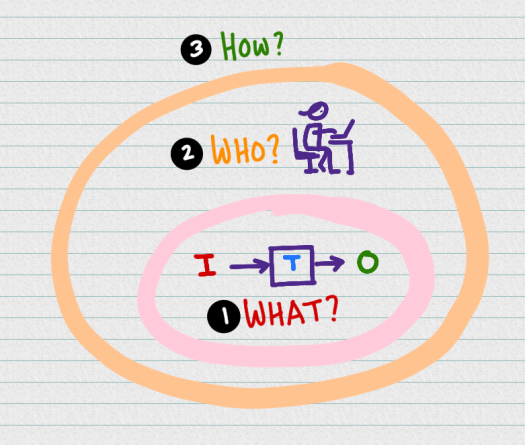
He said something like “When I’m looking at an opportunity I first want to know what needs to be done. Then I want to know who is going to do it. If I know those things then the how is easy – and I just need to find the capital to pay to get it done.”

I’ve written about this before, questioning whether Sinek’s popular model of “why, how, what” makes much sense, and wondering if it should be replaced with a different model that starts with “to what end?”

Still, looking back at this, it’s still not particularly clear what order one should follow.

So, why did this one stand out?

If you’ve read this blog for a bit you’ll be aware of my interest in Soft Systems, a methodology that helps approach “wicked” real world problems.

Wicked problems usually involve human activity systems – the kinds of things we do as a society – ranging from the complexities of government to the way in which the people in a company decides which projects they want to do.

The reason this is hard is because people have points of view – they have a perspective on a situation and express this in the form of a narrative – a story that helps them make sense of reality.

Now, if you have a story in your head about a situation – for example, if you believe that encouraging more cars on the road will add to air pollution and affect children’s health, then you are likely to oppose the building of a new school on the grounds that it will increase traffic.

The people who want to build the school will have views on how it will provide a better education for children in the area and help with regeneration.

Both are valid points of view, but that’s all they are – world views.

They just happen to be incompatible and possibly irreconcilable.

Societies have come up with ways to deal with this – using systems of planning and consultation to do or stop doing things.

The same thing happens, at a much smaller scale, when you want to work with an organisation and have to go through a sales process.

If you want to be successful when selling your services you have to start with where the customer happens to be.

If they have a need it can probably be expressed in the form of a “what” question.

What needs to happen?

Usually, some input (I) needs to go through a transformation (T) and be turned into an output (O).

What you’re describing is a system and if the system is non-human, you talk about its function and if it’s a human activity system you talk about purpose.

The purpose of Soft Systems is to understand “purpose” – it’s a strangely recursive thing, where you use a modelling language to express what’s in people’s heads – taking multiple narratives and turning them into a model that people can agree with.

What happens in practice is that the minute someone knows what needs to be done their thoughts turn to who can do it for them.

If you know that your boiler is broken, for example, isn’t the first thing you think about who you can call?

And ideally, you want to call someone you know, someone who has done work for you before and someone you can trust.

And if you call the right person they’ll know how to do the job and you’ll be fine.

The what-who-how model seems to actually represent what goes through people’s minds in practice.

If you’re selling, then, you should probably stop.

Instead, if you try to help the customer understand what they want then, when they get it, they’ll think about who can help them – and you’ll be right there in front of them, ready to offer your services.

In Jay’s podcast, they put this first bit really quite simply – you have to start with empathy for your customer.

Soft Systems is simply a rigorous way to be empathetic – to see things from the point of view of the person in front of view.

It should come as no surprise that if you have the ability to be empathetic you’ll be a better salesperson.

And you’ll also be the kind of person people want to work with again and again.

Cheers,

Karthik Suresh

Do You Ever Think About What’s In The Basement Of Your Body?

performance.png

Wednesday, 9.20pm

Sheffield, U.K.

The cause is hidden; the effect is visible to all. – Ovid

What is it that makes some people or teams deliver a result when it’s most needed while others falter and fail?

What is it about people that makes the difference between performing at your best and falling apart?

These are the questions Dr Alan Watkins talks about in a TEDx talk and it makes for an interesting listen.

He is a neuroscientist and argues that we now know a lot more about what is going on beneath the surface of our conscious minds.

Take sports, for example.

The Ashes are topical right now and the performance of the Australian batsman and former captain Steve Smith let to him being called the immovable Smith, with this write up by the BBC –

“From 17-2 in the first innings and 27-2 in the second, his fidgeting, flamboyant leaves and nudges off the pads for scores of 144 and 142 sucked the life from England – all this while dealing with constant taunting from the Edgbaston crowd in his first Test after being banned for the ball-tampering saga.”

The same game saw others collapse instead.

Watkins argues that what we see on the surface is performance – the results – and behaviour – what we see people do.

Many people think that by changing the way they act they will change their results.

The thing is that focusing on just what you can see is not a great plan.

Take sales, for example.

You could put in more effort, make more calls every day, keep driving yourself.

Sooner or later, however, the effort of putting in the effort will wear you out and almost every sales person starts to lose that drive they brought when they first started the job.

Watkins argues that you need to start with the lower levels of the human body and right at the bottom is physiology.

Physiology is simply the signals coming from sensors all over your body, from your heart rate to the electrical signals resulting from touching something.

Emotion, he says, is simply a collection of signals, a little like waves washing up against a beach.

The best example of this is your heart rate.

As you go through the day your heart rate changes, going up and down, responding to subtle stresses in your environment without you being aware of it.

It’s only when you become aware that you realise you have a feeling.

Feeling is all about awareness, while emotion is the swirling mess of electrical and chemical signals floating around inside you.

And then on top of all that you have your conscious mind – the space where you think and where you think everything happens.

The reality is that your thinking mind is a very small layer over everything else that’s there.

If you want to perform, Watkins says, the secret is understanding what’s going on below the surface – and then working out how to get some control over things.

What you’ve got to do is go from having lots of variance – lots of changes in your physiology – to coherence – keeping them within a manageable range.

The point really is that it’s not enough to want to do better, resolve to try harder or push yourself to work longer.

If you want to perform when it counts most you’ve got to get control over the most basic aspects of your physiology.

That means doing things like coming up with routines, forming habits, and practising self awareness – listening to what your body is trying to tell you about your state of stress or relaxation.

If you want your performance to be stable under pressure you’ve got to start by making sure the foundations are sound first.

Cheers,

Karthik Suresh

What Do People Expect To See When They See You?

genre.png

Tuesday, 9.27pm

Sheffield, U.K.

Always remember that you are absolutely unique. Just like everyone else. – Margaret Mead

I was listening to an interview on The Creative Penn and the topic of genre came up.

Genre is something I find hard to understand – and I’ve tried a few times to wrap my head around Shawn Coyne’s words on the topic and always come away with a headache instead.

So, let’s try again.

Coyne writes that “A Genre is a label that tells the reader/audience what to expect. Genres simply manage audience expectations. It’s really that simple. Don’t let the French etymology and pronunciation scare you.”

We’d all like to be appreciated for the unique person each of us is but that’s really too much to ask.

Most people don’t have the time or the interest in understanding someone else all that much.

Eleanor Roosevelt said ““You wouldn’t worry so much about what others think of you if you realized how seldom they do.”

In storytelling the point of genre is to help readers quickly select what they really want to read.

When I have some free time, for example, I read thrillers – books with action and very little real thinking.

It’s the opposite of the kind of stuff I read most of the time – and so it’s a welcome distraction.

Genre is everywhere – it’s really just a form of classification and if you want to be a member of a particular profession you need to learn the genre conventions that apply.

Not in a vague, theoretical sense but in a practical, applicable sense.

With stories, for example, Coyne talks about time, reality, content, structure and style.

Music has genres – from folk to jazz and beyond.

The hardest part for someone looking to stand apart from the crowd and be recognised for their individual and singular contribution is realising that they have to start by picking a crowd to join.

In the beginning, life is about which box you fit into.

In order to be accepted into a group you need to be similar to other members of the group.

If you’ve had the misfortune of having boxes full of microplastic beads you’ll know what happens when the colours get mixed up.

Having red pieces mixed in with the blue beads means you have to get the tweezers out and rearrange things.

It’s like that with most things in life.

You’re probably going to notice things that are out of place – and reject them.

Now – does that mean you should change the way you are to fit in?

It really depends on what you’re trying to do.

For example, if you’re starting a business it makes sense to think about whether your business model fits into a particular genre.

Some businesses are about freelancing. Others might be capital intensive or revolve around a brand identify.

The ability of a business model to deliver what you want is constrained by the characteristics of its genre.

A freelance business is unlikely to make you a millionaire while running a large corporation is unlikely to give you the time to spend six months writing a book on insect psychology.

Of course, none of this is new stuff.

I wrote a few years ago about the five ways your business can increase its earnings.

And this concept becomes really simple when you think in terms of biology.

A baby buffalo that is separated from the herd is the one the lioness takes down.

The secret to survival is to stay in the middle of the herd until you’re big and strong enough to face off a lioness.

First fit in.

Then, when you’re secure, stand out.

Cheers,

Karthik Suresh

What Does It Take To Create Something Useful AND Good?

alone-together.png

Monday, 9.55pm

Sheffield, U.K.

You must exorcise the evil proprietary operating systems from all your computers, and then install a wholly [holy] free operating system. And then you must install only free software on top of that. If you make this commitment and live by it, then you too will be a saint in the Church of Emacs, and you too may have a halo. – Richard Stallman

Do you work best alone or with others?

Do you have a point of view that is balanced or at one extreme or another?

Are you an activist or someone that just wants to get on with the day to day jobs that need to be done?

I recently found my installation disks for Red Hat GNU/Linux from 1999.

The reason we have the choice of systems and software technology that powers so much of the Internet is because of the work done by a small number of people.

And, along the way, we sometimes forget the lessons of history.

For example, if you use one of the popular Linux distributions out there now you will be interrupted by your computer asking to install updates on a regular basis.

If you use a browser from Europe almost every site will not have a pop up that attempts to comply with GDPR by asking you to click a button accepting unseen terms before you can get to the content.

I don’t know about you but I find interruptions unhelpful.

And I like coercion even less – and pop ups that demand you agree to terms before you get access to content are coercive.

So, what can you do?

The first thing is to figure out where the balance of power lies.

I was so irritated by the constant website pop ups that I turned off javascript on Chrome, the browser I use most of the time.

And something magical happened – most websites stopped hounding me for permission and just displayed content.

But Google didn’t – if you don’t turn on javascript you can’t access things like Gmail which are effectively a gigantic javascript program.

But you can enable javascript for certain sites – so that means you either turn it on because you want to or because the site is big and powerful enough to demand that you agree before it will let you interact with it.

It’s an object lesson in the balance of power.

Sometimes, as the user, you have it and at other times, the website has it all.

One way of getting back power is to retain control – to do everything yourself.

The patron saint of this movement is Richard Stallman, who has a fairly uncompromising approach to the ethics of computing.

His solution has been to use the law to protect rights – by creating software under a license that stops anyone from taking away rights from you or asking you to give them away.

The concept of free software – free as in free speech, not as in free beer – has underpinned the modern networked age.

Another individual that epitomises an individualist approach is Derek Sivers, who has been on the Internet for a while, doesn’t trust the cloud and runs his stuff on his own server.

In ages past people that wanted autonomy and control and freedom from oppression might have found it in monasteries and meditation.

These days you can have those things because other people who want the same things have helped to create tools that can help.

Other people, working in groups and organisations, in more traditional businesses have also created tools to help.

But how can you tell if the tools are good?

The simplest approach is to think in terms of utility – in terms of the benefits you get.

Many distributions of GNU/Linux focus on utility – on being useful and making things easier for you.

Platforms and services – from Facebook to Ebay exist to help people do things they never imagined they would need to do.

Isn’t that a good thing?

It probably depends on who you ask for an opinion.

I suppose you never really understand the value of freedom until you’re in a position where you’re unexpectedly deprived of it.

And that is not good.

Cheers,

Karthik Suresh

How To Become More Effective As A Group

learning-advantage.png

Sunday, 9.54pm

Sheffield, U.K.

The ability to learn faster than competitors may be the only sustainable competitive advantage. – Arie P. de Geus

I’ve just finished We do things differently by Mark Stevenson, a look at where things are going right in the world.

In one chapter called The worst school in the country we’re introduced to Carl Jarvis who turned around the school in question.

Before we look at how he did that, take a minute to consider what normally happens in organisations – the loop marked 1 in the picture above.

Leaders in an organisation start with an ambition – they want to achieve something and do well. That inevitably means coming up with activity targets – turnover and profit for the year, Ofsted results, sales calls per day and so on.

If you have more than one person doing such activities the natural next step is to compare how everyone is doing – carrying out a benchmarking exercise.

You find that some are below average and some are above average.

Oddly, it always seems to be around half on either side…

In any comparison you get winners and losers – people who do well on the metrics and people who do poorly.

Because we want people to do well we try motivational tactics – carrots such as payment of bonuses, for example.

Or we bring out the sticks and punish poor performance.

Firing the bottom 10% of the company every year used to be, and perhaps still is an approach used by some.

Either way, the winners are motivated, the losers tend to be demotivated and the net result is what shows up in the activity statistics.

The thing to notice is that winners push the numbers up by more and losers by less.

If the same people are there over time – this will end up with putting out numbers that vary within a predictable range most of the time.

In other words, you have a stable system in such an organisation – one that stays where it is but that cannot grow.

Surely you just get rid of the losers, you say – and keep the winners?

You could do that – but variation has a nasty way of evening the score – with one year’s losers going on to be next year’s best performers and vice versa.

All this work, however, misses the point.

The point of an organisation is not to create winners and losers but to get people working together well.

That’s the only reason to work with someone else – when together you can do more than either one of you could do individually.

The reality is that in most organisations you could do a lot more by yourself than working with anyone else.

And that’s a problem – because it makes a mockery of all the time we spend at work.

This is the thing that Carl Jarvis saw as he looked at his group of teachers.

Stevenson writes “Carl realised that his teachers. like many in the profession, had become atomised. They didn’t collaborate or feed back on each other’s work. They never saw each other teach. They didn’t discuss the impact they were collectively having on students and how they might work better together to improve it. In short, and with no small dose of irony, they were teachers who had stopped learning. They weren’t acting as an organisation but a set of individuals.”

Now, you can spend a lot of time thinking about what competitive advantage looks like for organisations.

The best one is actually having barriers to entry – having a monopoly on your business.

But the next best one, as in the quote that starts this post, has to do with your ability to learn.

Take the loop marked 2 in the figure, for example.

This is a thinly disguised version of Deming’s Plan, Do, Study, Act model.

Again, leaders can start with an ambition – a plan – but the next thing to do is look at what activity is actually going on.

Then, you study what you’ve found, perhaps alone but it’s better with others because you’re more likely to learn something new as you discuss things together.

Then you try doing something – taking action that might help and see the impact it has on activity and go around the loop again.

Unlike a loop that leads to motivation or demotivation – this loop leads to learning – and a learning loop is a positive one because whether things go well or badly, you have the opportunity to learn something from it.

As group participants and leaders, then, we have to let go of familiar instruments like criticism and contempt and reach for less natural ones like praise.

Stevenson writes about Carl – He spent weeks tirelessly observing and encouraging his teachers. “I told them they were all amazing, all the time. Even if the teaching I saw was terrible, I would pick on some small thing that was OK and praise it. I went over the top, but I had to, because I had to get them to believe in themselves again. I spent the first six months not in my office but in classrooms, watching things get better.”

It’s one thing saying that we need to create learning organisations – but it’s another creating them.

You’ve got to relentlessly, as the song goes, accentuate the positive.

Cheers,

Karthik Suresh

When Is The Right Time To Build An App For Your Business?

it-last.png

Saturday, 9.30pm

Sheffield, U.K.

As far as the customer is concerned, the interface is the product. – Jef Raskin

Dragging kids around the city centre and doing shopping is one of the less enjoyable things to do in the world.

Bored kids find inventive ways to act out – causing mayhem of one kind or another, especially when they’re also hungry.

Which is why we headed to a large chain restaurant, where we knew we would get cheap food made from plastic that would probably come quickly – and found a table.

And then, when it was time to order, we used an app.

And it worked perfectly.

Minutes later, the drinks arrived and the food shortly after that, and everything was good with the world.

Normally, I try and take off all the apps on my phone that want to distract me – email is out, social media is banned and whatsap is on mute with no notifications.

Anything that wants to try and interrupt me has to be eliminated.

But, there are times when I want something – a takeaway, a taxi or to order food.

There are certain types of choices that are simple to make – this kind of food from that place, take me from here to there and I want this and that off the menu.

If you look around you’ll see apps and interfaces taking the place of call centers and waiters to help you with those choices.

And they work well, when what you want is simple and can be set up as a menu.

At that point the waiter is no longer required.

The point at which you need someone to get involved is when things start to get complicated or need personalisation.

Like when you need help understanding what something means or does, or if you want to make unusual modifications to your order or you need a customised version that has your kid’s name and favourite character.

The point at which applications start to suffer is when they have to deal with lots of variety.

They are good with things that stay the same but start to struggle when something different happens.

Now, you might argue that you can deal with a different situation by creating a rule – something that helps improve the ability of the system to deal with variety.

This shows up as the option on some menus to change ingredients or the text box at the end of your takeaway order that lets you give instructions to the driver to come round to the side entrance.

But at some point things cross over – where the overhead of dealing with customisation results in a deterioration in the quality of service.

For example, we went to a climbing facility recently that had a ridiculously long, web based, legal disclaimer form.

It took so long to finish that the kids were out of sight and could quite easily have gotten themselves into trouble.

If something bad had happened, all those words wouldn’t have really helped with their liability – they would have closed down anyway if a serious incident happened just because of the negative news effect.

What they should have done was have a short form and get someone from the team to carefully explain how to be safe in the facility instead of hiding behind a legal shield made of cobwebs.

In one case the app or web interface made ordering easy and life easy.

The other case made getting started hard and customers irritated.

The point about going digital is this – the reason you’re doing it is to improve the customer’s experience.

So first you need to do everything to just do better work.

Make better food, create a better climbing environment and operate newer and cleaner taxis.

Then, look at the things people have problems with and redesign your operations to get rid of them by working better – through training staff to spot those issues and removing processes that don’t add value.

And where there is a high degree of variation – where customers are unsure or want a lot of customisation, personalisation or changes – put a real person in front of them, one who knows what they are doing to help them get what they need.

As the quote that starts this post says the interface is the product. In some cases that interface has to be human – and we should start by trying to make it as pleasant an experience as possible.

And then when you’re left with nothing else you can do to improve your service then look at how digital systems can make your customer’s lives easier.

This is what John Seddon calls an IT last approach.

A good rule is to only put digital systems in when customers start saying to you “Do we really need to talk to you to get what we want?”

That’s when you give them the ability to order from you through an app or online.

Cheers,

Karthik Suresh

p.s. Thank you for the feedback and likes on my recent posts.

There will be radio silence for ten days or so as we go off the grid for the summer holidays but the posts will resume after that.

Why Trying To Force Information Into An Order Is A Bad Idea

knowledge-order.png

Friday, 10.16pm

Sheffield, U.K.

Never impose your language on people you wish to reach. – Abbie Hoffman

A few days ago I was writing about why it’s very difficult to put knowledge into some kind of orderly form – but just couldn’t remember where I’d read that before.

The Internet has, however, brought it to me – although through a rather circular route.

As you probably know, if you read these posts, I’m interested in the history of unix.

One of the oldest utilities in the unix environment is an application called dc, which stands for desktop calculator – it even predates the c language.

dc uses something called reverse-polish notation, which means that instead of writing 1 + 1 =, you write 1 1 + and get the answer 2. It’s more compact – using one less operator and you don’t need brackets.

It can be useful when you’re writing scripts and want do quickly do some maths.

The wikipedia entry for dc has a link at the bottom for a paper by Douglas McIlroy, called A research unix reader, where McIlroy talks about how they came up with a way to document their growing system – which came to be known as man pages.

He wrote: ‘The absence of any “logical” grouping of facilities was a deliberate result of discussion. (As encyclopedists have always known, the relationships among knowledge are too various to force into rational linear order.) Retrievability and honesty were the prime concerns.’

So we are there – from wondering about reverse-polish and dc to the concept of information and order.

Now, you may wonder, why think about a concept that is nearly 50 years old?

It’s because even now if you try and document anything or create a system to hold information the chances are that you’ll make a mess of it.

Let’s start with something as simple as knowledge in an organisation.

Do you work in an organisation – have any of us worked in organisations – that have successfully implemented a way to collect and share knowledge between employees?

When you want to know more about something do you head to your corporate information management system?

The papers that pour out of organisations – policies, risk assessments, quality statements – are they ever used to do anything actually useful?

Or are they used to tick boxes to confirm that you have such documents?

Or do you head to the Internet to a collection of disorderly information in which it is almost certain that what you need exists someplace.

It is slightly astonishing, to me anyway, just how that quote from McIlroy is still so relevant today.

All over the world eager young and not-so-young analysts are trying to create databases and spreadsheets, trying to corral and corner data, rather like trying to trap a swarm of bees using a pitchfork.

Yes the columns that make up the pitchfork are solid but they’re not going to keep many of the bees penned in for long.

Or, as the picture shows, it’s like trying to stuff a cloud into a cardboard box.

If you want to create a useful knowledge system you need to let it evolve freely – precisely what has happened with the Internet – and what does not happen with most organisational projects.

But you also need to think about two more things – how you retrieve the information and how you keep it honest.

The retrieval job for the Internet has been taken up by Google – they spotted the solution there.

The honesty point is what threatens to bring the Internet down now – from the problems of fake news to the way in which politicians use the platform to promote policies of hate and division.

But all this is encapsulated in a paragraph of a few tens of words written all that time ago.

This idea that things don’t really change that much is nicely illustrated in Sinclair Target’s blog post about the utility cat.

I love this quote: “My aunt and cousin thought of computer technology as a series of increasingly elaborate sand castles supplanting one another after each high tide clears the beach. The reality, at least in many areas, is that we steadily accumulate programs that have solved problems. We might have to occasionally modify these programs to avoid software rot, but otherwise they can be left alone.”

And cat is important because it is held up as an example of how things bloat and get fat over time – almost as a default.

If you aren’t interested in the programming aspects of this – there is one thing to take away from this post.

When you find yourself trying to control information – trying to create a system to put around it – like a CRM for customer data or database for analytics – breathe to ten and walk away.

In reality the very last thing you should do is think about such things.

The first thing you should do is figure out what your customer needs you to do.

Cheers,

Karthik Suresh

Why Having Less Is A Lot Harder Than Getting More

little-prince.png

Thursday, 9.11pm

Sheffield, U.K.

Wealth consists not in having great possessions, but in having few wants. – Epictetus

Every once in a while you’ll come across someone who knows someone who is doing something with artificial intelligence.

They’re taking data, crunching it, putting it through clever, self-learning algorithms, and coming up with insights that make everything better.

Everything is always getting better – you get more features, better quality, and a richer experience

But it all comes at a price – one that I’m not sure how exactly to take a view on.

On the one hand the relentless drive for the new gives you things like the iPhone and iPad – the culmination of a decade long dream to have an electronic equivalent of paper, just better.

It’s like the scene in The Devil Wears Prada where we learn that the fashion of today eventually results in the cheap clothing of tomorrow.

But, if you have too much of a good thing over time, that is less good.

If you have read The little prince by Antoine de Saint Exupery you’ll remember how, at the start of the book, Exupery talks about boa constrictors.

He saw a picture of a boa constrictor digesting an animal and drew his version (which looks like my figure 2 above) and showed it to grown ups.

They asked him why he was drawing pictures of hats.

But it wasn’t a hat – it was a boa constrictor digesting an elephant – which he tried to make clear by drawing a second picture – 2a in mine.

At which point he was advised to stop drawing pictures and spend time studying instead.

And life sometimes seems like that.

We all start off as slim boa constrictors, unencumbered by food, and happy to take what we get.

And then the meals start and they get bigger and bigger, as our appetites and eyes grow.

If you’re lucky enough to be beyond the first few stages of the hierarchy of needs, then you probably have more stuff than you need, with more coming in all the time.

Eventually, you may also be in a position where there is an elephant in you and there’s no point moving any more, you’re pretty much stuck.

If you look around at your life and work there is probably little you actually need.

Without being completely minimalist – there are probably more pens in your house than you will ever use, more plastic boxes than food you cook – just more of everything.

More just seems to happen unless you’re one of those people that makes an effort to have less.

You’re the kind of person that passes on pens and pads at hotels and conferences.

You recycle all your plastic, never keeping a takeaway container just in case.

And, of course, you return all your shopping bags to the supermarket or only keep the four or five you need for a big shop.

The thing is that if you’re that kind of person you know just how much effort goes into getting rid of stuff.

For some of us it would be much easier if we stayed away from elephants altogether.

Cheers,

Karthik Suresh

What Would You Do If You Had Absolutely No Pressure To Do Anything

no-pressure.png

Wednesday, 9.29pm

Sheffield, U.K.

There are no projects per se in the Computing Sciences Research Center. – Ken Thompson

I’ve been watching interviews with unix legends the last couple of days on YouTube – when I have a few minutes spare.

For example, there’s one where Brian Kernighan interviews Ken Thompson.

In case you didn’t already know, Ken Thompson was a co-inventor of unix and Brian Kernighan wrote a number of programs and a series of books that helped popularise the system.

Thompson talks about how he had absolutely no ambition – he went to graduate school because a friend applied for him without his knowledge.

He had no ambition, he said, but he was a workaholic.

He was eventually recruited to Bell Labs where he built an operating system under the radar, because Bell had been bitten by a bad experience with another one.

He wanted to make the system but Bell wouldn’t fund it so the team came up with – (he searches for words here) – a lie that they were creating a patent document creation system so they could get funding for a machine and build their operating system as well.

He talks about how he realised that he needed an editor, shell and assembler to build his operating system and, while his wife and one-year old were away for three weeks, he built each part in a week.

In a different interview with Kernighan and Brailsford, Kernighan describes the environment that they worked in.

Bell had no shortage of funding, as it was supported by AT&T and hosted thousands of researchers who were just allowed to get on and work on what interested them.

Kernighan said that in his thirty years there he was never once told what to do.

Instead, at the end of the year, he would write down on one side of A4 what he had done that year – and the managers would use that to decide what to pay him next year.

Now, what would you do if you had that kind of working environment – one where there was no pressure on you at all?

The temptation is to think that people will goof off. They’ll simply do nothing – take the money and squander their time.

The thing is that being idle is actually quite hard.

Most people will struggle to stop and do nothing at all.

And when you’re given the time to think and work on things that interest you, then you can hardly help yourself from coming up with something new and innovative.

There are very few organisations that understand this – or are willing to take the risk of paying someone to work on what they want instead of what the managers want.

In theory, academia should be the kind of place where you can do that – where you can explore ideas free from pressure.

Except the pressure is there as well, the pressure to publish and be at the top of ranking tables – the relentless competition that governments imagine improves standards and results in innovation.

Except, innovation actually comes mostly from people who are just digging away at something that interests them.

Thompson seems to like the analogy of gardening – you work away at it and then something amazing happens as it starts to bloom.

So what can we do if we want to get some of that working environment for ourselves?

There are two things we need.

The first is a determination to work on the things that interest us – we have to make time for them even if that means working late at night or early in the morning.

And it’s actually even better if what we’re working on isn’t directly linked to reward or payment – we want to focus on being intrinsically motivated – working for the sake of the work rather than working for money.

The second thing that that will help is the presence of constraints – not having enough, not working on the latest kit – because constraints are what lead to innovation as we try and overcome obstacles.

Think about this for a second.

Have you been very busy last year?

With all that busyness, what have you done? And is it something you wanted to do?

As the saying goes, you’re either working on your own goals or working on someone else’s goals.

The time to make time for yourself is probably right now.

Cheers,

Karthik Suresh