Why It’s Really Hard To Figure Out Winners And Losers These Days

cost-disease.png

Monday, 8.56pm

Sheffield, U.K.

Costs do not exist to be calculated. Costs exist to be reduced – Taiichi Ohno

I learned about something called Baumol’s cost disease recently and it got me thinking about how rare it for organisations to really understand the impact costs have on their customers.

Warren Buffet is famous for avoiding technology businesses – which is strange considering how technology businesses seem to dominate the world these days.

We are fooled, however, by thinking that because Apple, Microsoft, Google, Facebook, Amazon, Netflix appear to be doing so well that’s the way of all technology businesses.

Except these are the rarities – the ones that succeeded, for which the stars aligned.

For every one of these, thousands, perhaps tens of thousands of technology businesses have gone bust.

And that’s because they don’t understand a simple principle that Buffett articulated a long time back.

Most tech businesses come and tell you that they’re going to cut costs – they’re going to make you lean and quick and reduce the cost of doing business.

That’s almost always the sales pitch – if you use us you will save money and improve margins.

They’re right about the first part – you might save money.

But these tech businesses will sell their tech to you and to every one of your competitors – so you’ll all be able to save money.

And when you’ve got those margins someone will blink – and offer lower prices to customers – and then you’ll all have to follow suit or lose business.

So, the only people who benefit from your investment in technology are your customers – who get lower costs.

Now, it might seem like a vicious circle – one you can’t get away from.

After all, would you still be holding onto typewriters rather than buying computers for your staff?

But the important point is that the advantage of technology is actually not that much of an advantage – you don’t often lose if you want and buy later rather than being the first mover.

In fact, waiting can be an advantage, because you then buy cheaper, better tested product rather than new, untried stuff.

While tech businesses promise to cut costs other industries just seem to see costs increase without any corresponding increase in productivity.

People in public service are paid more for not doing much more than they were doing a decade ago, for example.

Salaries have to rise, apparently, to keep people who would otherwise move to better paid jobs in other sectors.

So, even though people aren’t producing more they’re paid more – which inevitably works its way through to lower margins for the business – because few industries can pass through all their increases in costs to customers without being asked some rather awkward questions.

Which means people in these roles get comfortable and happy without having to do much more.

Now, in the middle of a healthcare crisis, it’s probably wrong to question whether the public sector is doing all it can – but is it?

Is it systemically ready to do things without mistakes – to do them at the lowest cost?

It’s pretty unlikely, if only because you have a system full of highly paid, very experienced people who have spent their careers working in a system that is complex and almost certainly full of problems.

There is probably very little they can do to change things – and while they might do the best job they can – it’s probably not that different to what they were doing a decade or so ago.

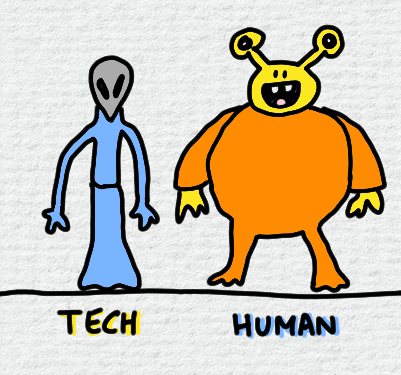
It does seem that tech by itself or people by themselves don’t really add much value.

But, I also learned recently, the combination of tech and human might actually be surprisingly effective.

In my experience most people struggle with the technology they have to use.

It’s not their friend.

The example I was given was how an AI program and a doctor are much more effective working together at diagnosis than either working alone.

But if you use a computer then you’re in a similar situation – do you rail at the software you have or do you enjoy working on your computer?

People who have to use proprietary programs probably have very different views to those who use a free system like GNU/Linux.

I certainly do.

If I had to write these posts using the WordPress tools or anything from Microsoft then I probably wouldn’t create anything.

I suppose the point I’m making is this.

It’s tempting to think that because your technology cuts costs or because you work really hard that you’re adding value and are a winner.

But there are too many businesses and too many jobs that are failing the employee and the market.

The goal is to do something that challenges you – something you enjoy.

And you win if someone is willing to pay you to do it.

And that’s enough for me.

Cheers,

Karthik Suresh

How To Do Customer Development For Complex Consultancy Businesses

customer-development-expanded.png

Sunday, 7.37pm

Sheffield, U.K.

Hell, there are no rules here – we’re trying to accomplish something. – Thomas A. Edison

I’ve started seeing more threads on Twitter these days and they’re making me think.

A typical thread has twenty or thirty points.

Some are effectively essays as the points build on and reinforce arguments the writer is making.

Others are nuggets of information, packaged together and delivered – held together by the thread.

And then you have lists – 25 of these and 30 of that.

One of these, for example, had to do with 25 facilitation methods – the kinds of things you might do to run meetings.

Now, when you look at a group of things like that what’s missing is really how you would use them in practice.

For example, if you were a Roman soldier, you would have a set of kit – a throwing spear, a thrusting spear, a short sword, a shield – and you’d use each of these in combat at the right point.

You’d be far more effective as a soldier if you knew how to use that set of kit than if you walked around carrying a whole lot of stuff pulled together at random.

So, I thought, if I were to describe how I currently think about the way in which sales works for me what would that look like?

My focus is usually on complex sales – the kind of thing where customers don’t quite know what they need yet and need to work through that before they are ready to buy.

It’s the opposite of transactional sales where the customer knows exactly what they want and the main thing they want to do is figure out who is offering the best deal.

A complex sale means that you need to understand a complex situation – one where there is a lot going on.

If you do this properly what you will end up doing is understanding what value means in customer terms – you’ll be able to define value in words the customer would have used.

But get to this point you have to do a few things first.

You have to start by studying the situation – building a picture of what is going on through interviews and going to where the work is done.

You’ll have to see what’s going on – trying to listen to the voice of the process.

For example, if you are working with an organisation that fixes things, then value probably has something to do with getting things fixed when the customer wants them fixed – and the measure that tells you what is going in is the number of days it takes for a fix to get done – which is the voice of the process.

Now, as you listen to people you’ll start to build a picture of how they see the world and when you put this down as a model it’s called a holon – a construct that describes their particular perspective.

These three things – listening to people, trying to look at things from their point of view and taking the trouble to look at measures that let you see what is going on helps you gain an understanding of the situation.

Once you have that you can start to shape an intervention – perhaps come up with a flowchart of how to do things differently.

And to explain to others why this process works you’ll come up with stories, with presentations that seek to explain and persuade.

But because your stories are founded on a deep understanding of the situation, you’ll be able to get people to listen more closely and focus on your points rather than trying to find holes in your argument.

I find that these tools are the ones I use most of the time in my process – and what they help me do is follow the platinum rule.

The golden rule, as you are aware, is to do to others the way you would have them do unto you.

The platinum rule says do unto others as they would have you do unto them.

Now, when I think about this approach – one that works for me – I don’t see it as an unconnected set of tools or tactics.

I see them as part of a systemic approach, one where the elements work together to create a better customer development process that is focused on understanding what value looks like before trying to deliver it.

And it seems to me that however you do your process it cannot but help if you give your customer the value that they want and need.

Cheers,

Karthik Suresh

What Do We Do When We Can No Longer Stand On The Shoulders Of Giants?

shoulders-of-giants.png

Saturday, 8.43pm

Sheffield, U.K.

If I have seen further than others, it is by standing upon the shoulders of giants. – Isaac Newton

For many Saturdays now I have taken a walk, doing a round of the charity shops close to me, accompanied by a small person and we both look for books.

Today, I stood and gazed at a shelf of books and wondered what I thought about them.

There was a selection of marketing textbooks – like a student had just dropped off four year’s worth of material.

A year ago I would have convinced myself to get pretty much everything on the shelf but today I was unconvinced – turning more to the children’s sections and books on drawing and doodling.

The reason for this, I think, is that I’m finding that theories about marketing and management are actually of very little use in day to day marketing and management.

Let me explain.

Isaac Newton’s saying that starts this post is one we all know – and clearly we have to learn from the lessons of the past if we are to avoid repeating them and if we want to build on them.

This approach works very well in the physical sciences – you don’t want to be in a position where you never learn that the earth is not flat, or the things that now are the basis of modern medicine.

But the same approach seems to run into problems when we approach the world of human society.

Science is very good at breaking down things and understanding the parts.

In doing that we come up with theories of why things are the way they are – and we use those theories to predict what else might be.

And science is so good at that it now seems that that way of thinking should be the basis of everything we do.

In marketing an early application of this way of thinking was Claude Hopkin’s famous book which was called, after all, “Scientific advertising”.

Anyone who wants to claim that their method works tries to use science – even if the scientific method has to be tortured a bit to make it seem like its producing valid results.

So you have a science of surveys and response analysis and statistics – all of which are used to come up with insights and theories such as those in the best-selling “Influence: The psychology of persuasion” by Robert Cialdini.

So, if you’re creating a new product or trying to connect with a market or sell something to a prospect – it makes sense to go out and pick up some books – the kind of books that I was looking at on that shelf perhaps.

But I’m realising that actually the scientific method is not everything – and it’s not really appropriate for everything that we do.

And actually, if we go back to before the scientific method there are ways of working we should not forget.

The first has to do with technology.

Technology is something that actually predates science – it comes before it.

We made tools and pottery and hot baths well before there was anything like a science of metals or minerals or state transition.

Nowadays technology is often based on scientific discoveries – which is why it might seem like it’s something that comes after.

But technology is fundamentally about tools used by people – and tools like the Internet and online commerce are really only a decade or a couple of decades old for much of humanity.

For example, I had to try and fix a leaking tap today – and constructing a new kitchen wasn’t really something that was a feasible option – even if it will happen in the long-term.

The tap is old, however.

But Ebay had one of the valves that I needed – and it’s on its way to me now.

And a YouTube video told me how to take the tap apart and how to search Ebay in the right way to find what I needed.

That’s technology to the rescue, not science.

Now, when you’re creating marketing for technology it seems to me that science will just get in the way.

That whole standing on the shoulders of giants things keeps you a little too far away from what matters.

What matters is what’s happening on the ground.

The people who succeed in online commerce are the ones who best understand what value looks like from the point of view of the customer.

The people who created a video that explained what I needed to do and the people who created an Ebay page where I could measure and check that what I was buying was what I needed were able to create the conditions where they delivered value and I paid a price.

And I don’t think that stack of books would have helped any of the people in that transaction do things better.

It might have even gotten in the way.

The more I think about this the more I am convinced that starting from the reality on the ground is the way when you’re trying to improve the way in which you carry out management or do marketing.

It’s coming up with approaches and strategies and tactics that are rooted in a clear understanding of the people you’re trying to serve and what value looks like from their point of view.

It’s grounded theory.

Which means, you have to get off those shoulders and get on the ground if you want to succeed here.

Which brings us to the second method.

Talk to your customers, listen to them and give them what they need.

And it might just be as simple as that.

Cheers,

Karthik Suresh

What Kind Of Working Model Makes You Most Productive?

collaborate.png

Friday, 7.53pm

Sheffield, U.K.

I like working with people. I believe change can only come through collaboration. – Alain de Botton

Quite by coincidence I’ve been watching the series “The last man in the world” at about the same time as hysteria sweeps the world about the Coronavirus.

The story, in case you aren’t familiar, is about how there is one man left on earth after a virus strikes and… well, the story goes from there.

There interesting thing about this particular virus is not that it’s spreading, but that the information about it is spreading faster than any virus before it.

We are all so connected that once the news started spreading everyone became aware and then started changing behaviour – probably hoarding and stockpiling.

In fact, the supermarkets shelves are showing gaps – and it really looks like people are panicking a little and laying down supplies.

When thing look like they’re going bad we start preparing for the inevitable fallout and all out conflict.

The fact that we regress so quickly to such behaviour tells us that flight or fight is an accurate depiction of our underlying humanity and one or brain’s biggest tasks is to override our evolutionary conditioning.

And it’s hard.

Take collaboration, for example.

You would probably agree that it’s the best way to work with someone else – to find a way to be open and honest and create value for each other.

The reality of work, however, is far from that.

All too often we have misunderstandings and power struggles, politicking and whinging.

While our brains have developed the ability to be rational when we’re in a safe space we still are some way from having the tools we need to help us work better together.

Although you could argue we’ve had them all the time – our ability to listen and talk and draw.

Collaboration is something that has to come from the lack of fear.

If you go into a meeting afraid you’re going to lose your job, afraid you’re going to lose the sale or afraid that you’re going to lose something you have then that fear will permeate everything – and it will make the other person uneasy as well.

It’s like the high pressure salesperson – you can tell desperation and it’s not nice.

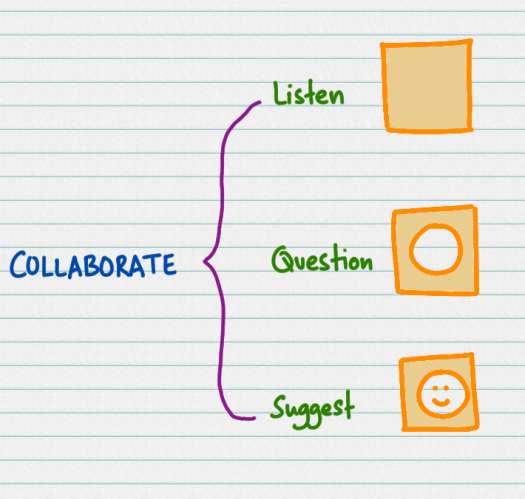
When I look at collaboration these days I think you need to get better at doing three things.

First you have to listen.

Whether it’s your kids or coworkers, whether it’s your boss or a customer, the essential skill to develop is the ability to listen.

When you listen you start to get a feeling for the shape of someone else’s thoughts – how they see the world.

To understand them better you ask questions.

Questions help you find the gaps, discover connections and see possibilities.

And then, when you’ve done those two things you can offer suggestions – possibilities for what you could do together.

And you will, in turn, hopefully be listened to and asked questions.

Just like that you’re collaborating.

Simple. Yes.

Easy. No.

But essential.

Cheers,

Karthik Suresh

What’s The One Thing You Have To Do To Succeed?

close-the-loop.png

Thursday, 8.41pm

Sheffield, U.K.

String theory is an attempt at a deeper description of nature by thinking of an elementary particle not as a little point but as a little loop of vibrating string. – Edward Witten

I know nothing about string theory but this Witten quote makes perfect sense when it comes to the basic nature of everything we do.

Think of some of the people you’ve worked with, some of the people you know.

They might be old or young, experienced or new to the world of work, different genders, races, backgrounds.

Now, what kind of impression do you get about the way in which they seem to operate?

Some might be dots or spots – contained patches of ink that encapsulate what they are.

Perhaps they’re artists or lawyers or doctors or police or firefighters – defined roles that you see in children’s books of what jobs people have.

Perhaps they see themselves the same way, as people with a singular passion or focus – either one that really does fill them up or one that they have adopted because it works for their business.

If you do a search starting with the string “I’m passionate about” you get a bunch of results that tell you how to answer that question in the context of an interview.

And that’s because when you’re really passionate about something you don’t talk about it – you just do it and talk about it – and people see how passionate you are.

So, if passion is a dot what might a line be?

A line, I think, is someone that has a job – someone that does a certain task.

They might process things, file things, analyse thing – but generally they start at one point and traverse a line and end at another point.

And a lot of people see this as a thing – if you do process maps or flows this is the kind of way you represent what’s going on – starting here and ending there.

With spots and lines you’ve probably captured the ways in which most people think about work.

But, when they actually start doing work the lines no longer seem quite that straight.

Actually where you end up seems to be related to where you started – and so you find yourself turning back and heading to where you were at the start.

For example, if you are in charge of a project and you send an email requesting information then in the world of lines you’ve done your job.

If you don’t get a response, however, you’re starting to look back at that email you sent and wondering what to do next.

Many people think that they’ve done their job – they’ve sent that email and that’s it.

If they’re asked later why things went wrong they can always say, “Well, I did my part!”

That gap – that failure to close the loop between starting something and making sure it’s finished makes the difference between success and failure in most situations I’ve seen.

You go out and meet someone and fail to connect in some way so you can follow up your discussion.

That’s often my big problem.

A bigger one, though, has to do with all those tasks where you should really chase and follow up but you just don’t.

When people succeed it seems to be because they make the effort to close that gap, to make sure they close the loop and them move on.

Now you might not do this with everything but if you do it with the important stuff then you start to create little success circles – closed loops that mean stuff gets done.

And then, if you decide that string theory is for you – you can think of those success circles as the elements of business, the elements of what you do.

Instead of seeing them as static, once done and then forgotten things, you can see them as vibrating string loops – with the energy and passion you have emerging from that work you’re doing.

And really when you get the fundamental building blocks of reality on your side is there anything you can’t achieve?

Cheers,

Karthik Suresh

What Is The Real Message Of Minimalism?

minimalism-revisited.png

Tuesday, 9.46pm

Sheffield, U.K.

Whereas a lot of Buddhism concerns itself with stages of enlightenment, various precepts and moral codes, and even power structures and hierarchies, Zen is just like, ‘Shut up, sit down, and observe your thoughts – oh, and by the way, what you perceive as you’ doesn’t actually exist.’ I loved the minimalist approach of it. – Mark Manson

I’ve been thinking a little bit about the things that matter recently – and it caused me to take another look at minimalism.

There are people for whom material things are very important – they are a symbol of status and achievement and power, or they are just things that they like to have and believe they deserve because they’ve worked hard for them.

The thing with stuff is that it weighs you down in a way that other things don’t.

Take learning the guitar, for example.

Once you’ve learned how to play the guitar that’s something you take with you – and you will always be one of those people that can sit strumming the instrument with a circle of people listening to you.

The things you learn, the skills you develop have no weight at all – they stay with you as long as you have your faculties.

So while there is no limit to what you can learn and how you can develop yourself – that’s not the case with stuff.

The more you have, more it has you – you have to deal with it and move it and clean it and maintain it and upgrade it and suddenly you spend all your time being a servant to your stuff.

Or maybe not.

So I went back online to see what people were saying and not much had changed.

One set of voices link minimalism with having less stuff – to the point where you have 100 things or less, 50 things or less.

Or you have less but better or some variation on that theme.

But it comes down to quantity and volume and generally just spending your time counting.

The other side of this coin is that you keep things that make you happy – things that spark joy according to Marie Kondo.

Which is a nice term and obvious to some and airy-fairy to others.

But you’ve got to remember that minimalism as a term probably originated in the art world – as artists tried to strip things down to the essentials – keeping only what mattered and creating sparse works.

Or, if you wanted to be more prescriptive about it limiting themselves to simple shapes and geometric patterns.

In the midst of all this you have a few furious Guardian columnists who denounce all this as a fad for the rich.

And they have a point.

There does seem to be a tendency among people to turn everything good into some kind of competition or formula.

They focus on the act rather than the intent and in doing so what they end up making are empty gestures.

And this leaves them open to accusations of being stereotypes.

For example, minimalism is a thing that men do because women are the ones that like fluffy stuff – how many men go out and buy throw cushions or whatever those things are called that litter every surface you want to sit or lie on.

It’s a form of shaming – isn’t it?

And it’s also something only rich people can choose to do – you can live without money only if you have enough.

When you don’t, life is too hard.

And all these are valid criticisms but I felt they missed the point.

Which is what?

Well… it seems to me that the only reason you would get stuff or get rid of stuff is to become free?

Free from what?

The Buddha probably got it right there.

Freedom from Suffering.

The actual word is “Duhkha” – and it’s not suffering in the sense of a wound or a sore, but the opposite of happiness or comfort.

It’s the opposite of what Pirsig terms “Peace of mind” in Zen and the art of motorcycle maintenance.

Wikipedia says the word originated as an axle hole that isn’t in the centre, and so the cart bumps along giving you an uncomfortable ride.

And how do you solve this?

By becoming more aware of yourself and what you really need.

Because that understanding is what matters – and it may or may not lead to a more minimalist lifestyle.

But it may lead to one with more “Sukha”, or happiness.

Cheers,

Karthik Suresh

5 Things You Have To Get Right To Be Successful In E-Commerce

e-commerce.png

Monday, 9.15pm

Sheffield, U.K.

Retail is a customer business. You’re trying to take care of the customer – solve something for the customer. And there’s no way to learn that in the classroom or in the corner office, or away from the customer. You’ve got to be in front of the customer. – Erik Nordstrom, President, Nordstrom Direct

I was invited to go to the Retail Without Borders conference recently where I learned much that I didn’t know about the world of e-commerce.

Or, at least, I had my eyes opened to how hard it is to do the simple stuff well.

For example, the five points in the image above are a mix of points made by different speakers – and if you are in e-commerce it’s worth checking how many of these you get right.

First, you have to start with enriched content.

That means going beyond having basic listings with text – the more useful detail you put on there the more people trust what you are selling.

Pictures help, as do videos – the trick is making sure you have as many as needed.

Then you have to make sure how have the highest retail standards possible.

This means getting your stuff out to the customer as quickly as possible – promising three days and getting it there in two, for example.

If you’re big enough then same day delivery or next day delivery helps you stand out.

Before you do that, however, you have to get payment services that work for the customer.

That means giving them options to pay – using methods like Paypal and credit cards – but also others that work in the regions you’re service.

More on that in a bit.

Now, you’ve also got to make sure that you’ve got inventory under control.

There’s few things that make customers more unhappy than finding what they’ve ordered isn’t in stock or that they have to wait twice as long.

And while we’re talking about customers make sure you have an engagement plan for them – how you talk to them and build a community of customers.

Now, if you live in a developed economy – especially the UK or US – all this seems obvious to you.

These countries lead the way when it comes to digital commerce and the services are pretty slick on each of these points.

In fact, you’ll find it hard to compete if you don’t have all these things sorted for customers in these regions.

Take payments, for example.

If you offer Paypal and credit cards then you have 100% – that’s right – the entire target population pretty much covered.

But once you go further afield it gets more complicated.

People in many countries still prefer to pay cash on delivery – COD.

They don’t trust cards or aren’t allowed to make international payments with the cards they have.

The logistics of shipping to different countries can get frighteningly complex very quickly.

Your goods can be stopped or lost at customs and there’s no way of getting them back.

And if you’re looking at non-English speaking markets then you need to think hard about localisation issues.

Are you using the language that people use – are you using the right dialect.

You can lose a lot of sales if you use only one language.

To some extent this checklist is for product sales but it works pretty much the same way for services – with the exception perhaps that your logistics gets easier if you have no inventory and can email your product.

The basic principles still apply.

But all this is really just about hygiene – about getting the basics really really right.

The thing that really matters is whether you’re giving the customer something of value.

This list helps you deliver it better.

Cheers,

Karthik Suresh

Why We Need To Work Hard To Do What Children Do Naturally

doodles.png

Thursday, 9.49pm

Sheffield, U.K.

You need to say, ‘This is a period of time in which I am going to try and make something.’ If you don’t do that, then how are you going to make anything – John Burgerman

Life is, in essence, really quite simple.

You sort of have to do certain things – eat, sleep, move around.

And the rest of the time you spend just being interested in things.

For children, almost everything is new, so they spend their days in a state of perpetual wonder.

This evening, my youngest saw the moon and was amazed at how it looked – and he spent the drive back looking for it everywhere.

The elder would have ignored it, with more important things already crowding out moonlight in his mind.

If I’d been in the car on my own I’d have noticed – because I like things like that – but with someone else we’d probably have talked about something else.

And as we grow into adults wonder becomes a rarer and rarer experience.

We get used to what is around us and we ignore things like the night sky much of the time.

And that’s a pity because time passes by so quickly, so inexorably, that all too soon another year has passed.

So what is it that children see and we don’t?

I picked up one of the kids books on doodles and tried my hand at a few.

Now, the drawings are clearly done by adults trying to create shapes that kids can try doing for themselves.

And when you first try them they’re hard – they really are difficult to get right.

But that’s the point – nothing is easy straight away, we are unlikely to be naturally brilliant at most things.

A child can fill a book in a day with doodles – just scribbling away all the time.

Most adults probably don’t think about drawing anything most days – they’re too busy with work and telly and everything else that has to be done.

In today’s world the thing that makes life complicated is all the distractions.

If you had nothing to do, no television, no mobile phone, you’d notice a lot more.

You’d read, look out the window, doodle – exercise your mind and senses just naturally.

These days the virtual worlds we have are so much more addictive and we get drawn into them – or we spend more time than we should on work that really should not have to be done.

If you want to do something about that state of affairs it starts by putting aside the time to do something creative every day.

Write. Draw. Sing.

Do something.

Because if you have children they’ll do what they see you doing.

And the best thing you can do for them in the world they’re going to grow up into is to encourage them to be creative.

Creative people will be able to live a life that is interesting.

And isn’t that all you want for them – and yourself?

Cheers,

Karthik Suresh

Is Most Of What You Do At Work A Waste?

knowledge-waste.png

Wednesday, 9.02pm

Sheffield, U.K.

What is needed is a total management system in which human ability is drawn out fully to enhance the fruitfulness and utilize the facilities and machines well, performing the work with absolute elimination of waste. – Taiichi Ohno

I’ve been thinking about waste in recent days – especially when it comes to knowledge work.

But what really is waste, and how do you start to think about dealing with it?

Taiichi Ohno is well known for his work on the Toyota Production System and his concepts around eliminating waste.

What that means is getting what you need in the amount you need it when you need it.

Most of the world still operates on a “push” principle – you try and get people to buy what you are selling.

A “pull” method creates things when people want it and that’s actually a really hard thing to get your head around.

Think of the business you are in right now – how do you go about marketing and selling your services?

If you’re like most people you think about new sales – about the people you need to bring in to get your numbers up.

And it’s hard work selling to new people – it takes time and effort and money.

What would be a much better situation is if people pulled your services when they needed it – when they’re looking around for what you offer.

Now I know there are businesses who are very good at getting their marketing right, whether online or offline.

But for every one of those businesses there are hundreds of thousands, perhaps millions of others who struggle.

That’s partly because tactics only work as long as no one else knows how to use them – as they become more successful more people copy them and reduce the impact of the tactic.

There was a time when spam email worked – but for most of us that kind of approach is unlikely to cause us to respond.

If we do want to grow our businesses the thing we probably need to do is understand our existing customers better – and try and eliminate waste in the way we serve them.

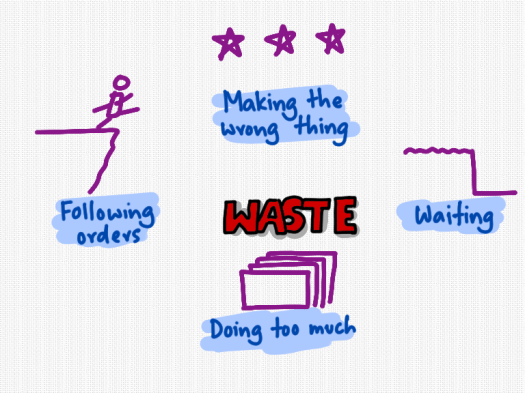
For example, how often do you end up making the wrong thing for a customer because you didn’t take the time to really understand what they needed.

All too often people try and guess what others need rather than taking the time to ask them and then write down what they say in their own words.

The minute you start to change the words they have uttered a game of “Chinese whispers” starts and you end up very quickly with something very different to what you started with.

Then there is the waste involved in waiting for something – you send an email and then because no one responds you don’t follow up.

After all, you’ve done your job so that’s ok right?

Equally wasteful is doing far too much for a customer – creating a ninety page powerpoint when a three page one would have done.

In knowledge work another kind of waste is the kind that happens when a leader issues orders.

A leader’s views will be implemented by subordinates no matter how wasteful they are – and they can be very wasteful indeed.

The thing that I’m starting to realise is just how much work is done by well meaning, driven and conscientious individuals that they do very well – but should not be done at all.

In an ideal world you would take the time to listen closely to your customer and build them exactly what they needed.

And by doing that, by eliminating the wasted activity that’s usually involved in businesses, you would give them the best product or service possible at the lowest possible price.

Because the thing about waste is that someone is paying for it.

Either you’re paying for it out of your profits or your customer is paying for it in their price.

Either way someone is losing.

And that’s a waste.

Cheers,

Karthik Suresh

Why Doing The Wrong Thing Better Is Not A Good Plan

wrong-thing-righter.png

Tuesday, 8.38pm

Sheffield, U.K.

The more efficient you are at doing the wrong thing, the wronger you become. It is much better to do the right thing wronger than the wrong thing righter. If you do the right thing wrong and correct it, you get better. – Russell L. Ackoff

A few weeks back I wrote a paper on getting started with visual thinking, reflecting on methods I use and the way in which they help in different situations.

Part of the reason I thought it was worth doing was because of the plethora of visual thinking methods out there – methods that I quite liked when I first came across them.

Take Dan Roam’s “Back of the napkin”, for example.

It makes a lot of sense – use pictures to help people understand your point quickly.

At the end of the book, however, Roam introduces a complicated way of picking and choosing what kind of pictures to use to tell a story – and in doing so I think he loses sight of the point that we’re trying to make it easy for someone to understand what you’re trying to say.

And then you have modern visual thinking or visual facilitation methods.

I found Mike Rhode’s sketchnotes principle very useful when taking notes in class – I could condense three hours worth of points into a single sheet of A4.

That perhaps tells you more about the content of the class than about my note taking skills…

A sketchnote is, however, a work of art – and it’s clearest to the person who took the note.

After all, if you’ve made those marks you probably remember what the points were because your brain is relying on additional data points – your physical movements, the spacial positions of content and the bits you added to highlight important things and make them more memorable.

A sketchnote on a big board becomes a visual facilitation exercise – which looks amazing when done but… what use is it?

Most of the time it’s a product, an output from a session that then sits there.

In some cases, it’s framed as a memory of the event, but I’m not sure how often it flows into the next step – where it informs some kind of action – or if there is even a next step at all.

This may seem a little all over the place – after all this blog is based on the idea that drawing things makes it easier to understand and talk to others about something that might be complex or difficult to “get” in the normal way.

But I think that often the focus of activity shifts from helping you to understand to creating something that is visually appealing – something that is pretty and makes you go wow.

And that is a problem.

Websites do this – the useful textual content on most websites can probably be put on two sides of an index card.

The rest of it is visual waffle, elements that are pretty but add no real informational content.

What seems to happen is that an industry quickly develops around any new idea.

It happened with websites, it’s happening with visual representations of ideas and events, and it happens with everything from Agile to Lean to the Business Model Canvas.

The central idea is often simple and useful.

But you can’t profitably sell simple and useful – so you have to make it complex and proprietary to make money.

Which is why something like Bikablo – which is a visual library of sorts that helps you create better pictures – leaves me with an ambivalent feeling.

On the one hand, it looks so good.

On the other, so what?

Maybe I’m just jealous because I can’t do it yet – you’ll see examples of that style soon as I start having a go – and then I’ll stop complaining.

The point I’m trying to make is this.

You need to know what problem you’re solving.

If you want to get better at communicating complex ideas or help a group of people work through their situation and come up with a way to improve things then you’ll need some basic skills in visual facilitation – but you don’t need to be a full-blown artist.

In fact, if you’re too slow getting everything perfect you’ll probably focus on the picture and not on the situation – and create a very pretty depiction of the wrong problem.

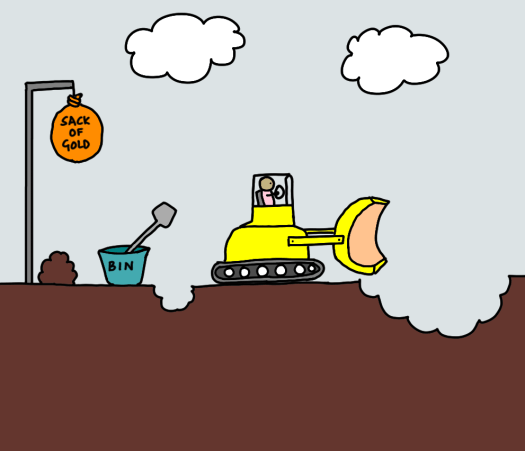
If you’re looking for gold that’s hanging from a pole you won’t improve your chances by throwing away your spade and getting a digger instead.

You’ll dig more ground more effectively and efficiently and be amazingly productive.

Without a result.

And what matters is the result – everything else is simply what you do on the way.

But as the saying goes you sell the sizzle, not the steak.

But… what do you end up eating?

And is it what you wanted?

And of course, if you do the right thing righter – solve the right problem and make it look amazing – then you’re untouchable.

Cheers,

Karthik Suresh