Are You Finding It Hard To Get Everything Done?

making-good-time.png

Sunday, 8.16pm

Sheffield, U.K.

To know the right means of getting something done is virtually to have done it. – Mark Caine

Do you ever wonder what you would do if you weren’t able to do the things you take for granted that you can do? If you lost the use of your dominant hand, or couldn’t see – do you ever wonder how you would respond and what you would do?

We know from books like Daniel Gilbert’s Stumbling on happiness that people generally overestimate how much of an effect this will have on them in the long term. Human beings are surprisingly resilient at coping with the things an indifferent fate throws at them. But what it would be like if you were proactive – if you thought through what you might do if the worst came to be?

I don’t think this can be dismissed as morbidity or pessimism. The idea of facing one’s own fears can help put things in perspective and show you what is important and what is not. Some thing as simple as being concerned about repetitive strain injury, something that I, as someone who tries to write every day, am starting to experience myself. What should I do, stop writing – take a break? Go on medication, surgery even? Perhaps the answer is in strength training. But what if that doesn’t help – what if I can’t write at all?

I find that when you think such thoughts it’s worth starting to consider what the worst case might be and what you might do. And you might find inspiration in the life of John Callahan who was paralyzed after an accident at age 21 but eventually created a career as a cartoonist and was the subject of the film Don’t worry, he won’t get far on foot. And if you’ve ever come across the application Dasher it’s a very good example of what technology can do to support people that have special needs.

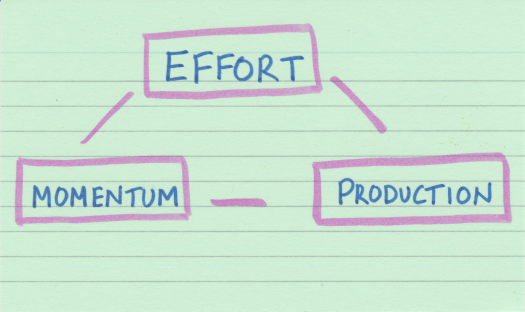
The challenge, for most of us, is finding the right balance between the effort it takes to learn how to do something, the amount we have to do every day to keep the momentum going and what we’re trying to produce as a result of the work that we do. It’s easy to end up wishing we could do what someone else does. I watched a YouTube video today of an artist painstakingly crafting a Chinese bow using mostly hand tools – and while it’s beautifully made and the artist is elegantly pictured throughout – there must have been some sweat and swearing involved as well. We like the results that we see – but not all of us are prepared to put in the work needed to replicate someone else’s results.

That’s why it’s important that we find the thing that works for us – the particular way in which we can contribute. It takes time and patience to do that but you have to put in the time to find your way. You can’t do it all so you do have to try and select and work and stick at something and eventually you’ll work it out. It probably helps to have the chance to do an apprenticeship or craft your own apprentice journey. But when you do find it you’ll find that it asks a lot of you – especially of your body. There’s a scene in the series Mozart in the jungle where musicians talk about how they devote years to their art, pushing their bodies to the limit, and how much strength it takes to do that day after day.

But sometimes just being strong isn’t enough and if you can’t keep doing what you love to do in the way you love to do it what options do you have left? There’s always teaching – help others to learn how to do the thing that you care about – create an apprenticeship, a learning experience for others.

When it comes down to it – working out the options is really not that hard. It’s the fear of the unknown that stops us. Once the thing has happened we deal with it – that’s what our brains evolved to do – to help us survive. To carry on. It’s not over until it’s over.

Cheers,

Karthik Suresh
What Does Product Development Mean To You?

cartoons.jpg

Slow parents understand that childrearing should not be a cross between a competitive sport and product-development. It is not a project; it’s a journey. Slow parenting is about giving kids lots of love and attention with no conditions attached. – Carl Honore

One of the best images I’ve seen about product design is the one about the skateboard, created by Henrik Kniberg. It’s a simple picture that gets across the idea of a minimum viable product really rather clearly. In essence, the idea is that a product is not about delivering a wheel or a chassis but delivering an experience to your customer. I’m not sure I agree entirely with Kniberg’s use of the metaphor but rather than critique his description I think I’ll focus on the what I take away from it, which really is about the idea of the whole.

The “whole” is a concept from systems thinking which relates to the idea of emergence. If you have a wheel, you can’t do very much. If you have four wheels attached to a board then you’ve created a skateboard and you can do something that you can’t do with just any one of those elements. You can stand on it and travel. That’s a product right there and it makes people who like skateboarding quite happy and you can develop it and make it better and faster. I had a classmate at university who built longboards and ordered light kits and had a nice business going. Then, if you add elements, like steering or an engine, or a chassis and seats you end up with different products that help you travel when you’re younger, travel faster, safer and so on.

This idea of product design as something more than a thing is really quite important to internalise. Your product is ready when someone finds that they can do something useful with it – the useful bit emerges as a result of the product existing but it’s not found in it. And sometimes people don’t really get this. They see their job as doing one bit and doing that really well. But what matters is getting the whole thing done and that is where customers find that they get let down. Everyone you talk to probably has stories of poor products and service – from hassles with building an extension to returning items ordered from a website. At the same time, people are getting much better at doing this well, and many market sectors will be changed by entrants and incumbents who change with the process.

I remember the first time we needed professional carpet cleaners. One was in the Yellow pages and I rang up, got through to his wife and was told he would ring back. The other had a website with prices on there and you could book it in then and there. Who do you think got the work? And these days, with the pandemic, who gets your business? Probably Amazon.

When I think about this in the context of writing I am constantly reminded just how efficient a product writing is. It’s easy to create and fast to read. But a word isn’t enough to create a product, and a sentence usually isn’t enough either. You need enough sentences to capture an idea, an idea that you can then send on to someone else. But just because a medium is efficient that doesn’t mean it’s used efficiently. Many books, for example, are really one idea stretched out as far as it can go and then some – but it’s something you can summarise in a few words. On the other hand, some academic papers pack in so many ideas that you could spend an age unpacking them.

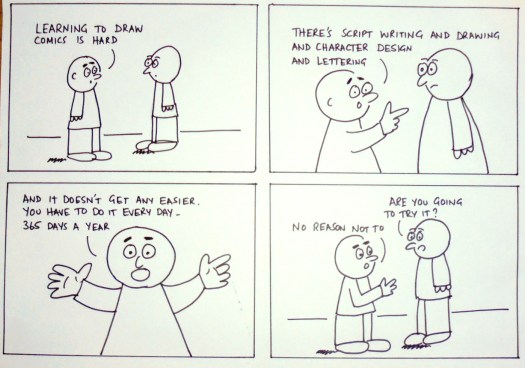
As you try and increase the number of elements in your product you run across the challenge of creating useful wholes. Take cartooning, for example. I draw simple images for my blog posts and for the last few years it’s something that’s done in a few minutes – a few lines that help to add some colour to the post. But when you try and create a cartoon you realize just how complicated a task it is to marry ink and paper when you’re trying to create more than words. What professional cartoonists do is make their lives easy – they create a few characters that live out a story. The characters often wear the same clothes and there are a limited number of backgrounds that are used again and again. Then again, you have cartoonists that create stunningly complex pieces like the work of graphic novelist Lars Martinson. It really depends on what you want to emerge from your creation.

What I’ve found challenging is finding a form of creation that words within the time that I have to work on stuff like this. Like most people that have a blog project this is not about followers or money or fame. It’s a place to practice an art – and for me that’s the art of letters and the art of sense-making with pictures. There are lots of things that I am naturally not – I’m not a natural artist or a writer or funny or insightful. What I’m good at is working on something day after day for a set amount of time and doing it without really caring too much about getting anything as a result of the doing. But there isn’t enough time so anything that uses the time better is helpful. With drawings, the fewer lines you need the better – and so cartoon like images are more achievable that realistic scenes. But cartoons are much harder to do than diagrams – which only need labels and not characters and dialogue and pacing.

And I’m not sure you start by knowing the shape and size of these pieces. You kind of have to start and then things start to make sense as you go about working on them. Going back to Kniberg’s skateboard – the point of his metaphor is to say that if you want to build a car you start with a skateboard as a minimum viable product and then you iterate towards the car. But the flaw is that quite often no one knows they need a car. When you had horse-drawn carriages, for example, do you think there were customers out there that knew they wanted an automobile? No, and they still don’t. Car, as you clearly know, is short for carriage and for a passenger it really doesn’t enter their heads that the horse in front could be replaced with a gas engine or a electric motor or a pack of huskies. It carries them and that’s the outcome. But, you build the horse-drawn one and then worry about the amount of dung and discover oil and things change. It’s the designer that makes the change possible.

Anyway, I do find cartooning hard and that’s why I think I’ll keep trying my hand at it and hopefully you will bear with me. Maybe we’ll both learn something.

Cheers,

Karthik Suresh

What Sort Of Contribution Can You Make To Your Community?

it-depends.jpg

Thursday, 8.50pm

Sheffield, U.K.

You never know whether the subject matter will click with the audience at that particular time. I wish there was a formula, you know, ‘That plus that equals success.’ – Michelle Yeoh

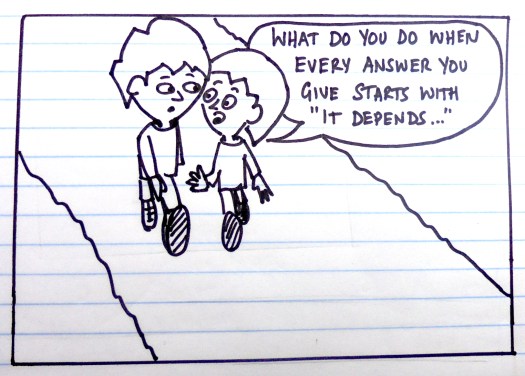
One of the words you learn when you go back to university is the word “contingent”. Contingent means something that depends on something else – the success or failure of an approach depends on what else is going on and the situation in which you happen to find yourself. This is a useful word to keep in mind when you try and reach for a simple answer to a complex situation. It’s possible that your simple answer will work if the situation is the right one for it. But what’s more likely is that you have to figure out what your situation is first and then the possibilities for what you can do start to present themselves.

Perhaps the most useful application of this word is to help us realise that what we can do depends on what is around us, the resources we have and the skills and capabilities we possess. And even if we have everything we also need a little bit of luck. We can’t control the luck but we can work on everything else.

The challenge we face, however, is getting the balance right between the elements we’re trying to master. I was reading a book called “Webcomics” and one of the artists, Shaenon K. Garrity talked about her “journeyman piece” called Narbonic. In 2004, this was supposed to be a six year project and it ran from 2000 to 2006. The point of the Webcomics book was to share the process that the artists featured had found effective in doing their own work – but there’s no suggestion that there is any perfect kind of work. What you can’t get away from, unfortunately, is the actual work of doing the work.

It’s obvious, isn’t it? If you want to get better at writing, you have to write. At drawing? You have to draw. At coming up with scripts? You have to come up with ideas. They are going to be bad in the beginning but as long as you keep going you’ll get better and that’s the only fact there is. You won’t get better thinking about it or reading about it or hoping something is going to happen. You have to get on and do the work day after day and eventually, you’ll find it starts to become easier. Perhaps it even gets better. And one day, maybe it’s useful to other people and that’s really when you’ve discovered a way to contribute that works for you.

This whole question bothers me, I think, because surely the point of living is to find some way to be useful, to help, to contribute, to do something good. We know that taking and having don’t really lead to happiness. We don’t need that much, really, and the more we have the more we need, and faster, to feel the way we did the first time. We’ve just gone past a holiday season and I remember, really quite vividly, the very first Christmas we had with our one-year old. He opened his first present and was totally delighted by it. He wanted to play with it straight away. And he was surprised when he was given another one to open. By the end of the pile, however, he had learned that more turn up and the next day we wrapped them up in newspaper so he could open them again. And the year after that, well, things kept being opened but that wide-eyed wonder and delight of that very first present – a Postman Pat red van – never really happened again. Not in the same way.

For me, anyway, I think happiness comes from doing something, learning something, creating something. And, if possible, doing that every day. And even if it’s really bad and you want to apologise for the poor quality of your work you have to do it – you need to just sit down or stand up or do whatever you need to do to get another day’s work done.

And I think I should point out that when I talk about work I don’t mean your job – what you are paid to do. I think your work is what you want to do, what you would do every day whether you were paid or not, whether there was any reward or not. And if you don’t have work to do like that, then it would be a wise move to take some time and find that thing. Because there is a very good chance that it’s what your society and community need most from you.

Cheers,

Karthik Suresh

Why You Should Give Yourself Permission To Drift

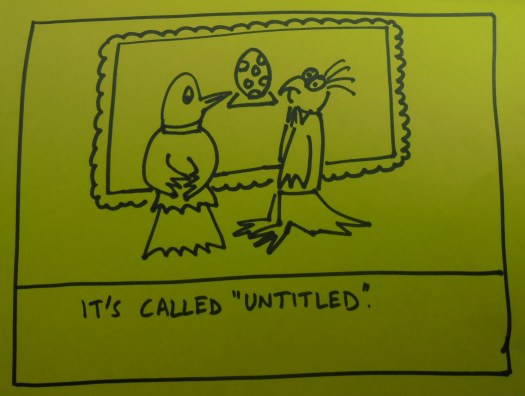
untitled.jpg

All loose things seem to drift down to the sea, and so did I. – Louis L’Amour

If you haven’t come across the idea of post-modernism it’s worth looking up. I was first exposed to it relatively late in life – when I did a management degree and it pretty much turned everything I thought was true upside down. And it’s affecting me to this day.

For example, you’ve read about SMART goals and why you should plan things and have a strategy. But that’s an approach from the fifties and these days there’s an understanding that things are not quite that simple.

I was reading a paper on conflict and reconciliation by David Bloomfield called “On good terms: Clarifying reconciliation”, trying to understand if there is something that we can draw on to resolve conflicts in daily life, at home, in business and in communities. My starting point was to wonder if there was a formula, something we could follow to sort it out. And that sort of thinking runs straight into the issues raised by a post-modern world.

post-modern.jpg

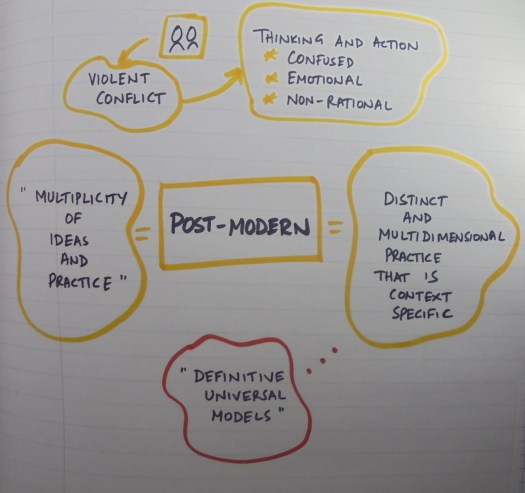
The essence of post-modernism is that you have many ideas, many practices, many perspectives. These may arise from different roots, some may be rational but others, especially in the aftermath of violent conflict, can be confused and irrational. How do you treat all these views? Do you treat revenge with the same respect as a search for justice? This is important in the context of many political transitions – do you now seek justice when the powerful are fallen or do you seek reconciliation – and what does that mean anyway.

Well, the term is hard to define, says Bloomfield and doesn’t go on to define it. You can see it as a process, something that you work through rather than an end result you reach. In this context the post-modern approach adds real value as you try and work out an approach that works in the situation rather than trying to apply something universal and general. That’s going to cause all kinds of problems as people resist being pushed down a particular approach, especially if there is any suggestion that they have to give up on any hope of getting justice.

reconciliation-process.jpg

Bloomfield argues that you need four things to made a reconciliation process work. Justice has to be seen to be done. People have to be able to speak about their experience and have it documented. They need the time and space to heal. And there should be reparations for the injured parties. Without these elements you can still move through the process but your outcomes will be different. With them, they may be better.

Cheers,

Karthik Suresh
What Does The Road Not Taken Look Like?

outside-the-lines.jpg

Tuesday, 8.25pm

Sheffield, U.K.

To know what people really think, pay regard to what they do, rather than what they say. – George Santayana

The real world is a difficult place. I think we forget that when we spend most of our time in digital spaces and imaginary worlds. In those places everything is reversible – you have a delete key and an undo button and anything that is wrong goes away and anything that is left is right.

Except, it often isn’t. It’s left all right but that doesn’t mean it’s good or complete or finished or useful. It just is – digitally perfect and devoid of reality.

But of course that’s not fair. The artifact is the responsibility of the creator and if someone pushes something imperfect into the world then that’s their decision and if it’s any good then it might survive and if it’s not then it will be forgotten. And that’s ok because that’s how things should be.

I might have written about this before but I might as well remind myself what I think. I’ve been reading the odd bit of material where someone self-promotes their stuff, trying to big it up, place it in a higher context and claim that it is the apex of a particular kind of knowledge. It’s not and that gets pointed out by the kind of people who feel like they have to point out stuff that they think is wrong. And, of course, they do this on social media.

So, I ask you, does it matter what people on social media think about what you do? Should you engage, respond, get angry or be happy if someone likes your stuff and says nice things or hates your stuff and says bad things. Does opinion matter?

Well, it does to most of us because ego is a fragile thing and we like to be liked and we don’t like it when people have a go at stuff that we create. But here’s the thing. Once you’ve created something and put it out there, into the wild, whether it survives or not is now up to it and its environment. Take the self-promotional thing I was talking about earlier. In this case it’s a model of a particular kind of thinking. If it’s any good then people will try it, and write about their experiences. They’ll reference it in their papers and it will become a widely cited piece of work. If it’s any good, that is. If it’s really good it could become a seminal piece of work – the grandad or grandmom of a field.

But if it’s not, no amount of self promotion will save it. It will die, abandoned by even its adherents as they see that the idea has no following. Followers matter because it’s people who review what you’ve done and decide it’s worth having in the world that eventually enable your creation to live or die. You can’t flap a bird’s wings for her – she has to fly on her own.

Now, what this leads to is that you can do things the known way or you can set out into the unknown. And the known way includes the way you’ve done things so far. If you have a pattern, a flow a way of doing things then you might need to ask yourself what happens if the world as you know it ends? What happens if you run out of road?

end-of-road.jpg

Take my own writing process, for example. Over the last few years I’ve established a rhythm – a flow of starting and finishing and coming up with something and getting it out into the world. And, as you do more of something, the more it becomes its own thing.

That makes me nervous – I’m not sure why. It’s like I have to test that when something is working it’s going to keep working by trying to break it. So, I’ve broken my process and it results in all kind of confusion as I try and work out what that means and what I should do next. For example drawing on paper rather than digitally creates all kinds of new questions – from the quality of the paper to how it reacts with different pigments and markets and how to get it into the computer and do something useful with it. And then there are those lines – and what you do with them and whether it’s ok to go outside them every once in a while.

There are questions about what you’re trying to do with the work you’re doing. Is the objective to create as much as possible or is it to work towards less but better? Do you try and get it right the first time or do you work towards a finished product in iterations? People do all these things in different ways in different contexts and it takes time to figure out what might work for you or for me. But you can’t think your way to the answer, you have to set off into the dark, onto the dirt track and just start walking. Hoping that there is something out there for you.

Cheers,

Karthik Suresh

What’s The Best Thing That Happened To You Today?

end-of-the-week.jpg

Friday, 8.40pm

Sheffield, U.K.

It’s a little like wrestling a gorilla. You don’t quit when you’re tired – you quit when the gorilla is tired. – Robert Strauss

I won’t lie to you – it’s been a hard and tiring week. Like millions of others we’ve been trying to balance work and home schooling, helped by a side of winter weather.

I’ve written a lot about management and strategies and all that sort of stuff over the years but these days we’re going through are the ones that make theory – the experiences that eventually show you what you’re really like, as a person, as a family, as a community. Even as a nation. It’s all very well talking about what you should do but we all should be documenting what we’re going through now, what happened and how we acted because it’s going to tell you more about how you react when things are hard than all the reading in the world.

And we don’t have it hard – not compared to the millions out there who either don’t have enough or are giving much more than the rest of us to keep things going.

But today, at the end of the week, it was nice to find an unexpected bag of chocolate at the back of the store cupboard, something that had been forgotten.

And it was just what we needed.

Cheers,

Karthik Suresh

This Is The Only Way To Get The Balance Right

reduce-scope.jpg

Thursday, 7.15pm

Sheffield, U.K.

A fixed deadline and a flexible scope are the crucial combination. – Jason Fried

It’s been one of those days. Like millions of others we have had to balance home schooling, work, sledging in the snow and the myriad other things that make up our everyday lives. And it’s exhausting like the memes circulating show. And while the videos show us the funny side of things they’re not very useful in telling us what to do.

And what should be doing is less.

The fact is that we have a fixed amount of time each day and working harder now is simply going to lead to burnout later. You might deliver and keep up for a while but eventually you’ll struggle and the fallout will be worse.

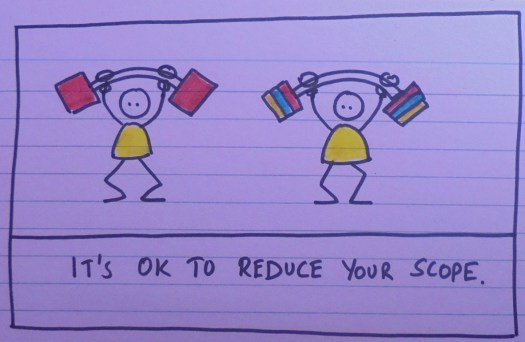
The answer is to keep the total amount of weight you’re carrying the same but do less of each thing so that the total weight stays the same. This means that you should reduce the scope of what you’ve got to deliver in the time you have by focusing on only the important, the crucial, the things that are necessary. And the rest can wait until things are back to normal.

Drawing is a good example. I might want like to draw a complex and nuanced piece but I don’t have time and a line drawing on an index card will get the point across. And that’s ok.

Well, that’s all I have time for today. See you in the next post.

Cheers,

Karthik Suresh

What Are Our Options To Resolve Conflict Situations In A Group?

win-win.jpg

Wednesday, 8.46pm

Sheffield, U.K.

He that would make his own liberty secure, must guard even his enemy from oppression; for if he violates this duty, he establishes a precedent that will reach to himself. – Thomas Paine

Today seems the kind of day to talk about conflict and how it works – from between siblings at home to the highest institutions of government taking in social media on the way.

I’m not a big social media user but what I see on my feeds patterns of activity – some promotional, some attention getting and quite a lot that’s criticism. The promotional stuff I don’t have much of a problem with. People should talk about what they do and what they’re interested in because that’s how we learn about their point of view and the contribution they might make. The attention getting stuff is sometimes entertaining but mostly uninteresting. And then there is the criticism – an approach that is really quite counterproductive.

You probably know about the four signals that tell you that a marriage is breaking down – the four horsemen of relationship Armageddon. These are criticism, contempt, stonewalling and defensiveness. If you see those happening in a relationship you know things are going to end poorly. And I see a lot of that online – open contempt and criticism. Of course, when you’re trying to appear strong and appeal to your fan base then these are the tools you use to attack your enemy – which works great when you seem invincible. But when you’re wounded then everyone piles in, eager to get rid of you as soon as they can.

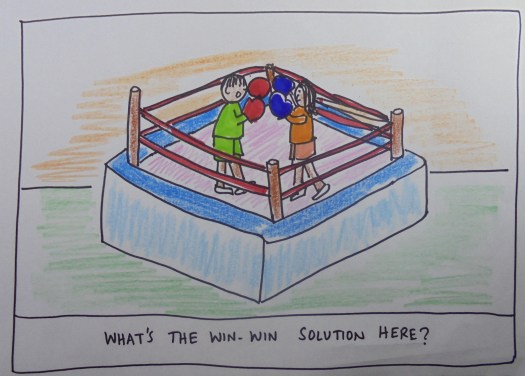
What can you actually do if you want to look at conflict resolution? I wanted to point to a paper but can’t find it right away but the essential idea is simple and you can set it out using a logic table. If you have two parties then the outcomes that can happen are: win-win; win-lose; lose-win and lose-lose. We talk about win-win being the ideal outcome but in many cases a win-lose or lose-win is the only outcome. You don’t get an equitable solution in a boxing match and you don’t get to share being the top person.

In addition to the list above though, you have a few other options. You can avoid the issue, flatter people and change the subject or just not turn up when it’s being debated. There are many ways to play the game and when you do that the point is just to stay in the game rather than a win or lose being declared. The one who wins is the one that doesn’t lose.

What’s my point here?

I suppose it’s that we shouldn’t allow ourselves to believe that there is an ideal solution and there is always a win-win. That’s naive. A win-win is more likely to be a special case when you aren’t playing a zero-sum game, one where one person’s loss is the other’s gain and vice versa. At the same time we play win-lose games when the situation isn’t a zero-sum one at all – when we’re supposed to be on the same side.

For example, what should you think when a community of practice tears into other ideas? Is it important that you contradict everyone that has the wrong idea (as far as you’re concerned) on social media? Well, for some people it might give them a sense of satisfaction but in the end I suppose what matters is the peer review process. I’ve just realized, as I’ve written this, that peer review exists all over the place. It’s not just for scientific papers and Google. The ideas that float up and persist over time are the ones that are probably worth holding on to. In most economies what you should probably be is some kind of conservative democrat – someone who believes in individual freedoms while helping society as a whole be better. You don’t have to rail against “wrong” ideas – you just have to talk about the right ones. And if they are right and people agree with you you’ll outlast the ones that are wrong.

I suppose what it all comes down to is that engaging in conflict is easy. It’s easy to fight. It’s easy to pick a battle with your sibling, your parents, your co-workers. What’s hard is having self-control, restraint, the ability to compromise. And when we’re stressed or overwhelmed we do what’s easy. But it’s doing the hard stuff that makes a society work or a community hang together.

What we have to believe is that we need to try and resolve conflict through dialogue and debate in our communities. And we have to hope that bad ideas may hold sway for a while but that the rot in them will eventually hollow out the bad ideas and leave a space where new, better ones can take root again.

That leads to the question of how do you contribute good ideas, what sort of responsibility do you have to help out? Let’s look at that in the next post.

Cheers,

Karthik Suresh

p.s. After a few weeks of angstiness I have restarted the Community book project and I’ll try and work through that over the next month or so.

What Sort Of Attitude Should You Have Towards Investing These Days?

all-different.jpg

Tuesday, 7.06pm

Sheffield, U.K.

Investing should be more like watching paint dry or watching grass grow. If you want excitement, take $800 and go to Las Vegas. – Paul Samuelson

So… the price of crypto is at a high again and it’s all over the news. I wasn’t really going to talk about it – I haven’t written about investing for a while but I should probably make a comment just so it’s in writing when I wonder what I thought at the time.

The reason I haven’t written about investing is that there isn’t much to write. The answer is to buy the S&P500 and get on with your day job. But I read Howard Mark’s latest memo (pdf link) and it is a good summary of the state of play for investors these days. If you don’t want to read all eighteen pages the TL;DR version goes like this.

Once upon a time investors had to work hard to get information about company performance so if you looked in the odd corner you’d find something cheap that everyone had overlooked. So you bought it at a low price and sold it when others realized its value and the price went up. More people started to get interested and it became easier to just buy good companies with great long-term prospects and hold them. The post-war years were boom years and big companies grew and grew as markets around the world opened up and as long as you held on to stock you could make money. Then the Internet came along and, after a false start, changed everything. Having an information advantage evaporated entirely with ubiquitous and free market data. Now, anything that can make more money out of providing a product or service than its cost of capital is worth an infinite amount of money. As long as it survives… So all you have to do is consistently pick winners. Or buy an index tracker and own the whole market. Your choice.

Back in 2018 when Bitcoin fever was kicking off I wrote a couple of pieces about building a trading system and buying crypto. Over a short period I bought into the market, saw it fall and sold at my stop-loss. I left my money in cash mostly because I didn’t know how to get it out and then reinvested it some time later. We’ll come back to that in a bit.

Mark’s memo is notable because it’s almost a conversation between him and his son, a distinction between an older generation and a new one. Marks plays the elder and talks about portfolio management, why the price you buy at matters and why you should take some money off the table when the price goes up. Things are different, the son argues. I’m going to buy something I believe in and hold it forever. And I’ll buy things that look expensive because they’re worth it.

But here’s the thing. The approaches don’t sound that different. Basically, set out your case and buy it if you believe. We’ll know in time if things work out for you. The chances are that you’ll go for the big companies, the ones that have made it. Or maybe you get lucky and pick that one company that goes on to dominate. But that’s not easy either. You’re looking for value, however you define it.

Anyway, back to crypto.

Let’s look at the bitcoin chart, updated from the heady days of 2018.

2021-01-12_bitcoin.png

In case you’re not familiar with this chart it’s a Point and Figure chart, the X’s are increases and the O’s are decreases. And if you can read this chart you can go in and out of trades when you see certain signals.

What the price history is telling you is that the price went down and up for a while, mostly down, and then shot up quite recently – which is when it made the news again. A pattern not dissimilar to what we saw in December / January 2018.

Would I have made money if I had traded this position? Well, my first reaction when I saw the chart was probably not, there were quite a few points where I might have bought and sold over the period. But I wasn’t sure what the returns would have been. Well, rather than theorize I modelled the position. Now, the way I’d have done it is by committing a fixed amount at the start. I’d have then traded in and out without adding any new capital – just seeing if I could increase my starting stake. If I had done that I think the positions would have ended up something like this.

2021-01-12_trades.png

If I had invested a thousand dollars back in 2018 and done the trades as in the table above I’d have made $27 in profit, a return of 2.7%, less than a percent a year.

That’s not a great return but it makes sense to me. A crypto currency is worth nothing other than the belief people have that it’s worth something. You could exchange it for a burger if someone would sell you one or you could exchange it for dollars. If it were used for burgers, the chances are that it would behave normally. But because you can exchange it for dollars the greater fool theory kicks in and everyone buys it hoping to find a greater fool who will pay more to take it from them and that drives the price up. Over time, however, that results in pretty random behaviour and when you try and trade it you make naff all because of that random quality of the thing.

But I didn’t trade the way I would have done. What I did was buy the S&P500 and a few other cheap index trackers and get on with the day job. Since 2018 the S&P500 has gone from somewhere around 2,600 to 3,800 – an increase of 46% or so. But you know what – my investment provider tells me that I’m doing a very bad job. My investment rating is zero, the report card says “could do better” and apparently the funds I have are not rated “high quality”. That the S&P500, the 500 most valuable companies in the US, are not high quality. Which should tell you something about investment research. High quality funds are the ones that make them the most money, not you.

Ok. Stop ranting. This is about crypto.

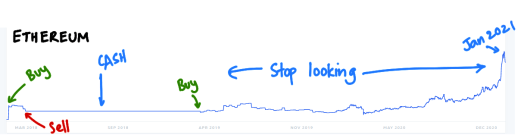
What I actually did with that tiny crypto position was reinvest it in 2019. I didn’t write about it but I really did invest it and to prove it here’s the portfolio chart.

2021-01-12_ethereum.png

This is an Ethereum position chart and the few wiggles in the front are when I bought and sold in 2018. Then I stayed in cash – which is the flat line – and then I bought again in March 2019 ish. And then I left it and forgot about it.

That position is up, at current prices, by 566%. Brilliant, right? I should have put more in, shouldn’t I? No… not really. It’s a tiny fraction of my portfolio and it should be a tiny fraction. If it grows, then great. If it doesn’t, I haven’t lost much. Although maybe if I get another low I’ll go in again.

I don’t understand the crypto market – no one really does. But I don’t understand the S&P500 either. The point is that you won’t get a return unless you own a tiny bit of the world and the world includes crypto and so you should get an exposure to them, either by owning a company or owning some directly. Just make some good choices about how much money to put in each pot, pay as little as possible in commission and things should work out ok.

We’ll go back to interesting topics (for me anyway) from the next post.

Cheers,

Karthik Suresh

Manage Your Energy Or Someone Else Will

zero-sum-game.png

Monday, 8.35pm

Sheffield, U.K.

Energy conservation is the foundation of energy independence. – Tom Allen

I’m a little low on energy today. Maybe it’s a biorhythm thing – the charts that I look at when I think about this sort of thing show everything at a low. Maybe biorhythms don’t mean anything but electric circuits do and I think they have something useful to tell us about living well.

Tom Allen’s quote has to do with energy, power, the stuff that comes out of a generator. But it could be applied just as well to whatever else you do. I’m starting to think that life is a zero sum game, where every unit of energy you give someone else is a unit of energy you don’t have for yourself. And that makes managing your energy really quite an important thing to get your head around.

For example, your creative energy can be used to work on your projects or work on your employer’s projects. If you use them to work on “work” projects you just won’t have enough energy left to do your own stuff. How many graphic designers go home and paint for the fun of it? How many chefs cook? How many writers write? I suspect those who do are careful not to give their all work, saving some energy, conserving it, so that they have some left when they get home and want to do a bit more.

I think that’s what’s happening today. I’ve spent a long time on a particular project and it’s just drained the energy I have left over. So, you might say, that’s ok. Take the day off. No one will notice if you don’t do what you want to do because that’s what you want to do. But that’s a dangerous argument, once you take a day off, it’s easy to take another day and then another one and before you know it a few years have passed and you don’t feel like you can do anything any more.

So, even if you’re tired you need to do the work. You need to get on and put something out that’s what you want to do. And that’s where the way to break out of a zero-sum game lies. It lies in routine and leverage.

First – you can keep going with muscle memory, just momentum from routine and the previous day’s work can keep you going even when you’re running on empty. Sort of like a flywheel that stores just enough to get you over the hump.

The second is to use leverage. Tools that help you do more quickly. Tools are amazing and if you get your toolkit working for you it’s going to help you out most during those times when you have little left to give. The tools will look after you if you look after them.

And then you’ll have another day behind you and time to recharge and start again.

Cheers,

Karthik Suresh