Becoming Fearless

ballpoint-pen.png

Tuesday, 6.36pm

Sheffield, U.K.

“When I use a word,” Humpty Dumpty said, in rather a scornful tone, “it means just what I choose it to mean—neither more nor less.” “The question is,” said Alice, “whether you can make words mean so many different things.” “The question is,” said Humpty Dumpty, “which is to be master—that’s all.” – Lewis Carroll

I’m a little concerned about developing repetitive strain in my wrists. It’s to be expected, I suppose, as I work towards writing a million words. Last year didn’t help, with an average post length of over a thousand words. I keep them shorter now.

If you want to write fewer words, however, you also need to think about how you can make them count. How can you do something that has some value, that makes an impact?

The strain affects writing by hand as well, and so I’m experimenting with different instruments, such as ballpoint pens. Like many people that are fussy about stationery I can go on for a while about the differences between pencils, ballpoint pens and fountain pens and what sorts of problems we have with paper. But now that we have the Internet it’s easier to go looking for other people’s stories.

In doing this I came across The Power of the Ballpoint Pen: An Artist’s Magic Wand, in which Jason Franz talks about how artists like it as a tool. He talks about strategy and purpose – how his strategy is to get his students to get over the fear of making mistakes by using hard to erase media. He also talks about how creation is a process of iterative development, something you do in layers, first sketching out a light outline as you search, then going over the good lines a bit more as you confirm, and then finally laying down a dark like as you punctuate and bring out the essence of your drawing.

I think this inability to erase is important – that’s why I prefer to write with a text editor that makes it just that much harder to delete large chunks and why I use drawing software that has no cut and paste ability (at the moment) and I hope they don’t change that. Putting down a line and sticking with it is skill you have to develop – and that’s the purpose of Franz’s approach. The iterative development he suggests is so that you can understand that just having talent is not enough to create good work – you also need to work at it. He wants you to slow down and see that anything worth having in the real world takes time.

And then the most important message is to let go of fear. When you can erase a mistake you can live your life being timid. Don’t do that. Make a firm line that can’t be erased. Be fearless.

Cheers,

Karthik Suresh

Is This The Model We Should Be Aiming For In Business?

autopoietic.png

Monday, 8.19pm

Sheffield, U.K.

The Chilean biologist Humberto Maturana passed away on the 6th of May 2021. I heard his name for the first time on the 8th in a talk by Peter Senge on facilitating system change, where he talked about autopoietic systems, a term created by Maturana and his colleague Francisco Varela.

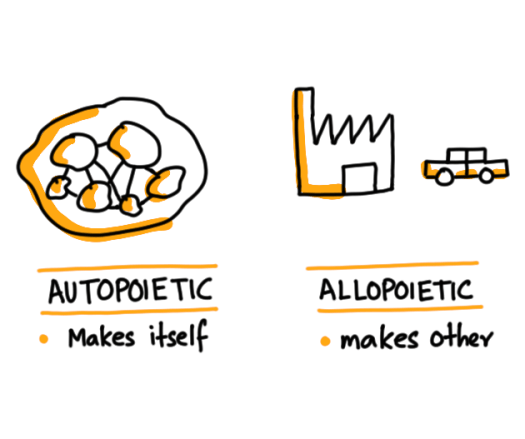
An autopoietic system is something that can maintain and recreate itself. It originally related to the idea of living things, like a cell, but it’s not really used as a definition for life these days. Instead, it’s more akin to a self-sustaining system, one that is capable of ensuring it’s continued existence.

The opposite of an autopoietic system is an allopoietic one. This is a system that creates something else, like a factory that creates cars. The purpose of the factory is to produce its output, not to maintain itself.

Of course, these concepts have blurred over time. Autopoiesis has been applied to more things than living systems. It’s arguably the kind of idea that underpins concepts of a circular economy, where across a wider system of interacting parts we collect and reuse material and maintain the integrity of the whole system.

We talk about sustainable businesses, but perhaps what we should be aiming for is autopoietic ones – business ecosystems that are self-sustaining. Ones that enable their own continued existence.

This is not what happens at the moment. There is arguably huge waste and destruction of capacity and potential. Few businesses last five years, and of those fewer make it to thirty. And there are very few that are more than a century old. If we could do a better job at creating organisations and institutions that are autopoietic, we might be able to move faster towards a more sustainable future.

Cheers,

Karthik Suresh

Understanding The Value Of Being Agile

agile-value.png

Sunday, 7.27pm

Sheffield, U.K.

Elves are like trees, grounded and focused from the trunk down but graceful and agile on top. – Orlando Bloom

I’ve come across a few posts on “Agile” in my feed and it reminded me that I didn’t know a whole lot about this approach to developing software. I’ve read the manifesto, of course, and I try and apply it myself. But as I spend more time researching the concepts in this space I wasn’t sure how to think about the approach – what was the intellectual framework that it fell into?

This video by Dave Thomas helped answer this question. Dave is one of the signatories on the manifesto and the basic thrust of his talk is that implementations of the manifesto have lost track of the values that it tried to talk about. And this is because you can’t sell values but you can sell methods and tools and processes. So what you have is an industry that teaches you rituals to follow that are supposed to deliver the kind of results you get if you put agile values at the heart of how you work. Somehow, the rituals don’t quite match up with what actually needs to be done. And it happens all the time.

Dave talks about what the values actually are – and it comes down to the ideas in the image that starts this post. The question of “what” is agile is answered by thinking of the steps you take. You start by understanding where you are, then you take a small step towards your goal. You then see what you’ve learned and what that could mean. And then you repeat the cycle, look at where you are now and take another step.

Dave also talks about this as a model that’s similar to the way in which you steer ships. Ships are hard to steer, they’re big things and it takes time for things to happen. So, you have controllers that help you deal with this, in particular something called a PID controller. PID stands for proportional, integral, derivative and it simply means this. You need to measure how far away you are from the error, what has happened so far and how long it takes for things to change.

This is interesting because Dave, who knows what he is talking about, has likened what he thinks of an agile approach as being akin to a cybernetic system. Cybernetics is literally derived from the idea of a helmsman – someone who steers a boat. I’ve written about cybernetics briefly in this post and explained it in this video. Agile software development, therefore, one could argue is closely related to the field of cybernetics.

The other element of Dave’s talk is related to decision making. He argues that when you have to make a choice between two alternatives that have similar outcomes pick the approach that gives you the most flexibility to change later. This is what we might call preserving optionality – making sure that the decisions you make don’t lock you into a single track that you will be unable to escape from if you need to later. That seems like common sense – but at the same time much of the world of business tries to do just that. And the world of politics, when you think about it.

Anyway, the best part of the talk is about the difference between agile as a verb and as a noun. The right way to think about it is to be agile, to do your work in a way that corresponds to the dictionary definition of the word. It’s not a thing you hold. It’s the way you act.

Cheers,

Karthik Suresh

How Involved Do You Need To Get To Understand Something

involved-or-apart.png

Saturday, 8.44pm

Sheffield, U.K.

The difference between involvement and commitment is like ham and eggs. The chicken is involved; the pig is committed. – Martina Navratilova

From what I’m told the positivist school of thought still dominates research methods in the U.S. Writers such as Robert Pirsig describe how it affected researchers in the 1970s, forcing them to look elsewhere if they wanted to progress their academic studies, usually in Europe. And even now, forty years later, I understand that certain subjects cannot be published in North American Journals.

I suppose academics, like all other people, are trapped in their histories. We all find it hard to let go of ideas that have worked for us, and that we therefore believe are true. No one changes in an instant. What happens is that attitudes change over time, small variations happen until we reach a tipping point and then one set of beliefs is replaced by another. It happens in that instant where the balance tilts from fractionally on one side to the other, and then it seems inevitable.

I think that must also happen with the positivist viewpoint. As a reminder, positivism according to Google’s dictionary is “a philosophical system recognizing only that which can be scientifically verified or which is capable of logical or mathematical proof, and therefore rejecting metaphysics and theism.” Metaphysics, according to the same dictionary, is “the branch of philosophy that deals with the first principles of things, including abstract concepts such as being, knowing, identity, time, and space.”

Let’s focus on the bit of the positivism definition that has to do with scientific verification. That has something to do about repeatability – when something happens in a particular way regardless of who is watching. And that’s the first gulf because when you move from observing things like stones being dropped from a height, where we are pretty certain that the stones don’t know about or care about who or what else is involved, to observing people and groups who are quite often intensely aware of being watched, things stop being quite as repeatable and therefore not as scientific.

So we wrap it up in methods that look like science because they produce numbers – like questionnaires and surveys or, in these modern days, cookies and search histories. The use of this data, in theory, helps us predict what’s going to happen on average. This is a seductive approach, the idea that science will help protect us from the risks in the future through superior scientific methods.

But we know that doesn’t work too well. The last two decades should tell you that. Scientists are probably following economists in mostly telling you what’s happened rather than being right about what’s next.

So this is perhaps the big challenge for our time. We have mastered the world – the physical one around us and we know how to make it do things that no other creature can do. What we now need to do is learn how to master ourselves.

Preferably before there is no world left.

Cheers,

Karthik Suresh

What Is Data And Why Is It Important To Collect?

collecting-data.png

Friday, 7.03pm

Sheffield, U.K.

I personally think there’s going to be a greater demand in 10 years for liberal arts majors than there were for programming majors and maybe even engineering, because when the data is all being spit out for you, options are being spit out for you, you need a different perspective in order to have a different view of the data. – Mark Cuban

I was reading a paper by Chris Huxham and Siv Vangen titled “Researching organizational practice through action research: Case studies and design choices”, and came across the phrase “deliberate and systematic data collection is essential, whether it be data such as flip chart notes made at a meeting…”

This stuck with me because I hadn’t thought of notes on a flip chart or whiteboard as “data”, but I suppose it is, everything is – when it’s collected. We tend to assume that data is a particular thing, like numbers or statistics, but it is actually everything. What we find unnerving about Google and Facebook is that they collect it all, whatever we do is monitored and stored and then something happens with it later.

The thing about data, however, is that it is useful to have it, whatever you do. For example, I’ve realised that I have spent most of my life creating data – once I learned to write anyway. I wrote when I was younger because it helped me think and early in my career I learned that taking notes during every meeting was a good habit to get into. There’s no point asking whether something is worth recording or not. Record it first and ask questions later. This has become a twenty-year habit And I hope it continues.

The reason you write, however, is not just to record. It’s so that you have space in your brain to observe and see the total context – the widest possible picture of what is going on. Without notes you’ll remember only a few things. With notes, you can ask more and explore widely. And if you take good notes, visual ones, you can map out understanding very effectively indeed.

But once you have this data what do you do with it? In the collection of essays, “Analyzing qualitative data”, Christina Hughes talks about Schatzman and Strauss’ argument that notes can be Observational Notes (ON), Theoretical Notes (TN) or Methodological Notes (MN). I see this recommendation as one to take notes about what you’re seeing, notes about what you think about what you’re seeing, and notes on how you’re going about making notes and thinking about what you’re seeing.

The reason why you might want to get better at collecting data is that once you have it and develop the skills to understand it life becomes a whole lot easier. If you think of a sales meeting as an exercise in data collection you’ll approach it very differently to if you think of it as an exercise in psychological manipulation. Any meeting, in fact, from one with your child to one with your boss and even one with yourself, will go much more easily if you first seek to collect data and then look to understand and make decisions on the basis of what you’ve collected.

Cheers,

Karthik Suresh

How To Develop Your Understanding Of A Field

connected-frames.png

Thursday, 8.28pm

Sheffield, U.K.

All our knowledge begins with the senses, proceeds then to the understanding, and ends with reason. There is nothing higher than reason. – Immanuel Kant

In Zen and the art of motorcycle maintenance the lead character, Phaedrus, recalls coming across the writing of Kant. He writes about studying it like a chess player, looking for openings. He writes about Kant’s “formidable logical fortification” of his position. But eventually he finds that Kant is lacking something – that the ideas about beauty seem ugly and somehow there’s something not quite right with reason itself.

We’re moving away from this idea that there we can reason our way to a better way to be, that logic is perhaps not all there is. The thing about reason is that it works within a frame. You define what your boundaries are, what your axioms and beliefs are, and then you can construct logical arguments. The thing is that those argument work only within the context of a frame. What if the frame is wrong – instead of being a rectangle, it’s actually a circle? That’s going to affect how you think and feel about what’s happening inside the frame.

We also have a habit of denying anything outside the frame. If it falls inside our belief system then it’s fine. If it’s outside, then it’s wrong.

I think we are moving to a system of understanding that is starting to look at the connections between frames rather than the frames themselves. It’s the interaction of belief systems that creates much of what we see in the world around us, whether it’s conflict based on age-old religious differences or modern differences of opinion on forms of government or the rights of people.

We spend too much of our time looking inside a frame – looking to do the best job we can do, or be a particular kind of person. If you want to make life easier and create more value – it’s worth understanding what’s going on more broadly. And the easiest way to do that is to start recognising the frames around you and seeing what kinds of connections link them.

Cheers,

Karthik Suresh

What You Need To Know To Understand System Dynamics

systems-dynamics-skills.png

Wednesday, 8.39pm

Sheffield, U.K.

If you take a more Darwinian point of view the dynamics of the universe are such that as the universe evolved in time, complex systems arose out of the natural dynamics of the universe. – Seth Lloyd

MIT, The Massachusetts Institute of Technology, publishes research on its DSpace repository and I came across an interesting paper on systems dynamics by Linda Booth Sweeney and John D. Sterman.

Systems Dynamics is one flavour of systems thinking that tries to understand the behaviour of complex systems as they change over time. I don’t have much experience of this space but came across quite a nice application of it when I presented a paper at a conference in 2019. Dennis Sherwood from The Silver Bullet Machine Manufacturing Company Limited described climate change using a systems model and it made quite a lot of sense. The most interesting part was realising that the issue we have with carbon in the atmosphere is akin to having a leaking boat. If we do nothing, we sink. If we plug the leak, we float. But another option is to bale water out faster than it’s coming in – and Sherwood’s argument is that carbon capture can do that, if we remove more carbon from the atmosphere than we create, then we can limit rises in temperature.

Anyway, the thing about systems dynamics is that it’s complex. The image that start this post shows you the kinds of things you need to know. For example, you need to know what happens when things interact, what kind of complex behaviour can result. You need to understand how feedback works and how things move through a system in stocks and flows. For example, if you buy a toy a day then that looks like a constant line, one toy every day when you think about flow. When you think about stocks, however, you end up with a rising line, as the total number increases every day. Which is why when the kids got to 10 years old there are at least 3,650 pieces of unwanted plastic that I didn’t have when we started.

Another important element to understand is how time delays work – you make a change and it takes time to work through. Moving too fast is a problem. Then there are non-linearities, not everything is causal and it’s hard to model some kinds of changes. And then you have people and the models they carry around in their heads or on paper.

All this skills are necessary if you want to create good quality models and it turns out that they are not innate – we don’t have a natural ability to think in this way. Not even smart people, the paper suggests, find this obvious or easy. One suggestion is that it’s just too hard and we aren’t clever enough to deal with the challenges. Or maybe it’s because the people doing the tests weren’t being paid or didn’t have enough time. Maybe it’s the test itself, it was done in a lab while in the real world we seem ok at making these kinds of decisions. But the paper says that perhaps the problems are even more basic than that. We’re poor at doing this because we don’t know why we’re doing it.

I liked this sentence, “Nevertheless, there is only a weak relationship between education and performance. For a large fraction of the subjects, training and experience with calculus and mathematics did not translate into an intuitive appreciation of accumulations, of stocks and flows.” Modelling does not build intuition – working on real-world problems does. This may not be a situation that’s unique to this field – it feels like a problem that applies to much of education. We are left wondering what the point of it all is.

Cheers,

Karthik Suresh

If You’re So Smart, Why Aren’t You Rich?

work-that-matters.png

Tuesday, 6.28pm

Sheffield, U.K.

The instant people specialize, it’s in their interest to dehumanize the people their specialized function operates upon. – William T. Vollmann

I’ve been reading a couple of papers by Colin Eden about action research and I’m glad I came across them a little later in my exploration of this research space. Eden writes about his experiences and what he’s learned along the way. Interestingly I think I discovered a lot of it myself, but he weaves it together and helps makes sense of it – and it starts to explain the journey I’ve been through.

There’s an important point that I haven’t really seen explained elsewhere and it comes down to the old joke that goes like this, “Why are academic arguments so vicious? Because the stakes are so small.” The nature of research has changed over time, a focus on measurable, positivist approaches that stress hypothesis and experimentation as a route to understanding have dominated thinking. That makes a lot of sense if you want to understand the material world – because it’s amenable to tests and measurement but it is much less useful when it comes to the inner world of the minds of humans and the forms of their societies. Quantitative research in such areas has been less successful, less valuable.

And I suppose the best example of that is mathematics – the purest kind of reasoning there is. Many mathematicians see their space as a pure art, untainted by any suggestion of real-world impact. I studied a lot of maths – from arithmetic to calculus and I can safely say that all the maths I need to know involves the basic operators we learn about in primary school. That was all that was needed to manage billions of pounds of trades.

The reason that any form of study that seeks to do something that is generally true – that works irrespective of people – is that in social systems the people are what matter. Eden points this point as one of the requirements for action research is that we research situations where people care about something enough to take action. If they don’t, then there is no value, no reason to invest and put money into the project. This is missed by lots of people – they study their areas and come up with a bright idea and are then surprised that no one cares. So they try and change policy, asking the government to force people to care. And that works – to the extent that people do the minimum needed to comply. What this means is you can spend a lot of time working on something that interests you but that people don’t care about enough to pay you.

The unsurprising takeaway is that if you’re smart then you’ll be interested in lots of things. But if you also want to be rich you have to work on things that matter enough to people so that they will take action.

Cheers,

Karthik Suresh

How To Take Notes

how-to-read.png

Sunday, 7.09pm

Sheffield, U.K.

The true art of memory is the art of attention. – Samuel Johnson

What is worth learning and what is not, and how do you tell the difference?

I have just cancelled our subscription to a well-known online library service because in its collection of over a million books there is very little of any quality. One of my children, after reading through a dozen or so titles, said that some were good but most were trash. I wonder if what happens to subscription services is the same thing that happens with subprime mortgage debt and junk bonds – where you package a ton of rubbish with a few nuggets of gold and sell the whole lot to a hopeful counterparty. Yes you can find a title that is very good in there – but if it’s very good the author probably wants to sell it as a standalone piece.

What this tells us about life is that hoping for a bulk order of good stuff is not a good idea. We have more content than ever before but the vast majority of it is of poor quality. But as a consumer you have to decide what’s good and what’s not because the heuristics that helped us decide have changed. For example, anyone can publish a book now, so the chances are that most self-published books are not going to be very good. Some will be excellent, of course, but how can you tell? Well, you look at peer reviews, of course – which can be hacked by some people but, on the whole, you hope that content with lots of reviews is better than stuff that hasn’t been noticed by anyone. But is that enough – what if you’ve missed something important in the overlooked material – what if there is a gem hiding there?

These sorts of concerns aren’t new ones. The German sociologist Niklas Luhmann wrote about this and came up with a system of note-taking that he called a zettelkasten, a slip box with notes that had a unique management system. In his essay on learning how to read he talks about the difference between memorising something and learning something – about how to see what is essential and new and sets out something of a process that aspiring learners can follow.

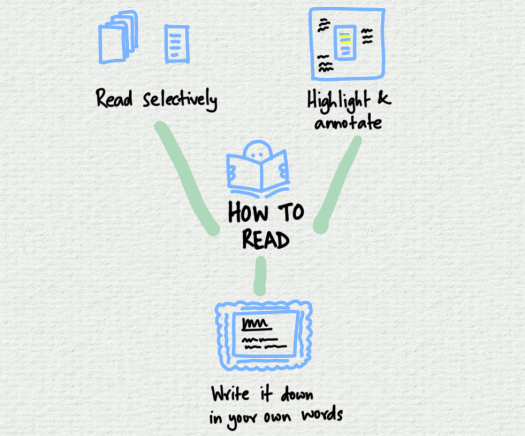
The first thing to do is read selectively. What does that mean? In my case it means peer-reviewed papers as being better than books, which are in turn better than a mate’s opinions or a WhatsApp forward. The Internet has made it possible for us to access information easily but this always-on aspect can lead us to collect more material than we can possibly process. I wonder if it will help to decide what’s worth reading by actually printing it out – if it’s a paper you think is worth spending time on then print it out. There’s a barrier – a small one – but it will filter out a whole lot of rubbish.

If you have a printout of something useful then you’re going to want to engage with it. That’s where annotation and highlighting come in – and where the margins play a role in learning. Writing in the margins and pointing to things you find interesting when you read the material is going to help fix it more firmly in your mind. Although it might actually be a good idea to slow yourself down a little bit more. For example John Locke’s advice on making commonplace books makes two suggestions: first, “extract only those things which are choice and excellent”; second, read the whole thing first then only on the second reading mark out what you want to make note of. This process of slowing yourself down, of insisting on taking your time and going through something again before you spend your time trying to understand and remember it has one huge benefit. You will not want to do it – so you will not do it for things that are not worth it. So, when you do force yourself to make a note it will be for something you want to remember.

This really comes back to how you want to use your time. The only thing that’s fixed is time – the one thing that you cannot change. So what you want to try and do is spend your time doing the highest quality work you can do and that means creating barriers, creating reasons why you should not do anything unless it’s absolutely worth doing.

Then, the last bit of the process of reading is to write what you’ve learned in your own words – not trying to remember what’s been said but to frame it in a way that makes sense to you. For Luhmann, this meant writing it down in his own words. For me, it often means drawing a model, like the one that starts this post. The important thing is that you use your own voice, you write something that is original. One obvious benefit of doing this is that you won’t breach copyright if you use those words later in a paper or publication. And, when you use your own words these days you might also want to consider whether you just use paper or consider other media. But that’s a different subject.

The takeaway is that in an always-on culture where you can have everything it’s up to you to create the habits and processes that make sure you focus on what is “choice and excellent.”

Cheers,

Karthik Suresh

Is Feedback Good For You?

does-feedback-matter.png

Saturday, 6.17pm

Sheffield, U.K.

A decent man who doesn’t consider himself a bigot can indeed be trained to behave like a bigot if he welcomes feedback exclusively from those who consider bigotry no big deal or, indeed, an attribute to be admired. – Adam-Troy Castro

I’ve been thinking about research and learning for a few posts now and I’m starting to wonder if a few things I’ve been told are actually all they seem.

For example, take the idea of thinking in systems. The essential concept here is that we start thinking in terms of parts and wholes and the relationships between the parts, and the emergent nature of the whole that comes from the interactions of these parts. Russell Ackoff presented an approach to this, describing four systems that came from this model, as shown in the table below.

systems-choice.png

In this approach what’s important is whether the part or the whole has choice – whether it can decide to do one thing or the other. So a clock, for example, is a machine made up of parts. But the gears of the clock and the clock as a whole does not display any indication of wanting to do something else – there is no choice involved anywhere. An animal, on the other hand, from an amoeba to a human makes choices as a whole – where to go, what to do, even if that choice is simply to move towards a source of food. The part of that animal, like the heart and lungs of a human, don’t have any choice – they just do what they do. Then you have a social system where choices are made by individuals and choices are made by societies as a whole. And then finally you have systems where the parts have choice – like animals and humans – but the whole doesn’t – because it’s the ecology or environment.

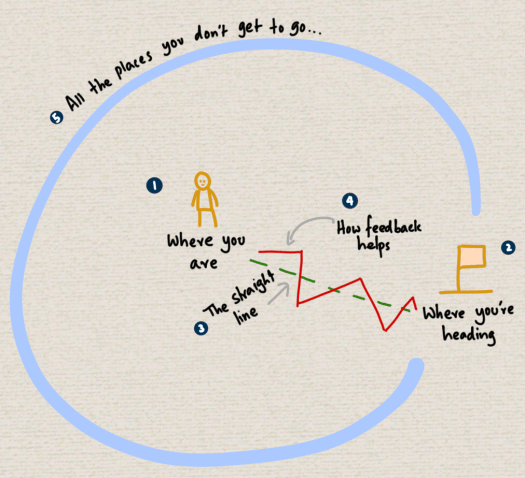
We’ll come back to this in a second but the next model that I looked at was about Cybernetics, which is the study of control and communications. In essence, Cybernetics is about steering your way to where you want to go. In the image above you start with where you are and figure out where you want to get to. There is a direct route from start to finish – but in reality what happens is that you set off and then check if you’re on course and if you’re not you correct your course. Often this results in an over-correction and you go the other way and so you check again and in this way keep getting feedback and correcting until you get to the destination. Makes sense, right?

The third thing I wrote about was models of gods. The two approaches I described were god as the creator and god as everything – a Western and an Eastern approach in simple terms.

Now, I’m questioning the wisdom of accepting any of these theories. Take the first one, about the systems model. Although you can talk about systems that have no choice when it comes to the part or the whole, such systems do not self-assemble themselves in the absence of input from a creator. You don’t take a walk and find clocks embedded in the sides of hills. A mechanistic system cannot exist without a creator, whether that creator is a human building a clock or a beaver making a dam. And if it does assemble by accident then if there isn’t someone around to notice does it make any difference? In essence, the first element of the division, while logical, cannot exist without consciousness. In fact, all those four systems have something in common – human consciousness to notice their existence. This may be relevant in a bit.

Now, the Cybernetic idea that you can steer your way from a start to a finish assumes that you know where you are and you also know where you want to be. Neither one of these is assured, in my experience. Quick, take an inventory of your assets, experience and capabilities? Do you think you know exactly where you are or are you still figuring out your strengths and weaknesses? And what happens if you do everything to get to where you want to get to – will that make you happy? And why are so many successful people apparently not entirely content? What if you live your life trying to be what you think you should be – steering your life on the right path. But if you didn’t have that feedback, perhaps you could have gone somewhere else? What if you’d followed your interests rather than looking around and seeing what else was out there or what someone else thought would be a good thing to do? You’ll never know now, will you?

The Gods argument came from Ackoff as well, the idea that a deterministic universe must have a creator – if the world is a machine someone must have built it. But if it isn’t a machine then actually what that tells us is not that God is everywhere but that we don’t need a God to explain how things were created. Which brings us to Terry Pratchett and his third model of a God which I had forgotten. He argues that we create gods as we need them. If we’re tired or scared or lonely and we pile a few rocks up and light a little flame and it makes us feel better and we decide that a good spirit lives there and then others notice and add their offerings and little prayers and then a thousand years later that’s a sacred spot with a temple and monks and rituals – we’ve just ended up creating a another god. These gods are everywhere – all it takes to make one is a few people with a belief. And gods today encompass everything from two thousand year old avenging old men to the ones that live in the temples of agile programming. It all comes down to belief and gods don’t exist – they are created by humans. For a god to be, we have to want them to be.

What’s the takeaway here. Well, it’s something around the idea that what you believe in matters. And that means that every once in a while you should question everything you believe in.

Cheers,

Karthik Suresh