What Does It Take To Write Something Good?

reporting.png

Tuesday, 7.37pm

Sheffield, U.K.

If people in the media cannot decide whether they are in the business of reporting news or manufacturing propaganda, it is all the more important that the public understand that difference, and choose their news sources accordingly. – Thomas Sowell

There’s more and more non-physical stuff out there, floating around the universe, thoughts and ideas and memories and asides and intimate moments and insipid chatter. The stuff you could turn off and you don’t and the stuff that you’d never find in any other way. And I wonder, do we already know what we should do and don’t because we can’t or because the incentives are wrong or because it’s just too complicated or because some voices are loud and insistent.

Let me back up a little.

Writing is thinking. I use this blog as a place to think – to understand what I think about something and so what you are seeing and reading is thinking in progress. I’m not trying to persuade you or sell to you or convince you of anything. I’m just trying to work things out.

But if I were trying to sell to you I’d have to take the thoughts I think and repackage them in a way that was persuasive and convincing, that told you a story you could believe in and buy into.

But what if there was no point. Should I still do that? Perhaps because it could make money? Perhaps because I believed it was a good thing to do – perhaps because you needed it?

Let’s take an example – if I were to talk to you to try and convince you it would make sense to have a story – one that sounded authentic and natural – like the way people are on telly. Of course, you know that it’s all scripted – you really really know that in your heart of hearts but you don’t want to believe it. Because it’s more fun to believe that it’s all authentic and natural. If you want to see what happens when you don’t work off a script search for Grand Tour Series 2 Episode 4 Review “unscripted”. It’s educational.

Ok, so I’ve told you that you need a script to do a good job. Now should I also sell you a teleprompter? Do you need some software to help you out – that scrolls text while you’re reading to the camera?

Well, I wondered if I did and had a quick look. And then I remembered you can do everything on the command line in Linux. So if you want to go through a text file and scroll the lines you can use a one liner using the awk programming language that looks a bit like this:

awk '{print;system("sleep 0.75")}' file.txt

That’s it – that should work and you can change the number to make the scrolling slower or faster.

awk, in case you don’t know, was first written in 1977 by Alfred V. Aho, Brian W. Kernighan and Peter J. Weinberger and the version that we now, gawk, was written by Paul Rubin and Jay Fenlason.

I don’t know about you but I like the fact that a 40+ year old program can help you do something you want to do and you don’t need to buy anything else or do something new. You just need to be willing to learn and think and use what is already out there.

But I can’t sell you that idea and I won’t try. There’s no money in it, after all.

I’ve just poked a hole in a theory I was holding – one that suggested that a willingness to pay for something was an indication of value. Therefore if it’s free it has no value. And that’s not the case, not for almost everything that adds value to my own working practice.

If you’re wondering where I’m heading with all this then let’s just look at the picture at the start of this post.

I don’t think I’ve done anything that’s listed there – but I would if I weren’t trying to think things through.

This list comes from a BBC video on scriptwriting if you want to get some useful information.

For now, I think I’ll move on.

Cheers,

Karthik Suresh

The Living Heart Of A Research Project

notebooks.png

Sunday, 9.41pm

Sheffield, U.K.

‘Research,’ for me, is a big word that encompasses a lot of different activities, all of them based around curiosity. Research is traveling to places, or studying snowflakes with a magnifying glass, or excavating one’s memories. Research is walking around Hamburg with a notebook. – Anthony Doerr

I came across the work of Lynda Barry at the start of the year and got very excited. I ordered all of her books and started to try out the ideas in there. And then I got stuck.

One of the reasons that I got stuck is that she asks you to slow down, to spend time. Time is what you need when you’re creating something and you need even more time when you’re trying to find out what you are meant to create. That kind of knowledge doesn’t come fast, you have to work and work and work and if you keep working you’ll stumble across something and realise that it’s your thing.

I work fast. Computers work for me – it’s easier to create images digitally and type on a computer than it is to work things out by hand. But there’s a realness to physical creations and I could argue that the way I use computers is as close to the physical experience as possible – hand-drawn images and prose as poetry. But what makes it out on this blog is a fraction of what comes in, and that stuff piles up. I’m on my third notebook of the year and have a lever arch file full of notes. When you have that much stuff how can you process it all?

I suppose the only way you can do that is by becoming more selective about what you read and write and think about. Today, for example, I came up with the idea of post-Western thinking and found there are a few papers out there that use that term. It makes sense because the way we think has been shaped by the tools we had. In the West, the printing press was the way people got their ideas across. It’s easy to print words and so people started to use words. Now, if you look at an academic paper, you can see the results of “word” thinking – and it’s easy to assume that this is the best way to think rather than consider that perhaps it was the best way to think when your only option was to use a printing press.

Lynda Barry’s idea is that a notebook can be at the centre of your research, the thing that pulls in everything and lets you work with what you have. The heart of the work. You have freedom in a notebook – freedom to use words and draw and colour and frame and point. Freedom to make sense of things in whatever way works for you.

But once you think you have something that’s worth sharing you’re not limited to a printing press to publish your ideas any more. You can use a blog and mix drawings and words. And of course there’s audio and video and everything else. And what this lets you do is tell stories that are more than just words. But what does that mean?

I was thinking about using a journal as a place for research and remembered coming across art journals earlier in the year – the kind of thing that Lynda Barry’s students do. If you search for art journals and research you then come across videos on using art based methods for research like this one by Dr Helen Kara. Dr Kara also talks about indigenous research, which is summed up in the phrase “nothing about us without us”, and talks about how you can include more than just words in your thinking – using artifacts, stories, song, tattoos and so on. You’re not limited to the traditional approach any more – and this is what sparked the idea that there might be this thing called “post-Western” that seems to capture what’s going on here.

Now, of course, you’re not going to change the system – not in academia, not in teaching and not in any other ingrained system that has a purpose. You may not agree with its purpose but it is what it is. You can do all the arty stuff you want to do in your notebook but if you want to be published you have to do what the journal reviewers want you to do. That’s the system and you’re stuck with it.

A lot of people who want to change things get stuck at this point. They don’t like the system and want it to change – not realising that the system is a living thing – a giant that is perfectly capable of swiping back at you when you try and sting it. And it will make you retreat under the sheer power of its blows. There’s no point trying to fight it. Not if you want to make a difference.

I’m too new at the whole research thing to know what is the “right” thing to do – but I’m pretty sure that the world is divided into two kinds of people – those that think there is a right answer out there and those that are right that there isn’t. You will make life easier for yourself if you do what is convenient. But I’m also too old to conform to a way of thinking that’s now a couple of hundred years out of date.

Here’s the takeaway. Your notebook is your happy place – the place where you do what you want the way you want. Don’t fight the system – give it what it needs and try to change it from within. But remember that the system is always the old way – and what you’re working towards is the new way – the post-whatever-is-now future.

Cheers,

Karthik Suresh

Why It’s Hard To Really Understand What’s Going On

rhizomatic-systems.png

Saturday, 9.52pm

Sheffield, U.K.

There are only two lasting bequests we can hope to give our children. One of these is roots, the other, wings. – Johann Wolfgang von Goethe

There are many plants in our garden but two will make the point that I need to make in this post. One was a young holly tree, spiky and in the wrong place. I dug it out without too much difficulty. There is holly everywhere so we used it to make some toys. The other is an unidentified beast, some say an Acanthus, that is impossible to get rid of. It has roots that go everywhere and they all seem tangled up and connected and any roots you leave come up the next year, even more luxuriant and irritating.

I have now started a PhD programme and so I’m thinking about knowledge and how to get it and make sense of it as it’s something I am going to spend the better part of this decade working on. So what does knowledge look like?

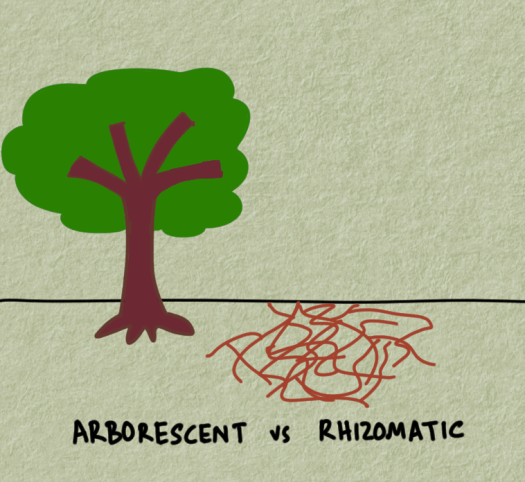
For most of us, we tend to learn things that have some sort of hierarchical structure to them. Something like a tree – an approach called arborescent. You essentially have the constant subdivision of things, a trunk into branches and leaves on branches. A branch does not connect to another branch and a leaf has nothing to do with other leaves – they are separate and distinct.

A Rhizomatic approach, on the other hand, comes from the idea of a mass of roots, where you have connections between the roots. There is no clear start and end, but multiple points at which you can enter and exit the mass. Knowledge is more like this – in the real world anyway – where what matters is connections and the route you take through what is there.

One of the nice things about being back at university is that I have access to research papers. But the trouble is that many of them are unreadable. I looked through a few to find an explanation of this rhizomatic – mass of roots – idea and Wikipedia explains it far more clearly than the papers do. Still, they make certain points and I want to try and capture those ideas.

That leads to a complication. Some time back I wrote about how Warhol never improved on anything and how this might be a good thing if what you want to do is create. The thing with research, however, is that it’s a process, a cycle, of reading and thinking and questioning and writing and reading your writing and thinking and questioning and rewriting.

There’s going to be a lot of this so it makes sense to be selective about what you read. And you need to have a way to write things down because writing is thinking.

This is going to lead to challenges that every researcher has faced since the dawn of time. Things like note-taking, indexing, referencing, avoiding plagiarism. And because I prefer to do everything on the command line I need a way that works for me. I think I have the bones of a system because this is something I’ve worked on for a good few years now, putting pieces in place as I’ve gone along.

What I’ve got to do is slow down. Because the purpose is not getting out words as fast as I can. The purpose is to put words together in a way that is good.

Cheers,

Karthik Suresh

Why Have I Never Come Across This Learning Method Before?

KaWa.png

Friday, 9.42pm

Sheffield, U.K.

Learning never exhausts the mind. – Leonardo da Vinci

I came across a YouTube channel on brain-friendly thinking and it has a number of techniques that I’ve never seen before.

Martin, the creator of these videos, uses techniques created by Vera F. Birkenbihl, who used to be one of Germany’s leading management consultants.

She devised a set of thinking tools that are known as analogous graffiti. There are three of them: ABC lists, KaWa and KaGa. This is how you use the first two.

When you’re reading a book or listening to a talk you might make notes as you go along – either linear notes or sketchnotes. If you use the ABC list method what you do instead is write out the letters of the alphabet vertically on a piece of paper and then write out the words that seem important as you read the book.

For example, I had a look at How to create a good advertisement by Victor O. Schwab. I haven’t had time to read the whole book but I looked through the table of contents and the first few chapters and created the ABC list shown in the image below.

ABC-list.jpg

Then I went back over the list and underlined the really important words in red. The ones that seemed to pick out the essence of the message in the book – what makes a good advertisement.

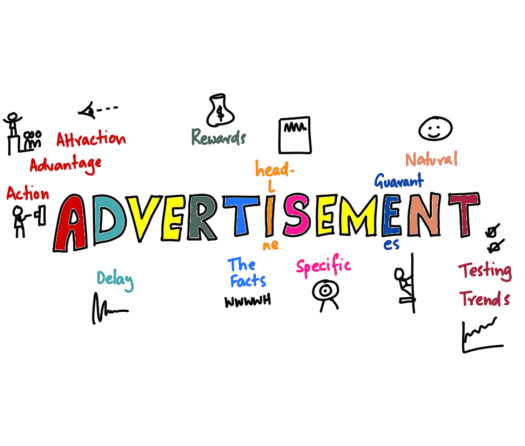
The second technique, KaWa stands for connotations of words. What this means is that instead of having all the characters of the alphabet you pick a word, like “advertisement” and then write out the words from your ABC list using the word you’ve chosen as an anchor. You can see this in the image that starts this post, where I’ve tried to connect words in the list to the letters of the word “advertisement”. You don’t always have enough letters so you have to be creative, like I’ve been with “headline” and “guarantee”.

The last technique, KaGa is for graphic associations. This is where you add drawings to help you visualise the words and ideas you’ve put down on the page, which I’ve done in black on the image that starts this post.

Why would you do all this?

One reason is that by going over the material in this way you’ve picked out the important words that the author felt they had to include. And these words, when seen again, help you recollect the points that were being made. It’s easy, for example, to see that your advert has to ATTRACT attention by using a good HEADLINE and by showing what ADVANTAGES the reader will get. It must cause them to take ACTION. Your enemy is DELAY. Be SPECIFIC, use FACTS. Be clear about the REWARDS the reader will get and GUARANTEE your product – remove risk. Make sure you TEST and are in line with TRENDS – selling ice to Eskimos and all that. And above all, be NATURAL.

Now that’s quite a good summary of what I might take away from the book if I read all of it carefully. And if I look at this picture a year from now I’ll probably remember those concepts pretty easily – perhaps more clearly than a linear note. I think it might even be more useful than a sketchnote which takes down lots of material visually but is not necessary organised for retention and learning.

I think I’ll be using these methods more in the future.

Cheers,

Karthik Suresh

What You Have To Get Right To Teach Well Online

principles-of-learning.png

Saturday, 8.21pm

Sheffield, U.K.

It is by teaching that we teach ourselves, by relating that we observe, by affirming that we examine, by showing that we look, by writing that we think, by pumping that we draw water into the well. – Henri Frederic Amiel

Learning how to teach better online is going to be essential for all of us, whether we’re thinking about engaging with students in a traditional school or university environment or if we’re training colleagues in a work environment. In many cases you’re also going to be teaching your customers before they’re in a position to buy from you. So what do we need to do in order to do this well?

I have been watching videos on copywriting recently and Google, knowing what’s going on, has been serving up ads for online courses and I’ve been listening to them to see how they’re structured. They annoy me. They follow a formula, telling you a problem and then trying to tell you all the benefits that you’ll get if you sign up to their program. Then they throw in a number of tactics like saying you’re getting a discount and the offer won’t be online for long and the kinds of things they think will force you to click the buy button.

I don’t like these adverts or the longer form content that is really a disguised advert because the thing they are teaching – that they have secrets to tell you – is just no longer relevant in this day and age. Every “secret” has been revealed, it’s out there. There’s no magic bullet tactic that, if you just learn, will get people to swoon over what you’re selling.

The thing people selling these products miss is that success for a person who really wants to teach someone else is not how many courses they sell but how many students actually learn something useful. And most courses don’t deliver value. A paper by Haugsbakken [1] references research that suggests most Massively Open Online Courses (MOOCs) score poorly. If MOOCs from universities don’t deliver good value the chances are that your average course dreamed up by someone in their bedroom is less than worthless. It’s probably a certainty.

But, let’s not bicker about whether you can do good work or not from your bedroom. Maybe you can. But, if you are serious about teaching, the paper has a checklist of things you should be aiming to do for your students.

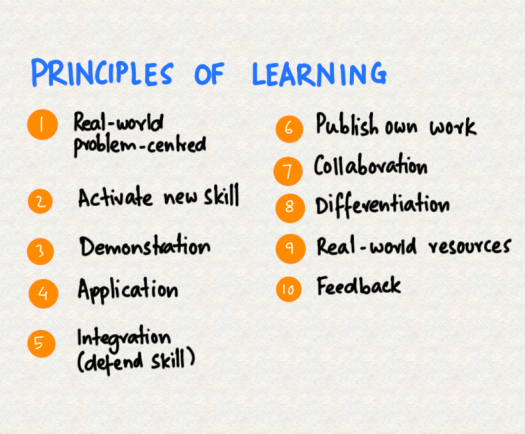
There are 10 things.

First, what you’re teaching needs to be centered around solving problems that actually exist in the real world. It’s needs to be of real-life value.

Second, it needs to help the student develop a new skill, building on what they know with what you’re teaching them.

Third, you need to demonstrate how it’s done well – you need to show the student what good looks like.

Fourth, you need to give the student the chance to apply what they’ve learned and make it their own.

Fifth, they need to understand the point of what they’re doing and why it works – they need to be able to defend the skill they’ve gained – so it’s integrated within their capability.

Sixth, they need to publish and show their work. There’s no point learning something and then hiding it away – show the world.

Seventh, they need to be able to work with others, and collaborate and co-create material.

Eighth, your teaching needs to be differentiated – providing different types of learners with the materials they need to learn in the way that best suits them.

Ninth, your resources need to based on real-world examples. Don’t teach something sophisticated with a simple example – use a case study that is a real challenge that you would face out there.

Tenth, provide feedback. Your job as a teacher is to be available to help your students learn what is good and what isn’t good and how to tell the difference.

Very few of those courses that you take by clicking on an ad will tick any of these boxes. Few online courses from universities will. For that matter, most schools and universities with face to face classrooms and teachers will never approach this level of teaching.

But if you want to teach this is something to aspire to – it’s what good should look like.

Cheers,

Karthik Suresh

  1. “Digital Transformation in the Classroom: Storytelling and Scriptwriting in Instructional Designing of MOOCs”. Halvdan Haugsbakken. European Journal of Education. September, December 2019.

What Is The Most Valuable Thing You Have That You Can Give Away For Free?

what-is-a-good-idea.png

A good idea will keep you awake during the morning, but a great idea will keep you awake during the night. – Marilyn vos Savant

Being able to have and hold ideas is what makes us human. It’s an ability that can trap us in prisons of thought and belief and it’s an ability that can free us to create extraordinary things. But what is a good idea and how can you recognize it?

I think we have to approach this question indirectly because the word “idea” is used in too many way too easily. Let’s look at the word “theory” instead because that’s a good substitute. In an introduction to a set of papers on theory development titled “Nothing Is Quite So Practical as a Good Theory” Andrew H. Van de Ven (1989) introduces a few papers on the subject.

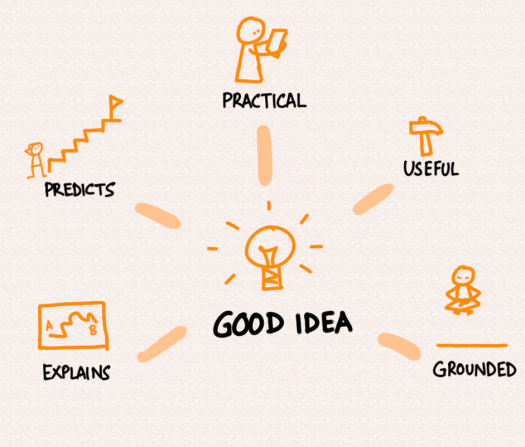
Cherrypicking from this paper let’s start with insisting that a good idea needs to be practical. It needs to be something that you can do. It also needs to be useful, to you, or to someone else. A good idea needs to be based in reality, grounded in data. A good idea explains something that you didn’t understand until then and a good idea predicts what will happen if you follow it.

Can you think of any ideas that you have that fit this list? You’ll find any number of good ideas in books – many are written entirely around one big idea. Take Felix Dennis’s How To Get Rich, for example. It pretty much comes down to “Get on with it.” In fact, his poem at the start of the book reads “The first step? Just do it, And bluff your way through it” One of my favourite books, Zen and the art of motorcycle maintenance says “the most important thing is peace of mind”.

A good idea can keep you going. That one in Zen and the art of motorcycle maintenance has served me well for twenty years. Your choice of ideas governs how you live and act and the choices you make. The ideas you hold will make you rich or keep you poor, give you freedom or hold you in bondage. You are entirely in the power of your ideas.

There’s nothing quite as valuable as a good idea but the great thing about a good idea, is that you can give it away and still have it. You don’t lose anything by telling someone else your good idea because when you’re done you both have it. It’s multiplied.

If you’re the kind of person that’s full of ideas, then you have a good chance at having a good one every once in a while. What you have to ask yourself is if you’re willing to be the kind of person that can execute on a good idea.

If you can, you’re set.

Cheers,

Karthik Suresh

Is Setting Goals Good Or Bad?

too-many-goals.png

Thursday, 8.24pm

Sheffield, U.K.

Each of us has about 40 chances to accomplish our goals in life. I learned this first through agriculture, because all farmers can expect to have about 40 growing seasons, giving them just 40 chances to improve on every harvest. – Howard Graham Buffett

Should you set goals or not? If you have a goal do you improve your chances of achieving it? Or do they just get abandoned, like many New Year’s resolutions?

My YouTube spinner put some videos on copywriting in front of me, including some by Michael Masterson. I had a look at one of his books and saw him reference Dale Carnegie, who said that most people struggle because they haven’t set goals but others struggle because they have too many goals.

This struck a chord with me because I have found goal setting a pointless pastime personally and professionally. Personally, goals are often mechanical, like saving a certain percentage of your income, or almost impossible to sustain, like giving up sugar.

Professionally, most people set goals they can easily achieve because if their salaries are tied to achieving goals it makes sense to make them as simple as possible.

On the other hand, some bosses seem to think that you can set unattainable goals to motivate people but what’s more likely is that when people realize that they can’t reach those goals. they either stop or go somewhere else.

Some goals are the wrong ones for you – like setting a goal to make money when what you need to figure out is what you’re going to do that will create value for someone else and therefore make money.

But you can also have too many goals – where you’re trying to do everything and that can end up with you doing nothing much. There just isn’t enough time to go around and do a little bit of everything hoping to achieve something big.

If you want to actually make something happen having eggs in lots of baskets is a losing strategy. What you want to do is put all those eggs in one basket and watch that basket really closely.

Then again, the word “goal” is a useful bit of shorthand – something that forces you to describe what you’re trying to do.

Once you’ve done that then you can look at what you do and stop doing all the things that don’t contribute towards achieving your goal.

Maybe the real value of working towards a goal has nothing to do with the goal itself. It’s your new-found ability to say “No!” to anything that does not move you towards it.

Cheers,

Karthik Suresh

Why Does The Small Stuff Take So Much Time?

your-work.png

Wednesday, 5.58pm

Sheffield, U.K.

Normal is getting dressed in clothes that you buy for work, driving through traffic in a car that you are still paying for, in order to get to a job that you need so you can pay for the clothes, car and the house that you leave empty all day in order to afford to live in it. – Ellen Goodman

I don’t think the quote above is as relevant these days – but it might be again. It all depends on how people around the world in positions of power decide how others should live their lives. And somehow, we don’t seem to make particularly good choices when it comes to the lives of others.

I have a notebook upstairs, somewhere. It’s a hardback notebook with a blue marbled cover and I made notes in it when I was being taught electronics repair by a laboratory technician a long time ago. We treated broken devices like patients and looked for symptoms so we could diagnose a fault and figure out how to fix it. I used to read sites like Sci.Electronics.Repair FAQ that told you how to fix all kinds of devices.

On one of our repair sessions we took apart a couple of VCRs and my teacher told me about how you an older model was often better than a newer model. On the old ones, it turns out, engineers often used higher quality components. Porcelain wheels rather than ceramic, for instance. Or they would have more heads to read the tape. They were trying to get the thing to work and work well so they put more into it.

Once it was working, however, the next task was to take things away, to make it lighter and cheaper, so that it was more affordable while keeping the quality at a level that was appropriate.

You could look at this as a bad thing – a designer’s effort was going into making something worse rather than better. But you could also look at this as a process of becoming more efficient, using less material to deliver the same outcome.

I was thinking about this in the context of service work today where a lot of the time a customer doesn’t get a physical product. For example, if you delivered a consulting service and had to print out a copy of your report, get it bound and hand-deliver it to every person in a company you’d think very differently about it than if you were asked to email it to a list. A real, physical thing makes you think, makes you wonder if you can do something more efficiently. You’ll print your report double sided, and give it only to those people who really need it, for a start.

I wonder if we don’t think about efficiency in the context of digital services because it’s hard to see things building up. We don’t mind people working long hours, spending lots of time in meetings, writing briefs that don’t answer the questions people actually have. Or actually, we do, but we don’t put the time in to design a better way of working by being clearer about what needs to be done and what doesn’t.

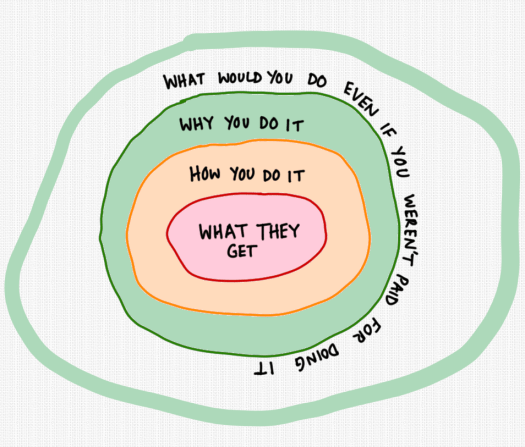
The thing for most people is that the job they do to earn a living takes up much of their waking days – but should it? The core of anything is what they deliver to a customer, what the customer gets from you. You have to know how to do that. And you probably have a reason why you do it. Whether you’re a computer programmer or a bus driver, the job is something that’s wrapped up in layers that look like the image above.

But then there’s what you would do with your time if you had the choice – what you would do even if you weren’t paid for it. This the utopian situation that Keynes suggested was a possibility, that you could work for 15 hours a week or less and still be as productive as you needed to be, leaving the rest of your week to do what interested you.

This utopia hasn’t come to pass because we don’t value our time in the same way we value materials. We will do everything we can to reduce the cost of materials but we don’t have the same pressure to reduce the burden of time. After all, if you pay someone a salary then you’d rather get as many working hours out of them as possible. If you pay them per hour then they have the same incentive, to stretch out billable time as much as possible.

I don’t know what the answer to this is but it seems a shame that we are willing to put the effort in to make a device as efficient as it can be but we don’t do that for humans.

Cheers,

Karthik Suresh

It’s Hard To Know What To Do Until You’ve Done It

terms-of-reference.png

Tuesday, 7.08pm

Sheffield, U.K.

Major organizational changes create uncertainty. But the point is to move quickly – faster than you are comfortable – because in hindsight, you will always wish you had made changes even sooner. – Irene Rosenfeld

I’ve been reading the Economist for a change, because it’s a little more effort to get the Financial Times. I had forgotten how well written articles are in that publication and I want to reflect on one particular piece on enquiries.

Things go wrong. Little things and big things, and when they do one of the options a government has is to run a public enquiry. This study has to serve several purposes, say what when wrong, who made a mistake, help the victims and try and change things. It’s not an easy thing to do and the people who run them have to know what they’re doing.

But who do you get? It’s often judges that are used who are great at fact finding but not so good at telling you what to do next. In fact not many people could probably tell you what to do next, but they could tell you what to do to avoid what happened. Which won’t happen the same way again for a while.

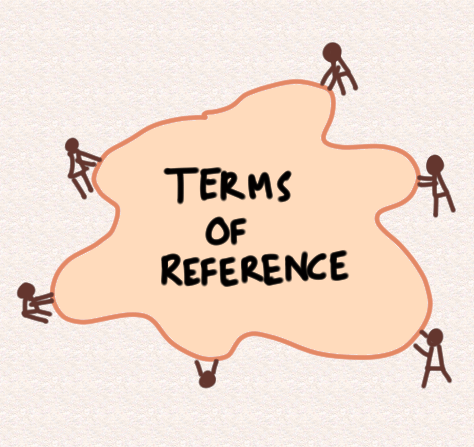
What’s interesting is that the starting point, according to the Economist, is usually a discussion over the terms of reference – what are we going to look at and what are we going to do?

I’m not a particularly prescriptive person because I don’t know what’s going to happen. But once you’ve tried something out then prescriptions start to get important. If you know that you need to do something in a certain way then you need to make that clear – somehow – in policy, in writing, you’ve got to get across what you want.

The thing is that even if you do that you won’t know if it’s going to work. People can read what you say and then go off and do their own thing. Looking at problems and then suggesting changes is one thing, but you don’t know if it’s helped until it gets tested in real life.

A better approach, according to Economist, might be to run drills, stress tests – something like a mock cyber attack so you can see if your defences work. That’s how the Scouts introduce young people to fire safety – by writing a plan and doing a drill.

Maybe that’s what we need a lot more in different areas of business.

Cheers,

Karthik Suresh

How To Be A Better Greater Fool

greater-fool.png

Sunday, 8.01pm

Sheffield, U.K.

The greater danger for most of us lies not in setting our aim too high and falling short; but in setting our aim too low, and achieving our mark. – Michelangelo

I’m into Aaron Sorkin’s “The Newsroom” at the moment and in season 1, episode 10 one of the characters, Sloan Sabbith, talks about how the Greater Fool is an economic term for a patsy, someone who buys long and sells short, the person left holding the ball, the hot potato, the asset. She says that “This whole country was made by greater fools.”

And that explained something to me, something I have missed for a while. If you want to be rich you have to be willing to be the greater fool. If you want to achieve your dreams you have to be willing to be the greater fool. If you want to do anything all with your life, well… you get the picture.

Why is this – why do you need to understand and figure out what this means for you? It comes down to this – what kind of person are you? Are you the kind of person that tells others what assets to buy and sell? Are you the kind of person that buys and sells assets for others? Or are you the kind of person that buys and sells assets for others?

Whatever business we’re in we probably can see ourselves in one of these roles. We provide advice, we help with transactions or we build assets. For example, in the business of education you’re in the advice business if you’re a lecturer, you’re in the transaction business if you’re in management and you’re doing research and publishing you’re in the assets business. Sort of.

It’s probably not a clean model but with advice you have knowledge without responsibility or reward. With transactions you have a slice of the pie that may make you rich but you’re always conscious that you make a tiny percentage of the real money. But with the assets business you’ve got a chance of building real value.

That value is not just in money – it’s your ability to control resources that include time. If you know what you’re doing and are recognised as an expert then people value your time. This might be one reason why people go long on a field, spend many years learning and mastering a particular kind of work. This is a long-term investment in their own learning and development, one that they believe that they can sell short.

You know the story of the factory owner who had a problem that no one could figure out. Finally, they called an expert who walked around and then marked an X and asked them to replace that part. The expert sent in a huge bill for $10,000 and the owner exploded – asking how the expert could justify the bill for a walk and a chalk mark. The expert itemised the bill as, “$1: walking around and making an X, $9,999: knowing where to make the X.”

The greater fool is often used as a derisory term – I’ve used it when talking about cryptocurrencies. But what the Newsroom script told me is that we all have to be greater fools if we want to make something of ourselves. It doesn’t matter what you want to do – whether it’s to start a business, learn a trade, develop a skill, start a practice. You’re going to invest many hours, perhaps much money, to make a long-term investment in what you believe in.

And when you do that, in your own way, you’re a part of building the future.

Cheers,

Karthik Suresh