Technology And Us

2025-03-12_handwriting.png

Wednesday, 9.53pm

Sheffield, U.K.

Technology is a useful servant but a dangerous master. – Christian Lous Lange

Technology should make our lives easier.

And it does.

But we also experience the unintended consequences of using technology.

Figuring out how to integrate technology into our lives without compromising the quality of our lives is a challenge more and more of us face.

An interesting example.

Yesterday, one of the not-so-small people in the house asked for help with his French homework.

I don’t speak French.

His pronunciation sounded problematic.

I took a picture of the page he was trying to practice, written in his handwriting.

ChatGPT transcribed it flawlessly.

Another AI generated French speech, complete with the right accent.

I sent the mp3 to his phone, and he had everything he needed to practice and learn the text.

Handwriting transcription would help me immensely.

Typing by hand makes my wrist hurt.

I’ve typed a lot of words in my time – and RSI was perhaps inevitable.

I work digitally because it’s efficient and because I don’t need paper.

But if I could just write by hand and get a decent transcription, then maybe I’d reduce wear & tear on my wrist.

That would be good, wouldn’t it?

The thing that worries us about technology is its impact on children.

We see them engrossed in devices, watching for much longer than we think is safe.

We see them move through a virtual world that is more pleasurable and fulfilling than the real world.

We fear they may get lost and never return.

Then there is technology that just makes things worse – like some workplace technologies.

The kind of technology that is about controlling and surveilling the worker rather than automating repetitive work.

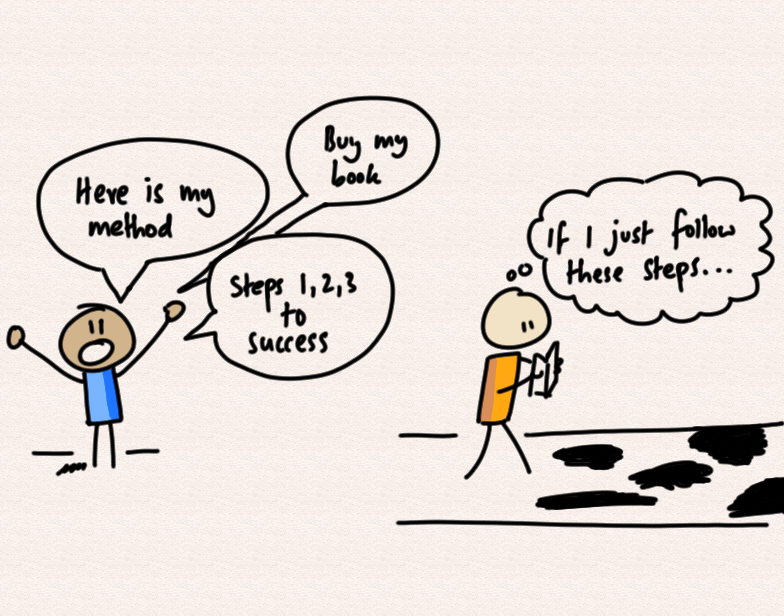
Tech that prevents us getting work done, and instead pretends that process is the same as progress.

But there is progress.

And I remain optimistic that technology can do more good than bad for so many of us.

Cheers,

Karthik Suresh

When Should A Ladder Not Be Climbed

2025-03-11_ladders.png

Tuesday, 9.50pm

Sheffield, U.K.

Success breeds complacency. Complacency breeds failure. Only the paranoid survive. – Andy Grove

Is there a point when an organisation starts to fail?

Or are there crucial points, when the decisions they make lead to success or failure?

Let me put some context around the question.

A startup run by owner founders is a dynamic and interesting place to work.

We build things for clients. As owners, we take a keen interest in how to make things work better. We hire people with fire, people that want to work on interesting things that make a difference.

And the business grows.

Eventually, we take on staff and those staff come into job roles. There is a specification, often a hastily written one. There is a niche, a box, a hole to fit a human shaped peg.

And soon, we have more pegs in holes than creative product building types because we already have a product and customers and what matters is getting customers served.

Eventually, everything we do is so structured that people who want to build new things can’t do that because the existing structure constrains them.

They’re mummified in a web of their own making.

Well, actually, they just opt out, either leaving or being invited to leave.

After a while, what you’re left with is a company full of people who know how to do their jobs but don’t know how to build products.

It’s time to change leaders at this point but really that makes no difference.

What matters is the market you’re in.

As Warren Buffett has said, a great business will do well even with average management. A great management team will not be able to rescue a poor business.

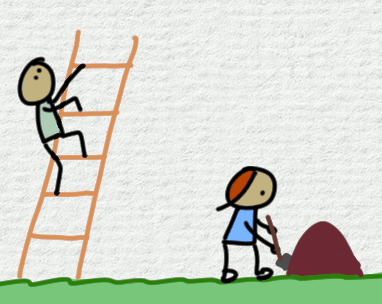
So why do people want jobs so badly – why do they want to climb ladders that lead nowhere?

I suppose some ladders do lead to big jobs and good benefits and a permanent feeling of unease.

What’s it like having a job where you don’t actually do anything?

Real satisfaction comes from being close to the ground, working on something that interests you.

Why not wrap a business around that instead?

Cheers,

Karthik Suresh

There Is A Sweet Spot For Thinking And Learning

2025-03-07_speed.png

Just remember, once you’re over the hill you begin to pick up speed. – Charles M. Schulz

I started the year planning to read the news more often.

I think it might make more sense just to stop altogether for the next four or so years.

Intelligence officials talk about monitoring chatter, a measure of the volume of communications.

You can use this technique with news as well now.

What I mean is that you don’t need to read the news, you just need to monitor how much something is mentioned.

Ten years back I had to read what was going on to know about certain bits of regulation.

Now, I can tell what’s happening and if its good or bad by monitoring my LinkedIn feed – not reading anything because who has time for that and posts are getting longer and longer – but just glancing at and noting the number of posts on any particular topic.

And this leads to a problem – what can you trust?

Not the mainstream news – even though I think many journalists want to tell a good story they’re forced down to do things that get clicks and traffic.

That is, if they still have a job. Because AI will clearly do that better and faster and cheaper.

Well, faster and cheaper anyway.

And the rest of the Internet is a cesspool of opinions anyway.

The most you can do is notice the pros and cons of a topic and see how things turn out.

Let’s take AI as an example.

My feed is filled roughly equally with evangelists and haters.

The evangelists think this will change everything.

The haters think it’s buggy and slow and not useful.

Me? I think it comes down to people and what feels right to them.

You’re probably somewhere on a slope when it comes to your experience of technology.

You don’t really like it, it gets in the way of doing what you really want to do. You don’t want to wrestle with a computer, you just want to get things done but it feels like you’re going backwards.

You use it because you have to but it really makes no difference. You’re about as fast with a computer as you are with a pencil and paper. It doesn’t add anything but it doesn’t get in the way either.

Then there’s a sweet spot, where you get the technology and the technology works for you. It’s accessible and understandable and you can get things done fast and well.

Finally, there’s the point where the technology moves too quickly for you to understand. Some people get it, but the rest of us are left behind.

Hopefully by that time you’ve made enough money to retire.

I think there’s a place for technology that doesn’t require human input, that replaces the effort altogether and there are countless examples of how that makes life better and civilisation possible.

But technology for people has to be at a level that serves them – that helps them to think and do what they need to do.

The right technology for me to think and work is unlikely to be the right one for you.

What’s important is getting a technology stack set up that lets you get on and work on what makes you happy.

And, of course, sometimes you just need to learn how to use the technology in front of you so that you can get on with the work.

There is a sweet spot, the right slope downhill that is fun rather than fearful.

That’s what you need to find.

Cheers,

Karthik Suresh

Why Do We Struggle To Be Productive In Organisations?

2025-03-05_information-systems.png

The least productive people are usually the ones who are most in favor of holding meetings. – Thomas Sowell

I’m looking at David Graeber’s “Bullsh*t jobs”, and just thinking about the challenge of doing useful work in an organisation, especially a large one.

The thing about being in a large organisation is that you have a real chance of making an impact.

Large organisations often prefer to work with other large organisations, so you are exposed to problems that you just wouldn’t see elsewhere.

You start to see how people make decisions about some really quite substantial sums of money.

And you also start to see how so many organisational problem situations are caused be internal rather than external forces.

Take hiring, for example.

When the amount of work we have increases we think that we need someone else – another body to help out.

That kicks off a process – you need to spec the role, figure out what the pay level should be, get permissions, advertise, interview, and appoint someone.

And then the cycle repeats itself – you have more work and your recruit has more work and it’s time to go and get someone new to help out.

Before we go down this route, however, we should really ask a couple of questions.

First, does this work need doing at all?

You’ll be surprised at just how much work is pointless work.

It’s not designed to be pointless – someone probably thought it was a really good idea – but it ends up being pointless because it’s not worth doing at all.

Of course, everything is more complicated than that.

Let’s argue that a particular type of work is pointless – like a formal performance review.

You don’t want to do it and your manager doesn’t want to do it. Surely you can just have a chat instead and talk about what went right or wrong.

That would be efficient, right?

But the reason you have these reviews is for more than feedback.

It’s a mechanism to show you’ve been treated fairly. A tool to ensure that the company has a record of how it’s dealt with you in case things go wrong.

So, from a legal point of view, doing all this extra work is worth it to avoid being sued.

And that’s hard to argue against.

Even though in almost every case you should.

The second question is whether you really need to hire someone.

Can a script do the job instead – what can you get a computer to do rather than a person?

Not because you don’t want to hire someone but because there is no point hiring a person to do something a machine should be doing.

Far too many jobs, especially temp positions, are of this type.

The difficulty is that the majority of people don’t have the skills needed to make computers work for them – and this is something, I am told, that’s getting worse for young people who have grown up tapping tablets.

Let’s wrap up this stream of thought.

Productive teams are small, have the minimum number of people needed to collaborate and use technology effectively to get things done.

Cheers,

Karthik Suresh

How Do You Make Yourself Resilient?

2025-03-04_freedom.png

Monday, 10.07pm

Sheffield, U.K.

We don’t have a monopoly. We have market share. There’s a difference. – Steve Ballmer

I’ve been thinking a little about resilience and what it means for us as individuals.

How do you think people get fired these days?

There are a lot of stories around but I think the general approach is that you have a short meeting with your boss and a HR rep and are told that you’ve been let go.

And that’s it. Your email is turned off. You lose access to company resources. You’re out there on your own.

So what happens next?

For the majority of people this is going to be discombobulating, a shock to the system.

If you’ve been cocooned in an organisation for a long time it’s hard to see how things can function without all that support around you.

Who’s going to give you a computer? Who’s going fix the printer? How do you set up a website? How does email work?

These are not hard things, if you know what you’re doing.

They might seem the hardest things ever if you’re facing them for the first time.

So, a first step to becoming more resilient is having alternatives in place before you need them.

If you were fired today what would you do?

Make a list of actions.

Then do as many of them now as you can.

You may never need to carry out your plan but if something does happen, you’ll thank your younger self for being prepared.

When it comes to computers why do so many people build their lives around online applications?

You don’t control them. They could get turned off at any time. They could double their prices.

There really is no reason to use them unless you have no alternative.

Install GNU/Linux on a spare computer and start using it and you’ll have all the software you need to get everything done.

But… that takes time and is hard. It’s much easier to log in on a browser and get on with it.

The problem is this – it’s a constant tradeoff between freedom and convenience.

It’s convenient to have a stable job, and it’s convenient to have someone else sort out the software for you, so you can focus on doing what you like.

But, when doing what you want to do depends on resources controlled by others, then you don’t really have a choice – there’s no freedom there.

Freedom is a function of the resources you control.

In one special and unique case, that of Free Software, you own resources that others own as well and no one has any less than anyone else.

There’s a final set of choices that are harder to work through.

Many technology services are built to capture market share – ideally everyone uses the one thing and it becomes an effective monopoly through capturing most of the market.

Think Google. And what OpenAI wants to be.

For some people going all in on Google made them rich.

Until changes in the algorithm broke their business models.

You might think all these thoughts are only relevant in this modern world of ours.

But it’s not.

I’m reading a biography of Shakespeare that reminds us that he once wrote “Like a fair house built upon another man’s ground; so that I have lost my edifice by mistaking the place where I erected it.

In other words, if you build on someone else’s land what you build belongs to the person who owns the land.

Read the terms of service for any product if you don’t think that’s the case.

And then, when you’re making choices, remember how the three little pigs made theirs.

Cheers,

Karthik Suresh

Using a Process View To Build Businesses

2025-03-03_process-view.png

Monday, 6.45pm

Sheffield, U.K.

If you can’t describe what you are doing as a process, you don’t know what you’re doing. – W. Edwards Deming

I have been thinking about transitions and how they take place.

I think we imagine that they will be big and impactful, we’ll know when they’re happening and there will be plenty of time to see what’s coming.

But what we see is the final spectacle, not the moments that lead up to it, such that the end, when it happens is always a surprise.

Think of those sheets of ice falling off Antarctic glaciers – the slow warming over time, the gradual weakening – and then the sudden, catastrophic failure.

We don’t want that to happen, not to us, and not to the businesses we build.

Instead, we want what Nassim Nicolas Taleb refers to as antifragility.

Disorder is something that happens periodically – life is just thing after another.

Disorder can be frightening. It can also be an opportunity.

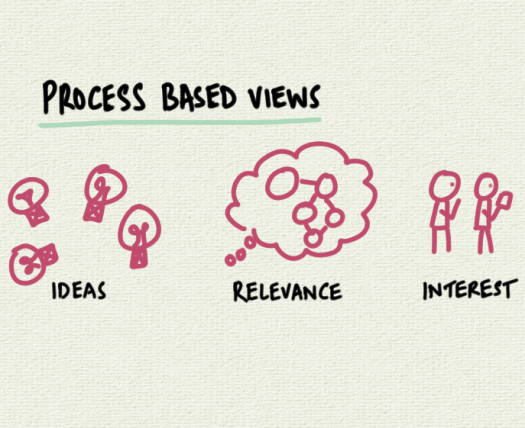
And one way to go after the opportunities is to think of what needs to be done through a process view.

A process view is a popular way to look at the world because things happen one after another, history matters, and connections matter.

If we think about the process of doing anything – writing a book, starting a business, cooking a meal – the same principles apply.

We start with ideas – questions, things that might work.

We filter them for relevance – are they things we can do? Do we have the capabilities and skills to execute? Do we have the resources we need?

Then, is it worth doing. Is it interesting enough to stop someone who is busy looking at their phone to stop and pay attention?

When you’re not sure what to do next, step back and set out your process.

Then begin.

Cheers,

Karthik Suresh

What is the purpose of a startup?

Wednesday, 7.20pm

Sheffield, U.K.

Man is an artifact designed for space travel. He is not designed to remain in his present biologic state any more than a tadpole is designed to remain a tadpole. — William S. Burroughs

A startup is like a tadpole. It’s a stage in the life cycle of an organisation. One approach is to see a startup as a period when an entrepreneur searches for a scalable business model. The dictionary definition is related to starting something up – from a small business to a drama group. Legally it might be a recently started company with little or no capital. Paul Graham of YCombinator fame defines it more narrowly – “A startup is a company designed to grow fast” – growth is what distinguishes a REAL startup, specifically its growth rate.

A popular tool for startup founders is the Lean Startup by Eric Ries. I first came across this concept in 2013 when I attended a Startup Weekend event. The Lean Startup built on Steve Blank’s Customer Development Process. It was an eye-opening idea, and the most valuable insight in there was “Get out of the building”. Go and talk to customers. It completely changed the way I looked at developing products and services for my customers. Rather than building something and presenting them with it I simply talked to them and started to build things that solved the problems they described.

That’s not all there is to the Lean Startup, however. Eric Ries suggested that what was needed was examining the components of a business plan and coming up with hypotheses about customer behaviour that could be carefully tested through experiments. It’s an approach that tries to be scientific. As a founder you come up with hypotheses. You design experiments to test your hypotheses. And if your hypotheses are valid, you go ahead and build your product.

I really liked the idea of the Lean Startup, but the principles didn’t really work that well for me. I created a number of business models, dutifully filled in the templates. But the hypothesis building just seemed like hard work. I don’t think I’d go as far as to say it doesn’t work, because the response would be that I just wasn’t applying it correctly. Instead, I put the theory on the back burner and moved onto other things, like Soft Systems Methodology.

For a long time, the only model I was aware of out there for a founder was that of the Lean Startup.

Until now…

Recently, I came across a special issue of the Journal of Management focused on the Lean Startup.

In their contextualising article, Zahra et al., (2024) introduce three alternative startup approaches : effectuation, creation theory and the theory-based view.

As described above, the Lean startup is about making a prediction and then testing if it’s right.

Effectuation is about: working with anyone willing to work with you; on what you can control; ensuring a low risk of loss; coping with surprises; and overcoming obstacles. These five principles were derived from conversations with 27 entrepreneurs and are described below:

  1. Bird-in-hand: Build immediately using resources you control. These include identify (who you are), knowledge (what you know), and network (who you know).
  2. Affordable loss: Invest very little and keep the downside risk low and affordable.
  3. Crazy quilt: Work with anyone willing to make real commitments, which means willing to pay or get involved and do the work.
  4. Lemonade: Turn failures into new opportunities.
  5. Pilot in the plane: Cocreate with partners who have made real commitments.

No 4 seems like an aspiration. The other four seem like very useful ideas.

Creation theory says that hypotheses are nonsense. We don’t know what’s going to work so we have “conversational experiments”. We talk to others about our ideas, most ideas die, some ideas survive and those are the ones where there is more certainty, eventually enough to build a business.

A theory-based view sounds similar to the lean startup, it starts with a theory of the business and is followed by using scientific methods in practice to collect and analyse data to validate the theory. But the creators argue it’s better.

Another idea that I hadn’t realised but which is obvious in retrospect is that startup theories mostly come from Western settings. Non-Western settings have fewer resources and more constraints. They may use strategies such as: seeing and copying what works; growing incrementally; leveraging family networks; having a number of options (bricolage); focus on making money with sales rather than gathering information; and changing what their families work on.

All the startup theories are predicated on the idea that business plans don’t work. Trying to predict and plan for the future is difficult. In practice, people shape and build their futures.

I think my approach in practice is a combination of effectuation and creation theory. I might dig into that more in future posts.

References

Zahra, S. A., Gruber, M., & Combs, J. G. (2024). Contextualizing Lean Startup and Alternative Approaches for New Venture Creation: Introducing the Special Issue. Journal of Management, 50(8), 2997-3007. https://doi-org.hull.idm.oclc.org/10.1177/01492063241264228

Are You Working On The Thing?

2025-02-14_blinkers.png

Friday, 8.08pm

Sheffield, U.K.

The main thing is to keep the main thing the main thing. – Stephen Covey

I have four books on my desk, twelve on the floor, and a worrying number of others waiting for my attention.

Which is distracted by Disney+.

It turns out the vast majority of academic papers are not read, much less cited.

That has to be the case for the majority of content put into the world – on social media, in books, and of course, in this blog.

So, when you’re working on something should you be trying to read as widely as possible?

Should you try and expand your field of vision and look at the range of arguments out there?

I’m starting to think you shouldn’t.

Your attention is valuable and you should protect it – in quite a selfish way.

The attitude to almost everything that crosses your path which is not directly relevant to your business should be to ignore it.

I’m not very good at taking this advice.

It is important to go deep when you’re working on something. You can’t understand it unless you spend time on it.

You won’t understand a subject unless you read the relevant literature.

You won’t understand a business unless you spend time working on it and dealing with clients.

And more often than not your competitive advantage comes not from doing something new but combining old things in surprising new ways.

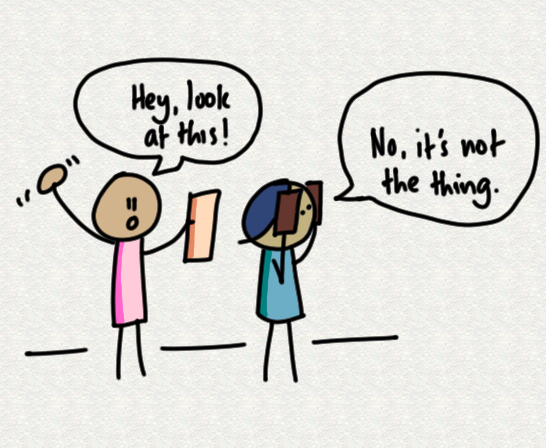
What I really think I mean is that it’s ok to ignore something if it’s not the thing.

If you start reading a paper and it’s clear from the first few sentences that it’s not well written, it’s ok to stop reading it.

This goes for ideas and pitches and beliefs too.

If it’s not for you, that’s ok too. Just say it’s not your thing and walk on.

I’m also starting to realise that’s simply what most academic journals do.

A journal is a place to have a conversation about a particular subject – one that’s set out in the guidelines for authors.

An editor will be quite clear that some papers belong in their journals and others don’t.

Bad papers don’t belong.

Papers that don’t talk about the topics that the journal covers don’t belong.

The rest have a chance, a small one.

Because there’s lots of competition. The way academics are judged is by the number of papers they publish – so like any metric publishing is being gamed.

And that explains why although more and more papers are being published, few are read and it’s hard to tell whether the rest say anything important.

This makes it all the more important to have a good filter – the equivalent of a firewall that drops all requests that don’t meet predetermined criteria.

And now I’m off to read something that isn’t quite my thing, but could be interesting anyway.

Cheers,

Karthik Suresh

What If The Way You Think Is Wrong?

2025-02-13_ssm.png

Thursday, 9.06pm

Sheffield, U.K.

On two occasions I have been asked, ‘Pray, Mr. Babbage, if you put into the machine wrong figures, will the right answers come out?’ I am not able rightly to apprehend the kind of confusion of ideas that could provoke such a question. – Charles Babbage

I am working on a talk on the history and foundations of Soft Systems Methodology (SSM).

If you don’t already know, SSM is a way to tackle real-world problem-situations involving human groups.

There’s a little bit to unpack there.

First, one kind of problem is, “What is 2.998 divided by 16.456?”

There is one answer to that problem.

A different kind of problem is “Why doesn’t X like me?”

The answer to that is more complicated and it might turn out to be one that you don’t want to know.

Then there are problems faced by managers in businesses, or entrepreneurs running businesses.

Now, what these come down to, as Wikipedia tells us, is that there are two types of problems: well defined; and ill-defined.

Well defined problems can be solved with a range of techniques, often mathematical.

Ill-defined problems need some more work – and one way to do that is problem structuring.

That means spending some time to figure out what the problem(s) are and then moving towards a solution.

So, why am I telling you all this?

Well, for a start let’s take what’s happening in the world right now.

Some people believe that what’s wrong with the U.S is a well-defined problem.

Government is too big, common sense has been overidden by overinflated worries over climate change and equality, and it’s time to look after number one rather than police the world.

Others believe that it’s more complicated.

Inequality is entrenched through generational disadvantage, money has taken over politics, and the people in power are blaming the weakest in society and around the world rather than taking responsibility for creating the mess that the world is in.

So here’s the problem.

If someone comes along promising to tear everything down and you give them a chance, will things get better?

How will you know?

The news is still going to be full of bad things happening tomorrow.

Except in the stock markets. Those with money in there are going to do well regardless of what’s going on in your street.

It’s like a Zen koan.

When the powerful play at soldiers, does anything change?

I probably picked something insanely complex to talk about a method to work on real-world problems.

I think the point I’m trying to make is that we aren’t taught to tell the difference between well-structured and ill-structured problems.

We think that all problems require problem solving – that there is a solution.

Like it’s an exam at school.

But the real world doesn’t work like that – at least not when you bring human beings into the problem-situation.

Okay – so that’s a term to highlight. Not a problem but a problem-situation, a situation that some people consider problematical.

The majority of people, especially ones trained in a scientific mindset, will try and apply science to the problem-situation – let’s come up with a hypothesis for why things aren’t working, let’s try some experiments, let’s pivot if we fail, and eventually we’ll get a problem-solution fit.

It’s an extremely persuasive argument. One that’s easy to sell. Why wouldn’t you want to follow a scientific approach?

If you subscribe to this view then you’re taking a “positivist” approach – you believe that all knowledge is true only if it comes from sensory experience, supported by reason and logic – it’s an objective view.

And that’s great, if you’re managing footballs or metal bars.

But people see and think and talk about their world differently – they have a subjective view of what’s going on.

Phenomenology is the term given when we’re trying to understand “subjective, conscious experience”.

Objectively, of course.

I was talking to someone the other day who believes a number of things that are wrong.

Wrong, objectively, as in the facts are wrong.

And wrong, morally, because humans can do better.

The difficulty is getting them to see that.

And unfortunately, not enough people know how to use tools like SSM to help.

Cheers,

Karthik Suresh

The 4P Discovery Model (or the $P Model)

2025-02-09_4p-model.png

Sunday, 9.43pm

Sheffield, U.K.

Study the past, if you would divine the future. – Confucius

For the last eight years I have been working on one deceptively simple problem.

How to find out what people want?

The world is full of people that experience problem-situations.

That is, they are in a situation they consider problematic.

For example, they want to know what impact regulation is going to have on their business, what their next career step should be, which technology they should invest in, and many other such questions.

I get involved in such situations as a consultant, either because it’s a field I know about, or because I’m working with someone else who can help.

I use a particular technique to listen to people called Rich Notes.

I’ve been refining this technique as part of my research programme, but I still wasn’t quite sure why it worked or what I actually did.

Until now.

I’ve come up with a 4P Discovery Model.

If you mistype the 4 you get a $, and that unintentional and arguably crass mistake makes another point, if you get Discovery right you’ll probably make some money.

Let me explain.

If you run a business, a service business or a product business, it helps to know what your market is willing to pay for.

Finding out starts with Discovery – an interaction with a prospect that tells you what you need to know.

Think about the last sales meeting you were in.

What happened?

Did the salesperson come in with a presentation and tell you all about what their firm did?

How much time did they spend listening to you and what you needed?

I’m willing to bet that 80-90% of the meeting was about them, with the rest left for you to ask questions about them.

There probably wasn’t much time in there that was about you.

My approach reverses that, the Discovery meeting is about listening to you.

And I’m interested in learning about four things – using what I call the 4P Discovery Model.

This is a model that I’ve followed largely unconsciously for a while, but have had to unpack and label so I can write about it.

First, the present.

Where are you right now, what’s the current situation?

Where are the pieces on your chessboard?

Second, let’s talk about the past.

How did you get here, what decisions led to this point, and what have you tried along the way?

It’s important to know what was tried and whether it worked or failed, and why, before we try and do something else.

Third, we need to find the pain, what needs fixing right now?

People rarely do things unless they really have to – it’s got to really hurt before they’re willing to buy some medicine.

And then finally, what are your preferences?

People are ready to buy certain types of products and services and not others for a range of reasons.

You need to find you what those reasons are – what kind of approaches are preferred.

This is especially important when it’s a group in the situation – they’ve all got different wants and have to negotiate a preferred one.

If you’ve followed the yellow brick road (or the purple arrows) then you know what to offer your prospect, and there’s a good chance they’ll sign up to your proposal.

And unlock a flow of $s.

Cheers,

Karthik Suresh