How To Become a Professional At Whatever You Care About

Sunday, 5.30am

Sheffield, U.K.

apprenticeship.png

You can observe a lot just watching – Yogi Berra

We live in a world where there is a shortage of teachers and mentors and, at the same time, unlimited opportunities to get better.

Once upon a time, if you wanted to learn a trade, you found someone who needed an apprentice and worked under them.

That teacher-student relationship was the main way new talent was developed for generations.

Now, we have courses for everything. You can learn to code in a weekend. Write, make pots or learn business studies.

So, what happens then?

The movies and success manuals would have you believe that if you’re hungry, always looking for new opportunities and pushing for those big chances you’re going to do well.

And that may be true.

But, is it good?

Will it make you a professional?

We know that there are no shortcuts to excellence in any field of work.

The 10,000 hour rule is about time – time spent doing deliberate practice. Practice that stretches and challenges you.

Take writing, for example. You’re often told that you’ll throw away your first million words.

That seems like a lot but, if you write 500 words a day, two hundred days a year, that will take you exactly ten years.

That ten-year period seems to be needed whatever you do.

It takes ten years to integrate into a new society as an immigrant.

Getting the hang of running a business seems to take that amount of time.

Becoming a musician or artist or craftsperson takes that amount of time.

And that’s time spent learning.

I’m fascinated by approaches to learning.

I read a quote the other day, browsing in a bookshop, while waiting for a train.

No thief, however skillful can rob one of knowledge, and that is why knowledge is the best and safest treasure to acquire.’ – L. Frank Baum.

If you are fortunate enough to be apprenticed to someone then you have an opportunity to learn that few others have.

The Japanese have words to describe this process that are worth reading.

Minarai, for example, means “learning by looking”.

The idea is that a master does not “teach”. Instead, the apprentice, “steals the art” – works out what works over time.

An article by Dick Lehman gives us an insight into this process.

What is the teacher’s most important lesson?

An apprentice’s answer: “Your lesson to us is that we are to express ourselves as fully as possible – with all our might and strength; to be ourselves, and to work within the limitations that greet us; but, through our works, to express our spirit, mind and heart, as best we can.”

But what if you don’t have a master?

That’s where the Internet comes in.

There is an Indian story about a boy called Ekalavya who wanted to learn archery under the renowned teacher Drona.

He was rejected from the school so made a statue of Drona using mud and practised in front of it until his skills were better than Drona’s best students.

These days, the Internet gives us masters to watch on tap.

You can get everything from the words of Warren Buffett to interviews with artists who will show you what they do.

I think when you’re starting out it’s okay to think that you need to be shown what to do.

Very quickly, however, the most important thing becomes whether you spend your time watching, trying and learning.

Because it’s one thing to take a course.

It’s something else to walk the road towards being a professional.

Cheers,

Karthik Suresh

What Would You Suggest Your Kids Should Do For Work?

addingvalue.png

Thursday, 9.30pm

Sheffield, U.K.

There’s more than one way to do it. – Perl motto

I’ve been thinking a bit about where one really adds value.

The late Felix Dennis wrote a book called How To Get Rich where he said that there is one talent you must have.

And what is that?

The talent to spot talent in others. To recruit that talent and nurture it.

But what if you’re that talent… how are things going to work out for you? Or for your kids?

Felix has a lesson later on. As talent gets older, he says, it gets expensive. Young talent can be underpaid if the work is challenging. Then, it’s paid at the market rate. Finally, it’s paid for what it did in the past, and that’s when you part ways with it.

And really, that’s an important lesson. In a traditional career path we climb a ladder. The idea is that we get on the ladder because of what we do and then we climb it because of what we can get others to do.

Its the whole making versus managing thing.

But really, what is a manager other than an intermediary between an owner and the customer?

When you look around you at people and what they do you start to see that programming is increasingly at the heart of everything.

If you work in an office you probably spend a lot of time doing stuff using Excel. That’s programming.

If you’re creating music, or art, or architecture you’re still probably using a computer.

Even if you do something that is a craft, like designing and building wooden stools or jigsaws, you’re probably going to use a computer to help you.

Telling a computer what to do is programming.

Okay – so that’s obvious you say – clearly the world is heading that way. What’s the insight here?

Well, the point is that there is a period of transition.

A period of pain for those who don’t get it.

And a period when they have to make choices.

The kinds of jobs where we add value really fall into two areas.

Either we make something that people will buy.

Or we sell something that people will buy.

Anything else really is a cost – and costs are things that you really want to get rid of.

If you’re doing something that gets you labelled as a cost then you’re going to have a rather fear-filled working life.

I think kids need to get this straight.

Either they’re good with people and can build relationships with them.

That’s worth a lot.

Typically between 10 and 60% of the value of a product.

For example, wouldn’t any of us pay 20% of the price of our product if someone else brought in the customers?

The remaining 40-90% goes to the owners after they pay their staff – the ones that make stuff, and the other ones.

I’d tell my kids to make sure that they’re making something.

And that making is the same as programming – programming an app, automating something, creating music or creating a product.

And if they don’t like that then just go out and learn how to sell.

I suppose you might, at this point, point to the public sector.

Well… that’s where you need to ask how much value is being added by some of the things that happen over there…

Brexit anyone?

Cheers,

Karthik Suresh

Why Planning Is Really Mostly About Getting Ready And In Position

battle-plan.png

Tuesday, 10.05pm

Sheffield, U.K.

No plan of operations extends with any certainty beyond the first contact with the main hostile force. – Field Marshal Helmuth Karl Bernhard Graf von Moltke

What should you do when trying to think about dealing with a difficult situation?

Say you’ve been asked to come up with a plan. Something in writing. Something that sets out how you’re going to go about things.

Well, that’s what I had to do recently. So, I started with what seemed like an obvious place.

I took out the textbooks.

That seemed reasonable. Surely, there must be something in there that would help me in the situation I was in right now?

But, something odd happened.

First, the textbooks set out the main possibilities, the main ways you can think about the situation.

For example, let’s say you have a question about organisation structure.

The textbooks will tell you that people in organisations tend to act along a continuum from task oriented to relationship oriented.

Task oriented people want to get things done. They’re interested in todo lists, responsibilities, due dates and specific actions.

Relationship oriented people want to get people working well together. They want to create a culture and shared vision of what is possible.

The books will tell you how organisations develop styles or personalities depending on which approaches are dominant in their leaders – from laid back approaches to micromanagement and time tracking in 6-minute increments.

You can also describe organisations in terms of how they are structured – from strict hierarchies and siloed operations to a loose network of independent professionals.

But here’s the thing.

All those descriptions of organisations are actually very little use.

They describe what is there but don’t tell you what is good or what you should use.

Is being task oriented better than being relationship oriented? Or is it the other way around?

The answer is that it depends. In some cases, one approach will work. In other cases it won’t.

It’s actually very hard to predict how things will pan out.

Take war-making, for example. The German battle plans of the second world war called for sending troops quickly to France through Belgium.

So quickly that any resisting forces would be overwhelmed and the war would be over very quickly.

Ironically, as a Prussian General observed, plans tend to fall apart once the fighting starts.

Which makes one wonder whether looking to a textbook for thoughts on what to do is akin to a military planner working out how to fight the last war.

The next war is probably going to be different with a whole bunch of things that just weren’t around for the textbook writers to write down.

What if thinking about organisations and their structure is actually irrelevant in a world where either everything is going to be done by a computer or by networks of creative professionals who come together and separate as and when needed.

To some extent the fact is that the more you try and control the more likely it is that you’ll fail.

Or get nothing done.

What you’ve got to do first is be ready, and then, be ready to adapt.

A plan then is more about getting in position than about doing something in a particular way.

As Woody Allen said, eighty percent of success is just showing up.

Cheers,

Karthik Suresh

How Many Years Of Experience Do You Have?

junior-senior.png

Good decisions come from experience, and experience comes from bad decisions. – Rita Mae Brown

Thursday, 10.06pm

Sheffield, U.K.

Sometimes it takes me a long time to get things.

A really long time.

For example, I always thought of “u” and “w” simply as letters in the alphabet.

You know – how it goes in the song you learn with your ABCs.

It was only when I did a poor attempt at learning french that I heard the sounds “ve” and “duble ve” and realised that a “w” was actually two “u”s – a double “u”.

Maybe it was just that my kindergarten focused more on rote learning and less on making sense of the origin of language symbols.

Which also makes sense when you consider that the teachers were dealing with four year olds who were struggling with the concept of staying in one place for more than two minutes.

Anyway…

I read something on Medium that is totally obvious when you read it but that, if you’re anything like me, you might have missed until now.

It’s by Ariel Camus and says “What makes senior developers senior is not that they know the syntax of a given language better, but that they have experience working with large and complex projects with real users and business goals.”

We all start at the bottom of a professional ladder and it’s easy to assume that those higher up are there because they are more skilled than us.

And that can sometimes be the case.

But it’s often not.

Take a lot of academic work, for example. It’s very easy to spend a lot of time carrying out research into a particular area.

The problem is that when you come out of school you find that you’re starting at the bottom in the world of work.

Having those degrees and smarts and skills doesn’t automatically propel you up the career ladder.

What gets you up is being able to show people with the power to make decisions that you’re the person they need to get a job done.

I suppose we should be careful not to confuse seniority with power.

Some people get to the top because they’re good with relationships or politics or power.

That’s not the kind of thing I’m talking about here.

What I’m talking about is the kind of knowledge that comes from trying to solve problems.

Preferably ones that real people have. And ideally ones that are expensive to leave unsolved.

It’s obvious really. It doesn’t matter how smart your work is if no one cares. If someone does care, that’s good but you’re not going to make a living unless they care enough to pay you. And they’ll only pay you based on what you save them so the more impact you can make the more you can make.

It really comes down to the old saying about years of experience.

Have you got ten years of experience?

Or do you really have one year’s experience repeated ten times?

Cheers,

Karthik Suresh

How To Use Stuckness For Problem Solving

problem-solving.png

Tuesday, 9.06pm

Sheffield, U.K.

Stuckness shouldn’t be avoided. It’s the psychic predecessor of all real understanding. – Robert M. Pirsig

I’ve spent much of the last four days thinking about a particular problem.

What I do in such situations is get up early, before anyone else is about and work on whatever is on my mind.

In this case it’s a programming job but it could as easily be a business issue, a personal one or something for work or school.

This is not my first go at this particular problem, either.

I’ve tried approaching it in a number of ways.

Guess which ones have failed?

That’s right. The ones where I’ve tried to take shortcuts or where I tried to get someone else to solve it for me.

We live in a world where “hacking” has become a term that means to find a quick and easy way to do something – like life hacking or growth hacking.

Old school hackers get very cross about stuff like that and say that hacking is really about getting to the edge – doing something difficult in a playful and clever way.

Its aim is not to save you time or money. That’s what tips and shortcuts try to do.

The assumption here is that if something is worth doing it’s worth doing quickly so you can get on to doing something else.

And that seems to miss the point.

If you’re working on something worth working on you should aim to get to a point where you are completely and totally stuck.

What does that mean?

If there’s a simple way to do something what that really means is that someone spent a lot of time figuring out that approach.

Take shift rotas, for example. If you don’t work a shift job, or even if you do, have you ever considered what it takes to create a shift rota?

I hadn’t. Not until I had to implement one because asking people to volunteer was too hard and time consuming.

A paramedic friend explained how their rota worked and I used it and it worked.

It was only when I went to business school and learned about different approaches to rota design that I realised that someone had spent the time to think about this and solve it.

Any approach you’re shown that already works is going to look simple.

It’s like being told how a magic trick works.

In the instant before you’re filled with wonder and delight.

In the instant after you just note how obvious the trick was.

So, if you don’t want to be one of the people that is always looking at what other people are achieving but want to do something yourself then you need to work on things that are hard to do.

You know they’re hard because you’ve spent time on them and you feel like you’re going nowhere.

You’re stuck.

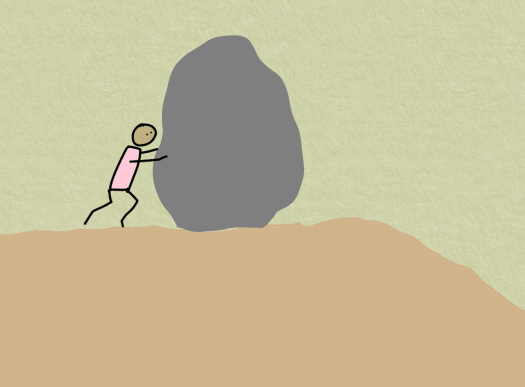
It’s like trying to push a big rock. It’s just there, in front of you, all grey and cold and big and immovable. You’ve worked on this for hours, you’re tired and exhausted and you want a way out.

So, what do you do?

You take a break. Get some rest. And then come back and keep pushing. Trying different approaches. Taking another break. And trying again.

When you’ve done this a few times you start to recognise the feelings involved. How your brain feels like it’s full of decaying gears and connectors, so rusted and unable to move that it feels like you’ll never do it.

Now, it’s a staring contest. You and your rock. You and your brain.

It’s time to just sit. Even if you feel like this is going nowhere. When you feel like there is nothing to do but sit and stare at the problem, that’s exactly what you do.

And I don’t know how to explain it but that sheer bloody-mindedness is what seems to lubricate your brain and get those parts moving again.

At some point you’ll break through, get that rock pushed over and it will start rolling downhill.

At that point, the work stops feeling like work and you just do whatever you’re doing. You’re in flow. And you’ll come up with a solution.

Strangely enough, stuckness is your friend. It tells you that you’re working on something worth working on.

And when you’re done you’ll be glad you stuck it out and go looking for your next problem.

Cheers,

Karthik Suresh

Why Planning for When You’re Bigger May Be A Waste Of Time

scale.png

Monday, 9.19pm

Sheffield, U.K.

Do things that don’t scale. – Paul Graham (Y Combinator)

Why would you want to be bigger?

I suppose your size could be a measure of success?

I’ve read that some successful people say that they don’t really care about the money.

To them, it’s a way of keeping score.

So, if you were coming up with a goal for yourself or your business, should you aim to be big?

Should you want to be a millionaire? Or start a billion dollar company?

Or are these approaches looking at the wrong things altogether?

After all, money is presumably a byproduct of what you do.

This can be something that’s a little hard to talk about.

You tend to get very quickly into the differences between tails and dogs.

For example, if you’re looking for an education should you go for the one with the biggest salary prospects or the biggest probability of getting a job?

Many of us do.

So, one would assume, that the better your education the better the job you will get.

Although, why is it that the people who run companies are not usually the ones with the most degrees or letters after their names?

Why is it that so often in real life, as Robert Kiyosaki brutally puts it, A students work for C students, and B students work for the government?

Let’s look at another area that appears to be exploding.

Almost everyone has an idea for a killer app.

Something that, if they could only get it built, would take the market by storm.

The steps involved are pretty simple. Find a development shop, explain what you want, pay for their time and get your app.

How much would you bet that the shop would get things right?

If you’ve ever tried to get something like this done, you’ll know that at the end you now know exactly what you want and it isn’t what you’ve got.

Now, why did you go to the shop in the first place rather than making something yourself?

You could have picked up Excel or created something that worked in a paper planner?

But, by raising money and getting a team together you felt like you could get to scale faster.

It’s the rocketship model. Money is like fuel. If you can create customers before your money runs out you’ve achieved orbit. If not, you’re probably debris.

I was reading some advice on coding – procedural versus object oriented.

Use object oriented, an experienced programmer urged. It might mean you write more code but if you get successful it will be much easier to manage then.

All of these approaches say you should plan for what happens when you scale.

But, Paul Graham doesn’t.

And the experience of many others also suggests that scale can be a trap.

At the start of any process you need to do things manually.

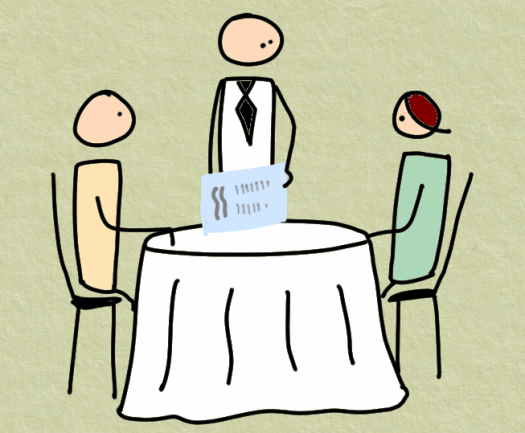
Recruit customers one at a time. Serve them, like you would as a waiter at a table. Get to know what they like and ask them how the food is.

Because, when you’re bigger you won’t have the time to do things like that.

And if right now, when you can talk to each prospect, you don’t, you’ll never know what they really want.

If you want to build something, build something you want.

If you’re building for someone else, like that shop you hired earlier, they’re less interested in giving you what you want than not being blamed when you realise that what you said you wanted wasn’t what you needed.

Building what you want is more than just building a product. It’s the same approach to building everything else – relationships, careers, interests.

The place where we go wrong is when we try to predict what will succeed rather than just working on what interests us.

And when we’re engrossed in our work we don’t think about money or size or scale.

We think about the work and if we’re lucky, those other things will turn up as well.

But it really wouldn’t matter either way.

Cheers,

Karthik Suresh

This Is Probably The Most Important Thing I’ve Learned In The Last Two Years

chunking.png

Sunday, 9.39pm

Sheffield, U.K.

Exercise everything every day — your body, your brain, your tear ducts. – John Carlton

Actually… it’s not exercise.

Although that’s an important point too. I might come back to that.

There’s a thing called “chunking” that goes back to a guy called Miller who wrote a paper in 1956 about how we could remember seven things, plus or minus two.

If you look into it, however, the applications of this insight seem to mostly be on training yourself to remember longer and longer sequences of numbers.

I read somewhere that’s because it’s easy to measure how your ability to remember numbers improves over time.

Which of course, should remind you of the famous story of the drunk looking for his keys under a street lamp.

A policeman stops to help and they search for a while. Then, the policeman asks if the drunk is sure he lost them here.

No, the drunk replies. I lost them in the bush across the road. So the policeman asks why are you searching here? Because that’s where the light is.

You probably use chunking all the time but just don’t call it that. And, when you find things hard it’s because you haven’t sorted the chunking out yet.

But, let me give you some examples of what this means when you go beyond the obvious ways of looking at this.

First, going back to 1983 is the Unix Documenter’s Workbench that has these lines about typing a document:

“First, when you do the purely mechanical operation of typing, type so that later editing will be easy. Start each sentence on a new line. Make lines short, and break lines at natural places, such as after commas and semicolons, rather than randomly. Since most people change documents by rewriting phrases and adding, deleting, and rearranging sentences, these precautions simplify any editing needed later.”

These lines and a variant of them find their way into many of the later guides on using the Unix platform and appear to be almost universally ignored.

Apart from around three people including Brandon Rhodes who wrote an article about Semantic Linefeeds.

He says that when you write in this way something magical happens. When you break lines at natural points your ability to rearrange thoughts and ideas suddenly becomes much better.

Okay… so what does this semantic linefeed stuff look like then?

Well, the paragraph in the Workbench that I typed out looks like this in my text:

chunk-example.png

What’s happening here, really, is that we’re chunking each line. Just naturally, each one has around seven words, plus or minus two. It’s much easier to see what’s going on – once you start to get used to it. It takes a while to break free from the way we’ve done it all our lives, after all.

A natural next step from this example is to look at programming where breaking a problem into chunks is often the only way you can possibly tackle it.

A big problem is usually too big to hold in your mind so you need to break it down.

You need to build a solution using smaller building blocks or chunks – which you make first.

When you start thinking of things in this way it’s clear that you can apply this approach to almost anything.

Want to create a new business process? Start thinking in terms of chunks.

Chunks are things you can build and test quickly. If you make them so they are mostly self contained you can discard them without breaking everything else.

Want to learn a language? Forget grammar at the start.

Begin by identifying chunks of language that say something useful. With enough chunks you’ll get a feel for how the language works and your capability will build. Inexorably.

This simple concept of chunking seems to me to be one of the most useful and least promoted ways of approaching life.

With chunks it doesn’t matter if your goals are clear as day or hazy and uncertain. As long as you work in chunks you’ll make progress day after day.

And, as so many times before, thinking about these subjects brings me back to Robert Pirsig and Zen And The Art Of Motorcycle Maintenance where Pirsig writes about a set of instructions that he says would improve technical writing no end. They start “Assembly of Japanese bicycle require great peace of mind.”

The thing is that anything that you do that grows bigger and bigger eventually gets so big that you can’t keep hold of all of it in your mind anymore.

And then, you spend your time panicking that you are no longer in control.

With chunks, however, you know that you can always change something without breaking everything and that way you suddenly have the ability to create big and complex things without losing yourself.

Because, actually, you only work on small and simple chunks that make sense.

Anything big emerges naturally from what you do.

So… then all you have to do if you want to build a body of work, live a long time, be a good parent and live a good life is exercise everything every day. In chunks.

Cheers,

Karthik Suresh

Why Being An Expert Can Be Dangerous For Your Mind

cup-of-tea.png

Saturday, 8.01pm

Sheffield, U.K.

Improve yourself: that is the only thing you can do to improve the world. Ludwig Wittgenstein

What should you do when you feel like you are an expert at something?

Probably be afraid.

I haven’t written for a week or so and after every such break I wonder if I can still come up with anything that makes sense.

Writers are plagued with such feelings.

Nothing you have done can guarantee the quality of anything that you will do in the future.

It’s like a having a trading strategy. Past performance is no guarantee of future results.

Just because value investing worked for Benjamin Graham, that doesn’t mean it would have worked for Warren Buffet.

As, in fact, it didn’t. Buffett and Munger made the first few hundred million buying overlooked companies on the cheap but their billions came from buying great businesses at fair prices.

Buffett’s ability to pick stocks is unlikely to help us today where we are probably better off putting most of our money in a cheap tracker and getting on with the day job.

But – the day job is also changing. There isn’t much room for people who talk about value instead of creating value any more.

What does that mean?

Well, we know that any business has two key functions: marketing and innovation.

Marketing, however, is more than just talking about what you do. It’s about showing that you understand what someone else needs.

Innovation, then, is about being able to fill that need.

Any person in a role is probably judged on those two functions as well, even if they don’t know it.

After all, you’re hired for what you say you can do and are kept because you do it well and get better over time.

If you don’t then there is a list somewhere with your name on it.

But then, where does value come from? Is it expertise you’ve built over time? The systems and processes you have? The investment in your infrastructure?

These days I cringe when someone says that their unique selling point is the capability of their people.

How do you measure that? How can you tell if your graduates are smarter than graduates in another company? Or for that matter, your engineers or MBAs or lawyers?

Any person or firm that thinks that they are at the top of their game or their league or their sector is in a dangerous position.

As they toast themselves someone, somewhere, is working to destroy their business. Someone who probably doesn’t even know they exist.

It’s like the old story of the learned person who went to a monk to learn Zen.

He talked of all the things he knew and went on and on.

The monk served tea, filled the visitor’s cup and went on filling.

Stop, said the visitor, it’s full, no more will go in.

That is like your mind, said the monk. Unless you first empty it how can you fill it with fresh thoughts?

When you go on a sales visit how can you learn what the prospect wants if you talk about yourself all the time?

Or, if you fill your days doing work the same way you have always done?

Or if you never try and learn a new approach, a new language or someone else’s method?

You are probably busy. But you’re probably not very happy.

Uncertainty, it seems to me, is a good thing.

It says that you’re still ready to learn and improve. To try and get better.

To enjoy different types of tea.

Cheers,

Karthik Suresh

How Can You Be Good At The Things That Are Important?

peace-of-mind.png

Sunday, 9.39pm

Sheffield, U.K.

The ultimate test’s always your own serenity – Robert Pirsig

I came across spider diagrams several years ago when doing consulting work.

That has always seemed like an odd description. They are web-like, I suppose, but they also create ugly images that don’t seem to really convey much that is useful.

You score better on some spokes than others. So what?

Then, when reading a book on neuro-linguistic programming, I saw the same diagram referred to as a wheel.

Now that made more sense. If you’re doing well on all counts then you have a circle. A wheel. Life rolls along nicely. But if you’re not scoring well on some of the axes you end up with a misshapen wheel that will bump and rattle along the road.

So what?

The wheel tells us that there are things that are equally important. There isn’t much point doing well at work if your family falls apart because they don’t see you enough. You could have lots of fun going out every night with friends but end up sick.

Still, you probably don’t need a diagram to tell you that. If you’re not doing well at the important things in life you probably already know that.

Perhaps you’re even choosing to focus on the things that are important to you, at the expense of the other things.

You can, after all, get to them later.

Or… can you?

There is a painted stone in front of me, on my desk. The colour has been splashed on, organic and natural and perfect.

It’s paint on a stone, green and pink and yellow, with a dash of black and a streak of blue, done unselfconsciously by a child.

The fact is the only thing that matters is what you are doing right now.

The only test of whether you are doing things right or doing the right things is how you feel.

Are you at peace? Or not?

The wheel that I’ve drawn is not a good wheel. It’s a blotch of dark pink on a backdrop of light pink. Because I’m not trying to draw a wheel. Because you and I already know that the wheel is not the point.

The point is whether you have peace of mind.

Robert Pirsig, in Zen and the Art of Motorcycle Maintenance writes about this state of mind.

People who are immersed in their work do it unselfconsciously like a child painting a stone.

They do it, not until closing time or until someone says they are done, but until they are done. Until they are satisfied with what they have done.

Pirsig writes: “Peace of mind produces right values, right values produce right thoughts. Right thoughts produce right actions and right actions produce work which will be a material reflection for others to see of the serenity at the center of it all.”

That is how you produce something that lasts, whether it is your work, family, health, relationships or having fun.

Sounds simple, but it’s not easy.

That’s what people across the ages have tried to achieve.

And we should also remember the words of Ram Dass who said “If you think you are enlightened, go and spend a week with your family.”

But what we can do is try.

Cheers,

Karthik Suresh

Why Thinking Long-Term Is The Only Thinking Worth Doing

forever.png

Saturday, 9.37pm

Sheffield, U.K.

In every deliberation, we must consider the impact on the seventh generation… even if it requires having skin as thick as the bark of a pine. – Derived from the Constitution of the Iroquois Nation

It’s not possible for long-term thinking to be in fashion. Ever.

Shortcuts, on the other hand, always are. Shortcuts or hacks or tips or timesavers – such things are always of interest.

A few years ago I did a study on change, talking to people involved in trying to make it happen.

And it was telling just how much focus there was on making everything line up with what was perceived as important.

For example, many in politics focus on jobs. Anything that increases jobs is a good thing. So everyone creates a pitch that talks up how many jobs their project will create.

Or take climate change. What we need is a more sustainable society and that is a hard thing to do. It’s easier to build new green power stations than to get people to use less energy.

But societies don’t make decisions.

People do.

So, what kind of decisions should we make?

For example, what should you do if you want to have a good life? What do you really want out of life?

When you’re young the chances are that you want to be rich or famous or both.

But the people who end up having a good life are not the ones with the most money or fame but the ones with good relationships.

Relationships with family and relationships with their community.

Which poses an interesting approach to doing business.

One of the big risks we face in a technological age is how dependent we are on technology we don’t own or control.

A writer, for example, writing with pen and paper is creating something that could live for decades, even centuries.

My grandfather memoirs, written over forty years ago, are still there on crumbling paper.

They have now been transcribed and the challenge is keeping them digitally for future generations.

If you’re a business, however, what sort of time frame should you use to think about what you do?

John McPhee in Draft No. 4: On the Writing Process writes about using the editor KEdit in 1984.

A friend, Howard J. Strauss, created scripts and programs that helped McPhee use KEdit in his writing process.

Howard died in 2005. In 2007, KEdit stopped being updated and its creator, Kevin Kearney, is semi-retired. There aren’t that many users left around.

I hadn’t really processed this message, this idea that a tool will die with its creator and those that use the tool will also slip away.

It only really struck me when I was browsing the website of the sqlite database and read these lines from Hipp, Wyrick & Company, Inc., (Hwaci), who support the software.

Hwaci intends to continue operating in its current form, and at roughly its current size until at least the year 2050. We expect to be here when you need us, even if that need is many years in the future.

Now, that’s long term thinking. Maybe the kind of thinking you should use in your business.

But is it long enough?

I’m writing this in Emacs, the editor created by Richard Stallman. This tool will never die, because Richard has given the world the source code. And it will outlive him as those who use it keep it alive.

But the editor doesn’t matter because the words themselves are in ascii text. Yes they make their way to a website where you can see them but they aren’t held prisoner by that website.

But, why think about all this? What’s the point?

The point is to think about the future. The future that your children and their children and the generations to come will live in.

I’d like future generations to know my grandfather’s experience. Especially because he took the time to write it down.

It’s my responsibility to pass it on. More importantly, it’s my responsibility to pass on that sense of responsibility to future generations.

I think that when you start to think of things that way, think of the long term, it seems obvious that shortcuts aren’t really worth taking.

You see, you’re not really trying to save ten minutes. You’re trying to create a future for children generations down the line.

Cheers,

Karthik Suresh