Keep Your Personalities Separate

2025-11-15_personalities.png

Saturday, 13.33pm

Sheffield, U.K.

Anything that is worth teaching can be presented in many different ways. These multiple ways can make use of our multiple intelligences. – Howard Gardner

I’ve been thinking of the difference between the tip of the spear and the person behind it.

“Word Craft” by Alex Frankel got me thinking about sales.

He points to Jean-Marie Dru who, in his book “Disruption”, suggested that communication is not something separate from your product – instead it’s an integral component of it.

In other words, your product IS your message.

As a consultant or business owner you are also a product – which means your message is hugely important.

For example, I use this blog as a thinking space. It’s where I can collect ideas and work on understanding them.

And one of the things I’ve been struggling with is separating me from my work.

To start with, I’m building a business that provides data management services to clients that need to disclose information under various regulatory and voluntary frameworks.

At the same time, I’m interested in a range of topics such as strategy and marketing.

And I’m also carrying out research into improving approaches to understanding and improving problematic situations – a field known as problem structuring – through using Rich Notes – a technique I’ve created.

So, who am I? What am?

The business builder?

The strategy consultant?

The academic?

I think what’s going on is that we are more than one thing.

But – if we’re trying to connect with other people we have to pick one personality and stick with it.

For example, I had someone mention that they had talked to a prospect about my strategy work but when the prospect checked me out on LinkedIn I came across as too energy focused.

So, I either lost a potential prospect because of my message or I filtered out a prospect that wasn’t the right fit for what I was offering.

It feels like you should put across everything about who you are – the richness that you have.

But you have to decide what you want people to think.

The kind of research I do is Action Research.

This is where you have a situation – like figuring out what to do about marketing yourself – and you try something.

Maybe rewrite your profile. Tweak your outgoing messages. Try and make it easier for prospects to work out if they need you or not.

The research comes from doing something and then reflecting on what you’ve done, looking for lessons to learn, principles to extract, steps to reuse.

That’s a messy, unpolished process that requires engagement in a situation followed by reflection and writing.

But this is necessary to work through your experience of taking action so that you can come up with theory – a way to explain what happens.

For example, here’s a five part theory

1. Your message is your product

How you describe yourself is what you are. Think about this carefully because it will determine how people respond to you.

2. If you have multiple personalities, let one out at a time

I don’t like simple frameworks. Yet they are essential – because what you’re trying to do is remove ambiguity – make it easier for people to understand what you’re trying to say.

The reason I use LinkedIn is to reach and connect with potential clients. So everything on there needs to be related to that objective.

I’m not doing a very good job of making it clear whether I’m a founder, an academic or a consultant at the moment, so that’s an improvement action I need to take.

Think of it like having more than one personality – having two operating at the same time is very confusing.

3. Cut and refine each message

Cut, cut cut. This post is too long. But that’s ok, because it’s a thinking post.

But your LinkedIn posts have to be tight. Your books, articles, promotional materials, training programmes – they’ve got to be trimmed until they fit exactly what a prospect needs.

4. Design for filtering

You are not aiming to sell to everyone. There is a subset of the market that is perfect for you. You need to find them.

If that market doesn’t exist you need to do something else.

Make sure your system is designed to filter out people who are not right for you and what you offer.

5. Test and learn

There is no right answer.

But there is the work.

Have an idea.

Try it out.

Reflect.

Learn lessons.

Try again.

And now it’s time for me to work on what the next personality has to do.

Cheers,

Karthik Suresh

Are You Describing Your Value In The Best Way?

2025-11-14_career-strategy.png

It’s a tough time for older job seekers.

We once interviewed an experienced, gray-haired candidate for a sales director role.

It was a no – not because of age but because their responses didn’t match the level of career maturity the role needed.

It got me thinking about how careers evolve, and what employers expect at different statges.

1. Early career: It’s a job

Your first roles are about learning, working hard and doing what you’re asked.

You build capability.

2. Mid-career: It’s about reliability

You’ve shown you deliver.

You’re a safe pair of hands.

The reward for good work is more work – and more importantly, responsibililty.

3. Experienced: It’s about knowing what you offer

Now you’re not just doing the work, you’re shaping how it’s done.

You sell ideas upwards.

You say, “Here’s what needs doing, and why.”

4. Senior: It’s about bringing about change

You recognize patterns – using knowledge and experience gained over decades.

You know what’s coming next, what needs to happen and what’s stopping us from getting better.

Your value is helping stakeholders in the organisation align, improve and move forward.

That salesperson we met?

We wanted level 4 vision – how they’d transform our go-to-market, upskill the team, build strategy.

What we got were Level 1 answers: “I’ll do anything you need me to do.”

I don’t think every rejection is about age.

Sometimes it’s because the way we describe the value we bring hasn’t matured as we have.

Should You Use AI Less Rather Than More

2025-11-11_ai.png

Should you use AI less rather than more? Extracts from a philosophical and a legal opinion.

Our goal as thinking beings should be to cultivate the faculty of reason – according to Daly (2026) – working on habits to develop excellence in five intellectual virtues.

These are:

  1. Knowledge of one’s field
  2. Intuition based on knowledge
  3. Wisdom in how one’s field relates to life and society
  4. Decision-making skill in how to achieve a desirable end
  5. Practical ability to make something using reasoning

The use of generative AI threatens the development of all these virtues.

The problem is that we experience sustained cognitive declines by outsourcing these habits to generative AI.

We literally get more stupid.

If that wasn’t enough the case for using Gen AI – that it makes us faster and more effective is undermined by Yuvraj (2025)’s verification-value paradox hypothesis.

In a nutshell, this hypothesis argues that the time saved by using Gen AI is offset by the increased time needed to manually verify the outputs from Gen AI.

This is because truth matters. Knowing that a collection of words belong together statistically is not sufficient justification to use them uncritically.

Verify. Then use.

Our cognitive skills matter. We should be very sceptical when it comes to replacing or diminishing them.

REFERENCES

Daly, T., 2026. A ‘low-tech’ Academic Virtue Ethics in the Age of Generative AI. J Acad Ethics 24, 13. https://doi.org/10.1007/s10805-025-09683-3

Yuvaraj, J., 2025. The Verification-Value Paradox: A Normative Critique of Gen AI in Legal Practice. https://doi.org/10.2139/ssrn.5621550

How to get from thinking to done – a guide for writers who haven’t got time to waste

Writers – we’re always looking for that magic method

There’s nothing writers like more than reading about other writers and how they work. Maybe if we copy how they did it, we’ll be able to write like them too. I have a shelf of books on writing – and I’m always on the lookout for more. Maybe one day I’ll come across the perfect book, that tells me exactly how to get the perfect words on the page. In the perfect order.

While I’m waiting to find that book I make mistakes all the time. I open a new file and start writing, stacking sentences one after another. I weave in my worries about writing with the content that I’m writing about. Eventually I have a collection of sentences. If they’re for a blog post, I hit publish. And then I move on to the next piece.

If you’re a writer, then you’re going to write because that’s what you do. It’s the way you make sense of the world. If you write about what interests you, then it’s easy to define your audience – it’s you. Writing for yourself is the easiest way to begin. If you write for someone else, that requires you to know them. And that takes time. It’s a bit like making software – often the best software to make is one that “scratches your own itch”. If it works for you then it may work for others. If you’d read it, perhaps others will too.

Through writing, you make something that lasts. So make stuff. Write. Publish. Make videos. That’s the problem with just talking – once you’ve said the words they disappear. Make what you think exist outside you.

This is easier said than done.

Planning is better than failing

The problem is that making something gets complicated very quickly if you don’t have a plan. The more things you have on the page, the harder they are to organize. A document gets unwieldy very quickly. For example, you can order four sentences in 24 ways. Seven sentences? 5,040 ways. 16 sentences – nearly 21 trillion ways.

That’s one of the attractive things about large language models. They’ve got the computational power to take a collection of sentences and order them based on how likely one is to follow the other. That may be useful to speed the process up, but I also worry that offloading this part of what our brain does may not be a good thing. It’s one thing using an electric saw to cut down on the manual work of cutting a lot. It’s another using your brain less.

Now, before you read any further, I think the best piece of writing advice I have come across is Jordan Peterson’s “Essay”. It’s a very prescriptive approach to writing a good paper. I have referred to this document more than I have all the other reference books that I have. There are specific details that many books do well, but this short guide is the best prescription for just getting on and writing a good piece that I have seen.

But I think there are a few small additions that will help me with my own writing. So that’s what I’m doing in this post – jotting down a few reminders so that my future self can spend less time reading about writing and more time just getting on with the job of writing. I forget things quickly, so I hope this helps me the next time I put pen to paper. Or, as you will read shortly, put the pen and paper down and turn on the computer.

Here we go.

Have you done enough research?

If you’re have trouble getting started, the chances are that you’ve not done enough reading yet. There is more material than ever on every topic out there. But it’s not easy to find, even in a world of Google and AI. What comes up first is rarely what you need. You have to keep digging – there’s much more useful content in journals, newspapers and magazines – the places where you have editors and writers working to create useful content that people are willing to pay for. The stuff on the Internet is unfortunately just not good enough. With the exception of Wikipedia.

The trick when taking notes is to write what you think about what you’ve read in your own words. Add academic references, if you need them, as you go along, or link to relevant websites. Another useful trick, which I believe comes from McKinsey, is the dot-dash method, which is a bulleted list that looks like this.

  • This is your general point, and it starts with a bulleted list with a dot
    • Each point below the top point is supporting evidence, a number or a fact.
    • Each of these starts with a dash

Don’t bother with paper notebooks because it’s a pain having to type up your notes later. Put them into the computer as you go, or tap them into your phone. Whatever you do, make sure that you use the native application on your device. I wrote something the other day on Dropbox on the phone. Then I lost it because I think I closed the app. Write on the native app on every machine. Copy the version across when you need to work on it on a new machine. Organise your folders to make it easy to find your drafts later.

You can keep your notes in a single file, or use a file for each reference. As with anything else, the more you have in file, or the more files you have, the more complicated it becomes to manage the corpus of information. Yes, you can search as long as the information is digital, but it’s easier if you cut things down as you go. But we’re getting ahead of ourselves.

It starts with bullet points

Now that you’ve done your reading, the next step is to write down bullet points. Work from your notes and what you know about the topic. Some will come easier than others, so it’s worth knowing what you’re aiming for. Say you’re writing a 1,000 word blog post. That’s around 10 sentences of 100 words each, in traditional paragraph structure. That means you need at least 10 ideas, so aim to put down around 30-35 bullet points. Maybe more. But don’t stop at 5. Aim for one sentence per bullet.

Okay, you now have a list of bullet points. Copy them to a new document or at the end of the current one, leaving enough space so you don’t confuse the old list with the new. Then start to organize the sentences. Remember that’s it’s very hard to organize all of them in one go. So the way I start it to look at each sentence and figure out if it’s in the beginning, middle or end of the piece. Start moving sentences around. Treat each line like an index card that can be moved to a different location. Put in headings if that helps with the flow.

What we’re trying to do is reduce complexity. Ordering 35 things is difficult. Ordering 5 stacks of 7 points is easier. Ordering 7 points in a stack in order – relatively easy. Move things up and down until you have what looks like a story. When you’ve finished, you’ll have an outline structure.

Copy the outline to the bottom of the page. This will form the skeleton for your first draft. Put the bullets back on the sentences. This will help to visually separate the text you’re going to write from the bullet points. Now it’s time to write.

Writing the first draft

At this point, treat your document like it’s a typewriter – a machine for making words and nothing else. This is not the time to worry about formatting. I get easily distracted by details about page layouts – which is about text formatting, not text generation. It doesn’t matter what software you use to write as long as you’re spending time writing, not fiddling with settings. Make words. You can make them look pretty later.

It’s ok to have a break every once in a while. These breaks help your brain think about what you’ve done – it’s going to be mulling over the sentences and ideas while you’re taking a walk or having a nap. Give yourself time to work on your piece. I’m usually in a rush, I want to get what I’m working on written and posted. But I have to learn to take my time, because nothing is formed perfectly the first time.

Having a routine helps. If you work at the same place, at the same time, with the same tools, the chances are that you’ll get some work done. However, don’t constrain yourself. Sometimes trying a new approach, a different machine, a different place can help you think differently. Time on task is what matters. If you’re stuck, you can go back to the way things were before.

Editing

I think Peterson’s “Essay” tells you what you need to know about editing. I’ve written about that process elsewhere on this blog, so I’m going to focus in this piece on the first draft and the first edit. After that, everything is about making it tighter and better. And then better still.

I’m the kind of person that likes to hold on to what I’ve written. This is odd, because I have no such interest in holding onto material things. I can quite happily throw away most things I own if I had to. So, why am I reluctant to cut sentences – to delete them and forget about them? This has to change.

Think like a sculptor. If you’re working on a block of marble, the figure you’re trying to free is inside the marble somewhere. Each shard you chip off brings you closer to freeing that figure. The shard itself is no longer needed. Treat your sentences that way. Chip away at them and discard the shards – keeping the core that matters. Delete as you go along. If you want, save versions so you can see your progress, a little like taking pictures. You’ll probably never go back to a previous version. Keep cutting away. Be brave. If what you cut was important, it’ll come back to you and you can write it again. Cut away everything that doesn’t advance your story.

Now you have the start of something you can work with. Copy what you’ve done to the bottom of the page and remove all the scaffolding – the headlines and bullet points. It’s time to start editing.

Now, I’m going to stop here and post this blog post. I’m also going to upload the pdf of the document behind this post so you can see the steps that led to this version. Now, it’s not like this is finished or perfect – it needs several rounds of editing to tighten before it’s ready to publish in a magazine, for instance. But remember – I’m writing this for future me to start with.

Knowledge As The New Foundation For Business Value

2025-10-31_knowledge.png

What explains the $100m to $1b salaries being paid to top AI researchers?

The way business value is created has changed forever – but our mental models haven’t caught up yet.

What is value anyway? In the 18th century, it was all about land. In the 19th, it became about labour. In the 20th, the narrative shifted to resources.

And now? It’s knowledge.

I was reading Grant (1996) and a quote stopped me in my tracks.

‘All learning takes place inside individual human heads; an organization learns in only two ways: (a) by the learning of its members, or (b) by ingesting new members who have knowledge the organization didn’t previously have’ (Simon, 1991: 125).

Some people think knowedge is safe in organisational rules and procedures. But we’ve all seen what happens when a key person leaves, and someone else picks up that rule book and finds it’s useless.

Will AI rescue us? That’s still up for debate – maybe if we can fix hallucinations and guarantee quality output. It’s still not clear if this is the answer.

But if these two are mirages – if knowledge can only be held and exercised by individuals, the foundations of shareholder value shift under our feet.

Value becomes about people, specifically ones that can create knowledge and apply knowledge. Finding ones that can do both is like hunting unicorns.

And that perhaps explains why some companies are willing to pay so much for them.

REFERENCES

Grant, R.M., 1996. Toward a Knowledge-Based Theory of the Firm. Strategic Management Journal 17, 109–122.

Simon, H. A. (1991). ‘Bounded rationality and organizational learning’, Organization Science, 2, pp. 125-134.

How AI Will Change HR Approaches

Lepak and Snell (2002) HR Approaches

Today’s Wall Street Journal reports that white collar jobs are disappearing as companies are pushed by investors to do more with AI and fewer people. What does this mean for HR?

We know that treating everyone the same hides important elements of strategy when managing groups of employees.

Scott Adams once joked that the reward for good work is more work. Real employment relationships depend on what an employee contributes to the firm – which Lepak and Snell (2002) talked about as the strategic value an employee brings to a firm and the uniqueness of their skill set.

This model is easy to think of in a 2×2 matrix, with uniqueness (U) on the one axis and strategic value (S) on the other.

Low U – Low S: COMPLY

These are standard jobs – janitorial, maintenance, basic admin – where compliance based HR works best. AI isn’t taking over blue collar jobs anytime soon.

Low U, High S: CONTRACT

These are core operational roles with clear deliverables

These are the ones that investors want bosses to sort out – get the same number of people or fewer doing more work using AI.

This quadrant is at highest risk of being displaced by AI and automation

High U, Low S: COLLABORATE

When there are things you need to get done but are not part of the core strategy of the business, it’s time to look at outsourcing or collaborative models. This is where consultants come in. We can support the business to get things done while not being on the permanent hires list.

Although these services are not directly at risk from AI, consultants that don’t use AI will have a higher cost base and so should really be thinking about their own staffing. At our carbon reporting firm, for example, we have AI developed tools that are doing work that we’d have hired a team of 4-5 to do as recently as two years ago.

High U, High S: COMMITMENT

The core, vital tasks that only a few people can do are the ones that are safe in a company. These individuals need to work within a commitment based contract – where they are dedicated to furthering the growth of the firm and happy with the rewards they get in turn.

AI is coming, however, for these roles – and we may end up with smaller and smaller core teams that outperform because they use AI to help them.

HR is usually seen as protective.

In an AI age, companies need to remember that it’s also a core strategic function, and companies that work out how to manage a mix of employment modes are more likely to succeed.

REFERENCES

Lepak, D. P, Snell, S.A. (2002). Examining the human resource architecture: The
relationships among human capital, employment and human resource configurations.
Journal of Management 2002 28(4) 517-543.

Why We Should Use Systems Thinking More

2025-10-28_systems-thinking.png

A recent HBR article by Bansal and Birkinshaw (2025) suggests we should use systems thinking more, especially when it comes to complex, wicked problems.

They argue that we often reach first for two approaches that seem to promise quick results.

Breakthrough thinking cuts through the mess, dealing with a knotty problem by simply cutting the knot.

Design thinking focuses on users – how they interact with products and services and how that can be made better.

But some situations seem intractable. They’re so complex and wicked that something else is needed.

Systems thinking looks at the big picture, at the interconnections between elements, and what might happen if we intervene – including knock on effects elsewhere.

We try and engage with the complexity of a situation but some systems thinking approaches can feel quite muted, like they almost lack ambition.

They seek to incrementally improve situations, not radically transform them.

That’s partly because radical approaches cause pain. And demolishing existing institutions without a coherent plan for a replacement tends to cause more problems down the line. And it’s partly because you’re working with people and have to deal with politics and culture along with the situation itself.

There’s no clear cut answer, and there’s a place for all these approaches.

The trick is knowing when you to cut, when to fix, and when to improve – and choosing the approach that helps most.

REFERENCES

Bansal, T., Birkinshaw, J., 2025. Why You Need Systems Thinking Now. Harvard Business Review 103, 124–133.

Work Harder, More Happens: Who’d Have Thought That

Saturday, 9.01pm

Sheffield, U.K.

When a man tells you that he got rich through hard work, ask him: ‘Whose?’

— Don Marquis

Your first few customers will come through founder-led sales.

This week I’ve been working on my sales process. The simple truth every founder needs to hear? It’s up to you. If you don’t put in the work, nothing happens. Clients don’t magically turn up.

I’ve been doing some things right and some things wrong.

I started posting regularly on LinkedIn. There isn’t a huge readership – we’re all competing with many other people on the platform – but being invisible isn’t a good strategy if you want customers.

You’ve got to get out and do something – anything – to get started.

A year ago I put some time into pushing out content. I found that the people that liked what I published and that I interacted with were similar to me – interested in the same topics and with similar jobs. I saw that as a problem. After all, I was networking to meet clients, not competitors.

What I hadn’t realised was that you have to reach out to clients first. Every potential buyer has been approached by ten competitors before you’re even thought of getting in touch with them. The chances of them seeing your content and getting in touch are vanishingly small. You’ve got to start by improving the odds.

And this takes work. Not hard work like digging ditches, but work nonetheless. It’s a few hours a day working on reaching out to people that work in the roles that have the power to decide whether to work with you or not. And then a few more hours the next day. And so on until you have your first 20 clients and can afford to hire someone to do this work for you.

People who can bring business into a firm are called rainmakers.

I’m working with a coach to improve my rainmaking skills. Having someone talk through a plan with you, and then keep you accountable and motivated, is a good way to build and keep momentum during what is going to be an emotionally draining period. It’s easy to get low when you have no responses. You get that dopamine hit when someone responds. You have to learn to keep working the plan despite what you feel from time to time.

It’s early days, but what I can tell you already is that if you put the work in then something will happen. I can also tell you that the opposite is true – the best way to stay exactly where you are is to do nothing at all.

I might spend the next few posts digging into rainmaking as a topic, working through some of the ideas as a new book project.

Cheers,

Karthik

Start Selling Like Your Life Depends On It

Saturday, 6.26pm

Sheffield, U.K.

Your customers are the lifeblood of your business. Their needs and wants impact every aspect of your business, from product development to content marketing to sales to customer service.

— John Rampton

I’ve got sales on my mind. I run a business – well, actually a couple of businesses now.

I dropped out of a PhD to join a startup twenty years ago as their first employee. Three of us in a small room. We grew to thirty and were acquired eight years later. I spent a decade in a corporate environment, and now am back to the startup routine, which is where I’m most comfortable.

That journey taught me a lot about building a business. In a startup you’re responsible for everything. Back then I was building computers and putting in wiring for servers. Now, you just start a Microsoft or Google workspace subscription and everything you need is up and running immediately. Infrastructure is not a problem.

Sales, on the other hand – there’s the real challenge. Sales isn’t magic – it’s a craft. One that you have to learn just like you learned everything else, with repetition and focus. So I’ve spent a little time today going back to basics. Reading the classics. And here’s what I’ve found.

You’re a founder. Get used to wearing that hat

First, we should start with Paul Graham’s famous essay on doing things that don’t scale. You have two jobs as a founder: recruit users and delight users.

Paul makes a distinction between founders and managers. Titles like CEO or COO mean nothing in a startup. You don’t have the ability to give your team instructions and then go golfing. You’re a part of the team – not apart from it.

You feel different when you introduce yourself as a founder, rather than a CXO or a sales person. It’s life or death for you. And you should approach it with that attitude. Seriously and with purpose. This matters. And if you really believe that, your prospects will see it too.

Commit, connect and collaborate

But what should you do – how do you spend your time? Three words: commit, connect and collaborate.

PA Consulting carried out research that found that professional services firm partners fall into one of five profiles. Only one of them is a rainmaker – that rare breed of person that brings in business to the firm. They called this profile the Activator.

An activator commits to building his or her network, connecting with people at different levels of an organisation. They know that a single contact is a single point of failure. As a result, they learn more about the company’s strategies, issues and needs.

Armed with this knowledge, they can collaborate with others to create products and services their clients truly need.

Engage on their time, not yours

B2B sales have changed since COVID. Everything starts with reaching out – but it’s not about cold calling or emails and relentless follow ups. I remember reading a line from a cold caller that said once a person was on their list, they stopped getting calls when they bought, or when they died. It’s a good thing that kind of thinking is dead.

Instead, you have to be where prospects are – which these days means platforms like LinkedIn for B2B consultancy firms like us. And events. And conferences. Places where people come together to learn from people.

The big difference is that the journey is now messy and multifaceted rather than linear and predictable. Lots of touchpoints rather than a funnel. Your content becomes the new cold call. Material that’s there for prospects when they are ready for it – case studies, opinions, videos – on their schedule.

Standardise marketing, not sales

Now this type of reality crashes headfirst into a common thought pattern. Many people believe that things that work have to be standardised, repeatable and teachable. In B2B, however, things are often complex, complicated and confused.

One of the best explanations of what needs to change here is the need to end the war between sales and marketing. The traditional view is that marketing is fuzzy and hard to measure. Sales is predictable and numbers driven.

In reality, we need to reverse this. Marketing is about numbers – put in the work, make connections, share content – and you’ll start conversations with the right people. Marketing opens the door. Sales then figures out what to do in the room – listening, understanding and co-creating the products and services that add value.

And closing the deal.

Learn to surface demand

Now you’re in front of a prospect. How do you talk to them and understand what they need?

Rob Snyder has an answer. His PULL framework gives you one way to structure a conversation.

Start by talking about a Project that they have to work on – one that’s Unavoidable and has to be done. That means it’s important. List the options that the prospect is going to consider. Do they all have severe Limitations? If so, you’ve got a demand signal – they need something. Now you can work out what that is and build it for them.

In other words, if you figure out what a prospect needs – demand – you can provide what they need – supply. It’s basic economics, just the other way around.

Putting it all together

In the end, sales is like everything else in a startup – you learn by doing. Get that right and you’ll end up with delighted customers, and a business that was worth building.

The Final Stretch

2025-10-10_final-stretch.png

Friday, 7.15pm

Sheffield, U.K.

You can’t run a marathon without running a marathon. – Chris Sale

I’ve been writing on this blog for 8 years. I have a process. Bash out a draft, spell check, and hit publish. It’s good enough so get it out there.

I think that’s been the right strategy so far. When you’re starting it’s important to focus on producing work – to build the habits that help you create. Quantity over quality.

Over the years I’ve tried different approaches. Short sentences. Long sentences. Academic paragraphs. Lightweight paragraphs. Experimenting with writing styles and structures. I’ve tried projects – book projects, book summary projects, social media projects.

In the process it’s helped me find my voice and develop a writing style that works for me.

But now it’s time to get better. To improve my writing – and that comes from editing and rewriting. This time I’m not writing for myself, but for a reader who is giving me their time. I have to deliver value in return.

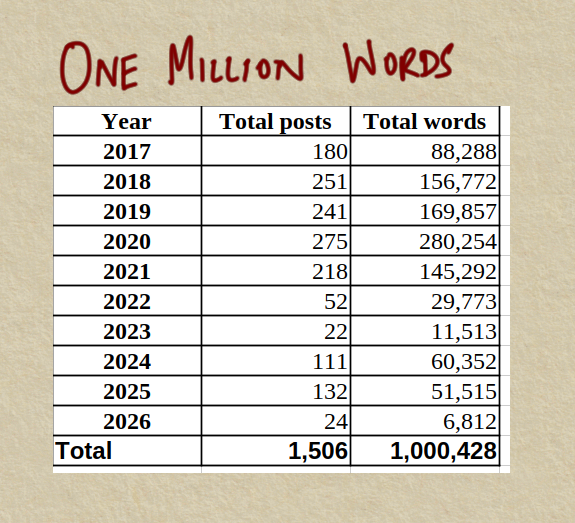
So that’s the plan as I head into the final stretch of my million-word writing goal. There are less than 20,000 words to go. I’m going to try and make them good ones.

Cheers,

Karthik