Why science can’t help us to understand ourselves

scientific-method.png

We think we are much better off these days than people that went before us.

And, using virtually every measure that matters, that is the case.

As Steven Levitt and Stephen Dubner write in Superfreakononics, whether it comes to “warfare, crime, income, education, transportation, worker safety, health”, many of us live in the most hospitable of times.

The reason for this is the scientific method and its rational approach to reasoned thought.

Our use of the scientific method has helped us create the modern world through a system of thinking.

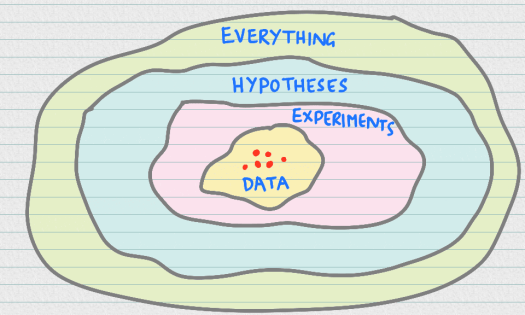
In essence, we look around us at everything and wonder why it is the way it is.

We look for explanations – create hypotheses – guesses at what might be going on.

Perhaps it rains when we do a dance, for example, or that the lines on our palms can tell what is going to happen to us.

Then, and this is the clever bit, we do something else.

We design an experiment to see if our hypothesis is right.

We collect real world data and see if what we predict will happen according to our hypothesis matches what happens in reality.

It seemed obvious for many years that a heavy object would fall faster than a light object when dropped from a height.

It took an experiment – dropping a heavy and light ball from a height and seeing when they hit the ground – to show that they fell at the same speed. Their weight made no difference to the outcome.

The experiment showed the hypothesis was false and so we needed another one.

The problem is that life quickly becomes more complicated from that point.

While the scientific method changed the course of human history and gave us cars, trains, planes, rockets and the rest of the modern world, it also created an illusion that it could explain everything.

And that’s wrong, it seems. The history of science shows that new hypotheses come along with irritating consistency to upend everything we know.

Simple Newtonian physics morphed into relativity and the simply incomprehensible world of quantum mechanics.

The logical end result of all this, as described in Pirsig’s Zen and the art of motorcycle maintenance, is that “The number of hypotheses that can explain any given phenomenon is infinite”.

What this means, in short, is that we think science will help us move towards the truth.

Where it matters, however, science simply increases the number of truths – what we believe to be true might not be true a few years from now.

Truth, rather than being fixed and unchanging, may be something we accept as true for the moment.

The point is that the scientific method has taken taken care of the material needs of many people – food, shelter, clothing.

The mistake we make is when we assume that because it explains so much, it explains everything.

The problem, again from Pirsig, is that the structure of reason based on rationality is “emotionally hollow, aesthetically meaningless and spiritually empty”.

We need to look elsewhere for meaning.

How to design a pilot

risk-reward.png

When we assume, Oscar Wilde wrote, we make an ass out of u and me.

Much of the time we’re not sure what option to take.

Whether its something simple, like changing the order in which we do things in the morning or a more complex situation, like deciding to move to a different country or go back to University for a graduate degree, we still don’t know how things will turn out.

With organisations – we face the same problems when trying to get a new customer to work with us, pick a supplier or decide in which projects we should invest company money.

So, how do we make a decision in these circumstances?

Some people decide, on the basis of their experience, that a particular course of action is appropriate. Then, they take things personally.

Questioning that approach is the same as questioning their competence or experience – which makes it difficult to have a discussion about the range of options.

This leads us down a binary decision path – either we do what is suggested or we don’t, and we might succeed or we might not.

The thing is that often the options are not really binary – there are more things we could do, if we were open to them.

Take the moving to a different country choice, for example. It’s different having a holiday in a country to moving there permanently.

It might be wise to try a longer holiday, see if there is a way to experience it for a three-month period, or spend some time asking people that have already done a similar move about their experiences.

These are pilots – experiments and research that try and test and validate our assumptions.

Ideally, pilots should be something quick, easy and cheap that we can try out and see whether an idea is worth doing and investing more time, effort and money in.

This happens all the time with new television programmes – a pilot episode is shot to test with audiences – and how they react may make the difference between getting funding to create a series or having to go back and start again.

Good pilots are designed, however, with one clear thing in mind.

They limit the downside, while leaving the upside uncapped.

This is what Nassim Taleb calls optionality in his book Antifragile.

Adherence to this principle, according to Monish Pabrai in The Dhandho Investor, is what has made a particular Indian community, the Gujaratis, so successful in the United States – owning tens of billions of dollars worth of assets.

Dhandho is a word that means “endeavours that create business” and it is based around a low risk-high return strategy that is all about “Heads I win; tails I don’t lose much”.

Taking a more well-known example – it’s what Richard Branson did when he set up his airline in 1984. He leased a single used Boeing 747-200 on condition he could hand it back after a year.

His downside was limited to a year of operating the plane and he knew that he could get money back for it if things went south.

Virgin Atlantic now operates 39 planes and turns over more than £2.5 billion a year with nearly 9,000 employees.

The opposite of an assumption, perhaps, is not a certainty but a pilot.

How are you?

model-of-personality.png

The answer we give to a question like “How are you?” or “How’s it going” depends on how we’re feeling at the time.

But – why do we feel the way we do at a given time?

The field of personality psychology tries to explain that.

It appears that there are three levels at which personality can be explored – corresponding to Dan McAdam’s three level model of personality.

At the foundation of our personality are traits.

Our general tendencies, or disposition, is based on traits that can help describe our personality.

For example, the Big Five personality traits are Openness, Conscientiousness, Extraversion, Agreeableness and Neuroticism, remembered with the mnemonic OCEAN.

These traits describe characteristics such as being open to new experiences, how organized and dependable we might be, whether we are energetic in the presence of others, whether we are compassionate and trusting rather than suspicious and how easily we experience unpleasant emotions such as anger.

While traits might describe what we are – they don’t explain why we are what we are – because we are more than just traits.

One level up is what we do with our lives – the things we do day to day – something called a Personal Action Construct (PAC).

The PAC is a model we have in our heads about the facts of our life and the order in which we put them.

A specific PAC developed by the psychologist Brian Little is the Personal Project. Brian explains his ideas in his book Me, Myself and Us and an entertaining TED talk.

In his approach, Personal Projects comprise things like “personal strivings, life tasks, personal goals, current concerns and possible selves”.

Brian argues that Personal Projects can explain a lot about why people act the way they do. If we can understand someone else’s projects that can help us understand and work with them better.

At the same time, if the projects we have are ones that are tiring and stressful or not aligned with our traits and sense of purpose, it’s not surprising that we aren’t that happy.

At the top of the hierarchy are stories – what we tell others to make sense of our own lives so far and what we want to do in the future.

Stories are important – without a coherent narrative it’s hard for us or anyone else to understand our position.

Whether we’re looking for investment for a new company, trying to change jobs, or create a new product or service or figure out what to about responsibilities when getting older – the stories frame and tell will steer the actions we take.

The point about this 3 level model is that all of this happens without most of us being remotely aware of it – who thinks about their personality in terms traits, projects and stories?

The level to focus on, however, might be the second one – Personal Projects.

Traits are inbuilt. Stories are after the event. The projects are the here and now.

As John Ruskin wrote, “Tell me what you like and I’ll tell you what you are”

How can you get there faster?

sequencing.png

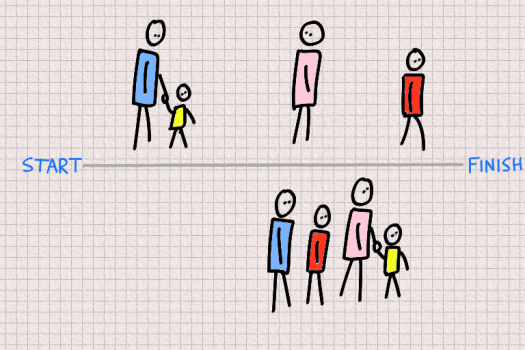
If you’ve ever been out with kids you will have experienced this.

Let say we set out on a walk someplace.

Everyone sets off at the same time from the same place. All is fine at this point.

Then, inevitably, the older kid starts to pull away from the group, walking faster, with one adult trying to keep up.

The younger one, along with the other adult, goes more slowly.

Within a short amount of time, a gap opens up between the members of the group.

In longer walks or hikes, this can become fairly substantial.

So, how long will it take for the group to reach its destination?

Some of us assume that with such a group, the time that it will take to get where we need to go will be based on the average speed of the individuals in the group.

So, as long as all of us try and keep up, we’ll get there.

This is why, all too often, one of the adults will turn back and shout to the other to keep up, or shout at the kid in front to slow down.

Eliyahu Goldratt in his book The Goal makes the point that averages don’t matter in this kind of situation.

The goal is to get everyone to the finish line. That only happens when the slowest member of the group makes it across.

The time for the group to reach the end, therefore, is the time it takes for the slowest member to reach.

This is something that we see all the time in work.

If there are a number of things that must be done in a sequence to produce a product and different teams do the work involved, the rate at which finished product is created is the same as the work rate of the team that takes the most time to complete its tasks.

Trying to speed up anyone else – or expediting – is a waste of time. Just like shouting in a group, it doesn’t do a single thing to actually improve the process.

The only place where any effort will make a difference is at the bit of the process that is the slowest – the bottleneck.

All too often, we think that if only we all did a better job, the company as a whole would be more productive.

Instead, it turns out, the company will become more productive only if we work on improving the performance of the activity that takes the most time to do.

In the example in the picture, the fact is that we can’t increase how fast the smallest kid in the group can walk.

By putting that child in the front, however, the rest of the group will stay close as although they can move faster as individuals, they can’t move past the slowest person in front.

As a result, the group doesn’t spread out and there is no need to shout any more – it makes for a calmer walk, even if it’s no faster for the group as a whole.

Now, in order to improve, we have to improve the performance of the slowest part of the operation.

That’s why, on a family trip out, we end up carrying the youngest kid so often.

Can you pick a winner?

picking-winners.png

Is it possible now, given all the information we have, to predict which sectors and organisations are going to succeed?

Take crypto-currencies, for example. What’s going to happen with them?

There is a proliferation of Initial Coin Offerings (ICOs) taking place – moving from pure currencies to valuing virtually anything, from content on platforms like Steemit to studies on tracking tuna fish.

The big choice many of us face is how to engage with a world of applications that start to bring some of these technologies together.

Software, for example, is increasingly sold only as a service, accessed through a web-browser or API with a sprinkling of blockchain to prepare for the future.

This creates a problem for buyers of such technology – especially ones that are expected to be transformational.

The first is that we don’t know which one will be the next google or facebook.

When it comes to a product designed for everyone – the more people that use it, the more we feel like we need to use it to connect with the others on there.

It’s not like we choose between competing platforms.

Once one platform is ahead, it dominates the space in a winner-takes-all way because there is no physical capacity in terms of the number of users it can serve in the way an airline only has a certain number of seats at any one time.

Warren Buffett, writing in 1999, described two industries that were expected to be transformational as well.

Cars and planes have changed people’s lives. Yet, during the course of the last century, there have been over 2,000 car makers and 300 airlines.

We are now down to a few global car makers – with Tesla being the first major disrupter of the status quo in a long time.

Airlines, at the start of this century, may have made a grand total of zero money between them.

Clearly – technology benefits us. It makes us more productive and transforms the way in which we do things.

The challenge is working out which technologies are going to do that – it’s based on survival of the fittest and the luckiest.

The lesson we should take, according to Buffett is this:

The key to investing is not assessing how much an industry is going to affect society, or how much it will grow, but rather determining the competitive advantage of any given company and, above all, the durability of that advantage. The products or services that have wide, sustainable moats around them are the ones that deliver rewards to investors.

Why are some people inspirational?

why-how-what-sinek.png

Why do some people and companies inspire loyalty and dedication from employees and customers? What’s different about them?

Simon Sinek argues in a TED talk that has been watched over 35 million times that it’s because such companies have a pattern of thinking that is inside out.

Many of us can easily say what we do.

That’s our profession, our job, our position in a family – we might be doctors, consultants, accountants, husbands, wives, parents and so on.

In particular, when it comes to work – we can point to the roles we have as what we do.

We also usually know how we do things.

We may have some extent of control and autonomy over the work we do and so design how we work, or we operate in a way set out by someone else.

In either case, we still know how to do something.

Where many of us struggle is in explaining why we do something.

Why are we in this particular profession? Why are we in a particular relationship?

Are we there because it’s something we truly believe in or is it just something we have ended up doing?

Many people make the mistake of thinking that companies exist to make a profit.

That’s wrong – companies make a profit by creating value for customers – profits are a result of good work and not the motivation for good work.

Sinek argues that if we know why we do something – if we have a sense of purpose and belief and mission – then others are more likely to buy into that than there are to buy into any particular product that we try to sell.

Take Apple, for example. Apple was infused by a zen-like focus by Steve Jobs on creating products that could change the world.

Jobs said nearly 40 years ago that “We’re gambling on our vision, and we would rather do that than make “me too” products. Let some other companies do that. For us, it’s always the next dream.”

That vision turned Apple into one of the most uniquely successful companies in history.

Again, from Jobs “you can’t connect the dots looking forward; you can only connect them looking backwards. So you have to trust that the dots will somehow connect in your future. You have to trust in something — your gut, destiny, life, karma, whatever. Because believing that the dots will connect down the road will give you the confidence to follow your heart even when it leads you off the well-worn path and that will make all the difference.

Interestingly – the why is not something that we can logically justify – it’s something that we need to believe in.

It is a matter of faith and and trust – a feeling of having a higher purpose – and perhaps it’s not surprising that people that radiate a sense of purpose and mission inspire us more.

Why what we believe matters more than we know

mindset.png

How do we make decisions that may influence our lives for many years in the future?

A surprisingly simple answer may be that it depends on our mindset.

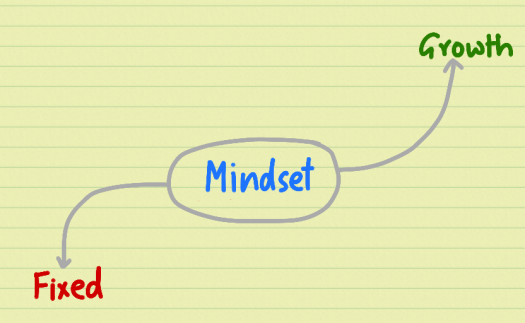
According to Carol Dweck, a Professor of Psychology at Stanford University who researches motivation, what we believe about what we are capable of doing has a huge impact on the eventual outcome – and success or failure.

This starts early. Four year old children given a choice between an easy puzzle and a hard one split into two groups based on what they believed.

The children with what Dweck calls a fixed mindset stuck with the easier puzzle, telling the researchers that smart kids didn’t make mistakes.

The children with a growth mindset took the harder one, finding the easy one boring and apparently more comfortable with the idea that they might not succeed.

The point, Dweck explains in her book Mindset, is that children taught to view intelligence and creativity as innate, fixed characteristics are more likely to view setbacks as permanent.

On the other hand, children that are taught that failing at something simply means that they have not yet succeeded can go on to practice, get better and try again.

Dweck’s is one of an increasing number of scholars that work in the field of positive psychology – studying how to live better rather than the more traditional approach of studying what is wrong.

The work they do, as a result, is based on modern research techniques rather than simple motivational thinking.

A sceptic, after all, would simply argue that it’s obvious that people who think positively do better. Where is the insight in that?

It turns out, however, when you carry out brain imaging scans of people with different mindsets the brain activity of growth oriented people showed more activity in processing meaning and relationships – literally having more neuronal connections firing trying to get to an answer.

The other thing that came out from the imaging studies was that growth oriented people were focused on finding the answer while people with a fixed mindset had more brain activity in regions that dealt with their emotional responses – how they would feel about getting the answer right or wrong.

In summary, a fixed mindset believes that capabilities are innate and fixed – people are born smart, for example.

A growth mindset believes that capabilities can be improved over time – persistence and hard work can make a difference.

This matters, especially when it comes to changing outcomes for children born into deprived areas where there may be a prevailing belief that they are simply less smart than others and will never amount to anything.

Most people will be on a continuum between the two mindsets.

Knowing which one we tend towards, however, may be the first step towards explaining some of the decisions and choices we have made so far in our lives.

Recognising that we can develop a preferred mindset may open up new opportunities – things that we can yet do.

Beauty in time: The Japanese aesthetic of Wabi Sabi

wabi-sabi.png

Wabi Sabi cannot be explained, Marcel Theroux found when travelling in Japan. It is ingrained in Japan – hard to disentangle as a concept.

Then again, perhaps it’s not that hard to get really.

What really matters?

Is it the next shiny new thing? Or is it the thing that has memories and history and feelings baked in?

Being attached to material things is at once the source of prosperity and anxiousness.

The more we have, the more we want – and the more we have the more we fear losing them.

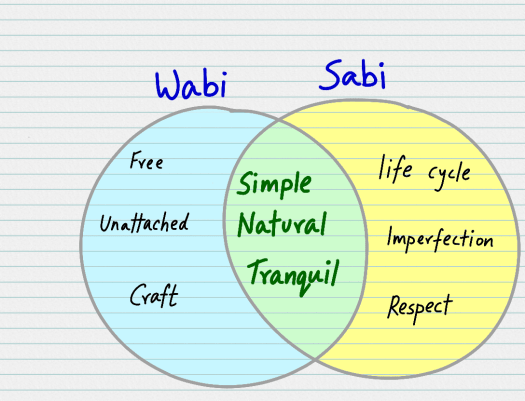
The Wabi part of Wabi Sabi has changed over time from meaning the desolation of poverty to the freedom that comes from being unattached.

Some of us can now have so much, that to truly appreciate things we must select only those things that truly matter to us.

When we are not attached to things, even the things that we have made ourselves, then we can focus on craft – getting satisfaction from the act of doing rather than the fact of owning.

The Sabi part of Wabi Sabi is the concept of a life cycle – how time adds meaning to things.

Something when first made has no history yet.

No one has used it, infused it with memories and given it meaning.

The act of using creates memories and imperfection.

A tea cup may get chipped over time – but it will also be associated with the memories of when we used it and so we treat it more carefully – with respect.

The concepts put together create a spare, austere philosphy that realises that happiness comes from creating value over time – whether in objects, relationsips or work.

It doesn’t need to be perfect – it does need to have meaning.

Perhaps the current buzzword of authenticity is trying to reach the state of Wabi Sabi – a simple, natural and tranquil existence that comes through in what we have and what we do.

Maybe we should aim to have less, that we value more, and appreciate better over time.

Should families have regular meetings?

family-meeting.png

How can we raise a happy family?

Modern families are often overwhelmed by the amount things we have to do – it often feels like are out of control.

And, according to Brice Feiler, the author of The Secrets of Happy Families, our children sense that is the case.

The way to make things better, it turns out, may be to bring some practices from work into our homes.

Many organisations, whether they realise it or not, are having to become more agile – a way of working that involves small teams working for short periods of time on small elements of projects, with a focus on making real, tangible progress.

These teams use tools like checklists, daily updates, weekly reviews and feedback.

An agile approach shifts power from executives directing work to teams that work towards a goal and increasingly manage themselves.

In this TED talk, Feiler says that when some families tried to use this approach in their homes, their children loved it, it helped reduce stress, increase communication and made them happier.

Everybody likes checklists. Children really like them.

If they have checklists of things to do in the morning, they quickly get into the habit of doing things on the list and checking them off.

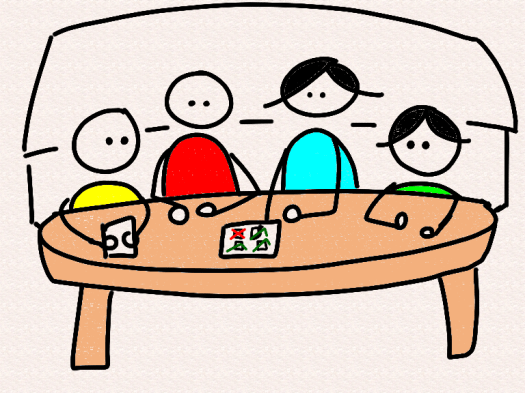
But to make a real difference, we need to sit down and talk together.

During weekly family meetings, which don’t need to last more than 20 minutes, we should asks things like what worked well this week, what didn’t work well and what shall we agree to work on next week.

The agile manifesto sets out the principles that underpin agile work – highlighting the importance of face-to-face communication, adaptabilty, self-organising teams and regular reflection as a group.

As parents it’s instinctive to want to tell our kids what to do.

That is not going to prepare them for a job market where they will be valued more for their creative ability than their willingness to follow orders.

Instead, Feiler says, we should try and empower our kids – helping them practice how to make decisions, come up with consequences for their actions.

If we help kids set their own goals, make plans to achieve them and teach them how to reflect on how things are going and how they should adjust their own actions – we may raise children better prepared for the changing world of work.

And, more importantly, we may be able to build a happy family that feels like it’s a close knit team.

The case for quitting

why-dont-we-quit.png

Choosing what to quit and when to quit it is more important than we sometimes realize.

So, why don’t we quit more often?

Why do we persist with a job, a relationship, growing a moustache and a myriad other activities that we should really just drop and walk away from?

According to Steven Levitt and Stephen Dubner in Think Like a Freak, there are three main reasons why we don’t quit.

First, we’re afraid to be seen as a failure.

Phrases like “Winners never quit and quitters never win” have been seared into our brains from a young age.

The second reason is the idea of sunk costs.

If we have already invested time into a career, energy into a relationship and money into projects and investments, then quitting means effectively writing off all that investment.

Having sunk all that we have into something, we’re afraid of stopping just before the big payoff.

What if we carried on for just a bit longer?

The third reason is our tendency to focus on costs now instead of opportunity costs.

If we do something now with our time, that also means that we have to give up the idea of doing something else with our time, even if that something else might be more valuable.

We have limited, scarce resources of time, money and energy.

For every unit that we spend in one place, something else needs to be abandoned.

It’s easier, however, to focus on what we need to do now than to think about what we are giving away.

For example, we’d rather buy something nice now than put the money into a pension to use in 50 years.

These three reasons are rooted in our past, present and future: what have we invested already, what do we choose to do right now and what will we look like to others in the future.

The point, Levitt and Dubner write, is that we don’t really know. We can’t run experiments that simultaneously test quitting and persisting.

Or can we?

The authors set up a site, now defunct, called Freakonomics Experiments, and asked people to put in their questions and take a decision based on a coin toss.

That mean’t half the participants would quit and half would persist.

The results were eye opening. On almost every question, the people who quit were happier 6 months later than those who didn’t.

As they write in their blog on the topic “We just came up with a basic truth, which is: when you’re not sure what to do, you should quit. This is what the data tells us: if you can’t decide, it means you should have quit already and you should quit right away.”

Perhaps the last word on this should go to W.C. Fields, who said If at first you don’t succeed, try, try again. Then quit. There’s no point in being a damn fool about it.