Why we might be thinking about goals all wrong

types-of-goals.png

Goal setting theory has always bothered me – there’s something a little artificial about it – something not entirely natural.

Take the wording in this paper, for example. Edwin Locke and Gary Latham point out that some 400 studies carried out over 25 years show that specific goals lead to better task performance than easy or vague or abstract ones.

This inference hits the target but misses the point.

Before we look at why that is the case, it is useful to note that goals are then split into extrinsic and intrinsic ones.

We try and achieve extrinsic goals to show that we are capable of doing something, or to avoid showing that we are not capable.

We try and achieve intrinsic goals because they give us feelings of mastery and control and satisfaction.

The findings from more studies is that intrinsic goals lead to longer lasting performance.

There seems to be little appreciation, however, about the nature of goals themselves.

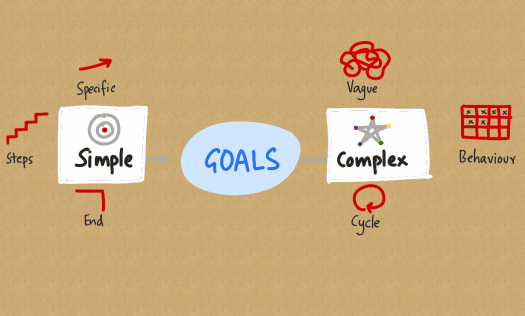
A more useful classification of goals, it seems to me, is to think of them as simple or complex.

A simple goal might be something like hit the bulls eye four our of five times on a shooting range. A complex goal might be create a sustainable level of income for a consulting business.

What happens all too often, especially when it comes to an activity like sales, is that we try and set simple goals and targets to achieve a complex outcome.

We’re then surprised and disappointed when the results don’t materialise and get cross and angry and change people.

Perhaps the mistake we’re making is in thinking that all goals are the same and all we need to do is make them SMART – the whole specific, measurable, achievable, realistic and time bound thing that is trotted out in courses.

Instead, we need to recognise the characteristics of the two types of goals and what we need to do to make progress towards them.

Take a simple goal, like getting better at hitting a target with a bow and arrow.

That is a specific goal and can be made SMART.

We can make progress towards the goal by improving how we carry out each step of the sequence of activities needed to achieve goal.

Elite athletes train until their muscles remember what to do and visualise every step they must carry out.

Finally, simple goals have an end point. We achieve them – and then that’s that. There is nothing else we need to do.

Complex goals, on the other hand are vague. They include things like living a good life, having peace of mind, and doing one’s best.

We make progress towards such goals not by following steps but by practising behaviours.

For example, we might try and learn something new every day, talk to a new person, take a different route, try new experiences.

When it comes to tasks like writing or sales, it is well known that having ridiculously low targets is a good way to actually make progress.

Finally, with complex goals there is no obvious end. When do you achieve being good? When is your business sustainable?

There is always change and we will need to adapt and discard less useful behaviours and adopt more useful ones.

Goal setting is a useful exercise. The problem is that we may be trying to adapt goals that are designed for success in fields like sport to life in general.

And life is more complex than that.
What Groucho Marx teaches us about win-win strategies

groucho-marx-strategy.png

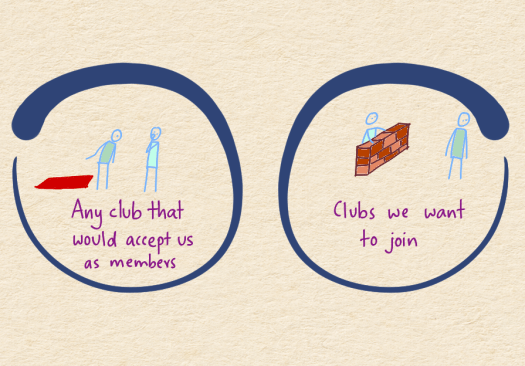
Groucho Marx, an American comedian, once wrote when resigning from a club that he didn’t want to belong to any club that would have him as a member.

Which, when we think about it, is often the way that we approach many situations.

Take selling or job hunting.

Many of us believe that if we make enough calls or apply to enough positions we’ll get somewhere – it’s a numbers game and we just need to make the numbers.

So we grind it out, spending day after day, and wondering why we aren’t getting anywhere fast.

That’s not a strategy – it’s a treadmill.

Terry Speed, Professor Emeritus at the University of California, Berkeley writing in the American Statistical Association membership magazine, suggests that a job hunter should instead make two lists.

  1. Where would I immediately accept a job offer?
  2. Which employers would be delighted to employ me?

It’s important that answers to both questions are unconditional – we accept and they offer without bargaining.

If we’re thinking like Groucho Marx, there is no win-win.

We want to work at places that may not want us. And we’re hesitant to consider the places that do.

According to Professor Speed, we’re in good shape and well calibrated if there is an overlap between the lists.

It’s worth spending the time to work out who really wants to – or will want to work with us because we can both benefit from collaborating.

That really means seeing if we’re aligned. No amount of external management or manipulation can overcome poor alignment of goals and expectations.

Conversely – sharing goals and aligning expectations means that we can spend less time on control and more time on execution.

Ideally then, we’d join clubs that we really wanted to be part of, and which would be delighted to have us as members.

But how do we know when this is the case – how do we know when we’re aligned?

There’s no easy answer to that question. It’s not something that can be assessed with a simple checklist.

We may just have to learn to look harder at what is in front of us until we can see.

How to become more intentional

intentional.png

What does it mean to be intentional?

Google to the rescue. It means to be deliberate, to do on purpose, to be purposeful.

That is a teleolgical concept – an attempt to explain something in terms of its relationship with a goal or final end point.

So, being intentional is, in a sense, being purpose driven, or goal driven.

How does knowing that help us?

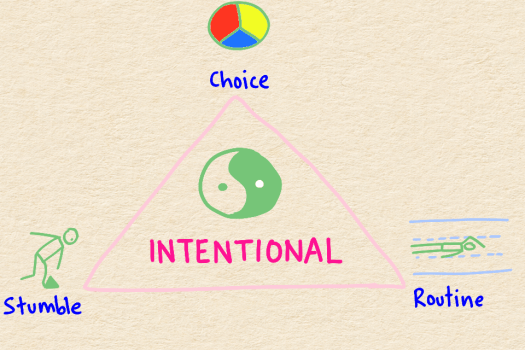
There are three things, at least, that we need to think about when trying to be intentional.

The first is that we can’t do everything – we have to choose.

Students are often told when going to University that they have a choice of three things: sport, a social life and their studies.

If they are going to excel and be at the very top, they need to pick two to focus on.

We have to decide which two are most important to us and make those our primary activities.

Even if we aren’t planning to perform at an elite level, we still have to make choices between reading and watching telly, between going out late partying and staying up late working on a business.

The second thing is that we have to develop routines.

Willpower is a hard and tiring way to organise our lives.

Routines are better. If we set and keep appointments with ourselves every day to do the things that are important then, over time, we will see results.

We don’t have to set hard to achieve targets. We just need to do the minimum every day and it will build up over time.

As the saying goes, people overestimate what they can do in a year and underestimate what is possible in ten years.

The third thing is that we have to know how we will respond when we stumble.

And stumble we will. We may want to do something – work on a book, lose weight, make sales calls – and there will be times that we just don’t have what takes to do it.

There’s no point getting upset about that – it’s going to happen so we might as well deal with it.

As W.C Fields said, if at first you don’t succeed, try, try again. Then quit. There’s no point being a damn fool about it.

With some things it’s hard to keep going – especially when our intention is to overcome routines we have created earlier, like overeating or smoking.

The thing about stumbling is to follow the if-then rule. If something doesn’t go the way we wanted, then what are we going to do next?

Do we want to get to an end or get balance?

An intentional approach suggests that there is an end – a place we can get to where everything is all right.

At the same time, we may only realise we have arrived when we don’t feel the need to go elsewhere – the end is where we are right now.

That’s another choice we need to make.

How to be more focused in life and work

focus.png

We’d all like to be more focused.

At the same time, there is an industry that specialises in hijacking our brains and hooking us (and our children).

How are we going to win?

It turns out that we can focus on the things that we want to focus on – a so called top down approach – when we want to.

At the same time, our focus can be drawn automatically to distractions – or bottom up signals – like notifications on mobile phones.

So, is there anything we can do to get better at focusing on what we want to rather than being victims of our devices and environments?

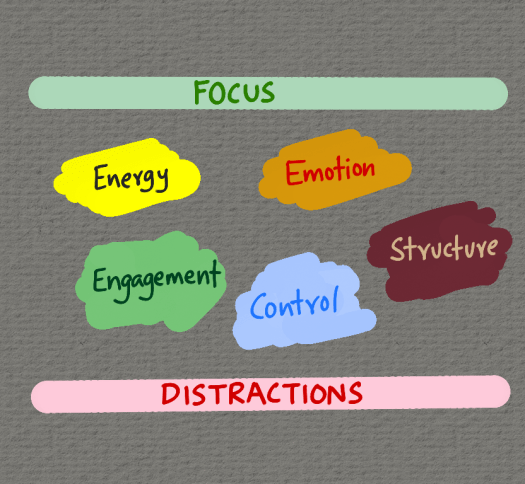
According to Edward M. Hallowell, the author of Driven to distraction at work: How to focus and be more productive, there are five things we need to do.

Manage our energy

Scott Adams, the creator of Dilbert, writes that we should manage our creativity, not our time.

People who manage their creativity get happy and rich.

People who manage their time get tired.

Substitute energy for creativity and we get the same message – the more energy we have, the more creative and productive we can be.

Many people make a big fuss about how hard they work. In this day and age, however, is that the smart thing to do?

Manage our emotion

How we feel affects how we work.

A high stress environment or managers that use blame and threats to get work out of people isn’t going to make us feel good.

And feeling good – or even more fundamentally – feeling safe – is crucial for us to be able to do good work.

If we want people to produce, we have to give them room to experiment, to fail and to learn.

No one gets it right the first time. If it looks like they do, the chances are that they are just very good at hiding it when things go wrong.

Be more engaged

We’ll do things more happily when we’re engaged – when we like what we do.

That seems obvious – but the fact is that we’re all good at different things. Some of us like working with people. Others like solving problems.

What’s important is looking out for the tasks that help us get into flow, where we can lose ourselves in the work and we finish with more energy than when we started.

If the work drains us, or the people around us drain us, then it’s time to look at what else we can do.

Be more structured

Routines help.

They help by reducing the amount of thinking we need to do, freeing up time for more creative and important work.

Some people take this to extremes – wearing just black, for example. That cuts down decision making on what colour to wear.

Routines also create habits. If we have a routine where we start or end the day with creative work and do the administration in the middle, then every day we are going to get a little further.

Learn to take back control

This is the hardest one for many of us to learn.

We’re too eager to please – to say yes.

Life is all about goals.

As Brian Tracy says, either we’re working to achieve our goals or we’re working to achieve someone else’s goals.

We really need to focus on reaching our own goals.

Why cities and businesses benefit from clustering

clusters.png

It’s easy to assume that if we had no competition, business would be great.

It turns out, however, that we are much better off being near competitors than far away – and this is because of the benefits of clustering.

Four benefits in particular stand out.

The first is access to talent More companies in a region means a greater need for people with relevant skills. This may drive up prices for talent and attract people from elsewhere.

Alternatively, a company may spawn a host of related businesses set up by ex-employees.

One of the most famous examples of this happening is the traitorous eight, employees who left Shockley Laboratories to found Fairchild Semiconductor.

Fairchild Semiconductor in turn led to birth of Silicon Valley and the creation of several companies, including Intel, founded by Gordon Moore (of Moore’s law) and Robert Noyce from the original eight.

Proximity leads to productivity When we have competitors operating close by we watch them carefully and try to match what they are doing and keep up or stay ahead in the market.

This sense of competition means that we’re always trying to become better – to become more productive.

In a global economy anything that is seen as a commodity sees margins fall the virtually nothing.

The only way we can make money is by doing more better with the things that go into our business – and that means being more productive.

At the same time, we want our local economies to succeed – we have common interests Businesses don’t start and stop quickly. They take time and effort and investment.

If we work on something for a while we’d like it to be sustainable and endure.

In addition, when the local economy does well, everyone does well. For example the value of the houses we own goes up. There are more jobs, and our children don’t have to move cities or countries to find work.

So, working together to make our local economies grow makes perfect sense.

Although we can work with anyone anywhere, we still like face-to-face Finally, we can hire people from anywhere. But our competitive advantages may lie in what is available closer to home.

We need a local touch to tap into the ecosystem around us – and this is still best done with face-to-face contact and a personal connection with others.

That’s when we realise that there are other people that are in the same position as us, and yet more that have gone through a similar process before and can share their knowledge and insights with us.

To benefit from an ecosystem we must invest the time to become part of the ecosystem.

It’s give and get, not just come and take.

How to show why your product is valuable to a customer

value-proposition.png

As product developers, we need to ask ourselves early and often whether what we are creating has any value to a customer.

There seems to be a belief that anything can be sold, no matter how rubbish it is.

That may only be the case in movies or in urban myths about salespeople – it’s not what we see in real life.

The action of buying and selling is so fundamental to human society that it cannot be based on anything other than the transfer of value from one person to another to be sustainable.

So, how should we approach the act of understanding the potential for value, creating it and communicating it to a customer?

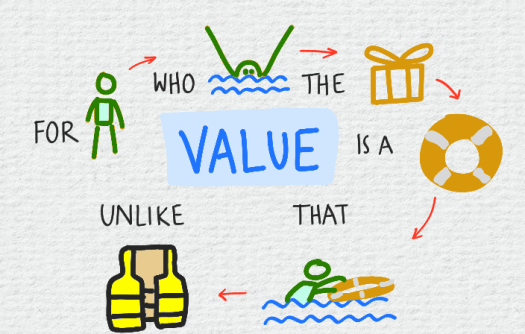
Geoffrey Moore in Crossing the Chasm has a model that we can use to think our way through this as illustrated in the diagram.

We start looping round the model with FOR.

There are customers out there for our product, and there is everyone else. We are focused on creating something for our potential customers.

The quickest way to failure is to try and please everyone, so we need to be laser focused on the set of people that could buy what we have to offer.

The next stop in the model is WHO.

Only some customers need our product right now. The others may later, or may already be using something else.

The customers who are effectively thrashing about in the water and are in danger of drowning are the ones that we should focus on.

So then we move onto THE.

The product, that is. Our product may be a inflated rubber tube attached to a rope, or a heavy duty iron bar.

That may be how we think of our product – as a set of features and attributes. Our products were created using specific things and perform in a certain way.

Customers don’t care…

What they are concerned about is the next step in the model – the IS A.

Our product is a lifebuoy. Or an anchor. One is clearly a more appropriate one to throw to the person in the water.

Because of what happens in the next step – THAT.

The lifebuoy is something that the person can hang onto until being rescued.

The final part of the model is UNLIKE.

This is an important step that is often missed.

We might have lifebuoy to hand. We might also have a life jacket.

Which one would we throw into the water?

Both will float, but the lifebuoy is clearly easier to hold onto and float, unlike the life jacket.

If we can put all these elements together in a simple statement, we will be able to say why our product is valuable to a customer.

What is the difference between strategy and tactics – and how do goals and objectives fit in?

goals-strategies-objectives-tactics.png

We often hear the words strategy and tactics, usually closely followed by goals and objectives. Is there a consistent way in which we can use them when thinking about a situation?

A good starting point is Liz Ryan’s story about how an old boss defined strategy as how to get out of the woods.

Thinking about a situation like being lost in deep woods is a good analogy for a problem we have to solve.

We know we need to get out but we can’t see very far ahead – so what are we going to do?

Jeremiah Owyang writes about strategy being done above the shoulders and tactics being done below them.

Strategies are about options. Tactics are about actions.

Before we delve into that – Mikal E. Belicove reminds us of the GOST model – Goals, Objectives, Strategies and Tactics.

A goal is somewhere we want to be – like an X on a map that marks where treasure is hidden.

An objective is something we can attain – a specific something – like getting hold of a ship.

A strategy, then, is to evaluate the options we have and select the ones with the greatest chance of success.

Strategies and tactics are linked – head and hands working together.

We decide that we will go a certain way, and that means we must do specific things in order to succeed.

Is it any use trying to get these words straight – will it help us in any way?

Yes. All too often, we see what others do and think that the way for us to succeed is to do the same things.

But, all we are seeing in action are their tactics. We don’t understand the strategy that led to the selection of those tactics.

All too often the ways that worked for others will not work in the same way for us.

Steve Jobs, for example, was apparently a tyrannical perfectionist whose near obsessive character built Apple into what it is today.

Should a modern CEO therefore cultivate a tyrannical, perfectionist and obsessive character?

Most would and should hesitate at the idea.

The classic quote about strategy and tactics is from Sun Tzu, who wrote Strategy without tactics is the slowest route to victory. Tactics without strategy is the noise before defeat.

Strategy and tactics must be intertwined and executed in context. Some strategies work better than others depending on the environment.

If we’re large, we should use overwhelming force. If we’re small we should move quickly and be hard to catch.

We’ve got to find a strategy that is right for us – and then select and execute tactics that will help us win.

It’s really that simple. But that doesn’t mean it’s easy.

What is the optimum size of team or group you can manage?

optimal-team-size.png

How big should a team be? Is there a right size that can be managed effectively or a recommended approach that works for organisations?

To come up with an answer we need to look at what the organisation does and where it is in its lifecycle to come up with a model that works in its particular situation.

The starting point is to look at effectiveness.

The military has a history of requiring teams to effective – lethally so.

The smallest unit in the Roman army had 8 soldiers led by an officer and with two support troops.

The equivalent in a modern army is a squad, with 7 to 12 soldiers, although a smaller sub-team known as a fireteam with 4 or fewer members is the smallest cohesive unit.

The word cohesive is important here – as the team needs to work together and be cohesive to be effective.

Success as a whole depends on the coordinated use of cohesive teams and this is as true in military operations as it is in business or the public sector.

The next thing to look at is management

We sometimes think that teams work for their managers – a good manager can get better performance out of the team.

An alternative view is that people in cohesive and well performing teams are more likely to work to support each other and avoid failing in their role than they are to please a manager.

A manager’s role, in that case, may be more about coaching and helping a team to bond than about telling them what to do and how to do it.

That suggests that hierarchy is necessary to scale how people work.

Each team that actually does something should have between 4 and 8 people.

Fewer than that may mean they don’t have all the skills they need to be effective, while more than that means coordination becomes a problem.

Above the coal face – where things are done – we need structures that enable coordination and communication.

Technology can help here – but face to face communication can help in a way that emails and phone calls can’t.

The size of management groups will therefore depend on how much time leaders have to talk and meet with their team. If they spend every day communicating, then they can have more direct reports.

They might also want to do some work, however, and perhaps having more than 7 or so people looking for time with them will eat into that.

Finally, we should consider the phase of growth the company is in.

George Bradt, the co-author of First-Time Leader, writing in Forbes describes how to think about teams during different growth phases.

He shares the story of Devanshi Garg and the approach taken by Icreon Tech when entering the U.S.

In the beginning, Garg suggests, we need a team made up of people that think like founders – partners who can do many things, adapt to situations and solve client problems.

Later, as we grow to more than 10 people, we need to think of our company as an extended family. We know most people and how they work.

Over 30 people, we need hierarchy – developing leaders and supporting them with effective management systems.

In the end is there a magic number?

I’d go with Michael Lopp’s formula. Seven plus or minus three.

What is the most important model for a B2B CEO or MD to know?

innovators-dilemma.png

There is one business book that Steve Jobs said deeply influenced him – The Innovator’s Dilemma by Clayton M. Christensen.

Here’s what happens with a company. The founders have an idea and create a product of a service. In the beginning the product has some core functionality and some users take it – perhaps its cheap and does the main things they need it to do.

This is the low end of the market – where adequate performance is just fine.

Over time, the founders improve the product and build the company. There are more people, more iterations of the product and it gets better and better and just climbs up the S-curve of performance.

At some point, the product satisfies the needs of virtually all its customers – even the ones demanding high end performance and superior quality.

The company is now established, has lots of customers, is profitable and seems to dominate its space.

What are the founders doing now?

Perhaps they’ve been replaced by executives and have retired to a beach somewhere.

The execs come in with suits and briefcases and do what the company does best. The double down on the products that are doing well creating even more capability and features.

The only companies that can afford their high end tools are the large, established ones. The little customers aren’t attractive anymore.

The market doesn’t really need these whizz bangy things but, well, the execs might as well keep going and offer more options.

Along the way, they might create some new tech or capability, but its not really that interesting to customers and doesn’t get attention or resources – everyone’s focus is on the main earners.

Some of the people working on this other cool stuff get dejected and think about leaving and starting out on their own.

They ditch the suits, come to work in t-shirts and shorts, perhaps on a skateboard, and get on developing the tech that the large company rejected in a new startup.

This new tech is newer, probably faster, cheaper, easier to maintain and so costs much less than the older, more established technology of the incumbent.

The suits are going to find that they are standing at the edge of a precipice – they just don’t know it yet.

The startup tech is adopted by the low end of the market. In its new, unrefined form it does what is needed by these customers and starts building market share.

Soon, its climbing a new S-curve.

Finally, the suits look down in horror and see that the startup has hoovered up all the small customers they have been ignoring.

It’s now too late to create competing technology. Perhaps they can buy the startup and survive that way. Or else that’s it – they’re now walking dead and business is moving wholesale to the new company.

This disruptive cycle is the dilemma faced by the innovator.

We often think that companies go out of business because they fail to innovate.

According to Christensen, that’s not the case. The incumbents do their core business really well. They don’t invest in their fringe ideas because the return on investment isn’t proven – and they make sensible asset allocation decisions in proven markets and technologies.

Those perfectly sensible actions allow the startup to take root, grow and eventually disrupt the incumbent’s market.

A B2B CEO or MD needs to know which S-curve their company is on – the incumbent’s or the startup’s – and where it stands on the slope.

They need to know that before doing anything else.

What we should learn from the golden arches

brand.png

I watched The Founder last night – the story of how Ray Kroc took McDonalds nationwide and created the phenomenal company that now operates across the world selling burgers.

The film is emotive – showing how Kroc tried to work with the McDonald brothers to grow a fantastic new idea but then, after being frustrated with the way in which they didn’t embrace his vision, was shown that he had been thinking about his business all wrong.

He wasn’t in the hamburger business, he was told. He was in the real estate business.

The way in which Kroc wrested control of McDonalds from the founders was by realising that the value of the business lay in the land under it rather than the burgers that were cooked on the land.

Owning the land gave him control – he could control what was done on his land.

This is the same insight that Steven Levitt and Stephen Dubner explore in Freakonomics. The landholder gets the value – a great brand selling in a great location has to pay more to be sited there – so the landholder gets to charge more.

The other thing that Kroc saw was the brand.

All across America, as he travelled, he saw crosses and flags, crosses and flags.

They signified America – a god fearing, law abiding country – a country for families and wholesomeness and apple pie.

His vision was to see McDonalds as a brand for America – with the golden arches just as iconic as the cross and the flag.

That was the insight that made him – a 52 year old salesman – who was able to see how a brand for a restaurant could convey just as much meaning and signify all that felt good for people at that time in that place.

The film shows other points. Kroc worked harder and longer than anyone else. He had human frailties. He was misunderstood and mocked.

Which goes back to the old saying – first they ignore you, then they laugh at you, then they fear you and then you win.

Kroc is shown listening to motivational tapes – the kind that we still can get and listen to today that extol the value of persistence.

Talent is not enough. Genius is not enough.

Persistence is what matters – when the going gets tough the tough get going and all that kind of guff.

At the end its all still complex.

Kroc built an empire – and in the film he’s pictured as someone who wanted to win at all costs, someone who wanted to crush competitors and have it all.

But the point is that he saw something that no one else did in the same way then.

He saw just how much people yearn for meaning – the golden arches mean something – a place of safety and sanctuary for families.

And that’s why they just keep coming.