How To Round Out Your Thinking

rounded-thinking.png

Thursday, 8.49pm

Sheffield, U.K.

Abstract thinking leads to greater creativity… But in our businesses and our lives, we often do the opposite. We intensify our focus rather than widen our view. – Daniel H. Pink

We’ve all met practical people – people who want to get on and get the job done.

Perhaps you’re one of those people.

A no-nonsense, down-to-earth sort of person.

You know what you know and believe in the value of experience.

If you don’t know how to get it done you’ll find someone who does.

In the process, you’ll surround yourself with good people – a team – and your business will do well.

Or maybe you’re a restless risk-taker – some always looking for the next opportunity.

Someone ready to experiment and invest in the new. A Richard Branson type who starts an airline because he’s delayed on a trip and figures he can do better.

It can seem like those are your two options for how to go through life.

Either be someone who actively experiments and changes the world.

Or be someone who is solidly planted in the real world.

Be a river or be a rock. Those are your choices.

Or are they?

An article by Beverley Kaye in the book Learning Journeys is an interesting example of how to think about this.

Dr Kaye writes about her experience defending her doctoral dissertation.

She was a checklist sort of person, a get it done sort of person.

She was prepared and ready to check off the defence of her dissertation.

Except, she ran into trouble.

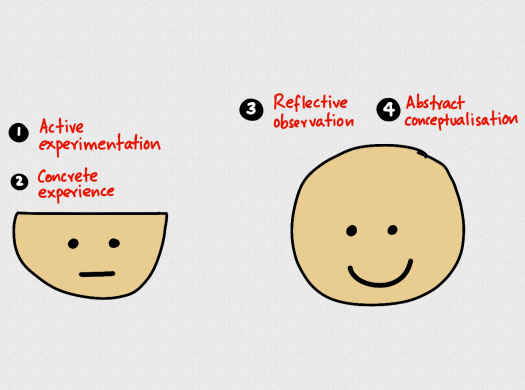
She was operating from her flat side, she was told and needed to get more rounded.

But what did that mean? And how could someone so practical and in the real world get their heads around that?

And it’s not an easy thing to do.

You know the story of the unreasonable person.

Reasonable people adapt to the world around them.

Unreasonable people adapt the world to themselves.

All progress, therefore, depends on unreasonable people.

Those hard-headed business folk, whether rock solid or fluid experimenters are unreasonable people and have given us products and services that have changed lives.

Externally anyway – not so much internally.

We’re stuck in a consumer society and many people, although they are technically among the wealthiest in the world don’t seem particularly happy.

What’s lacking is inner change.

The Kolb Cycle says there are four ways to learn: active experimentation, concrete experience, reflective observation and abstract conceptualisation.

The first two are easy to recognise – we all start with flat heads.

The ways that round us out are harder to understand.

Can you look back at your life, at the days you spend – just look at them without criticism or judgement and try to see them for what they are?

How did that last meeting with a prospective client go? What worked, what didn’t – was she happy, difficult, neutral?

If you were someone else looking at your life what would you see, what would you think?

And what would you think was going on – how would you conceptualise the situation?

Or, more simply, how would you explain what’s going on?

To see things for what they are and come up with an explanation for why they are what they are is an attempt to round out your thinking.

To try and see without filters, blinders or anything else in your way and to try and look for explanations that are clear and plausible is the way to get started.

And then, if Dr Kaye’s experience is anything to go by, then one day you’ll just get it.

Cheers,

Karthik Suresh
What Is A Crucial Question To Ask If You Are A Service Provider?

customers-customer.png

Wednesday, 9.54pm

Sheffield, U.K.

The ‘U’ goes before ‘ME’ in Customer. – Janna Cachola

How many businesses can you think of that are pure product plays now?

Natural resources and commodities perhaps.

And of course all the factories pumping out things from shampoo to chocolate.

But many businesses depend on a combination of products and services and when you’re selling to someone else they might be buying your product but they’re taking your service into account as well.

Which makes it useful to study exactly what’s going on when you try and pitch your product or service to someone else.

If you make a box, for example, you could find a prospect and show off your box.

Your prospect is probably stood there with folded arms – she probably already as a box supplier and doesn’t really see what you do differently.

If your box is a service, like management consulting it’s harder to see the point of what you do.

Either she believes she doesn’t need you or already has a provider.

The mistake most people make is to focus on the features and benefits of what they’re offering.

Asked why they’re different – what’s their Unique Selling Point – they talk about their people, how nice they are and how good their product is.

Faced with objections they go on the offensive – ready to “handle” them, brush them aside, tear them down or climb over them.

And that’s irritating – like when someone uses the strategy of agreeing with everything you say so that they can then repeat what they just told you.

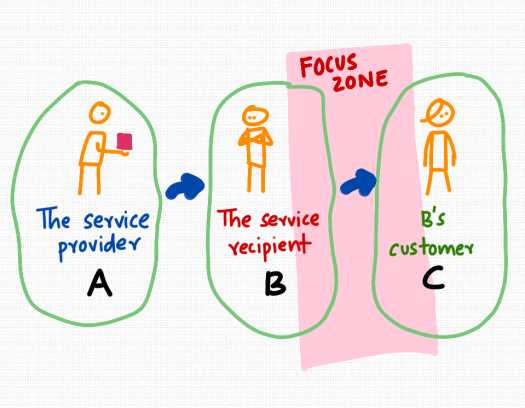
So that’s where a model like the one above, based on the one in Soft systems methodology in action, written by Peter Checkland and Jim Scholes, comes in.

Checkland and Scholes quote Richard Norman who says that the question is not “Who is my customer” but “Who is my customer’s customer”.

If you are the service provider, A, and you are trying to sell to the service recipient, B, and you focus on the transaction between A and B – there you are product in hand facing a reluctant and irritated counterpart.

Yes you could argue that they shouldn’t be like that – that they should be open to salespeople because that’s how they are introduced to opportunities – but people are people and if they don’t like being cold-called you’re not going to change their minds.

However people who don’t like being sold to open up and become much more interested when they talk about how to serve their customers better. Let’s call those folk C.

The transaction between B and C is of vital interest to B. That’s something that matters and anything that makes it better is worth considering.

So, if you want to sell B your service you need to figure out how best you can help B add value to C.

That’s your focus zone.

Now this seems, like the authors say in the book, a simple and obvious model.

But just think back of the number of times you’ve been in conversations where the focus was about A and B and C wasn’t mentioned at all.

The fact is that if you want your service to be considered your attention and the time you have with B needs to be spent on the focus zone – where you think about how the two of you (A and B) can add value to the transaction between B and C.

If you can really add value then you will find B open to the prospect of sharing value with you.

And be warned, value is not always easy to find.

Technological solutions that cut costs for B, for example, rarely raise margins. Instead the savings are passed through to C in the form of lower prices.

Good value, sustainable value comes from adding something more magical – by creating competitive advantage for B and C in some way.

But what is sustainable competitive advantage?

Well… ideas for that are going to come out of your discussions as you explore the focus zone.

But here’s a suggestion – prioritise ideas that are inimitable – hard to copy.

Because that can often be the secret to advantage – doing something no one else can.

Cheers,

Karthik Suresh

How Do You Get Started When Thinking About A Problem?

problematic-situation.png

Tuesday, 9.20pm

Sheffield, U.K.

If you break your neck, if you have nothing to eat, if your house is on fire, then you got a problem. Everything else is inconvenience. – Robert Fulghum

I think I wrote something a while back about experiencing a block when trying to think about a business problem.

This particular one had something to do with organisation structure.

When you look at how organisations are structured you find that you can classify them in different ways.

For example, you could look at them as highly centralised, silos, networks and so on.

So, you’ve given the organisation structure a name – now what?

That was the problem I came up against – saying you think something is something simply says you think A = A.

It says nothing more about whether A is good or bad or what you should do to make A better.

It’s like being frustrated by someone and swearing at them.

It doesn’t really change anything about the situation at all.

The point is that we’re in the vicinity of a problematic situation and how we think about it is going to affect what we do next.

For example, say you’re married and have children you probably face quite a few problematic situations.

You’ve got the situation in the morning, getting everyone ready and fed and off to school and work.

You’ve got the situation around homework and the balance between letting kids play, spend time on screens and getting enough sleep.

Problematic situations often overlap with other problematic situations.

Your employers may want you in the office at the same time that you need to help with getting the kids to and from school.

Then, of course, you have any number of problematic situations at work.

These range from getting sales numbers up to recruitment and retention, keeping clients happy to getting new equipment for the office.

On the whole we just get on with these situations – many of them can be solved with planning, preparation and some shouting.

But others can’t.

Especially ones that involve more people, more situations, more moving parts.

At this point, you’ve got to figure out where you are on the map in relation to the problematic situation.

Are you in the middle of it, enveloped by it and flailing about?

Are you outside, looking on with interest but without involvement, feeling or fear?

For example, let’s say your company has set sales targets.

Is that something that affects you personally?

You’re worried about what you’ll miss out on if you don’t hit the numbers, excited by what you could get if you do?

Or is sales something someone else does while you get on with the job in front of you?

Or are you a consultant, desperate to get involved and show how clever you are?

Well, from my experience, when you’re on the outside your experience isn’t worth as much as you might think.

That’s because the models you have – the sales boards, targets, mission statements, CRM systems and all the other tools you’ve used successfully are the kinds of tools others know about as well.

On the other hand, when you’re inside the organisation you might not know as much as you think you do.

That’s because you only have the one experience – perhaps a few others – but in the main the one you’re having right now.

And it’s hard to step back from that experience because you see what is going on so clearly – you see the people and the politics and the culture all working together. Not working well, perhaps, but working nonetheless.

So, to change things you need to move closer to the edge from wherever you are.

If you’re too close you need to step back so you can start to see the bigger picture.

If you’re too far away you need to step closer to see the detail.

You’ve both got to take some steps on the road.

The further apart you are the bigger the difference in what you’re seeing – in your points of view.

You’ve got to get closer and so the first job for anyone trying to work together to improve a problematic situation is to get to a point where you’re both looking at roughly the same thing in roughly the same way.

And then you can make a start at talking about the problem.

Cheers,

Karthik Suresh

A Thinking Reset – How Can It Be Done?

models.png

Monday, 9.04pm

Sheffield, U.K.

Subjectivity is objective. – Woody Allen

April has not been a good month for this blog.

7 posts in 22 days is not a particularly good writing tempo.

But I have some reasons (excuses?).

First, while there haven’t been posts on the blog, words have been created in April, interrupted by all the holidays.

I’ve been experimenting with writing longer pieces – papers, if you will. These are a first pass at the sort of stuff that can make it into print or be collected in books.

Writing for print is different from writing for online views – you tend to write in paragraphs rather than sentences – fuller thoughts rather than staccato bursts.

Text on a blog doesn’t work the same way in print – you have to work on it and rewrite – or perhaps write again to see a different kind of flow.

The other more geeky part is that I’m using Groff, a text processing language, to create the papers, learning more about the language itself in the process.

The second reason is that it’s time to take stock of what I’m working on with this blog.

There are lots of models here – models that try and explore different types of thoughts.

But what can we say about the models themselves – and what they say about the nature of thinking?

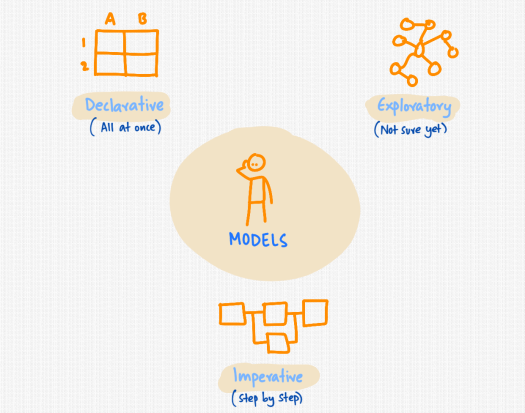
For example, many models you pick up are in the form of a 2×2 matrix.

That’s the kind of thing consultants love – four boxes to choose from and you must fit in one of them.

I was doing a programming course on Coursera and the instructor, Charles Severance, said that CSS is a declarative language – everything happens at once.

CSS, as you probably know, is the language that makes websites look good.

You write down rules about how big text should be, what font, what colour – all that sort of stuff – and then the page looks the way you want.

It just happens straight away.

Many models are like this – you look at them and they tell you all you need to know at a glance.

Other models are less sure of themselves.

Mind maps, for example, are an exploratory model.

You don’t know where you’re going with them, you just start and see where you end up.

And then there are models that tell you what to do step by step.

In programming jargon these are imperative models – they have sequences of steps that you follow.

Something like a business process or a habit.

Ok, so this is just one way of looking at models. Why does it matter?

It matters because much of how we think is still based on 1960s thinking.

Back then the engineers and economists were in charge and we thought our job was to take rational action to achieve goals.

We realised that we couldn’t know everything and take the perfect or optimal decision but we could select from alternatives and decide something that worked for us – satisficed us, in the jargon.

Many of the models we see also flow out of that mode of thinking – a positivist one.

Alternatives to positivism are interpretive approaches – ones that are only a couple of decades younger are less sure of themselves.

They see the world as created from the thoughts people have.

Not the physical world – but the social world.

The one that includes all of us.

Now one of the problems with learning that there are different ways of thinking is that one starts to look at things from one’s preferred point of view.

If you have been successful setting and meeting goals then you might wonder what I’m on about.

If you’ve been frustrated when people say one thing and act another way – speaking as if there is a plan and acting as if they’re driven by emotion and feeling – then you might be willing to give this interpretive approach a try.

But, as you might see from the nature of this post that can be confusing.

With one approach you and I can be gloriously detached from the ideas we look at.

The models we inspect sit alone and perfect – independent and proud.

With the other approach the models are one way someone else approached a problem in a different time with different people in a different situation.

There may be similarities but the differences are probably more than you think.

Some of the models might be based only on thoughts – ideas that people have had.

Like the way Plato used to work.

Others may have been tested using scientific methods suitable for testing how fast balls of different sizes drop but totally inappropriate for how people think and act.

Now, taking a step back, if you’ve made it this far you’re wondering what the heck is going on.

This post is a mix of arcane Linux stuff, arguments about thoughts that are 60 years old versus ones that are only 50 and unexplained programming metaphors.

So the one thing that you should take away is this.

Every model in this site and all the others you see don’t exist outside of the human mind.

And so, how you think about them matters.

Not me, not the creator, not anyone else.

But you.

Because although the model is generic you and your situation are unique – and that requires an approach that is designed around you and how you think.

And the kind of things I’d like to explore next is how to do that step by step.

Cheers,

Karthik Suresh

How Do You React To Questions Or Suggestions?

reactions.png

Sunday, 9.26pm

Sheffield, U.K.

Think twice before you speak, because your words and influence will plant the seed of either success or failure in the mind of another. – Napoleon Hill

There are two ways to deal with the world: scientists try to explain it and artists try to see the value in it.

In other words, scientists try and interpret it while artists try and appreciate it.

But why is that? Is it just natural to look at things that way or is there some reason why artists resist explanations and scientists resist any attempt at being less than completely objective and value free.

These types of questions led David Cooperrider to look again at how organisations functioned and suggest that you could stop thinking in terms of solving problems and more in terms of appreciating mysteries – something he called Appreciative Inquiry.

In other words, stop trying to solve your problem. Instead, appreciate the nature of your situation.

This attempt to reframe the discussion apparently did not go down well.

And one reason for that is the way we react to suggestions – the way in which we react to words.

Before we look at what that means we need to remind ourselves that the things we see in the world didn’t come into existence fully formed and perfect.

Although you now see institutions everywhere – companies, courts and senate halls among them – there was a time when they didn’t exist.

It’s easy to see this if you’ve ever tried to arrange a trip with friends or planned a startup.

The trip or the startup didn’t exist before you started that first conversation with your friends.

The words you spoke to each other, the shared meaning you created and the agreements you made resulted in creating the trip or startup that then emerged.

In essence, the words you spoke had real power – although simply vibrations in air they caused something new to come into existence.

This way of thinking about things is a social constructionist approach – the idea that the world around us is created from the conversations we have.

And that makes the words you say important.

Very important.

This can be hard for someone like me, who believes themselves to be rational and relatively unaffected by the emotional content of words, to appreciate.

But you can see the impact of words every day – probably every time you have a conversation at work or with friends.

Let’s say you want to start a business – a new agency.

There will be people who will be negative about the whole thing. They’ll tell you it’s a bad idea and list all the things that could go wrong, believing that they are being helpful.

Or perhaps you want to marry someone from a different religion.

Your family may simply say No! Not if you want to remain a part of their family.

There are those people who find problems everywhere they look.

They may agree that things should improve, we should take action but here are the reasons why it needs to be thought through or slowed down or checked over.

These are people who like committees – where good ideas go to die.

Then you have people who are both helpful and positive, people who say yes, and give you more suggestions on what you could do and how you could avoid risks.

Some people believe that what needs to happen is that problems need to be solved – we need to find out what’s wrong and what needs to be done to fix things.

The appreciative inquiry approach tries to use a different approach – a positive one that uses questions and stories to look towards a better future.

Although, it isn’t just supposed to be a way to go to your happy place.

Appreciation is about seeing the whole for what it is, warts and all.

Seeing the beauty of what is as well as noticing the cracks that mar its surface – and then taking steps to touch up or improve its appearance.

But the secret is that the way to creating that new future starts not with decisions, resources or actions.

It starts with words.

And it’s limited only by what you agree to do together.

Cheers,

Karthik Suresh

How To Make A Real Difference – For You Or For Society

praxis.png

Saturday, 8.34pm

Sheffield, U.K.

In theory there is no difference between theory and practice. In practice there is. – Yogi Berra

I learned a new word today – praxis.

It has a long history – back to Aristotle, it seems.

Aristotle said the work we do results in theory, produces something or is practical.

The reason they are different has to do with the why question – why do we do each type of work?

What’s the purpose behind each one?

If you study maths, say something like number theory, you do it for the sake of the knowledge itself.

For example, the mathematician Srinivasa Ramanujan once explained that the number 1,729 was a very interesting one.

It’s the smallest number you can get to by adding two cubes in two different ways.

Now – you’d want to know that really only for the sake of knowing it.

Although, number theory turned out to have quite a few applications later on – at the time mathematicians like Ramanujan were interested in it really because it was interesting to them – and that was all there was to it.

They’re the folk, I suppose, that contemplate on top of a mountain, and think their way to truth.

At the foothills, you find another sort of folk – productive ones.

People who work close to the earth – making things.

They use techniques – methods that result in something predictable.

Like pots, or washing machines or asphalt.

But then there’s another sort of person – the type Aristotle calls practical, which sounds quite similar to productive but is not the same thing.

The productive person knows what the end goal is.

The practical person doesn’t.

Instead, they face situations – situations where there is no clear answer, no one true way.

They have to use judgement and thought and feel and the kinds of things that aren’t easily expressed clearly as a theory or as a technique.

One way to think of it is as an oscillation, or more visually, a route march from theory to practice and back again.

For example, you might start a new job in a fast growing company.

Experience the joys and stresses of the early days.

And the predictability, higher income and maddening bureaucracy in later years.

All these are experiences that you get while doing productive work.

But do you know why you feel good or bad?

Why you like your job or hate it?

There are simplistic explanations – like most poople leave bosses, not jobs.

And that what’s going on is institutional discrimination.

But then if you get a chance to actually study the theory – you might be introduced to the concept of modern and post-modern organisations – and that gives you a way to understand your experience and perhaps look at it differently.

Something new happens when you use theory to understand what you’ve experienced.

Or when you try and apply theory to improve the situation you are in.

And in turn, use the experience you get by applying theory to look back and improve the theory itself.

That kind of activity is praxis – the journey between theory and practice – the mixing of the two until there is no start or end, just the journey.

And if you want to make a real difference – especially when it comes to important situations – for you personally or for society as a whole – praxis is the way to go.

There’s a reason why theory for theory’s sake is confined in ivory towers.

And a reason why just focusing on the bottom line or the method or the engineering is not enough to solve complex societal issues.

What we need is practical action informed by theory.

Cheers,

Karthik Suresh

How Are You Going To Learn If There Are No Teachers?

eklavya.png

Friday, 9.17pm

Sheffield, U.K.

Doctor Who: You want weapons? We’re in a library. Books are the best weapon in the world. This room’s the greatest arsenal we could have. Arm yourself! (from Tooth and Claw in Season 2) – Russell T. Davies

There are two things that I’m thinking about today – and they are sort of related.

The first thing has to do with knowledge – where it is, how to get it and who can help you.

And the second is what that help is worth.

The reason for this is that I’d like to find someone who is an expert on a particular research methodology – someone that can help guide me as I try and learn more about it.

The problem is we’d all like to learn from the best in the field- but what if that isn’t possible – you can’t afford them, they’ve retired or moved on?

In such a situation I’m always reminded of a story my grandmother used to tell.

It was about a boy – a poor one who wanted to be an archer.

His name was Eklavya and he wanted to learn from the best teacher in the land – Drona – the one who taught the royal family.

But he was too poor and Drona refused to take him on.

Eklavya was undaunted. He went into the forest and built a clay statue of Drona and practised in front of it – treating the statue as his teacher – as his guru.

And he became good – so good in fact that when Drona and the royal princes came across him practising they realised that he was better than them.

Things didn’t turn out too well for him, but before we get to that…

There is a concept in India called gurudakshina.

Teachers, or gurus, didn’t charge fees for lessons.

Instead, once students had finished learning they gave their teachers a gift – something that showed how they valued what they had received.

A pre-historic pay what you want pricing strategy, if you will.

It was a strong concept back then and Drona, when he realised that Eklavya was going to be better than the princes he tutored, was torn.

Should he be proud of the young archer? Or worried for the future of the kingdom when a poor peasant could be better than the royals?

Eklavya stood before Drona and asked him to ask for anything as gurudakshina – he saw him as his guru even though all he had done was practice in front of a statue.

Drona asked for Eklavya’s right thumb – and the boy severed it and gave it to him – ending his archery dreams.

I did say it didn’t end well…

Now there are more layers of story to this – but for that you need to read the epic.

The point is this – knowledge has no value when it is secret.

If you know something – then until people know what you know they can’t tell if it’s worth anything.

So knowledge is not an asset – not in the sense that you have to control it and use it carefully in case it wears out.

If it’s good people will value it – and value you.

In addition, when you put your knowledge out into the world you lose nothing.

You don’t know less – you haven’t had something stolen from you.

Unless you have a different point of view – one that sees knowledge as a business and something you can make money from.

Which, to be fair, is the foundation of the entire modern education system and the exploding number of courses out there.

Or you could read a book.

The educational business model that looks most appealing, however, is probably one that is closer to the gurudakshina concept.

The online MOOC provider Coursera, for example, lets you audit many courses. You can do the whole course for free – only paying if you want a certificate at the end.

If you’re in the knowledge business – and we all are to some extent – that’s an approach that might be worth adapating and adopting and seeing what that does for you.

Cheers,

Karthik Suresh

How To Tackle Really Big Problems – Like The Future Of Humanity

un-sdg-concepts.png

Thursday, 9.31pm

Sheffield, U.K.

You are either part of the solution or part of the problem. – Eldridge Cleaver

The UN Sustainable Development Goals have been coming up a lot in conversations – so what are they and why should you care about them?

You could start by reading the 2030 Agenda for Sustainable Development, with its 91 clauses and nearly 15,000 words, but what if you want a quick summary?

un-sdg-official.png Source: UN in collaboration with Project Everyone

The graphic above lists 17 goals – a todo list for world leaders to do some really big things and improve the situation on the planet.

Looking at that list, however, do you understand what they’re trying to do?

I struggled a bit – the 17 items seem sort of related and sort of not.

But 17 items is just too many to have in your head and think about.

So I thought it might help to group them and look at them again – which looks like this:

un-sdg-17.png

When you do that, you start to see relationships between the goals.

Some have to do with basic needs – like having money, food and energy.

Others have to do with opportunity – like having an education decent work and being treated the same.

We’d like to live in good societies – peaceful ones, with safe cities and responsible industries.

And we need to look after the planet – to preserve the life on land and sea.

And this results in higher level, simpler view that looks like this:

un-sdg-concepts.png

Writing out the points as a sentence:

We need to work together to meet humanity’s basic needs, enable people to contribute, create decent societies and preserve the planet.

Which, quite frankly, is everyone’s job – not just for world leaders.

So there you go – nearly 15,000 words reduced to 21.

Now you can’t argue that that you don’t know what the plan is to save the world.

So the next question is what are we going to do to help?

Together.

Cheers.

Karthik Suresh

Solving Problems Versus Improving Situations

wicked-problems.png

Wednesday, 5.10pm

Sheffield, U.K.

For every complex problem there is an answer that is clear, simple, and wrong. – H. L. Mencken

One of the things about real-world problems is that there is often no way of knowing if you are solving them or making things worse.

A lot of people talk about problems being wicked.

That sounds good – better than complex or difficult – wicked is more about messy, complicated uncertain situations.

But it isn’t clear – what is it that makes a problem wicked?

If you want an academic discussion you might like Guy Peter’s analysis here but I was wondering if we could pick out a few types of problems to consider and see if they might be called wicked.

The effects of feedback

The first type is one that you’ll see quite often, once you’re aware of what’s going on.

For example, you need to invest in sales and marketing to grow your business.

In many businesses that’s not something that will result in immediate sales.

What it does is raise costs straight away.

Increased costs mean profits go down.

The powers that be order costs to be cut which then results in a reduction in the sales and marketing budget.

This process ends up going from left to right and back again, linking two activities that cannot be done at the same time – investing in sales and marketing and cutting sales and marketing costs.

So what this does is set up an underlying tension in the business – an oscillation as the business bounces from investment to cost-cutting and back again – with no real solution or continuity.

Incompatible objectives

When you go to an elite university you will have a choice: social life, sports and grades.

Pick any two.

You can stay out all night partying and do last minute cramming, ending up with great memories and a good degree but you’re not going to get out to the playing field early every morning as well.

If you’re training hard the alcohol, fast food and indulgences are out.

It’s gym and the books for you.

The thing is you can do any two well – but if you try and do all three you’ll probably fail at all of them, or at least not do very well.

And this kind of thing carries on.

Time, cost and quality, for example.

If you increase or decrease one you’ll normally affect the others/

If you increase quality, you’ll probably spend more in time and money.

If you cut costs, quality is going to be affected.

These objectives cannot all be met – and that means when you work on one you’ll affect the others – and not in a good way.

Irreconcilable differences

This comes down to people – how they think and how they act.

There are so many situations where the differences are so big that there seems no possible way to reconcile them.

Take every conflict situation out there, between ideologies such as capitalism and communism, between religious views, conflicting opinions on everything from co-sleeping to gay marriage – there are people for and against who will never see things from another person’s point of view.

Tragedy of the commons

And then you have situations where although we should collectively act in one way the incentives are such that we make things worse by acting selfishly.

For example, if you farmed along with other people on common land, ideally you would make sure that everyone’s animals could feed.

For you, however, the more you feed your stock the more you benefit.

For many of us the way we live – the amount of packaging we use, the number of times we replace clothes, the amount of food we throw away – is unsustainable.

We know that – but we do it anyway.

It’s not evil – maybe it’s selfish but that’s the way things are.

What can we do about wicked problems?

For a start, we need to stop thinking about finding solutions.

There isn’t going to be a point where we can step back and say we’re done.

Maybe it’s thinking about things being dynamic rather than static.

It’s hard to spin a ball on your finger and keep it spinning – but maybe that’s the image to keep in mind.

You’re trying to reach a compromise, an accommodation, an improvement, something people can live with.

All weak sounding words – much less appealing than solving, winning, resolving.

But more realistic and achievable in the real world.

Something that keeps everything still spinning.

Cheers,

Karthik Suresh

How Should You Judge Yourself At Any Point In Time?

river.png

Tuesday 8.20pm

Sheffield, U.K.

Time is an enormous, long river, and I’m standing in it, just as you’re standing in it. My elders are the tributaries, and everything they thought and every struggle they went through and everything they gave their lives to, and every song they created, and every poem that they laid down flows down to me… – Utah Phillips

Have you ever wondered, as the years slip by, if you are doing well?

Doing well compared to others, compared to the dreams you had, or where you feel you should be at this point in your life?

If you were a river, how wide should you be right now?

Let’s imagine someone who knew from the beginning they wanted to be rich – and they had a number in mind – a big one.

What happens once they reach that number?

Do they stop and start doing something else – horticulture, perhaps?

Or do they set a new, higher number and go after that?

Is chasing a number a good way to live?

Most of us don’t really know – because we haven’t hit those kinds of numbers.

We are where we area right now.

And we’ll be doing better than some and worse than some.

But, if you’re reading this, the chances are that you’re one of the luckier people out there.

But that should cause you to wonder how you got there.

We like to think we start with nothing – we’re a tiny trickle, a barely visible stream at the start of a journey.

And, over time, we are joined by tributaries – the waters that help us grow – waters carrying education, careers, partners, children.

If we look at where we once were, we might be pleased to see the extra bulk we’re carrying around.

Or we might wonder whether life was simpler as a small stream rather than this unstoppable dash for the sea.

Or maybe we count up the tributaries so far and wonder how many more will join us before we reach the end.

There are two things to notice here.

One is that we don’t wake up one day and find that we’ve turned from a stream into a river.

It takes time and distance.

The second is that what builds us is not what we started with but what new tributaries we add.

And that’s why standing in one place and looking at what you are is perhaps not the best thing to do.

A better thing might be to be grateful – grateful to the people who put you where you are – if you were lucky enough to have parents and grandparents or carers who, by the way they lived their lives, enabled you to live yours.

Or maybe you did start entirely on your own – and have clawed and fought your way to where you are.

Then you should probably look forward – and do the things that need to be done.

It seems to me that if you look back – you should look with gratitude.

If you look forward – you should look with hope.

But wherever you are – whether at the start or the end, whether little or large, you should judge yourself kindly.

And count yourself lucky to be here.

Cheers,

Karthik Suresh