Stop Looking For Systems To Solve Your Problems

2025-12-19_ontology.png

I avoid thinking about words like “ontology” and “epistemology” – unless I have to.

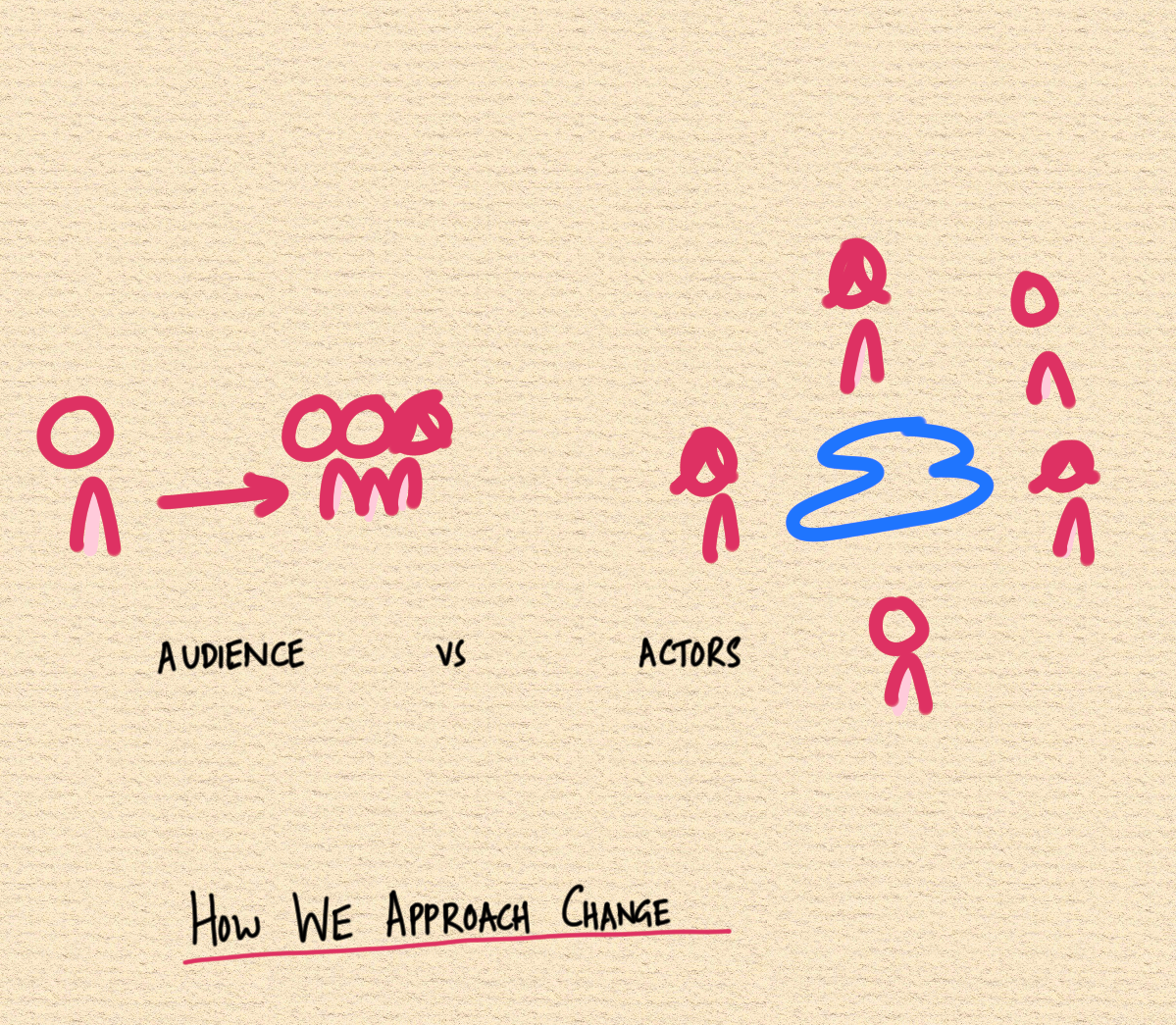
A recent paper argues that work by Churchman on the philosophy behind inquiring systems, practically applied by Checkland in soft inquiry suggests at “ontological models of organisational behaviour were inappropriate”, and only an epistemological perspective provides a “basis for understanding complex systems that characterise human society” (Stowell, 2024).

Wait, what?

A lot of people suggest that ontology – classification and explanation – sits at the top of a hierarchy. Get the ontology right and you’ve done the important work.

This is a critical component of AI – it’s the idea that the knowledge base or scaffolding that goes into an LLM gives you “truth”. It’s the structure that holds knowledge, that shows it in relation to other knowledge.

The implication is get the structure of the system right and you’ve solved the problem.

Take my field for example, carbon reporting. There are thousands of systems that help you organise and classify information.

Then why are so many people frustrated when they actually use these systems? Why do so many end up going back to spreadsheets?

It’s because there isn’t a single accepted model of knowledge when it comes to decarbonisation. The GHG protocol is a framework, a starting point. A tobacco company is going to have a different situation to a clean tech firm. When you actually work with a firm you quickly discover peculiarities, edge cases, complexities that don’t fit neatly into the system’s ontology.

And systems aren’t famous for being flexible. We learned from trying to use ERP software that it’s easier to change your business to fit a system than the other way around.

Here’s the takeaway.

Stop looking for a system to solve your problem.

Instead, think about what you want to know about your business and how you want it to change.

Then design and build a system that wraps around your business and helps you get that done.

Reduce Interruptions To Avoid Getting Stuck

2025-12-18_interruptions.png

Do you think having real-time information is more helpful than getting a single end of day report?

When I was studying computer systems they taught us about why computers hang – you know when everything just stops working.

This happens when you’ve got too many things open. Run enough processes, open enough windows, ask the computer to do too much – and it will freeze.

This is because computers do one thing at a time but switch between them quickly.

So, the computer switches to a task, loads everything into memory, and then runs out of time, so it stops, and loads the next thing in. And it keeps doing this – loading in information but never actually having the time to process it – so nothing gets done.

The way to solve this is by reducing the number of interrupts. Close things down. Reduce how much switching you need to do.

We don’t get letters through the post much, but it’s the difference between getting the post and checking your phone. You are on your phone constantly – but nothing really happens of much value. The post comes once a day, and you deal with it then – leaving the rest of the time free to focus on work.

Monitoring something like your carbon numbers once a day, for example, is enough to give you a sense of where you are and if you’re on track or need to do more.

The solution to overwhelm, is to do less – preferably one thing at a time.

Why Getting Stuck Is A Good Thing

2025-12-17_stuck.png

Getting stuck is a necessary precondition for progress.

One of my favourite books is Robert Pirsig’s “Zen and the art of motorcycle maintenance.”

For an engineer, the test of something is “does it work?”

And an essential part of making something work is first getting stuck.

I’m reminded of Pirsig’s words every time I come across a problematic screw or bolt.

Nothing stops you in your tracks more effectively than being unable to get at the thing you want to fix.

Our christmas lights broke recently. The transformer that powers them seems to come in a solid block. There appears to be no way to get into it to repair it.

That sort of block in everyday organisational life can paralyse people. We just can’t get things done becuse of the other things that are in the way.

One way to try and solve such problems is to start writing things down.

This rather simple activity is at the heart of the research I’m writing up for my PhD – how listening to people and taking notes can help us understand situations and come up with plans of action to improve them.

It’s essentially the scientific method.

If you’re stuck – if something isn’t working, if a tool you’ve bought or a process you’ve implemented isn’t working the way you hoped, it’s easy to get frustrated and discouraged.

But really, it’s a learning opportunity. Getting stuck shows you there’s a problem. Working on getting unstuck helps you come up with a solution.

This is the way we’ve built every service line that’s added value over the last 20 years.

Why You Should Call On A Braintrust

2025-12-16_braintrust.png

We make poor decisions under pressure, especially if we’re making them on our own.

The solution is to be able to call on a braintrust.

I’ve been skimming through Ed Catmull’s “Creativity Inc.”, a memoir about the culture at Pixar.

In the movie business directors and producers commonly get feedback in the form of extensive written notes.

At Pixar they did things differently, pulling experienced people into a room to give feedback on the product they were working on.

With candour.

Many organisations operate in a command and control mindset, where orders are given and expected to be followed – a way of operating that comes from military metaphors of structure.

This discourages feedback.

But if you get a group of smart, opinionated people to give you fearless feedback on where things are, you’ll learn more and make the product better.

But you have to get the right culture in place, one that permits openness and honesty rather than penalizing it.

This doesn’t come naturally and Catmull talks about ideally having a facilitator – someone that can help a group stay on track and talk through these issues in a constructive manner.

It’s not the easiest thing to do as anyone who has sat through a bad meeting will remember.

So, if you’re struggling with getting your teams aligned, maybe it’s time to look at how you can have better conversations.

A good place to start is by reading about problem structuring methods or PSMs.

Let me know if you have any other good resources or examples.

Question Everything In The Pursuit Of The Truth


How can we build better businesses?

The only way to be create change is by asking difficult questions.

This is hard to do when you’re inside an institution.

Stafford Beer wrote that when the Emperor asks for dumplings, you give him dumplings.

When someone in a position of power asks you to do something, however foolish, you can do it. Or you can quit.

If you’re going to question powerful people it’s sometimes easier for them to remove you than answer them.

But in the long term, such actions result in weaker institutions and eventual decline.

That’s why wise leaders need people around them that are willing to speak truth to power.

If you want to build better businesses you have to be willing to question the taken-for-granted ways of doing things now.

You also have to question the products and strategies that are proposed to you to improve the situation.

That’s the Socratic method – assume nothing, and question everything in the pursuit of the truth.

It’s a risky strategy. The famous painting of Socrates shows him still challenging opinions while reaching out for the glass of hemlock that’s going to kill him.

But that’s the only way we can make things better – by putting our thinking to the test.

With AI Your Job Depends On How You Validate What’s It Produces

2025-12-12_wrong.png

If you’ve ever presented to a decision maker you know what happens if they spot something’s off.

If one thing is wrong, the whole thing is wrong.

Go back and check it again.

I’ve recently been on the giving and receiving end of AI generated material.

For example, I ran some company reports through a couple of tools I’d built.

These tools used different approaches to analyse the content of a document and give me a report.

Both reports had issues, things that I could spot immediately.

I now had two choices – take the report to someone else and point out that there were some errors.

Or review the source information, and cross check what had been produced?

What would you do?

Well, when I was given information that was wrong recently – or more accurately – clearly hadn’t been reviewed, I didn’t go ahead with the deal.

I think we need to figure out where AI sits in workflows – and I’m starting to believe it’s not a solution.

It’s not something that’s going to replace all your people – although you might stop hiring for certain roles.

It’s a tool.

What you produce is better or worse depending on how you use it, and how much you put into validating what comes out of it.

You Can’t Move A Big Rock With A Small Lever

2025-12-11_levers.png

Why is it hard to get decarbonization projects away?

The main issue, as far as I can see, comes down to big rocks and small levers.

Regulators want us to understand what risks and opportunties affect our businesses, and work out mitigation pathways.

This isn’t new, especially to Operations Researchers. We’ve had the tools to model alternatives, outcomes and preferences to support decision makers for decades.

What stops us from taking action is that most models don’t capture all the variables that matter.

Let’s take one of the biggest issues. Getting capital.

You run a company and if you invest in machinery you get your money back in 2 years – a 2-year payback.

So it seems rational to ask that every project you approve has a 2-year payback or less – or a better use of money is to invest in your core business.

Almost every energy saving project has a 5-year payback. So it doesn’t clear that hurdle.

One way of solving this is for an energy services company to finance the project and have savings pay for the capital – a no brainer you would think – except there are balance sheet implications and long-term obligations. So that’s complicated.

Plus – define savings. You’ll have to bring in a financial engineer.

Oh and by the way – that payback equation – it’s bad maths. You need to look at NPV to work out if it’s worth investing or not really.

In the last 10 years the one technology that’s flown off the shelves is LED lighting. It’s met the two-year payback requirement but do you know what really sealed the deal?

It made products look good. I remember a bathroom supplier telling me that it made their stuff sparkle. Get your product to boost sales and the pitch is much easier.

Getting projects away is not about modelling and optimization. It’s about attitudes, beliefs, values, forecasts, preferences, risks and most of all, leverage.

Making a plan is the easy bit.

Getting a big enough lever to move huge rocks requires a bit more preparation and thinking.

Develop The Art Of Talking About The Important

2025-12-10_importance.png

Selection is the art of picking out the important stuff.

I’ve been thinking about this as I read papers on deliberative processes – how we talk in small groups to take action.

Many of us have to have complex conversations – about strategy, sustainability, resilience, value, impact, and a myriad other topics.

But it’s difficult to hold more than a few ideas in working memory at one time.

As a result, we’re easily biased, swayed by what we’ve heard most recently, the thing we reacted to most viscerally, the image that comes to mind most easily.

The way we talk about complex things matters. The methods and procedures we use to manage discussions will lead to better or worse decisions.

One way to think about this is using the input-throughput-output framework from Gastil et. al, (2012).

Input is the raw stuff – the people and ideas you have to bring together to be able to understand a situation.

In our business, sustainability reporting, that’s involving diverse stakeholders, finding data sources, understanding strategies.

Throughput is about engaging with the stuff. How do we work with what’s there? How do we do this efficiently and cost-effectively. We want to work out the best way to work with the complexity of a given situation.

That might be interviews, working out process flows, constructing automations.

And then there’s output. Surfacing the important stuff. The ideas that matter. Analysis that helps support discussions. Conclusions that lead to action.

You can use the ITO model in many situations. Yesterday I was listening to a panel about circular economy principles in construction, and the same ideas came up. We need to reduce inputs – lowering the need for materials at the start of the construction process. We want to maximise throughput – keeping elements that have been made in service for as long as possible. And we want to close output, recovering materials and reusing them as much as possible.

But can you just imagine how complex the discussions are going to be to make this kind of process work?

My prediction: regardless of what’s happening with AI the ability to have good conversations – high quality deliberative processes – will still matter in 2026.

Strategies Must Be Dynamic to Succeed

2025-12-09_targets.png

All we have to do to succeed is set a goal and head towards it. If only it were that simple.

Anyone with any experience knows that we always start at point A – a place that we’ve arrived at with a history.

Things have happened. They can’t be changed – but the decisions we took and the stories we told ourselves brought us here.

Now the task is to get to B – and there are multiple ways to get there – endless possibilities.

For example, we know that we need to live sustainbly, to use resources in a way that means future generations can also live.

But the solutions aren’t simple. Can we innovate our way to zero carbon materials and living? Can we keep living the way we do and suck carbon out of the air? Do we have to voluntarily use less? Will we be forced to use less because prices will go up?

The end point, B, is not static. It’s a moving target, buffeted by changing politics, values and economics.

Our strategies, therefore, can not be static. We have to tack our way towards B, making improvements and adjustments as we go along, responding and reacting to the environment.

The good news is that we naturally seem to want to make things better. No one sits down to design a worse and more inefficient solution.

The bad news is that we’re going to be uneasy and unhappy about the rate of change and the extent to which we’re progressing. Which is not fast enough.

If we’re too comfortable, that’s a warning sign that we’re getting complacent.

We have to see the possibilities for a better future, otherwise why act at all?

The takeaway: for strategy to be useful it must be dynamic and responsive.

Because things will change along the way.

How Will You React To The Rising AI Tide?

2025-12-06_competence.png

If you aren’t willing to look at the world from a different angle, it will change around you before you realize it.

Jordan Peterson argued that the world had moved from a dominance hierarchy – the big and strong win – to a competence hierarchy.

Competence is built over time, so as long as you practice something you will get better as you get older.

But what does practice look like when you don’t need to do parts of the work?

Take music, for example. You could learn to play the guitar, which is hard and tiresome work. You could use a tool like Garage Band, and press buttons to make music. Or you could go all geeky and synthesize it with code generators.

What matters is that you pick a method and use it to create better music.

In a work context, we’ve used flash reports – a one page summary of progress – for 20 years.

I saw a post recently by someone that used Google’s Nano Banana to create a very pretty, beautifully laid out flash report. At first glance, it’s really good.

But is it useful?

The point of a flash report is that it communicates important information quickly and easily.

That artifact in itself is a collection of pixels – the user has to make it useful by embedding it in a repeatable workflow.

The options are to use it as a template for a PowerPoint that is edited manually. It’s a little more of a stretch to create an automated workflow that takes notes information or instructions and creates a finished report. You need skills to do that, and a human in the loop to check the output.

Things get more complex as you try and make something that looks good actually work in practice.

When you’re faced with rising waters, the sensible thing is not to waste time protesting that about the nature and speed and levels and use and abuse of the water.

It’s more useful to build a boat.

What’s your boat for the way in which AI is washing over your industry?