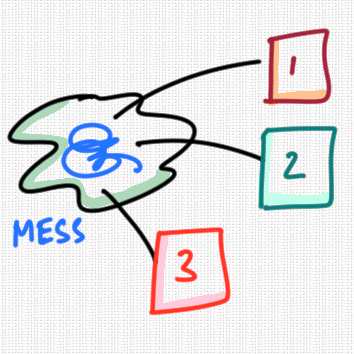
Why We Need To Get Better At Explaining Ourselves

Success depends less on the structure you create than the story you tell.

When you’re working in a company does it often feel like the structure is working against you rather than for you?

I’ve been reading Jackson and Carter’s “Rethinking organisational behaviour: A poststructuralist framework” and think it has useful insights to sustainability managers – well, all managers in general.

It starts by getting clear on what we mean by structure.

There are three versions of structure.

First, there is structral functionalism.

This view is that structure is visible, most clearly in the org chart.

You change things by getting the right structure. If things aren’t working, then restructure.

This is a dominant view – many people think it’s the “natural” way to think about organisations.

But – does it work? If you look at your organisation do you see visible structure getting results?

If not, we turn to structuralism for an explanation.

Structuralism says that it’s the stuff under the surface that drives behaviour – that which you don’t see but exists.

This is the underlying logic – the relationships and dynamics between leaders and teams that result in one thing or the other.

What makes a difference is the less visible stuff – power relations, inequalities, differing levels of freedom to act.

And then we have the third view – poststructuralism.

The first two approaches suggest that structure is a real thing and exists – either above the surface or below – but it’s there.

Poststructuralism says that structure is constructed – from the way we explain things.

Explanation is the key – it helps us make sense of what is going on.

That explanation is the structure, not real and objective but a product of the human mind.

If you’ve read this far and are wondering why this matters, this is why I think it’s important.

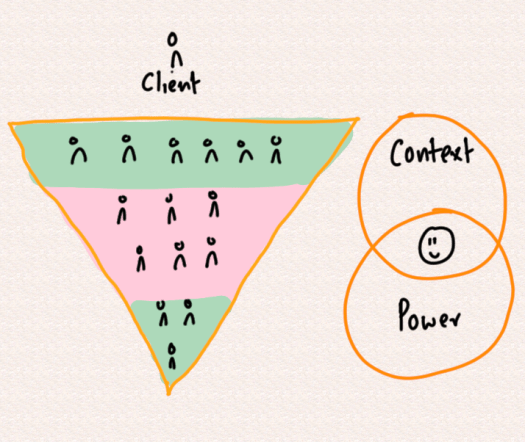
If the poststructralism view is right, then success depends not on the structure you create but the story you tell.

I’m sure you’ve heard of the famous Amazon process where people are asked to write a plan rather than use PowerPoint.

This could be seen as an implementation of poststructuralism – tell me a story – get your thinking down on paper and explain what you want to do and why it’s going to help.

Help me make sense of what is going on, so I can decide what to do next.

Becoming A Cynical Optimist

2026-02-14_wait.png

Cynical optimism – that’s what’s needed right now.

This is the term Jim Swanson, the CIO of J&J, used about the need for AI to shift from vision to execution.

I think we’re at the same point in the sustainability sector.

For the last ten years, we’ve talked to clients about a 3-year ready-set-go strategy.

Year 1. Get ready, collect data and understand your baseline. Year 2. Set goals, allocate resources. Year 3. Start running.

In 2024, we realized we were running towards a cliff edge created by near-term goals.

If you’re familiar with the history of the space you’ll know that these are complicated decisions to make.

In an ideal world, we’d use more renewables, cut down on personal consumption and move to more sustainable alternatives.

In the real world, fossil fuel company shares soared after the Russian invasion of Ukraine, COVID increased consumption with home shopping, and countries are rolling back on sustainability policies – worrying more about geopolitics and trade.

2030 seemed a long way away in 2012, but it’s now much closer. If you’re operating a large industrial or commercial firm, the road ahead is hard to see.

The advisory firms get this. Many are already suggesting that it’s time to look at interim targets and test if they’re still achievable.

A good question to ask – leaning into the cynical optimist approach – is knowing what you now know what would you do differently when it comes to setting goals and allocating resources?

How would you execute now?

Maybe it’s time for a refreshed plan.

Financial Metrics In Project Assessment

2026-02-13_investment-evaluation.png

Is this worth doing or not?

Understanding financial metrics used for investment decision making become more important as we try to turn plans into action.

I thought I’d do a quick dive into the methods out there and came across a useful paper by Delapedra-Silva et. al. (2022).

Many businesses use simple or discounted payback as a way to evaluate an investment.

It’s an easy one to calculate – how many years before you get your initial investment back. And that’s why it’s very popular in businesses.

But it doesn’t take the lifetime of returns into account. What if you keep getting a return well after the initial payback period?

That’s where Net Present Value comes in. The value of an investment is the total of the discounted cashflows you get.

So a business in the stockmarket is valued on the basis of what the market thinks it’s going to make in the future.

And then you have the Internal Rate of Return (IRR), which is the discount rate that sets NPV to zero.

If the IRR is 10%, you can compare that to alternative investments, like a bond – and make a call on whether the difference is enough to make up for the risk.

These three are fairly traditional approaches, along with the return on investment (ROI), which is the percentage return you get – the inverse of payback.

These approaches work great in regular businesses but they struggle to make the case for long-lived assets like energy projects – renewables or large scale replacements and refurbishments.

A more useful metric is the levelized cost of energy – the lifetime costs associated with producing energy over the the actual energy produced.

This value, in say pence per kilowatt hour can be compared with the market price to see if you’re going to save money or not.

A closely related metric is the energy ROI, which is the total energy you need over the energy produced – although this isn’t that common.

But even these methods don’t account for the full complexity of the decision.

In the real world, you’ve got to think about timing and flexibility – what happens if you do a project earlier or later, or what happens if the market moves one way or another.

This is where Real Options Analysis comes in, where you start with the NPV, and then layer in the additional value from different kinds of flexibility and uncertainty associated with the operation of a particular project.

All this might seem complicated but it’s more straightforward than it looks – really.

And the biggest benefit comes from thinking this through with your team.

REFERENCES

Delapedra-Silva, V., Ferreira, P., Cunha, J., Kimura, H., 2022. Methods for Financial Assessment of Renewable Energy Projects: A Review. Processes 10, 184.

Making The Sustainable Path The Obvious One

2026-02-12_act-wait.png

“What if everyone did this?”

You already know the golden rule. The platinum rule says treat others like they want to be treated.

Useful rules, but not enough to address big questions like how do we make our organisations more sustainable?

Taking action disrupts the status quo. It introduces risk and uncertainty – and the possibility of loss. It seems safer to stick with what we’re doing now.

Change has to be worth changing for.

That’s why policy is so important. Leaders who shape the rules of the game ask “what if everyone did this?”

They create incentives that help organisations choose action over inertia.

But the rules aren’t clear right now. Many companies we speak to feel stuck – wanting to take action but finding it difficult to make a business case and get the resources and support they need.

If we want to build more sustainable companies – we’re going to have to do more to make the sustainable path the obvious one.

The Economics Of Knowledge Work

2026-02-10_saas-llm.png

I keep seeing that AI has a cost problem: SaaS is expensive to build but cheap to scale; LLMs start cheap but costs go up as you grow and use them more.

I’m not convinced by this argument.

Say I’ve got to come up with an economic forecast.

There are a few ways I could do this.

Subscribe to a Bloomberg terminal for 30k that has all the data and analysis I need.

Hire someone to read and summarise material for maybe 100-400 a day.

Or run some PDFs through an LLM as a starting point for 20p.

You still need quality control so the real cost of an LLM is compute + review time costs.

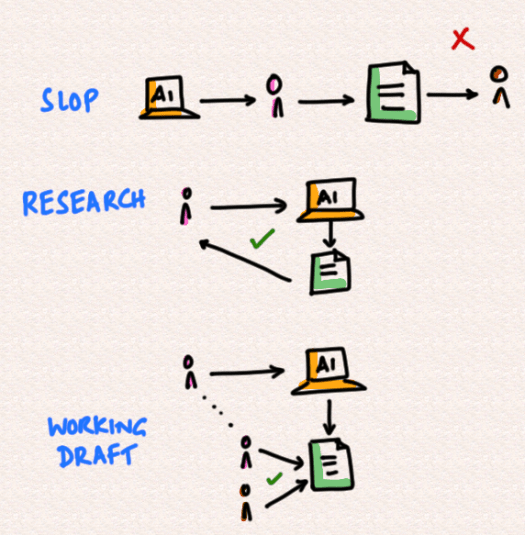
But LLM + time is cheaper and possibly higher quality than time alone if you use the tools well.

What this means for me is that when I come across a business problem my first question is:

“Can an LLM help me do this better or faster?”

Before reaching for more expensive options.

Because the economics of how we deliver knowledge work are changing – and we’ve got to figure out where human judgement and input adds the most value.

The RADA Loop – Why Reporting Is Helpful

2026-02-09_reporting-action.png

This is the time of year when I’m looking at numbers and prepping reports.

And every so often I’ll see someone say that reporting is a waste of time. Stop doing it.

We’ve been managing reporting for the UK’s Streamlined Energy and Carbon Reporting (SECR) since 2019, and before that set up a trading desk for the Carbon Reduction Commitment (CRC) scheme – so been in the game for a while.

And now we have some data.

An evaluation by the government has found that “there is evidence to suggest that SECR has led to reductions in energy use and GHG emissions from organisations in scope of the regulations”.

There are more details in the report but what I want to focus on is the RADA loop – something we see in practice.

Reporting is a necessary first step. Gather data, build an evidence base, and publish findings.

Doing this gets attention – from internal and external stakeholders. Putting any statement out there needs input and approval from stakeholders across the organisation.

But how do they interact? They’re pulled into discussions, into conversations. Working groups are set up to talk about what this means now and in the future.

And that leads to action. Everything from, this isn’t important so we’re going to do the minimum to this is an existential issue and we have to get the positioning right.

And the actions then flow back into reporting, where we can monitor what’s going on.

In a decade of doing this, we’ve seen teams grow from small starts to making big impacts. Careers have developed. We’ve gone forward and back. But corporates are making a real difference – and that should be recognized.

We’re not going to solve climate change in a year. But we will make a difference if we use the decades wisely.

What I Want To See From AI

2026-02-06_data.png

I started watching an AI demo yesterday that promised to show me how to build tools insanely fast.

I switched off after a few minutes.

For one simple reason – it skipped over the real work.

The demo assumed data was readily available – clean, structured, and good to use.

But when you build real world applications, getting the data is the hard part – that’s what takes the time.

It’s easy to analyse clean and tidy datasets.

It’s much harder dealing with a mess of files, formats, layouts and data entry styles.

There used to be a saying about graphical user interfaces. They make it simple to do simple things, and impossible to do complex things.

I’m seeing a similar thing with AI. We’re presenting simple things like dashboards and charts like they’re breakthrough technologies, when they’ve actually been around for ages.

The demos I want to see are different.

Show me AI working with messy data and helping with the practical problems organisations face every day.

That’s when AI use stops being theatre and starts to create real value.

Service As A Software – A New Way To Think About SaaS

2026-02-05_new-saas.png

Most companies don’t need new software. They need to get better at using what they already have.

I’ve seen this called “Service as a Software”, rather than the traditional SaaS phrasing.

Traditional development is based on building solutions to client problems. But developers are often separated from where the work is being done.

But if you actually go and spend time with the people doing the work, or try doing it yourself, you’ll find that it’s less about a solution and more about improving what they’re doing already.

For example, I’m willing to bet that any potential client of ours has some kind of carbon reporting system in place.

It’s probably built using spreadsheets. It was probably made in-house or by a consultant. It probably takes a long time to collect and enter data. And it probably has broken formulas. And it’s probably stressing people out as they try and get their reports out.

A solution oriented approach says – let’s get rid of all that. Here’s some software that we’re hosting – put everything there and it will be fine.

There is an alternative approach – an inquiry-led one.

This is where we go and look at what’s being done now, talk through the situation, and see how we can improve it – make things better.

Every single one of the issues I’ve listed can be solved using tools you already have, and the whole process can be improved with simple processes.

Why not wrap these processes in software and offer them as part of your service to clients?

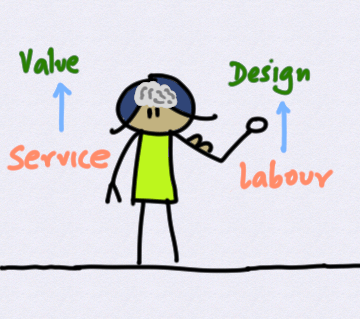
That’s Service as a Software. The service comes first, because that’s what matters to clients. The software is implementation, but the service delivers the impact.

And that makes the difference between services that make people’s lives easier and platforms that just give them more work to do.

The Shape Of Organizations To Come

2026-02-04_future-organisations.png

AI is changing the shape of how organisations are staffed.

The traditional shape is a pyramid.

Leaders at the top. Their reports below. A hierarchy of workers making up a growing base.

But AI is (maybe) decoupling time from output. You can produce the same or more without adding people.

That turns a pyramid into more of an obelisk.

Few leaders. And a slimmer working core.

Then you have the point.

Newer firms don’t need to hire to grow in the way they did a decade ago. They may stay small, a few core contributors delivering outsize value.

The one that people are worried about is the diamond, where you still have leaders at the top and an experienced middle, but the base tapers to a point.

Companies stop hiring junior talent, or hire fewer juniors – expecting AI to take over these jobs.

It’s early days. I think we can see the obelisk and point shaped organisations springing up around us. The diamond – less sure about that. But we’ll see what happens over time.

Are there any other shapes you’ve come across?

Four Green Houses. One Red Hotel

2026-02-03_world-monopoly.png

The answer to what’s going on with real-world geopolitics is in a game of monopoly I played with my son.

He is fiercely competitive. In this game, he landed on a property that I wanted.

Rather than just letting me buy it, he forced a bidding war, driving the price higher.

I had money. I could have kept bidding. But I bailed out, thinking it wasn’t worth the price.

And that was a mistake.

From that point, I was going to lose the game.

The key to monopoly is four green houses equals one red hotel.

Where are the properties that matter on the world board?

It’s where the resources are, and the ones that matter are the rare earths and critical minerals that underpin today’s technology.

These are the properties where prospective hoteliers need to get a foothold and start building their green houses.

It’s where the conflict is happening – armed conflict, and the threats of conflict.

The three big players in the game are the U.S, the E.U and China.

It’s coming down to how much they’re willing to spend and do to get control of these properties.

How they play the game will shape the economic machine for decades – and dictate the balance of global power.

This is not the time to blink, or bail out of the game.