
Sunday, 8.59pm
Sheffield, U.K.
You don’t lead by pointing and telling people some place to go. You lead by going to that place and making a case. – Ken Kesey
I’m going to have to focus on my thesis now for a bit – I need to make some progress there.
So please bear with me while I work through some stuff that may or may not be of interest.
My area of research is called Soft Operations Research, or Soft OR.
OR is a field that uses scientific methods, tools and techniques to solve problems related to how a system is operated and find optimal solutions.
Figuring out how much resource or material needed to get a particular task done efficiently is the kind of problem where you can bring out the OR toolkit.
It works really well when you need to think about how to get things working.
It’s not as effective when you want to get people working.
That’s where the “soft” part of Soft OR comes in – a different set of tools that we can use with people to structure decisions and problems so we can do something about them.
My thesis is about a tool I’ve come up with, called Rich Notes, and I’m trying to figure out how to write about it.
One of the ways of doing this is to discuss its use in practice with case studies.
So what does a soft OR case study look like?
I picked up Peter Checkland and Jim Scholes’ “Soft Systems Methodology in Action” to find out.
SSMA has a number of case studies and is probably a good model to follow.
Chapter 6 has two studies in a product marketing function, and seemed a good starting point for me.
There are two ways you can apply soft systems methodology or SSM. One is to use SSM to do a study, and the other is to do a study that uses SSM.
There is a difference. In the first I say I’m going to use SSM and plan a study that is designed to apply it. In the second I do my work and if I come across a situation where SSM could help, I use it.
The second approach is where a lot of ad-hoc managerial applications happen, for example when I talk to colleagues or long-standing clients.
The former is when I am trying to suggest that I consult with a new client – and propose that I use SSM.
Regardless, I’ve done something. What now, how do I describe it in my thesis in a useful way?
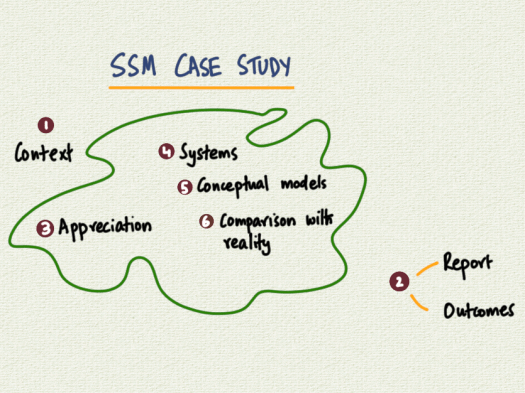
There are six things to consider, as I’ve gleaned from Chapter 6 of SSMA.
First, describe the context – what’s the background, what’s the situation, and how did you enter it?
The thing that people are most curious about is how it all began.
It’s like asking a couple, “How did you meet?”
It’s that context that helps us situate ourselves in the situation.
Second, from an SSM perspective, it’s worth understanding what’s going to be the end result.
Sometimes it’s a report. Sometimes it’s an outcome – some kind of change for the better.
Did you know at the start what sort of end result you were aiming for, or were you making it up as you went along?
Third, how did you gain an appreciation of the situation?
This is the important bit – seeing the situation from the points of view of the people involved.
It’s not about one side of the story but getting multiple perspectives and seeing what’s going on with fresh eyes.
How did you do that?
Then we come to the last three steps, which are a bit more technical.
Fourth, what systems did you conceptualise?
A system is about parts and connections – what are the bits and pieces that make up the situation you’re studying?
Fifth, what conceptual models did you build?
A conceptual model brings the system to life.
This is probably not going to make sense unless you already know a bit about this topic, but think of it like this.
A system is like the parts of a motorbike. The ignition, the gears, the handlebars, the fuel tank, the wheels, the frame, and how they are connected.
And don’t forget, the rider is also part of the system – maybe that’s you.
The conceptual model is how you start and ride the bike.
The first is static. The second is dynamic. Together, they get you going.
Sixth, you compare your models with reality and make changes.
What does your model say should happen, what is really happening, and what needs to be done to make things better?
In your case study, what did you do?
Bring these six pieces together and that’s how to write a soft OR case study. Should be good to fill a few pages.
Now I need to go and do a few of those.
Cheers,
Karthik Suresh
 Handcrafted insight