
Wednesday, 4.13am
Toronto, Canada
Peace is not the absence of conflict but the presence of creative alternatives for responding to conflict – alternatives to passive or aggressive responses, alternatives to violence. – Dorothy Thompson
As I consider the ideas associated with Lean Thinking I am struck by the bias towards a logical and machine-like approach which addresses but doesn’t embrace the complexities of real-world conditions.
I read somewhere that from the eighteenth century onwards the tech bro equivalents were lawyers – human society was becoming more complicated and brute power and hierarchy weren’t enough to manage evolving social dynamics.
The answer was contracting – agreeing between people what they would do – and putting a system in place that would enforce such agreements. Of course, that had been in place earlier. As Terry Pratchett observed, rich people found it was much easier to accumulate wealth and protect their hoard with the point of a pen rather than the point of a sword.
Most situations that have even a whiff of difficulty have social contracts at the heart of them, written or unwritten. The breakdown of an employee-employer relationship, for example, has as much to do with a breach of the implicit contract they have as any overtly agreed contract, which will always be subject to power imbalances.
Conflict is everywhere these days. Many countries are going through instability and pain, and responding with tribal reactions of fear and anger. Human beings cannot remove these instincts from themselves, and the inevitable result is conflict.
Unless we have tools to avoid a situation escalating to that point.
Coincidentally, there is something big taking place in a rather important country and CNN has some advice on conflict resolution, that we can apply to a range of other situations as well.
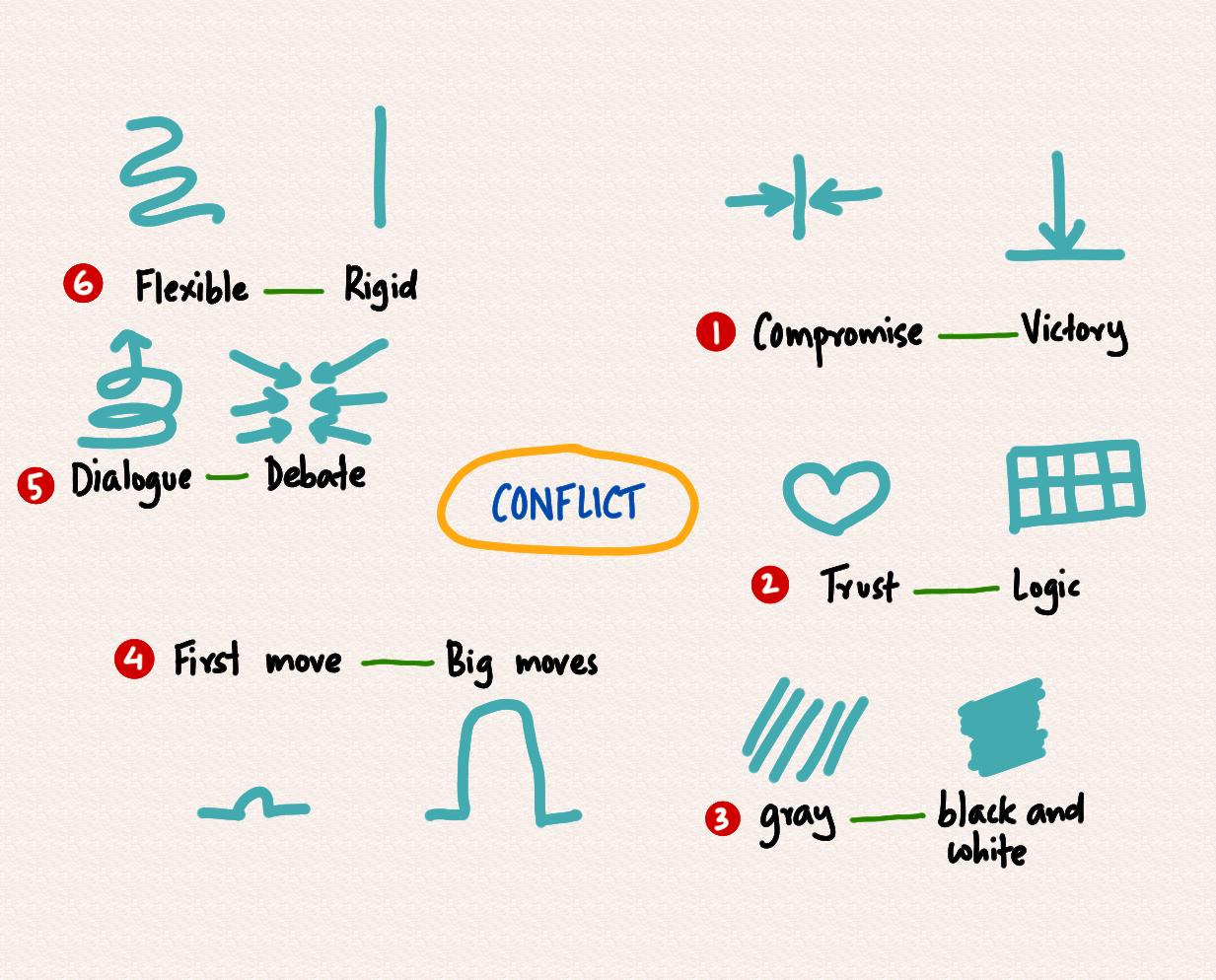
There are six points to consider.
1. Compromise or Victory?
Colin Eden’s SODA method is based on a two poles theory. Each thing you think about can be expressed in terms of two opposites. Articulating them this way helps you to see the range of what’s possible and try and see where you are on that line.
So the first thing you have to consider is whether you want victory rather than compromise. An all out push for victory is going to lead in one direction. All out compromise will lead to another. And there are plenty of examples of both leading to hubris.
The parties involved have to feel out where the situation is between these two extremes.
2. Trust or logic?
The potential for compromise can only exist if there is a chance of building trust. Logic does not work, few people are persuaded by logic. For example, you may subscribe to a philosophy that asserts that it is perfectly acceptable to act as if you are acting in a trustworthy way because the outcome you want is victory, and therefore lying is a logical approach to take if you have to in that situation. Get the other person to trust you and let down their guard and then go ahead and …
In turn, I logically know that regardless of how you act I cannot trust you.
We build trust over time, through conversation and trust-building actions. Again, it’s complicated. Sometimes you can see it in action, as when someone invades someone else’s territory. Sometimes it’s harder to spot, as when someone intrudes on someone else’s turf accidentally on purpose.
3. Gray or black and white?
Nothing is ever simple and clear and black and white.
I don’t need to go on about this, you know that when you look closely at anything it becomes more complicated and confusing.
There’s always something that led to something that led to where you are now.
And tracing it back can unearth generational trauma, passed on time after time.
Either you’re prepared to dig in and understand the layers or you’re not and want to just look at the surface level – and that decision will have an impact on how you approach the situation of conflict.
4. First move or big move?
Few things are better done fast, especially when it comes to important things. Everyone wants to move ahead quickly, and make a big change. But real change grinds slowly and you have to decide what you’re willing to do in the situation.
In the UK, for example, the Liberal Democrats, excited by their status as a junior partner in a Coalition government, naively reneged on their campaign promises and put up tuition fees for students.
A big move.
And they were nearly obliterated as a party when it came to the next election.
They should have stalled on that one – refused to budge without the support of their voting base.
Big moves require big agreement – and that takes time to build through a series of small moves.
The Paris Climate agreement in 2015, was the result of decades of slow, patient work building the science-based argument for action.
5. Dialogue or debate?
This one overlaps with some of the other points – dialogue is about exchanging ideas while debate is about winning, dialogue takes time while debate is about making your points and moving to a vote, dialogue is about consensus building, debate is about gaining power.
Which one do you think will make a situation better?
6. Flexible or rigid?
This one comes down to you and your personality. I’m flexible, perhaps too much so. I have friends who are rigid, perhaps too much so. And the potential for a good compromise is somewhere in the middle.
If I flex too much I will sign up to something that I will be unhappy with in the future, and I have to learn not to do that. If my friend is too rigid then no one will work with them and that’s not good either.
The takeaway
These points are thought-provoking and important and relevant whether you’re running a country or managing a home renovation, running a non-profit or a global business.
When two humans encounter each other there is the potential for conflict.
The fact that we have survived is because we have learned to manage it.
Cheers,
Karthik Suresh
 Handcrafted insight