The History and Foundations of SSM

Sunday, 8.48pm

Sheffield, U.K.

My methodology is not knowing what I’m doing and making that work for me. –Stone Gossard

This is a retake of a talk I did in 2025 at the EURO conference on the history and foundations of Soft Systems Methodology (SSM).

I go into:

  • The origins of SSM in Systems Engineering applied to problems faced by managers
  • SSM as a part of Soft Operations Research (OR), and views of Soft OR.
  • Key books that documented SSM’s development
  • SSM over the years, and the “definitive” version of the methodology
  • Issues and critical views of SSM
  • A summary of how to use OR for problem solving.

The AI transcription of this talk is laughable so I’m going to protect you from that summary.

Cheers,

Karthik

Use Roadblocks To Change Your Behaviour

2026-02-21_diversion.png

Change is really hard.

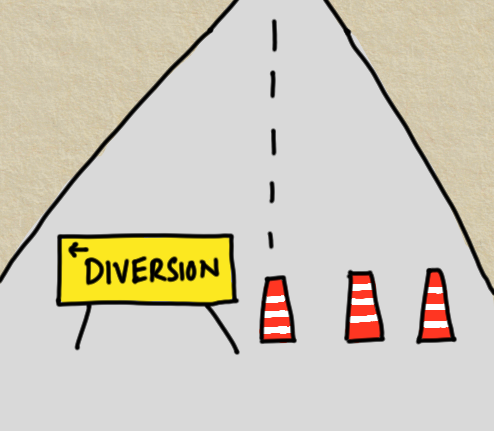
A road I use every day is shut. There are orange cones blocking entry and a big yellow “Diversion” sign.

It’s forced me to look at my options.

I tried a couple of new routes. They worked well.

I might never have tried these roads if my usual route had been open.

The old road is open again now.

And when I saw that muscle memory took over and I headed that way again.

It’s easier to keep doing things the way they’ve always been done.

We change only when we have to.

If you want to sustain new behaviour, put a roadblock in front of the old options.

Constraints Help Creativity

Friday, 10.39am

Sheffield, U.K.

I think frugality drives innovation, just like other constraints do. One of the only ways to get out of a tight box is to invent your way out. — Jeff Bezos

In these first few posts, I’m going to fumble my way around a video making process that works for me.

I’m also trying to figure out a workflow where AI helps and augments what I am doing, rather than being a replacement, or a dull and sanitized average that isn’t worth your time reading.

So here’s my starting approach.

  1. Think about the content and create a through line
  2. Practice saying it aloud and seeing if it works
  3. Record a one-take video of the content. Only re-record if it’s really bad.
  4. Trim and upload to YouTube

Then, it’s how to share the material.

My usual WordPress flow of org2blog doesn’t seem to work well with video, so I’m typing this straight into the WordPress editor.

Now, for AI.

I’m using Whisper to transcribe the text of the talk, and then using llama3.2 locally to create shownotes. I’m going to add these below with minimal editing. Feel free to ignore them, but you might like them more than the video! In which case let me know.

Cheers,

Karthik

AI Generated summary below

Summary: Ideas for Creating Video Content

The speaker aims to create video content focused on explaining ideas and
concepts, rather than entertaining or visually building up an idea. The
key goals are:

  • To focus on the core concept and keep it simple
  • To understand a particular message in detail
  • To stay on one particular idea and maintain a through line throughout
    the explanation

Choosing Topics

  • Select topics that are personal and important to the creator, rather
    than exotic or complex
  • Focus on explaining theory and then applying practical examples
    (practice)

Constraints for Improving Focus

  1. Technical Limitations
    • One-take video to improve clarity and communication of ideas in
      one go
    • Limited camera angles and drawing from a whiteboard or annotation
      tools

Approach to Ideas

  • Two levels: theory (overall umbrella of ideas) and practice (hands-on
    application)
  • Theoretical understanding informs practical experience, while
    practical experience informs theoretical understanding

Learning Cycle

  1. Thinking and conceptualizing
  2. Producing something (making a video in this case)
  3. Reflecting on the production to identify areas for improvement

Why We Need To Get Better At Explaining Ourselves

Success depends less on the structure you create than the story you tell.

When you’re working in a company does it often feel like the structure is working against you rather than for you?

I’ve been reading Jackson and Carter’s “Rethinking organisational behaviour: A poststructuralist framework” and think it has useful insights to sustainability managers – well, all managers in general.

It starts by getting clear on what we mean by structure.

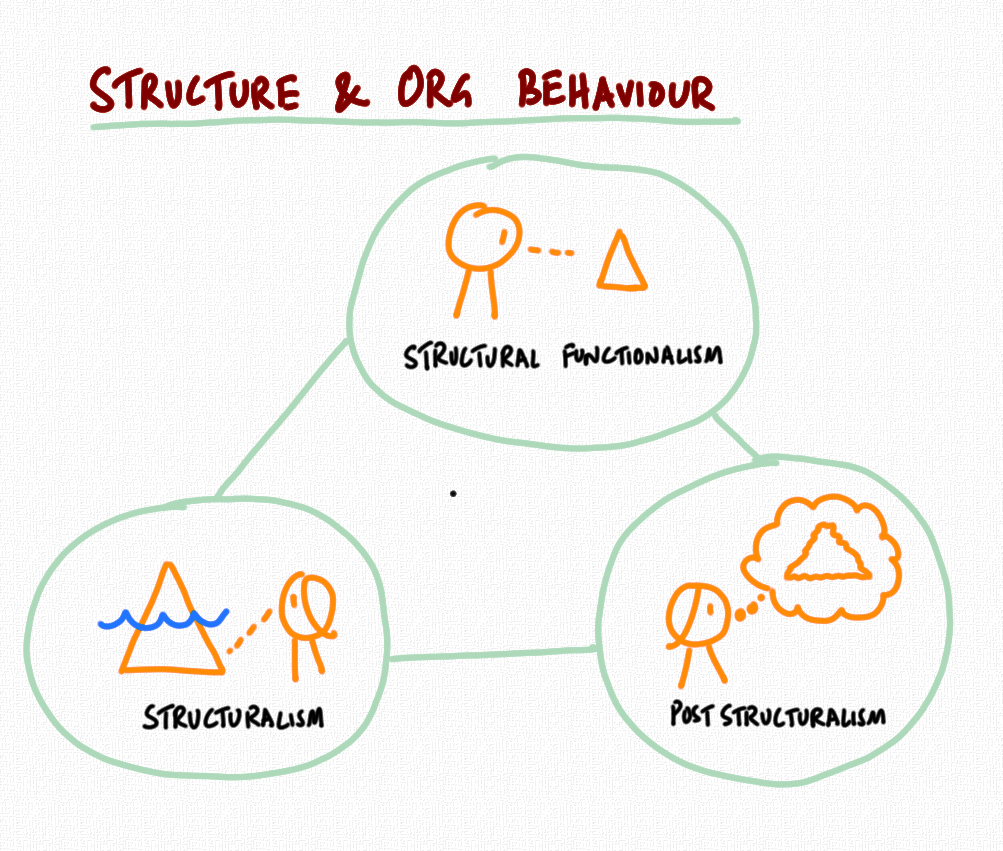
There are three versions of structure.

First, there is structral functionalism.

This view is that structure is visible, most clearly in the org chart.

You change things by getting the right structure. If things aren’t working, then restructure.

This is a dominant view – many people think it’s the “natural” way to think about organisations.

But – does it work? If you look at your organisation do you see visible structure getting results?

If not, we turn to structuralism for an explanation.

Structuralism says that it’s the stuff under the surface that drives behaviour – that which you don’t see but exists.

This is the underlying logic – the relationships and dynamics between leaders and teams that result in one thing or the other.

What makes a difference is the less visible stuff – power relations, inequalities, differing levels of freedom to act.

And then we have the third view – poststructuralism.

The first two approaches suggest that structure is a real thing and exists – either above the surface or below – but it’s there.

Poststructuralism says that structure is constructed – from the way we explain things.

Explanation is the key – it helps us make sense of what is going on.

That explanation is the structure, not real and objective but a product of the human mind.

If you’ve read this far and are wondering why this matters, this is why I think it’s important.

If the poststructralism view is right, then success depends not on the structure you create but the story you tell.

I’m sure you’ve heard of the famous Amazon process where people are asked to write a plan rather than use PowerPoint.

This could be seen as an implementation of poststructuralism – tell me a story – get your thinking down on paper and explain what you want to do and why it’s going to help.

Help me make sense of what is going on, so I can decide what to do next.

My New Target, 1,000 Vlog Posts In 5 Years

Monday, 12.48pm

Sheffield, U.K.

What you get by achieving your goals is not as important as what you become by achieving your goals. – Zig Ziglar

A few days back, on the 11th of February I achieved a goal I set back in 2017 – to write a million words in ten years.

I have enjoyed that process – writing is not easy but it is rewarding.

I feel like this work has helped me discover what I was interested in and how I could explore and understand different topics using text and drawings.

Now it’s time to set a new goal. I’d like to get better at explaining ideas – and a good way to do that is by vlogging.

So that’s what I’m going to start doing now with this blog.

The goal is 1,000 videos in five years. And this post is the first one.

Let’s see how things work out.

Cheers,

Karthik

p.s I’m still experimenting with getting my tech setup working so there may be some problems with the first few posts as I figure things out.

Becoming A Cynical Optimist

2026-02-14_wait.png

Cynical optimism – that’s what’s needed right now.

This is the term Jim Swanson, the CIO of J&J, used about the need for AI to shift from vision to execution.

I think we’re at the same point in the sustainability sector.

For the last ten years, we’ve talked to clients about a 3-year ready-set-go strategy.

Year 1. Get ready, collect data and understand your baseline. Year 2. Set goals, allocate resources. Year 3. Start running.

In 2024, we realized we were running towards a cliff edge created by near-term goals.

If you’re familiar with the history of the space you’ll know that these are complicated decisions to make.

In an ideal world, we’d use more renewables, cut down on personal consumption and move to more sustainable alternatives.

In the real world, fossil fuel company shares soared after the Russian invasion of Ukraine, COVID increased consumption with home shopping, and countries are rolling back on sustainability policies – worrying more about geopolitics and trade.

2030 seemed a long way away in 2012, but it’s now much closer. If you’re operating a large industrial or commercial firm, the road ahead is hard to see.

The advisory firms get this. Many are already suggesting that it’s time to look at interim targets and test if they’re still achievable.

A good question to ask – leaning into the cynical optimist approach – is knowing what you now know what would you do differently when it comes to setting goals and allocating resources?

How would you execute now?

Maybe it’s time for a refreshed plan.

Financial Metrics In Project Assessment

2026-02-13_investment-evaluation.png

Is this worth doing or not?

Understanding financial metrics used for investment decision making become more important as we try to turn plans into action.

I thought I’d do a quick dive into the methods out there and came across a useful paper by Delapedra-Silva et. al. (2022).

Many businesses use simple or discounted payback as a way to evaluate an investment.

It’s an easy one to calculate – how many years before you get your initial investment back. And that’s why it’s very popular in businesses.

But it doesn’t take the lifetime of returns into account. What if you keep getting a return well after the initial payback period?

That’s where Net Present Value comes in. The value of an investment is the total of the discounted cashflows you get.

So a business in the stockmarket is valued on the basis of what the market thinks it’s going to make in the future.

And then you have the Internal Rate of Return (IRR), which is the discount rate that sets NPV to zero.

If the IRR is 10%, you can compare that to alternative investments, like a bond – and make a call on whether the difference is enough to make up for the risk.

These three are fairly traditional approaches, along with the return on investment (ROI), which is the percentage return you get – the inverse of payback.

These approaches work great in regular businesses but they struggle to make the case for long-lived assets like energy projects – renewables or large scale replacements and refurbishments.

A more useful metric is the levelized cost of energy – the lifetime costs associated with producing energy over the the actual energy produced.

This value, in say pence per kilowatt hour can be compared with the market price to see if you’re going to save money or not.

A closely related metric is the energy ROI, which is the total energy you need over the energy produced – although this isn’t that common.

But even these methods don’t account for the full complexity of the decision.

In the real world, you’ve got to think about timing and flexibility – what happens if you do a project earlier or later, or what happens if the market moves one way or another.

This is where Real Options Analysis comes in, where you start with the NPV, and then layer in the additional value from different kinds of flexibility and uncertainty associated with the operation of a particular project.

All this might seem complicated but it’s more straightforward than it looks – really.

And the biggest benefit comes from thinking this through with your team.

REFERENCES

Delapedra-Silva, V., Ferreira, P., Cunha, J., Kimura, H., 2022. Methods for Financial Assessment of Renewable Energy Projects: A Review. Processes 10, 184.

Making The Sustainable Path The Obvious One

2026-02-12_act-wait.png

“What if everyone did this?”

You already know the golden rule. The platinum rule says treat others like they want to be treated.

Useful rules, but not enough to address big questions like how do we make our organisations more sustainable?

Taking action disrupts the status quo. It introduces risk and uncertainty – and the possibility of loss. It seems safer to stick with what we’re doing now.

Change has to be worth changing for.

That’s why policy is so important. Leaders who shape the rules of the game ask “what if everyone did this?”

They create incentives that help organisations choose action over inertia.

But the rules aren’t clear right now. Many companies we speak to feel stuck – wanting to take action but finding it difficult to make a business case and get the resources and support they need.

If we want to build more sustainable companies – we’re going to have to do more to make the sustainable path the obvious one.

Target Achieved: 1 Million Words

2026-02-11_crossing-finish.png

Wednesday, 10.28am

Sheffield, U.K.

It is insight into human nature that is the key to the communicator’s skill. For whereas the writer is concerned with what he puts into his writings, the communicator is concerned with what the reader gets out of it. He therefore becomes a student of how people read or listen. – William Bernbach

The number 42 has a special significance for me. Other than its appearance in the Hitchhiker’s guide to the galaxy, it also happens to be the number on my birth certificate. I didn’t have a name – just baby number 42.

And so it’s pleasing that on the 42nd day of 2026 I’m going to reach a goal I set myself ten years ago.

I have always wanted to write. It’s the way I make sense of the world. It’s how I process and understand what is going on, and the way in which I deal with the ups and downs of life.

I write for me. Because if I didn’t write I would explode.

In 2016 I came across a quote by Ray Bradbury, in which he said that you should write a million words to throw away if you wanted to be a writer.

Those first million words were practice, trash, what you had to do to find your voice and your style. A practice that you had to do to become a writer.

So I set a goal. A million words in ten years.

I set up a WordPress blog. And got started. And here are a few things I’ve learned on this journey.

Write first thing

We all have competing priorities. My children were ten years younger when I started. I was getting more unfit as I got older. Work was hard. Family life is challenging. There’s always something important to sort out.

But what you do first thing in the morning tells you what’s most important to you.

I started by setting aside time to write – getting up at 5 or 6 before everyone else was up, and wrote for an hour or so before it was time to get ready for work.

But that wasn’t always possible, and so sometimes I had to get the writing done last thing at night.

Somewhere along the way I started making a note on each of my posts of the time I sat down to write, and looking back, I can see that they’re outside the working day. Early starts – late nights – it doesn’t really matter.

What matters is, as Hemmingway wrote, getting the seat of your pants on the seat of your chair.

Make it as easy as possible to write

I once read a book on Feng Shui that said if you want to do less of something put a barrier in front of it.

Want to watch less TV and read more? Put a plant where it obscures the TV a little. That worked for a while for us.

Conversely, want to do more of something? Make it as easy as possible to do.

I’m a tech guy. So I set up a system where I can log into my machine and use the same workflow every time. One powered by Free Software.

I draw a picture using MyPaint. I run a script that sets up a post template with an image link and edit it in vi. Then I switch to emacs and post it to WordPress using org2blog.

This isn’t a workflow for everyone – you’re not going to touch it unless you’re a diehard GNU/Linux user – but I think everyone needs something like this. A friction free process where you sit down, do the work, hit publish – and the work is done.

Don’t let your fears and critical self stop you

We’re all afraid of what the world will think of us. What if we write and share something and people don’t like it? What if they laugh at us?

That critical self stifles our ability to express ourselves. It kills us before we get a chance to live.

The reality is that no one cares. Everyone is more concerned about their lives and problems than about you. It’s going to take a huge effort to get noticed at all.

Those days of obscurity are a gift. You can write, experiment, have a go at things without worrying about it.

The best time to plant a tree is ten years ago

The second best time is now.

Doing this work. Doing the thinking and writing has made a difference. It’s a small thing – a few words a day. But they’ve helped me develop a new skill, develop my career, find a niche to add value, and work on a programme of research.

None of which might have happened if I hadn’t taken the first step, and published the first few words ten years ago.

But this is only the start.

I saw this period as a time for practice, a time to develop my skills.

The reality is that I don’t feel a better writer now than I did ten years ago.

Each post is still a struggle. A fight to find words. A mess as I work through these thoughts. They are, as Anne Lamott puts it, sh**ty first drafts.

The focus on publishing, on putting stuff out, has meant there isn’t time to go over and polish material. I like some sentences. Others need work. And there’s filler and irrelevant thoughts that wouldn’t make it into a “real” journal.

So that’s the next challenge.

So far, I have written for me. Because I like to write.

Now I have to learn to write for others, and create words that others will enjoy reading, listening to, and find useful.

I’ve written a million words.

2026-02-11_million.png

Now, I’d like to work on a million good ones.

Cheers,

Karthik Suresh

The Economics Of Knowledge Work

2026-02-10_saas-llm.png

I keep seeing that AI has a cost problem: SaaS is expensive to build but cheap to scale; LLMs start cheap but costs go up as you grow and use them more.

I’m not convinced by this argument.

Say I’ve got to come up with an economic forecast.

There are a few ways I could do this.

Subscribe to a Bloomberg terminal for 30k that has all the data and analysis I need.

Hire someone to read and summarise material for maybe 100-400 a day.

Or run some PDFs through an LLM as a starting point for 20p.

You still need quality control so the real cost of an LLM is compute + review time costs.

But LLM + time is cheaper and possibly higher quality than time alone if you use the tools well.

What this means for me is that when I come across a business problem my first question is:

“Can an LLM help me do this better or faster?”

Before reaching for more expensive options.

Because the economics of how we deliver knowledge work are changing – and we’ve got to figure out where human judgement and input adds the most value.