Are You In Control Of Your Route To Market Or Not?

2025-11-30_solid-ground.png

Sunday, 7.02am

Sheffield, U.K.

In real open source, you have the right to control your own destiny. – Linus Torvalds

If you start a business you need to be visible on social media – which is why I spent the last 140 days writing on LinkedIn.

Two things have happened.

First, I have been more visible. I’ve had people comment on how active I am. They’ve referred me to others. I’ve had a few good conversations start as a result.

Second, my engagement statistics are slowing down. I don’t know if that’s because readers aren’t interested in what I write or if the algorithm is throttling my output because it wants me to pay for reach.

The advice on LinkedIn is that if you want to get a following, focus on one topic.

My content fails this test.

I have a new business to promote, so I write about that.

But I’m also interested in AI, technology, politics, science, innovation, marketing, strategy.

What I see from people that are successful on LinkedIn is that they push out stuff in their niche that is one message repeated again and again in slightly different forms.

It’s advertising posing as communication, engagement, education or entertainment.

It’s just not very interesting after a while.

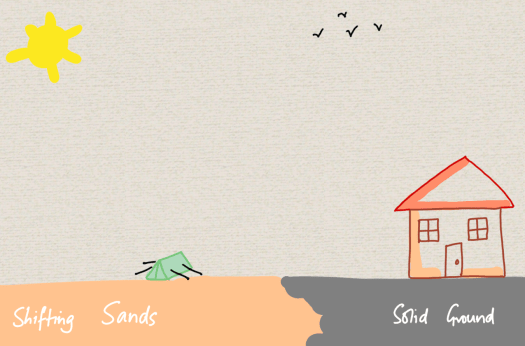
Another problem is that you are playing in someone else’s sandbox.

You can’t build a permanent home on shifting sands. Building a business that depends on the vagaries and algorithmic experiments run by big Tech seems risky.

You need solid foundations.

The bedrock on which you build your marketing strategy has to be under your control. Write first for your website, and have an outbound process – reach out to customers directly.

Email still has a place.

The problem with any technology is that either you control it or it controls you.

There isn’t an in-between – a good, win-win solution. Very smart people are trying to engineer situations where you work for them. And it’s increasingly hard in a world of SaaS and AI to even control your own computer – unless you’re familiar with Open Source and things like GNU/Linux.

If you take one thing away from this post it’s that you need to use systems other people own just enough so you can then move conversations into systems you own.

Cheers,

Karthik
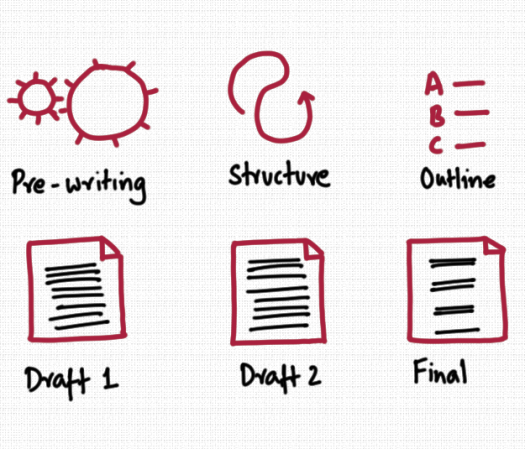
Writing As a Process

2025-11-29_writing-process.png

Reading maketh a full man; conference a ready man; and writing an exact man. – Francis Bacon

Introduction

Do we still need to write in a world where machines can pump out pages of text in a few minutes?

I think so. And for one simple reason. For survival.

Prehistoric people didn’t have gyms because daily life was hard work that exercised their muscles.

We exercise to keep ourselves fit in a world that no longer requires us to lift heavy things or work hard for food. As a result, our muscles atrophy unless we put in extra work.

The same thing could happen to our brains if we delegate the work of thinking. But while we have machines to do the physical labour for us – do you really want to have to spend your days in the equivalent of a mental gym to stay occupied?

Writing work is thinking work. It takes effort to figure out what you know and explain that to someone else. It’s also hard to keep a reader’s interest. Every sentence needs to add value.

And that requires a process. One that lets you build a piece in a systematic way. This is the process that I’m trying out.

Start with Prewriting

I tend to leap straight into writing and that’s not a good thing.

The first few paragraphs of any writing are like getting rusty machinery moving. You need to oil the parts, complain about how rubbish everything is, and get the gears moving.

A good place to start is with freewriting – in a document that no one will see where you can drop in whatever is on your mind.

No one wants to read about writer angst. But it needs to get out of you to get your brain and fingers moving. So write it, and then move on. This isn’t going to be published.

Draw a Structure

The next practice I’ve found useful is to draw a diagram. Something that expresses what I’m trying to get across.

This blog is full of such diagrams. Making them helps me get a sense of what I’m trying to get across. Is it a process, a feeling, an observation, a structure?

There’s something that I’m trying to capture with a piece of writing – and drawing helps me unlock that before I try and get the words out.

Make an Outline

I know that outlining is a good thing but I’ve struggled with it all my life.

I think I’m the kind of person that has to go into the detail, struggle with the mess, before trying to frame it in some way.

I was in Copenhagen the other day and the person I was with marvelled at how the buildings were made without any scaffolding.

That wasn’t true, of course. Scaffolding has been used since prehistoric times. You can’t build a building without planning, diagrams and scaffolding. But at the end, you take everything away, and you’re left just with the finished structure.

An outline is just scaffolding for writing. It helps you stay on track and it makes it easier for the reader because it gives your piece structure.

I find it easier to keep the outline text at heading level, rather than trying to go deep into sections. It’s hard to get into a writing flow if you’re constantly interrupted by reminders.

Write the First Draft

Then it’s time for the first draft.

I go down the outline, and start to create sentences.

The point at this stage is to get words down – to create a messy first draft. No stopping, no going back, just moving forward and laying down words.

Write the Second Draft

The second draft is about editing.

Remove the scaffolding and read and edit each phrase and line.

Choose better words, polish paragraphs and sentences, make the sentences active.

See the shape of the piece. Add headlines, connect sentences.

Make the piece easy to skim read.

Write the Final Draft

And then we’re on to the final stretch.

Look at the piece from a reader’s point of view.

Is it easy to read? Does it flow? Does the order of ideas make sense?

Move sentences around. Move paragraphs up and down. The easier it is to follow, and the more sentences logically and naturally transition from one point to the next, the more useful it will be to a reader.

And readers only stick around if what they’re reading is useful.

Publish

And then it’s time to press the publish button and send your work into the world.

This is an ideal writing workflow – and not one that’s worth using for every piece of writing.

A quick blog or social media post doesn’t need all this work.

But longer pieces deserve it – because writing them is as much about you as it is about the reader.

It’s the ability to work through an piece from start to finish that makes you still relevant in a machine age.

Daily Practice – The Machines Are Coming For That Too

2025-11-28_daily-practice.png

Friday, 9.44pm

Sheffield, U.K.

It’s a philosophy of life. A practice. If you do this, something will change, what will change is that you will change, your life will change, and if you can change you, you can perhaps change the world.

– Vivienne Westwood

I have been writing on LinkedIn every day for the last 140 days, thinking that it might help as I take a new business to market.

I’m not sure it’s working.

Here’s the problem – what do you put your effort into every single day to develop your practice?

There’s a choice – write for your own blog – which is what I was doing. Or write in a platform, which someone else owns.

The way that works for me is a routine – a consistent approach that I commit to every day.

That means writing 7 days a week. No excuses, no interruptions. If you stop, everything stops. And when you stop, it takes time to come back and start again.

But it’s hard to do that on a blog and on LinkedIn – writing once a day is hard enough. Writing twice is perhaps asking too much. Especially if there is more writing to do – such as working on a thesis or papers.

So I decided to prioritize LinkedIn for a while because it felt like the place I could connect with prospects and partners.

But, I think consistency is now a problematic thing.

It’s hard to tell the difference between someone that puts in the effort every day and a bot.

If people are using AI tools to write and publish then what they do looks very similar to someone who does it through discipline.

Or, to reverse it, consistent discipline now looks like you’re using a robot to do your work.

And that’s problematic. I’ve seen views go down massively on LinkedIn. I don’t want to jump and blame the algorithm but it’s one of three things:

  1. It’s depressing reach so you reach for the boost button and pay more.
  2. There’s more AI content but the same number of eyeballs, so mathematically everything gets lower views.
  3. It thinks you’re a bot and so depresses your content.

There may be more options but I can’t think of any right now.

So, the logical thing to do is to change – stop being predictable to a machine that’s adjusting itself as it goes.

My primary writing space has to be this blog – it’s where I work out ideas and think through situations.

And I think LinkedIn has to be a more random thing. In fact, I’m thinking of having a random number generator, like between 1 and 7, and only posting on the days when it’s over 4 and over.

Will the algorithm reward such randomness as evidence of being human? I don’t know – but I do know that life is too short to try and work for an algorithm.

So if you’re subscribed, you will probably see more posts from me again.

Cheers,

Karthik Suresh

The Sustainability Diamond

2025-11-25_sustainability-diamond.png

Tuesday, 7.57am

Sheffield, U.K.

Sustainability can’t be like some sort of a moral sacrifice or political dilemma or a philanthropical cause. It has to be a design challenge. – Bjarke Ingels

I’ve been thinking of how to market environmental consulting products for a long time.

I remember sitting in a marketing training program so 20 years ago, and coming up with four words that mattered to clients when trying to make choices.

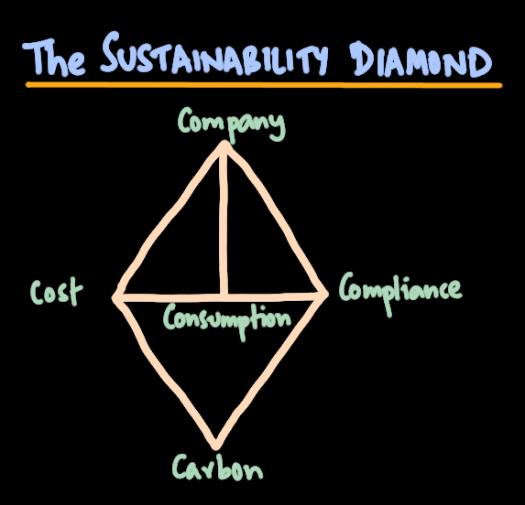
Cost, consumption, carbon and compliance.

These four words were, at the time, seen as quite technical – and I had to play with them to make the messaging easier for a lay audience to understand.

But the words themselves have stayed relevant.

Over the decades, companies have focused on one or the other at different times.

A good way to think about this is what I’m calling the sustainability diamond.

At the top of the diamond sits the company. Or any other organisation structure that has to think about its use of resources.

Resources have a cost – using gas and electricity results in bills, raw materials have to be purchased.

Companies actively track current and expected future costs – helped by traded commodity futures markets.

That’s where I started my career – building systems to look into the future and make decisions based on where prices were now, and where they were expected to go in future.

A bad trading decision could result in a swing in prices of 50% either way.

Then there was consumption – how much of the resources you used.

The easiest way to save money is not to burn fuel, to use fewer resources.

But it’s also a hard source of savings. It takes time and effort to identify where you can make improvements.

Energy and resource usage can easily become wasteful if you don’t monitor and control what’s going on.

In the middle of my career consumption management became more important.

As we added more renewables to the grid, the idea that we could manage demand – pay consumers to reduce their usage if supplies dropped – came to the fore.

This meant that if the wind stopped blowing and energy supply fell, we could balance the system by dropping demand rather than having firing up a gas turbine to fill the gap.

But to do this you needed a good handle on usage – and we built systems to monitor this on a minute by minute basis.

Cost considerations came screaming back after a series of events – the Fukushima nuclear reactor, the rise of shale gas.

But for the last ten years or so, the focus has been on compliance as new rules came in – most importantly net zero targets in many countries, starting with the UK.

Companies had to start complying with these new rules – measuring and reporting on the resources they used and starting to make plans to make their companies more sustainable.

These then are the three facets of the diamond – managing cost, consumption and compliance are the drivers for taking action.

And the action we take has a result in terms of carbon.

Recently, it’s become clearer and clearer that we should think of carbon like we think of dollars – a way to normalise different measurement systems.

For example, we convert all currencies into a standard one, like dollars, if we want to get a like for like understanding of how a firm is doing financially.

Measuring outcomes in terms of carbon allows us to do the same – taking therms of gas, kilowatt-hours of electricity, litres of diesel, purchasing spends – and putting them all into one, relatively consistent, unit. There are issues with conversions and emission factors, but on the whole we end up with something that is consistent and comparable over time.

The Sustainability Diamond may be a good way to keep the big picture in mind while focusing on any one part at a particular point in time.

Cheers,

Karthik Suresh

Get Computers To Work For You

2025-11-20_working-hard.png

Working hard in a world where you have computers seems like a failure of imagination to me.

I dropped out of my first PhD to join a startup.

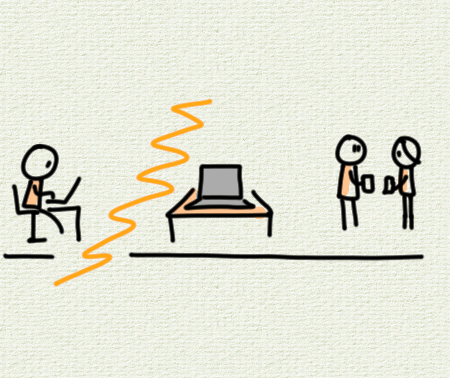
While I was doing the PhD, however, I had plenty of time to get coffee with colleagues and talk about research.

And this was for one simple reason – my computer busy working for me.

I inherited a codebase in c of around 4,000 lines.

I cut it down to 100 lines in python.

And then I built a pipeline – the computer started with a model, did an initial pass to reduce compute time, and then worked through complex calculations on a computing cluster my colleague built. When the calculations were done, and the results were formatted and pulled together.

Yes, you could work hard at each of those steps and it would take days or weeks – or you could use a machine and get it done in three hours.

And this isn’t new stuff – we’ve had the tools for around 40 years now.

I’ve used the same approach again and again, and we do the same thing in our latest business.

Raw data is entered in spreadsheets. Computers do a series of tasks and clean and usable outputs pop out the other end.

Most systems on the market give you more work to do.

Our systems do the work for you.

What Are Rich Notes? 2025 Update

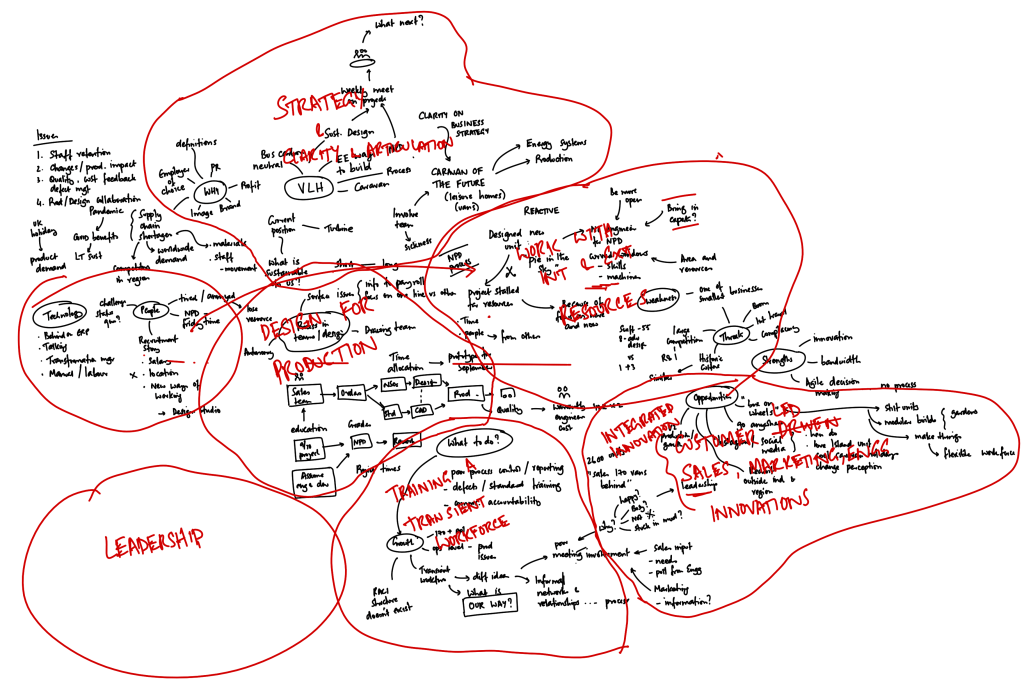
If you haven’t come across Rich Notes before, they look like the image above.

I make rich notes in my work nearly every day, to document and facilitate meetings with prospects, clients and colleagues – especially if we’re trying to work through something complex and multi-faceted.

They are notes taken by hand mostly using digital tools such as paint software and a graphics tablet.

  • The content includes text and images.
  • The structure is non-linear and non-hierarchical.
  • They are made using rich structural elements such as branches, processes, and lists.
  • They follow conversations, capturing what people say – or their narratives.

What makes rich notes different from tools like mind maps is their rhizomatic structure – a term from botany.

A tree is not rhizomatic. It has a structure that starts with a trunk, divides into branches, and keeps splitting until you get to the leaves.

Think of it like a top down approach that imposes structure where it grows.

A rhizome grows horizontally, with stems and roots growing off various nodes.

Rhizomes can interconnect at different points. If a piece breaks off, it can grow on its own.

It spreads out, growing around obstacles.

In the social sciences Deleuze and Guattari first used the rhizome as a metaphor to argue that the non-hierarchical, non-linear structure of a rhizome provided a richer way to understand social phenomena such as philosophy, linguistics, science and politics.

They talked about a rhizome establishing connections between signs, power organisations and circumstances.

In any situation you have multiplicities or dimensions and they talked about the need to flatten everything on the same sheet – lived events, histories, concepts, individuals, groups, social formations.

This again resonates with taking rich notes on a single infinite flat sheet.

Taking rich notes helps you get an understanding of a situation in all its detail, but what happens next?

That’s for another video.

This post is a script that I worked on for a recent talk. If you want to listen to the presentation I recorded, see the video below.

Innovation Teams In An Age Of AI

2025-11-17_innovation-teams.png

How do you build innovation teams in a world of AI?

Pretty much the same way you built teams before AI.

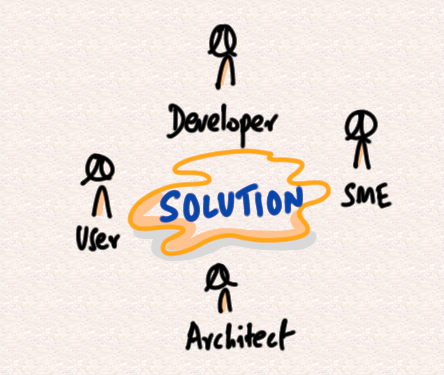
There are four roles that are crucial but most firms only get three right.

You need a developer – someone who can make what you need.

You need an SME – someone who knows what do do.

And you need an architect – someone who knows how something should be made.

One person can deliver all three roles if they have the experience.

But what’s usually missing from the conversation is the voice of the user.

Maybe it’s because users introduce real world complexity and nuance – they bring context.

It’s messy and untidy and hard to solve.

But building for context is what results in success.

Keep Your Personalities Separate

2025-11-15_personalities.png

Saturday, 13.33pm

Sheffield, U.K.

Anything that is worth teaching can be presented in many different ways. These multiple ways can make use of our multiple intelligences. – Howard Gardner

I’ve been thinking of the difference between the tip of the spear and the person behind it.

“Word Craft” by Alex Frankel got me thinking about sales.

He points to Jean-Marie Dru who, in his book “Disruption”, suggested that communication is not something separate from your product – instead it’s an integral component of it.

In other words, your product IS your message.

As a consultant or business owner you are also a product – which means your message is hugely important.

For example, I use this blog as a thinking space. It’s where I can collect ideas and work on understanding them.

And one of the things I’ve been struggling with is separating me from my work.

To start with, I’m building a business that provides data management services to clients that need to disclose information under various regulatory and voluntary frameworks.

At the same time, I’m interested in a range of topics such as strategy and marketing.

And I’m also carrying out research into improving approaches to understanding and improving problematic situations – a field known as problem structuring – through using Rich Notes – a technique I’ve created.

So, who am I? What am?

The business builder?

The strategy consultant?

The academic?

I think what’s going on is that we are more than one thing.

But – if we’re trying to connect with other people we have to pick one personality and stick with it.

For example, I had someone mention that they had talked to a prospect about my strategy work but when the prospect checked me out on LinkedIn I came across as too energy focused.

So, I either lost a potential prospect because of my message or I filtered out a prospect that wasn’t the right fit for what I was offering.

It feels like you should put across everything about who you are – the richness that you have.

But you have to decide what you want people to think.

The kind of research I do is Action Research.

This is where you have a situation – like figuring out what to do about marketing yourself – and you try something.

Maybe rewrite your profile. Tweak your outgoing messages. Try and make it easier for prospects to work out if they need you or not.

The research comes from doing something and then reflecting on what you’ve done, looking for lessons to learn, principles to extract, steps to reuse.

That’s a messy, unpolished process that requires engagement in a situation followed by reflection and writing.

But this is necessary to work through your experience of taking action so that you can come up with theory – a way to explain what happens.

For example, here’s a five part theory

1. Your message is your product

How you describe yourself is what you are. Think about this carefully because it will determine how people respond to you.

2. If you have multiple personalities, let one out at a time

I don’t like simple frameworks. Yet they are essential – because what you’re trying to do is remove ambiguity – make it easier for people to understand what you’re trying to say.

The reason I use LinkedIn is to reach and connect with potential clients. So everything on there needs to be related to that objective.

I’m not doing a very good job of making it clear whether I’m a founder, an academic or a consultant at the moment, so that’s an improvement action I need to take.

Think of it like having more than one personality – having two operating at the same time is very confusing.

3. Cut and refine each message

Cut, cut cut. This post is too long. But that’s ok, because it’s a thinking post.

But your LinkedIn posts have to be tight. Your books, articles, promotional materials, training programmes – they’ve got to be trimmed until they fit exactly what a prospect needs.

4. Design for filtering

You are not aiming to sell to everyone. There is a subset of the market that is perfect for you. You need to find them.

If that market doesn’t exist you need to do something else.

Make sure your system is designed to filter out people who are not right for you and what you offer.

5. Test and learn

There is no right answer.

But there is the work.

Have an idea.

Try it out.

Reflect.

Learn lessons.

Try again.

And now it’s time for me to work on what the next personality has to do.

Cheers,

Karthik Suresh

Are You Describing Your Value In The Best Way?

2025-11-14_career-strategy.png

It’s a tough time for older job seekers.

We once interviewed an experienced, gray-haired candidate for a sales director role.

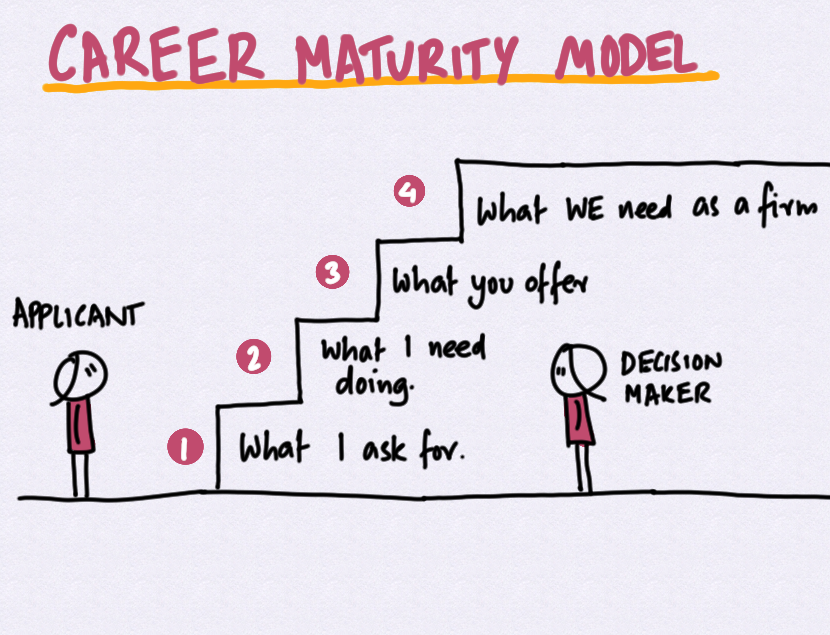
It was a no – not because of age but because their responses didn’t match the level of career maturity the role needed.

It got me thinking about how careers evolve, and what employers expect at different statges.

1. Early career: It’s a job

Your first roles are about learning, working hard and doing what you’re asked.

You build capability.

2. Mid-career: It’s about reliability

You’ve shown you deliver.

You’re a safe pair of hands.

The reward for good work is more work – and more importantly, responsibililty.

3. Experienced: It’s about knowing what you offer

Now you’re not just doing the work, you’re shaping how it’s done.

You sell ideas upwards.

You say, “Here’s what needs doing, and why.”

4. Senior: It’s about bringing about change

You recognize patterns – using knowledge and experience gained over decades.

You know what’s coming next, what needs to happen and what’s stopping us from getting better.

Your value is helping stakeholders in the organisation align, improve and move forward.

That salesperson we met?

We wanted level 4 vision – how they’d transform our go-to-market, upskill the team, build strategy.

What we got were Level 1 answers: “I’ll do anything you need me to do.”

I don’t think every rejection is about age.

Sometimes it’s because the way we describe the value we bring hasn’t matured as we have.

Should You Use AI Less Rather Than More

2025-11-11_ai.png

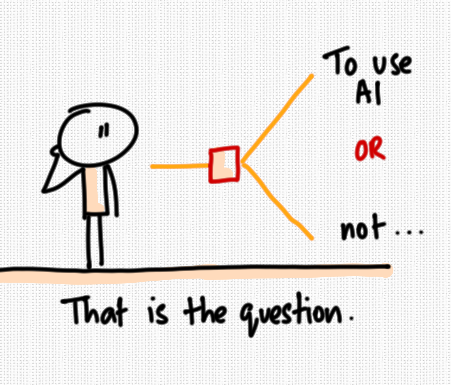
Should you use AI less rather than more? Extracts from a philosophical and a legal opinion.

Our goal as thinking beings should be to cultivate the faculty of reason – according to Daly (2026) – working on habits to develop excellence in five intellectual virtues.

These are:

  1. Knowledge of one’s field
  2. Intuition based on knowledge
  3. Wisdom in how one’s field relates to life and society
  4. Decision-making skill in how to achieve a desirable end
  5. Practical ability to make something using reasoning

The use of generative AI threatens the development of all these virtues.

The problem is that we experience sustained cognitive declines by outsourcing these habits to generative AI.

We literally get more stupid.

If that wasn’t enough the case for using Gen AI – that it makes us faster and more effective is undermined by Yuvraj (2025)’s verification-value paradox hypothesis.

In a nutshell, this hypothesis argues that the time saved by using Gen AI is offset by the increased time needed to manually verify the outputs from Gen AI.

This is because truth matters. Knowing that a collection of words belong together statistically is not sufficient justification to use them uncritically.

Verify. Then use.

Our cognitive skills matter. We should be very sceptical when it comes to replacing or diminishing them.

REFERENCES

Daly, T., 2026. A ‘low-tech’ Academic Virtue Ethics in the Age of Generative AI. J Acad Ethics 24, 13. https://doi.org/10.1007/s10805-025-09683-3

Yuvaraj, J., 2025. The Verification-Value Paradox: A Normative Critique of Gen AI in Legal Practice. https://doi.org/10.2139/ssrn.5621550