
Today’s Wall Street Journal reports that white collar jobs are disappearing as companies are pushed by investors to do more with AI and fewer people. What does this mean for HR?
We know that treating everyone the same hides important elements of strategy when managing groups of employees.
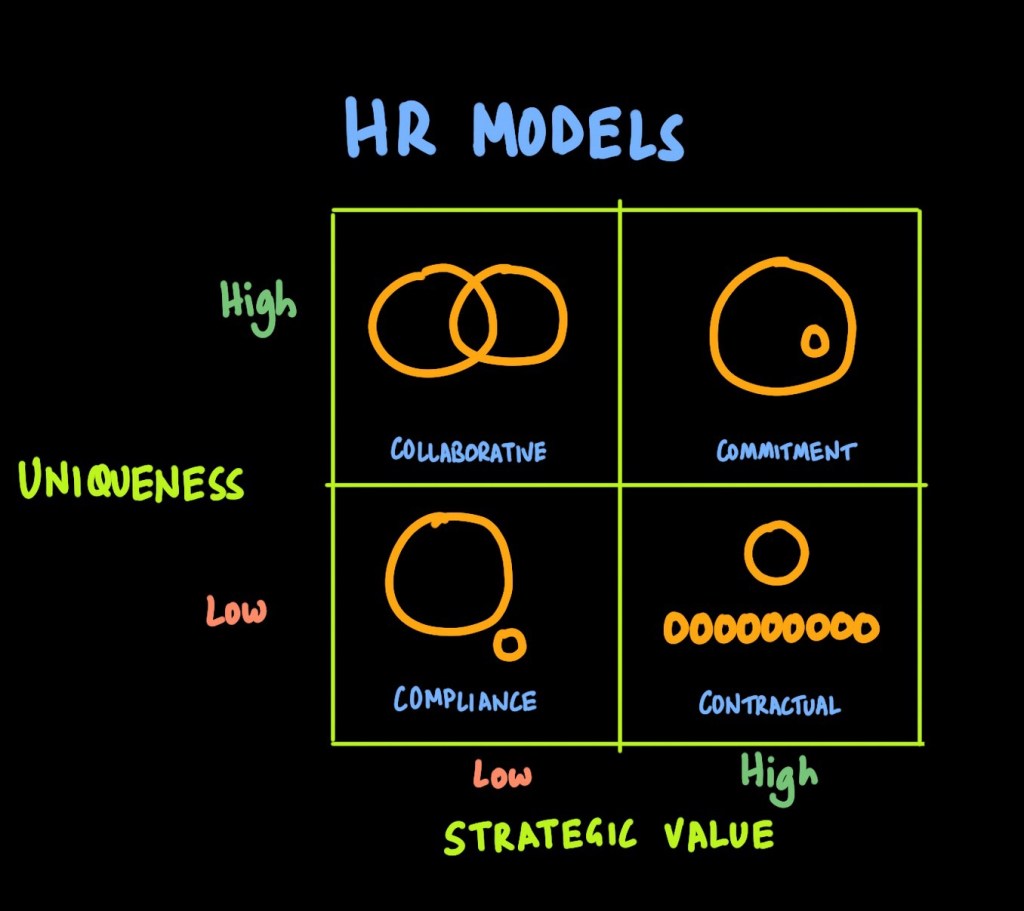
Scott Adams once joked that the reward for good work is more work. Real employment relationships depend on what an employee contributes to the firm – which Lepak and Snell (2002) talked about as the strategic value an employee brings to a firm and the uniqueness of their skill set.
This model is easy to think of in a 2×2 matrix, with uniqueness (U) on the one axis and strategic value (S) on the other.
Low U – Low S: COMPLY
These are standard jobs – janitorial, maintenance, basic admin – where compliance based HR works best. AI isn’t taking over blue collar jobs anytime soon.
Low U, High S: CONTRACT
These are core operational roles with clear deliverables
These are the ones that investors want bosses to sort out – get the same number of people or fewer doing more work using AI.
This quadrant is at highest risk of being displaced by AI and automation
High U, Low S: COLLABORATE
When there are things you need to get done but are not part of the core strategy of the business, it’s time to look at outsourcing or collaborative models. This is where consultants come in. We can support the business to get things done while not being on the permanent hires list.
Although these services are not directly at risk from AI, consultants that don’t use AI will have a higher cost base and so should really be thinking about their own staffing. At our carbon reporting firm, for example, we have AI developed tools that are doing work that we’d have hired a team of 4-5 to do as recently as two years ago.
High U, High S: COMMITMENT
The core, vital tasks that only a few people can do are the ones that are safe in a company. These individuals need to work within a commitment based contract – where they are dedicated to furthering the growth of the firm and happy with the rewards they get in turn.
AI is coming, however, for these roles – and we may end up with smaller and smaller core teams that outperform because they use AI to help them.
HR is usually seen as protective.
In an AI age, companies need to remember that it’s also a core strategic function, and companies that work out how to manage a mix of employment modes are more likely to succeed.
REFERENCES
Lepak, D. P, Snell, S.A. (2002). Examining the human resource architecture: The
relationships among human capital, employment and human resource configurations.
Journal of Management 2002 28(4) 517-543.
 Handcrafted insight