How To Deliver Quality Outcomes

2025-08-30_next-generation.png

Building a company is a constant cycle of finding fit for purpose.

Every new service line I’ve built has started with a trigger that we should really get our heads around what’s coming next.

A lot of consultants feel like they have to perform – to pretend like they know everything and are on top of it all.

In reality, most of us are a page or two ahead of clients.

Around a decade ago, I started treating business building like a research project.

The research phase is about accepting that things are a mess – in your head at least – that there is lots going on and it’s not clear what’s important and what’s not important.

Anyone looking at building a sustainable firm today has to engage with a mess – what’s going to happen with regulations in the US and EU? How will China change the game – or has it already changed it entirely? What do we have to do, what would be nice to do, and how do we make the case for action?

There are no simple and easy answers to these questions.

But if we engage with the detail, with the mess, we can start to create a programme for action that we can use in practice.

A series of steps that can make some part of the situation better.

But the difference today is that the research work is not done in a room alone.

It’s action research – done in the real world and participatory – done with clients and co-creators.

Helped by technology, including AI.

And if we do this well, we will create quality outcomes – defined as ones that are “fit for purpose”.

Change Is Here – And It’s All About Speed

2025-08-29_time-to-value.png

As a founder building a consulting firm I’ve been reflecting on the benefits of speed.

The thing we can do today in service firms differently from a few years ago is dramatically lower time to value.

Speed is a superpower. If you’re fast enough you can predict what others are going to do and do it before them.

But in service firms, we’ve always been limited by the speed at which we can get manual work done.

And there is a lot of manual work in consultancy. There’s research. Analysis. Verification. Report writing. Presentations.

The traditional model is to hire – Maister’s grinders, minders and finders model. That’s how we built businesses from 2000 to 2025.

Things are changing. That model is evaporating in front of our eyes.

For example – I was listening to a webinar a day or so ago, but I needed to process some documents. The task was to extract key elements and put them into a structure.

In a previous life I’d have sent this over to a back office team. Someone would have picked up an email and done the work, and then let me know. Maybe. I’d probably have had to chase it.

This time, I remembered I had gemini on my machine, working at the command line. So I told it what to do and went on listening to my webinar while it did the task in the background.

And it did an ok job. It pulled out what I needed. Not perfectly, but it got me an hour or so down the road so I could finish things off.

The real benefit of these tools is they give you time back. You get to a value point faster than you could before.

And this frees up the time to focus on making things better – to really improve what’s happening – and deliver better outcomes.

Change is here. And it’s all about speed.

Cross Little Chasms Rather Than Big Ones

2025-08-28_chasm-model.png

I was thinking about Geoffrey’s Moore’s crossing the chasm concept, which Clayton Christensen also explored in the “Innovator’s dilemma”, and an old memory popped into my mind.

The first proper game I played was Prince of Persia on my dad’s computer – an IBM PC-XT, which had no hard drive, only a 5 1/4 inch floppy drive.

I found a version of that DOS game recently that I could try on Linux – and if you’ve played it you’ll remember the character jumping over hazards.

Moore’s book is about marketing – early adopters vs the mainstream. Christensen’s is about crossing the early thorny stage to find and serve a niche that eventually disrupts the status quo.

The idea of a chasm, a space we have to cross which has hazards in the way, is more generalisable to everyday business operations as well.

Take sustainability, for example.

I liked a post by Maria Svantemark about the questions to ask if you were going to take on a Head of Sustainability role.

https://www.linkedin.com/posts/mariasvantemark_%F0%9D%97%9B%F0%9D%97%BC%F0%9D%98%84-%F0%9D%98%81%F0%9D%97%BC-%F0%9D%97%B8%F0%9D%97%BB%F0%9D%97%BC%F0%9D%98%84-%F0%9D%97%B6%F0%9D%97%B3-%F0%9D%97%AE-%F0%9D%97%9B%F0%9D%97%B2%F0%9D%97%AE%F0%9D%97%B1-%F0%9D%97%BC%F0%9D%97%B3-activity-7366370211559624707-yhpm

Each one of the questions she asks is a little chasm that needs to be crossed. Will you have a supportive team? Will you have a budget? How much power will you have? What does the company want to achieve.

And of course I focused on the last one – which is how is data collected now?

If it’s spreadsheets and a SharePoint folder, it’s going to take a year of work before you can do anything.

The reality is that most organisations start with spreadsheets. And it makes sense to use SharePoint.

It’s a big chasm to cross to try and get them to stop doing what they’re doing and starting using an entirely new system – especially when it’s not clear exactly what time this system is going to save.

So we took the approach of crossing a little chasm instead. We keep everything in spreadsheets and build better data management and dataflow processes so that we can get the information we need quickly and easily.

Once we have clean data, we can feed it into other systems, that you can select because they add value to your processes – specialist billing tools, asset management tools, pricing and procurement, climate risk measurement. These then take the data we collect and give you added value.

Company operations are full of chasms.

Choose the ones you can step over rather than the ones you will struggle to jump over.

Change Happens One Day At A Time

2025-08-26_balance.png

The challenge for most of us is to stop looking back and start to look forward.

Accounting is rear view work. So is calorie counting. And carbon reporting.

We count things and by the time we know where we were, we are now somewhere else.

It’s easier to count things after the fact so that’s what we do. But knowing what’s going on a month or so later isn’t really much help.

But maybe we should be looking at things differently.

For example, say you set a daily budget – for anything, your spending, the number of calories you can take in, the amount of carbon you can burn.

Then, you work out what you think you’re going to do that day first thing.

And you keep a record, jot things down and at the end of the day work out your daily profit and loss.

That’s a good signal.

If you’re negative, say you’ve spent too much today, maybe it’s time to back off and give it a couple of days to rebuild your numbers.

Real change happens slowly, one day at a time.

Why You Should Build For Users, Not For Yourself

2025-08-22_solution-fit.png

There is no “simple button” or “magic bullet”. There is work. And there is continual improvement.

I learned something early in my career that stuck with me.

I could build technology. I’d studied, practised, was familiar with a range of tools, and could create something that worked well for me.

Reliably. Predictably.

Then, when I gave it to someone else, they always broke it in new and interesting ways that I hadn’t considered.

Some people think of this as a problem with humans – and some technologists work very hard to remove this irritant from their workflows.

But that’s a mistake. The people at an organisation are the ones that buy your product, that engage with it, that need it to make their work lives easier, that promote you if you make that happen.

So I learned to build for users, rather than just building for myself.

And this starts by understanding that your prospect is in an existing, probably complicated situation.

In that situation, they usually have an existing, probably complicated set of issues they consider problematic.

You can’t rock up and offer your nice, packaged brick of a solution to fill their jagged and misshapen issues.

It’s not going to work. Maybe you’re so great at selling that they buy it. The disappointment comes later.

The only way is to change our approach.

We need to shape our solutions to fit our client’s problematic situation.

And then constantly work with them to improve and make it better.

More Than Half Of SaaS Tools Are No Use

2025-08-21_tech-stack.png

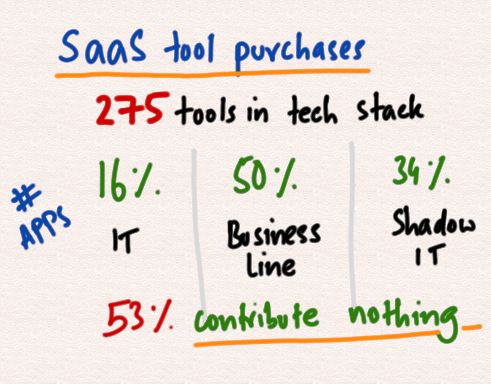
More than half the SaaS tools in organisations contribute “little or nothing to organizational outcomes”.

A post by Tom Fishburne of Marketoonist fame caught my eye last week.

https://www.linkedin.com/posts/tomfishburne_marketing-cartoon-marketoon-activity-7360671448283168768-C_N8

It cited research from Zylo that said the average firm had 275 tools in their technology stack.

16% of tools were purchased by IT, half by the business line, and the rest were shadow IT purchases.

In conversations with sustainability managers, a version of the following story comes up again and again.

  1. We’re drowning in spreadsheets.
  2. There is no budget for hiring, or we’re struggling to get people to do these jobs.
  3. Internal audit has highlighted weaknesses that we need to improve.
  4. Senior management think we need a system – someone has recommended XYZ software.
  5. The software doesn’t save us any time in the work we need to do – but now we need to format everything so it fits the interface so that’s more work.
  6. Any changes are complicated, costing more in changes or we have to do this outside the software.
  7. We’re still paying for the license, but have gone back to Excel to get the work done.

There also seems to be a bit of a price war going on with sustainability software – one manager said they had shifted to another tool that cost 66% less. There is an oversupply of tools out there and the sector is probably overdue for a shakeout, so it’s not surprising that prices are plummeting.

We’ve approached this from the other end. Rather than building software, we use lean processes to get the data flowing cleanly, so that it can be used in the next stage, whether that’s in a DIY PowerBi system, internal management reporting, or a SaaS platform that clients have invested in.

Let me be clear, I’m not against SaaS – the data just shows that there’s a disconnect between what people buy and how they use it.

And if you’re a SaaS vendor customers seem to be looking at the level of implementation support that comes with your product.

If you’re a senior manager, talk to your team doing the work and see if the tools they have are really saving them time.

And if this is a problem, get in touch. We can help streamline the process, get the most out of your existing investments and get that tech stack working for you.

Make It Simple, Easy and Useful

2025-08-20_technology.png

I’m enjoying building stuff again, after years of managing stuff being built – but as I look around, we’ve still not learned basic lessons about how to build useful technology.

Here are some thoughts.

1. People use technology.

Many tech folk seem to think that their software is going to be the most important thing for the client.

Some of the more extreme ones see users as interchangeable identikit people that live in little boxes and will do what they’re told.

Then they’re surprised when those people have views, get frustrated because the software doesn’t work for them, and push back on adoption.

Build for users – not for some ideal or ideology that’s been dreamt up on a whiteboard.

2. Managers think more about people than technology

I did a session with a manager recently to talk through all the things that they were trying to sort out.

Technology didn’t come up a single time.

Alignment did. Strategy did. Communication did.

Most managerial problems are people problems. They are also opportunities.

Learn how people work – and then make something that’s going to make it easier for them to get work done.

3. Simple and Fast = Useful

I came into the workforce with a bunch of programming skills and quickly realised that the business world runs on Excel, not Perl or python.

It still does. SaaS has not changed that equation. Most SaaS vendors still tell you about the option to export data to Excel.

We build services that take advantage of Microsoft not because it’s the best tool but because it has overwhelmingly dominant distribution – every company over a certain size will give its employees access to this ecosystem.

I’d rather build something that can be bought and used tomorrow than something that takes months to get through procurement and legal and IT and corp security.

Do you recognise this picture? Agree or disagree? Anything else to add?

What Matters Is The Action We Take

2025-08-19_windmill.png

Of all the seasons, the hungry season is the one we hope to never experience.

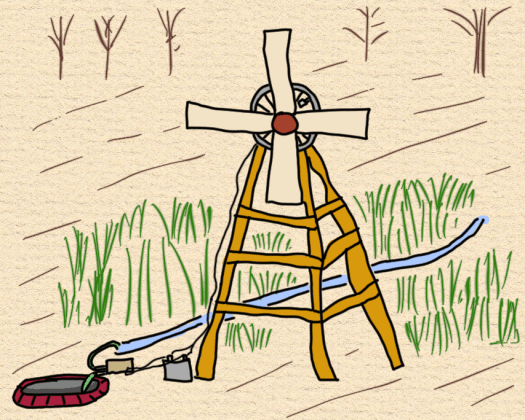
I watched “The Boy Who Harnessed the Wind” yesterday” – a 2019 directorial debut from Chiwetel Ejiofor.

The film is a micro exploration of what happens when human activity meets the effects of climate crisis and its impact on a subsistence farming family in Malawi.

  1. The weather dictates the growing seasons.

You plant when the ground can be dug – it gets too hard in the dry season.

  1. The rains are unpredictable Floods one year,

droughts the next. It’s a gamble.

  1. Resources are scarce. The only tools are hoes –

a technology so old it predates the plough.

  1. Short term interests. Cutting down trees gives farmers

money in the short term but removes the barrier that protects against floods.

Many of are so isolated from the food system that it’s hard to imagine what it’s like for subsistence farmers to be so dependent on the weather.

The developed world isn’t that much more resilient, really. COVID showed us that we are only a few days away from being unable to supply our basic needs if the system is disrupted.

How many people know there is a Hungry Gap in the UK – from around April to mid-June where we rely on imported and stored produce because the winter crops are down and the summer crops aren’t ready be harvested yet?

Spoiler alert – the story’s hero, William Kamkwamba, finds a book on energy and uses scavenged parts to build a working turbine, allowing his family to irrigate crops during the dry season and survive a famine.

Here’s the thing about the climate crisis.

We know it’s happening. We know that there are a range of reactions from people out there, from denial to catastrophizing.

What matters is the action we take.

Just Looking Makes A Difference

2025-08-04_observer.png

I could read Terry Pratchett again and again and learn something new each time.

And the first page of Soul Music has the line “… if it is true that the act of observing changes the thing which is observed, it’s even more true that it changes the observer”.

This line helps explain some of what is going on right now in the world.

Let’s look at this in a specific context – what organisations are doing about sustainability.

8 years ago, when we first started building systems to count carbon, we were starting to observe something that was considered a problem.

It took a few years to build a data set that showed trends – where we could see the impact of production and system transformation in the numbers coming through.

And that inevitably started to change the organisation and the teams we worked in. We started to pay attention to how things were done, which contracts were in place, which materials were being used.

Just looking made a difference.

And that, I think, is what the backlash against ESG appears to be attacking.

People with vested interests don’t want you to look at things that will affect their businesses and profit centres.

It’s the central premise of the film “Don’t look up”.

And they have the political and regulatory power to attack the ways you look, from removing the ability to calculate emissions factors to stopping you using sustainability criteria in selecting suppliers.

I don’t think their efforts will work in the long term. It takes a lot of energy to push a narrative that protects a small group of people while putting the future of the majority at risk.

And of course, the climate doesn’t care about regulation and what people think. The pandemic cut transport emissions. At least some of us are more reluctant to fly as data shows turbulence increasing.

Just watching, observing, looking at what is going on around us is going to make a difference.

Focus As A Strategy For Service Firms

2025-08-01_focus.png

One of the hardest things to do with a service firm is to focus.

It takes a particular kind of discipline to turn away work.

Sometimes I see posts on here arguing that’s because service firms are desperate – they’ll take on anything.

I don’t think that’s right.

When you offer a service, it’s inevitable that if you do a good job clients will ask you if you can help with related issues.

And we want to help clients in any way we can so we’ll look into it and figure out what needs doing.

Often that leads to new service lines because if there is a problem that is worth solving then there’s an opportunity to provide a service.

But more often, it’s about having partners that you can work with that already do that kind of work well.

What we shouldn’t do is what my son did when I was teaching him how to ride a bicycle.

He came around a corner at full speed and then was suddenly distracted by some butterflies.

Butterflies are pretty, but you need to stay focused on the main job you’re doing.

The reward for doing good work is usually more work.