Where We Focus All Our Attention

2025-07-31_small-vs-big.png

The thing I most enjoy working in a small, flat team is that our entire focus is on the value we deliver to a client.

That early, startup-like stage is simple.

Only do what adds value. Everything else is a cost.

The challenges start to mount as you grow.

Big companies start to organise into hierarchies, reporting lines, with a boss pulling the strings.

And pretty quickly, the focus shifts from the client to the bosses – we take decisions based on what the boss wants or thinks or we think they think.

And really, the boss is often least qualified to make the call because they are further and further away from the client, from the actual work being done.

The ones that realise this design operations that delegate and empower – letting teams self-organise and structure for impact.

Those that don’t rely on command-and-control strategies that look increasingly outdated.

For me, anyway, at this stage of building our business, it’s all about working in a team that is hyper-focused on creating client value.

The Difference Between Leaders and Contributors

2025-07-30_heads-up.png

Life time success can be predicted well by one of the 5 big personality traits.

I recall a remark by Jordan Peterson about the OCEAN model – the idea that personalities can be measured across 5 dimensions – Openness, Conscientiousness, Extraversion, Agreeableness, and Neuroticism.

Of these he said conscientiousness is the biggest predictor of success and, of the two elements of conscientiousness, orderliness and industriousness, the latter is more important.

Or to put it in fewer words, people that work hard get ahead.

But, I wonder if that applies mainly to work – to the contribution you make.

I think leadership may be different – the best leaders are perhaps ones that score highly on openness instead.

Openness is being willing to look beyond the here and now. To engage with new ideas, even if they are uncomfortable or new, and grapple with existing organisational structures to bring in new and better.

Another way to look at this is to see great contributors as being heads down, focused on the work and the next task – on what’s happening right now.

Great leaders are heads up, scanning for what comes next.

How To Think About Value In Work

2025-07-28_hfpvd.png

These 5 words will change the way you think about work.

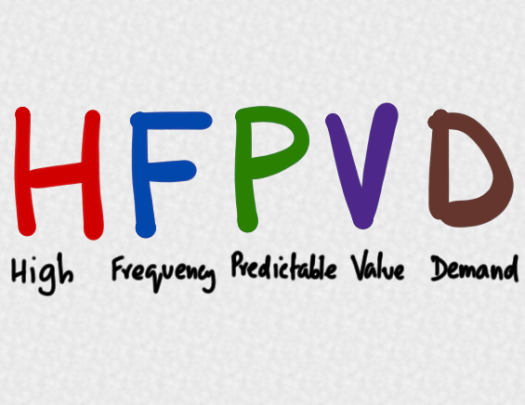
High Frequency Predictable Value Demand.

You may think you and your team are working very hard but take a closer look.

Customer demand is the term for the thing that we need to work on.

Demand is of two types – according to John Seddon – failure demand and value demand.

Failure demand is work that results from not getting what the customer wants or needs right. Not being clear about the specification and building the wrong thing. Not fixing the problem and having to go back out again.

It’s still work – but it’s because the system is not delivering.

Value demand is work the client needs and wants.

It’s the good stuff, building a tool or process that makes things better, fixing the fault in the machine the first time, laying the driveway using the right technique so the flags don’t pop up after the first winter.

That last one is a sore point…

So what about the other three words?

Once you know the sorts of things your client values, you can organise for greatest effectiveness.

High frequency – which requests come along again and again.

In carbon reporting, for example, we know that there are several emissions sources that are going to be a feature of most organisations – electricity, gas, petrol, diesel, propane, and so on.

They’re also predictable – bills come along every month for some, but some are billed less frequently. We can still predict that we’ll get a couple a year so if they’re missing that’s a problem.

Once we’ve see what HFPVD is, we can design processes that make it easier and quicker to deal with that demand.

Instead of rushing around trying to get all this done at the end of the year, we can do a little every month and get it done over time.

This has the side benefit of being able to put in monthly monitoring and control, or feed into other systems and management reporting.

To learn more about how HFPVD fits into the development of better service processes read the article linked in the comments below.

How To Resource For Sustainability In Your Company

2025-07-26_resourcing.png

I’m wondering if the way in which we think about resourcing for sustainability is problematic.

I see more adverts for sustainability professionals in my feed and from a quick look at what companies are asking for it seems that they don’t really understand what these professionals do.

These roles are transformational ones, dealing with the complete overhaul of existing systems with mixed levels of internal support, and varying degrees of external hostility or support depending on where they are located.

And we ask them to do too much.

They’re expected to wrestle with the details of data collection across multiple subsidiaries, countries and suppliers.

They need to pull this together for regular reporting and management information.

They have to engage with a range of stakeholders across their organisation, getting them aligned on strategy.

They need to provide decision makers with recommendations and the backing information required to understand and evaluate options.

And they need to take action, making projects happen – everything from new solar panels to making sure contracts are renewable.

Have I missed anything?

Are there people out there that can do all of these things?

I listened to a talk recently with a large accountancy firm and solutions provider where they said that finding people with tenure in doing this work was like looking for unicorns.

I think firms need to think hard about what they really need to put together a team that works.

Here’s what I’d recommend after a decade of working on this.

The in-house team’s highest priority is engagement and decision making support.

They’ve got to engage with everyone else – legal, procurement, IT, operations – the list goes on, to build support and champions.

They need time with the CEO, CFO and the rest of the leadership team to educate, engage and involve them in assessing choices and deciding what to do.

Data management should be outsourced to a team that is willing to deal with the complexities of your specific situation.

This is a task often given to interns – but that’s problematic. Do you really want your most junior staff doing work that needs to be signed off by the CFO?

Who’s going to check and guarantee the work.

I’d suggest following Jack Welch’s advice – if you can’t put your best people on this, find someone else and get them to put their best people on it.

When it comes to reporting, choose a platform. There are many out there, or you can use BI tools to put something in place until you’re clear what you want.

Finally, you’re going to work with construction partners to get projects away.

If you’re in charge of resourcing, it’s not about hiring one individual and overloading them until they break and leave.

It’s about giving them the resources and support they need to get the job done.

It’s About Having A Conversation, Not About Selling

2025-07-25_sales.png

It used to take us 18 months to get a new client.

Anyone that works with large companies has experienced this.

From the time you get an introduction to when a proposal is signed it’s easily over a year.

It was anyway.

We usually travelled to meet the client.

That always felt a little unsustainable – burning fuel to find out how you could help someone use less fuel.

The sense that this was an important meeting always put some pressure on everyone attending, especially those responsible for sales.

You had spent time and money to get here, and the next 45 minutes were crucial to going ahead.

And that’s where things often fell apart.

The problem with a sales meeting or a demo is that we feel that it’s our one chance to tell the clients about everything it is that we do.

So we spent the first 80% of the meeting talking about ourselves – our backgrounds, our product, the problems we solve.

Then we spent the next 20% of the meeting asking for feedback about what the client thought of us.

By the end of the meeting we had no idea what the client really wanted – because we hadn’t given them a chance to tell us.

So we doubled down, sending out huge proposals that set out everything we did again, hoping that something would land.

Unsurprisingly, that didn’t work either.

Eventually we learned how to do it better.

We had to talk less and listen more.

When we did that, we learned more about their situation and what they needed from someone – perhaps us if we were the right fit.

We built a process around this approach – one where we can figure out if we want to work together in a couple of hours – focusing on what matters to our client instead of wildly pitching everything we think we can do.

And it’s real simple.

It starts with a conversation rather than trying to sell something.

The Difference Between Clients And Customers

2025-07-24_customer-clients.png

Over time my immediate bookshelf has resolved itself into three categories.

Writing, drawing and systems.

I have more books than shelf space in my office.

Every once in a while I cull them, moving ones that I don’t read often into storage.

On my systems shelf is a slim tome called “Systems thinking in the public sector” by John Seddon, a title that I picked up in a charity shop in 2019.

It’s one of the few books that had such an impact that I wrote to the author, who kindly invited me to a seminar.

The big idea, the one that changed how I looked at things and underpins my research now, is that you have to think differently about services than products.

In essence, when you run a manufacturing operation that makes products your objective is to reduce variation from a nominal value.

You want all your car doors to be identical – if they all vary a little that’s going to be problematic.

As you vary from that box you’re trying to make costs go up and quality suffers.

In services, however, the nominal value is not quite as easy to grasp.

Take what I do, for example. If you’re doing carbon accounting it’s easy to start by reaching for an objective standard – the GHG protocol, the UK’s SECR and so on. You ask – what must we do, how do we know we’re doing it right?

The answer, unsatisfyingly, is that it depends. Guidance is descriptive rather than prescriptive.

A few quick examples. If you have a large UK portfolio and a small global one, can you just focus on the large one? Similarly, if a particular raw material is the bulk of your Scope 3, can you focus on just that category. If you’re in a hard to abate sector is it ok to set targets for just the elements of emissions that you control?

In situations like these, the approach we take is a negotiation – leaders, advisers and auditors review the position and talk about how to approach it and agree what to do next.

And each company does this differently, in a way that’s often squiggly.

The data collection and reporting service we design for these different companies has to be able to cope with the variety of demands they have – a one-size-fits-all solution often isn’t enough.

If you’re selling a box – something that focuses on reducing variation, that standardises, systematises an approach, then you probably have customers.

If you’re designing a service that wraps around the individual needs of the stakeholders in an organisation – then you probably have clients.

What matters is knowing the difference.

A Network Structure Beats Hierarchy In A Post-Pandemic World

2025-07-23_post-modern.png

When you run your own business you get to choose how you structure it.

I think we’re still struggling with how to do this in a post-pandemic world.

I’m a startup person, happiest in a small firm with a few partners.

Life is simple here.

We have two jobs –

  1. Build stuff that solves problems for clients.
  2. Talk about what we do so new clients can find us.

The problems start when we try and grow up.

As you grow, you add more people, and as you add more people you create structures and roles and processes and governance and bureaucracy.

This is how you start loving your work and then find yourself ten years later wearing a suit watching others work and wondering why it’s all so boring.

The pandemic changed all that. We found we could work with anyone, anywhere.

What mattered was finding ways to build teams that worked great together.

And you can do this remotely just as well as you can do it in-person. People who say you can’t just don’t know how to do it yet.

And these teams don’t need to be at the same firm.

We can cut across organisations – the team is made up of the client or problem owner and people from multiple firms that bring the expertise together that’s needed to improve the situation.

It’s the network that delivers value, not the hierarchy.

This is, if done well, inherently more efficient, effective and sustainable than the way we did things before the pandemic.

Some people will disagree vehemently. And that’s ok.

The economics are what matter in the long run.

It’s OK to Push Against Boundaries To Make Things Better

2025-07-22_decisions.png

Many of us, perhaps the majority of us, are insufficiently cynical about how the world really works.

We spend time doing what we think is right – and are frustrated when things don’t work out.

Many years ago, I went to a seminar on decision modelling, where I was introduced to decision trees.

These are branching models of decisions, consequences and outcomes.

Forks in the road, if you will. Times that come along where you must choose to go one way or another.

These choices come along all the time. Should I buy this software or wait? Approve this project or not? Go one way or another?

We can spend a lot of time modelling all the options and putting together sets of recommendations.

But does all this modelling actually help – will anyone use it in decision making?

That’s where understanding boundaries comes in handy.

All too often, we draw a boundary around the work that ignores where real power, real decision making authority rests.

I saw a good example of this during a recent seminar. This had to do with ways of decarbonising an asset portfolio – and there were a number of options that could be explored.

We could look at redesigning the assets, changing fuel sources, working out schedules and timelines for replacement.

But what was possible depended entirely on government regulation being passed.

Although it looked like there were many options, the political and policy process, which was outside the boundary of the analysis, would determine which pathway through the decision tree could be activated.

So, all we can do right now is wait.

A fancy term for that is preserving optionality – wait until you absolutely have to do something rather than moving too fast too early.

In the meantime, use the tools you already have to get on with what must be done.

Of course, this is also a recipe for stagnation. If you do only what is required, how will you get ahead and prosper?

And that’s why the prescription is not about being cynical or about being over-prepared – it’s about tempering analysis with a dose of reality.

Do the modelling – it helps you think clearly about what might happen in the future, but include the constraints and fuzzy factors that are traditionally excluded as being too “soft” from your analysis.

Boundaries are also mental constructs – it’s ok to push against them when you’re trying to change something for the better.

A Systems Model For Decarbonising Organisations

2025-07-21_strategy.png

The model for decarbonising business is arguably quite simple.

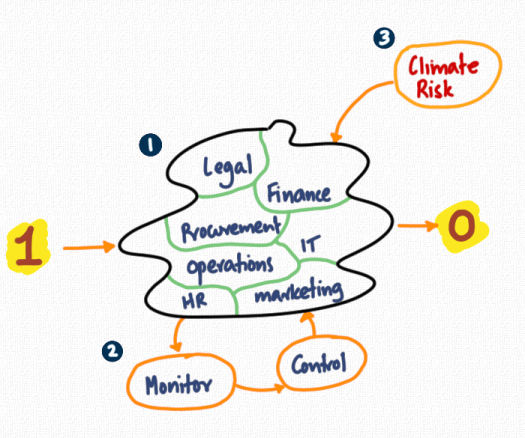
Take a company with emissions of 1 or more, and make that number 0.

The devil is, as always, is in the detail.

How can we stand back and look at the situation facing organisations today?

The first thing is to recognise that making an organisation more sustainable is not a departmental activity – it requires coordination with all the main functions.

The sustainability team has to work with legal, finance, procurement, IT, operations, HR, marketing and others and get them aligned on the way forward.

But the first question anyone asks is “where are we right now, what does the data say?”.

So the starting point is often the second step – we need to monitor the organisational system – and that starts with collecting data and creating a robust and reliable data set.

Ten years ago, this was an annual exercise that no one worried about too much. You had different reasons for collecting this information, depending on the market and schemes you were part of, but it was really an end-of-year exercise.

If you want to make decisions on the data, however, if you want to use it to take control action on the organisational system, then you need it more frequently – so that’s a harder thing to put in place.

But we have the systems and technology to do that now.

Some people worry that we’ve gotten stuck at this step – collecting and reporting, but taking no action.

But taking action is a non-trivial problem and goes back to step 1 – we have to get the key decision makers, the people with power, aligned first.

And there are other factors that influence their decision making – what customers think, what the regulations say, what employees want, what’s the best use of money right now?

It takes a lot of talking, lots of engagement, to get some clarity on this.

In the meantime, the climate keeps changing.

There is a definite shift in the mood music – from an attitude of we can solve this to what do we do if things start going bad?

There is more talk about the third element in this picture – the exposure to climate risk.

Depending on who you are and what you do the impact from climate change could be nothing, or pose an existential threat to business.

A major emerging risk to solar panels, for example, is extreme weather, with hail and wind risk factored into insurance premiums for developments.

The stuff we’re focus on right now – the carbon accounting – is just the basics. It’s what we have to do to be able to have a proper conversation based on data and evidence.

Those conversations, the engagement with leaders in organisations on which decisions need to be made – that’s where the real work is.

Building Custom Solutions Versus Buying A System

2025-07-19_build-buy.png

In this day and age you should always go out and buy a system to get a task done – there’s an app for that.

Right?

I’m not so sure.

More than ten years ago, we were trying to get into the demand response business.

Demand response, in case you don’t know, helps balance a grid that has a high proportion of renewables.

Because the sun doesn’t always shine, and the wind stops blowing, renewable supplies can be intermittent, and be unavailable at certain periods.

Instead of spinning up a gas generator to keep supply going demand response programmes pay large users to switch off and drop demand – hence demand response.

We went to the market to see if there were solutions out there that would do the things we needed – monitor notifications from the grid, meter client sites in near-real time, and pull everything together so that we could ask a site to turn down or up as needed.

We looked at the market, talked to providers – but nothing quite fit what we needed.

So we started building our own. In doing that we learned more about how meters operated, which ones we could connect to and which ones were tricky. The difference between modbus and TCP-IP.

Eventually, we did get our own system running, held together with a combination of servers and code that did the job – that ran and helped us operate the business.

Would we have been better off buying a tool? I don’t know, because we didn’t.

We built a lean and low-cost system that let us do what the market needed and test if it could be a business.

Which it wasn’t. The DR business at the time didn’t have a working economic model – it’s a monopsonist system which basically means suppliers can’t make a margin.

It wasn’t for us.

For the last several years we’ve been developing systems for energy and carbon data management instead.

It’s not an easy space for corporates to scan – there are thousands of systems out there and it’s even more complicated with the hopes and promises from AI.

And the next couple of years look to be challenging – with a greater focus on costs and a need for effective solutions that deliver clear outcomes.

Keeping it lean and simple still has value here.