What To Do When Nothing Has Value

2025-06-28_karma-yogi.png

Saturday, 9.40pm

Sheffield, U.K.

The major value in life is not what you get. The major value in life is what you become. – Jim Rohn

I think we are living through a change in the global system, one that could have profound consequences.

Or it could fizzle out.

But while we’re waiting to see what happens let’s conduct a little thought experiment.

Let’s think about a world where there are fewer jobs to do because of these new technologies that make people with jobs so productive that companies don’t need to hire as many people as before.

New entrants to the labour market find there are fewer jobs to go after.

The well paid ones, the few that lead to money and status, are hoovered up by the rich and connected.

The rest struggle to get anything.

That’s one view.

Or, the technologies allow us to do more than ever before.

Every single person has the tools to create something great – they don’t need the resources of a corporation to create a new product, find a market, delight customers.

So yes, there are no jobs. But instead there is an explosion in businesses – where people create value.

I started this post by suggesting that a world could exist where nothing has value.

Perhaps I should examine my assumptions there.

If a machine can do something in seconds that would take an artist days or weeks, and do so for free – what happens to value?

The value of the machine generated product is nothing.

The value of the artists work is something – to a person that values the artist – and nothing if not.

The art in itself becomes less important than the way in which its produced.

There is a market for free. And there is a market for handcrafted. And each of us needs to decide how we go after the market that works for us.

The drawings I make for this blog are stuck at a 4th or 5th grade level.

Look at the picture above. It’s not art. It’s just someone doodling with a pen. It’s not worth anything.

Except to me.

Because it helps me in my process – in the writing that I do next.

And the writing isn’t brilliant either – it’s rambling, informal, grammatically questionable, unedited.

Nothing that would make it into the New Yorker.

Except, I’m not writing for the New Yorker,

I’m writing to get my thoughts in line, because it helps me in how I live my life.

Culturally, I was brought up in a tradition that values work, not the results of work.

I don’t know how well that translates to you reading this, but it comes down to saying do what you must do, do the thing that you’re working on with no thought of reward, no need for gratification.

Do it because it must be done.

But why, you might ask? What’s the point of that. You may point to Samuel Johnson who said “No man but a blockhead ever wrote, except for money”.

But if you live in a world where you cannot sell your writing, you cannot sell your art – because the machines do it instead – should you stop making art, stop writing?

Or are you now free – to do it because you want to not because you have to.

Because you value doing what you do.

And when that happens it doesn’t matter what happens in the rest of the world.

You just do you.

And figure out some other way to create value for others that brings in money.

Cheers,

Karthik Suresh

6 Levels Of Moral Development For Organisations

2025-06-28_6-levels.png

Rafe Esquith writes about Lawrence Kohlberg’s Six Levels of Moral Development in his book “Teach like your hair’s on fire” as a model for young people.

I think it could also help companies trying to figure out their culture and strategy.

Let’s take becoming more sustainable as an example – how would companies look at these different levels?

1. Stay out of trouble

Most organisations start here. They ask what the minimum compliance levels are and do what is needed to stay out of trouble.

2. Do things for rewards

Some organisations will get involved in programmes and schemes that offer a reward, such as grant funding for early adoption.

This can help unlock some projects that might otherwise not meet investment criteria.

3. Please someone else

We probably see companies start projects when customers ask them to make progress against the customer’s own objectives.

Questionnaires, rankings, and customer promotions may help make the case that an organisation should do more in a certain area.

4. Follow the rules

This might seem similar to 1, but the difference is that in this case it’s more like making a set of rules to follow rather than complying with someone else’s rules.

For example, you might set out rules on how to book travel – avoid meetings if possible, choose low-carbon options, and so on.

A collection of such rules then guides behaviour.

5. Be considerate

This level of operation is one that is empathetic – that considers others.

Perhaps the easiest way to see this is action is with the construction industry.

Is that development next door making noise at all times of day and night or are they considering the impact on the people around them.

In fact, there is a considerate constructors scheme that is just about this.

6. Have a personal code

This is the most difficult one to reach. It’s about having a code about what is the right thing to do and doing it regardless of what’s happening elsewhere.

You see this in action quite a lot. Companies sign up for a programme because it is good marketing, and then pull out when it’s too hard to reach, or if the political environment changes and certain views fall out of favour.

Do you carry on with those views, because you think they are right, or do you bend to power?

Esquith thinks that the 6 levels are an easy-to-understand set of building blocks that can help young people grow as students and people.

Perhaps they could help companies do the same.

A Roundup Of EURO 2025

2025-06-27_or-conference.png

I’ve returned from the EURO 25 conference with 30 pages of notes and a new appreciation for my own bed.

Like many practitioners I never realized that what I had been doing for over a decade was operational research – OR.

Many businesses get stuck trying to figure out what to do as things change around them.

Take sustainability, for example. What happens now? Should you invest in sustainable choices? Will everything just go back to fossil fuels? How do you make decisions in such complex environments?

Those are the kinds of questions OR helps with – it helps decision makers make better decisions.

And there are four things – at least – that I took away from the conference.

  1. Meetings are where things are decided

Many people hate meetings. They love the idea of sending their virtual note taker instead and just reading the summary.

That would be a mistake.

Meetings are where ideas are exchanged, consensus is formed, decisions are made, and resources are allocated.

You need to be in the room.

Soft OR and problem structuring talks about ways to hold better meetings.

Some great talks in this stream from Mike Yearworth, Chris Smith, Leroy White, and the UCL team with Ke (Koko) Zhou, Nici Zimmerman, Irene Pluchinotta and others.

  1. Models capture complexity

Just talking is rarely enough.

Models give people the power to hold more complex ideas in their heads and build more complete pictures of situations and resource flows.

Systems thinking is having a moment, we were told.

And as many equate ST with Systems Dynamics, David Lane’s talks were a must.

  1. Let’s get philosophical

Systems approaches have their roots, the founders tell us, in different philosophies.

It gets complicated very quickly.

Which is why it was helpful to have a session on the philosophical foundations of Systems Thinking by Graeme Forbes, along with an alternative history by Roger James.

  1. Reflecting on the field

As OR practitioners, we want to make a difference and improve how organisations work.

Mike Jackson talked about the way this has been done in the past, talking about Russ Ackoff’s vision of OR.

And, to learn more about how to study interventions in-depth, I had my first introduction to Behavioural OR with a workshop run by Martin Kunc and Alberto Franco.

I’ve missed many more great speakers from this list, and even more sessions I couldn’t attend – given there were 2,000 odd talks.

But there’s lots to think about.

I think the most important thing that came out was in David Lane’s session – with Blackett’s advice to OR practitioners trying to get things done:

  1. Use what you have
  2. Get access to senior people

At the EURO 2025 Conference Next Week

2025-06-21_euro-2025.png

Looking forward to listening to a range of speakers at EURO, the 34th European Conference on Operational Research next week.

I’ll be spending time mostly in the Soft OR and Problem Structuring streams.

Two items for your diary if you’re attending.

On the first session on Monday, Chris Smith will be talking about the Development of The Rich Notes Technique Through an Action Research Programme – on work we’ve been collaborating on with Giles Hindle.

In the afternoon, I will be talking about the History and Foundations of SSM.

Then its a job of looking through the list and selecting from the many options – the Systems Thinking stream looks interesting.

Graeme Forbes is on Tuesday at 14:30, talking about the Philosophical Foundations of Systems thinking in room Parkinson B11, and Christina Phillips is in room Maurice Keyworth 1.32 on Wednesday at 10.30 on Design Thinking for Impact in OR.

See you all there.

The Leaner Your System, The More Flexible You Can Be

2025-06-20_pain-free.png

Every once in a while you come across a term that captures what you want to convey – and one that caught my eye recently was “pain-free progress”.

It was made in the context of physical pain but I think we should be able to use it when talking about software as well.

There’s a big disconnect in the way programmers see the world and the way managers see the world.

Programmers build what you want – give them a specification of what’s required and they’ll make something that does that.

The problem is that if you ask people what they want, you might end up with a long list of requirements.

But is it what they need?

This approach often results in programs that do what they’ve been asked to do but struggle if they’re presented with something outside what they’re designed for.

Managers, on the other hand, are usually just tired.

What they need is for the thing to work and make sense.

I’ve found that when you’re building or selecting software tools to help manage an aspect of operations the first version you create is the one that helps you learn what is really needed.

You’ve got two options from there.

One is to build on what you’ve made – add more functionality and features.

The other is to strip back – what is useful and what isn’t? How can you reduce the number of things that are going on so that what’s needed is done more simply and reliably?

The second approach, I think, is closer to my idea of pain-free progress.

Ironically, the leaner your system, the less it does, the more flexible and reliable it usually turns out to be.

Deal With These Key Corporate Departments Before They Turn Into RoadBlocks

2025-06-19_implementing-ai.png

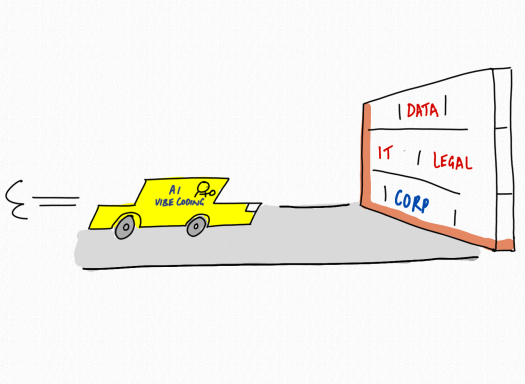
I see at least three sets of stakeholders that we must involve from the start of an AI project if it’s going to work in a large company.

IT evaluates and decides which tools are ok to use and which ones aren’t.

Microsoft has a decided advantage when it comes to large firms because they’re already on every machine and their cloud products are the standard toolkit for the majority of users.

Copilot does a lot, and if your organisation pays for it, you can get access to advanced features.

So that’s usually the place to start for the easiest route for a solution that meets IT requirements.

But there are lots of other tools that do things better than Copilot – ChatGPT, Gemini and Claude all have their own strengths – and wouldn’t it be nice to be able to use them as well?

That’s where Legal comes in. What you’re allowed to use will be determined by what levels of protection are in place. All these tools have enterprise licenses but it’s still all new.

It’s worth having in-house lawyers involved or get in external experts that can provide an opinion on what’s ok and what’s not.

Then there is the question of data.

I think that the code and computational aspects of this whole space are a commodity – you can get what you need from one provider or another, and you can spin up your own infrastructure and private LLM if you want complete control.

The thing that makes a difference is data.

Although ChatGPT and others have made it simple to connect your data sources, such as SharePoint’s, directly to their engines – I’d be surprised if many large organisations are doing this without commitment from the top down in management.

Competitive advantage in this space comes from access and control over curated and specific data that is hard to get in the open market.

It’s probably a good idea to proactively deal with these areas at the same time as you’re exploring and building solutions.

How Productive Will AI Make Us?

2025-06-18_ip.png

The question of who owns the IP produced by generative AI will have a huge impact on productivity.

The rules have been fairly straightforward for a while – don’t copy someone else’s work.

But how does this this work when an LLM generates work for you that its remixed based on other people’s work?

It looks like the platforms pass that concern over to you.

You start the process with a prompt – which you have written, so you own.

The output is yours, depending on the license terms of the AI tool you’re using. Some seem to want to hold on to the IP, so that’s not entirely straightforward.

But the output can also be a copy of someone else’s copyrighted content.

This is most obvious when you create a character that looks exactly like a commercial one, but it also applies to code, which might be harder to spot.

There is a danger zone where you prompt an AI and get output that you then use in a commercial product without checking if it infringes anything.

This leads to a few scenarios.

First, you need humans to check the work, so your productivity is limited to the ability of people to process and check what’s going on. You get a boost, but it’s small.

Second, the checking process gets automated and tools can give you output that has been checked against everything else and guaranteed to be original.

Third, existing protections are swept away and you can do what you like.

Fourth, the whole thing is like smoking. It feels good, you do it for a while, then find out that it rots your thinking and we start to move away from it as a society.

Five, the hype fades and we move onto the next thing.

Six, none of the negatives happen and the industry sorts out the issues and we become incredibly productive.

There are probably more scenarios you can think of.

Questions About AI Use In Companies

2025-06-17_soft-or.png

I have many questions as we figure out how to use generative AI.

Peter Checkland has a model that (simplifed) says that things happen – life is a flux of ideas and events.

We engage with this flux with standards. We learn from our experiences. And we modify our standards. So what are the standards that we need to think about now?

This is a non-exhaustive list for working with AI – again, more questions and observations than answers.

Monolithic or hierarchical?

Is it better to work on one big project – try and create it end to end in one-shot or work on and assemble components? The larger something gets, the more complex it is. It looks like Deep Research takes the component approach and builds up over time.

Expert Mode or Collaborative?

Should we work on projects together or have an expert go away and build tools to a specification? I’m seeing the return of interest in Extreme Programming (XP), which has pair programming as a collaborative building approach. Will we see that come back?

Exploration vs Deployment.

When you can build anything, what do you focus on? How do you move from having a mockup to something that can be used in production? Is it an extension of what you’ve made, or is it a rebuild?

The legal aspect.

This seems a thorny issue. Who owns the output of LLMs?

Let’s say you use an LLM to write code for your app. The chances are that your competition is doing the same. So, if you have the same code in both your applications, how does that work?

As far as I know you can’t copyright the output from a machine, so now is all code fair play? What if you mix this generated code with your own IP?

Cognitive accessibility

LLMs produce information far quicker than we can process them. There is a limit on what we can take in, so how are we going to reduce the flow of information so that we can actually make sense of it. I saw a post recently that said you can check 10 lines of code, but 500 is probably fine. What happens if your 200 page strategy deck goes unread and accepted because it takes too long?

Standards

We are going into this space with standards – IP protections, data management, work processes, that are being upended.

There’s a race to limit protections to support rapid development. There is a race on, and it looks like winning matters more than following rules.

Is that the new standard companies have to sign up to in order to stay relevant? Move fast and worry about the consequences later?

So many questions… You probably have more.

Is A Surface Level Understanding Enough For You?

2025-06-16_western-town.png

I was wondering when I’d get an opportunity to use Deep Research – I didn’t have any particular need for it on a day-to-day basis.

Until now.

The EURO conference is coming up next week and I’m brushing up on my history of SSM (Soft Systems Methodology).

Mingers (2000) has a table listing published case studies that use soft systems or soft OR methods.

This, I thought, might be an opportunity to test Gemini’s Deep Research.

I asked it to review the literature and create an up to date table.

The results are impressive. On the surface.

24 pages. 7,399 words. 53 references. In about half an hour.

The table in Mingers (2000) has around 51 references. Gemini has 13 – rather shallow. I assume it would do more if you asked.

The writing is fine. The structure is good. The content is relevant. The experience is dead.

There’s nothing that stands out. It feels like one of those film sets they use when making Westerns – something that looks like the real thing, but that’s empty behind.

It has the following readability grades:

  • Kincaid: 14.7
  • ARI: 16.6
  • Coleman-Liau: 18.2
  • Flesch Index: 23.6/100
  • Fog Index: 18.5
  • Lix: 62.0 = higher than school year 11
  • SMOG-Grading: 15.5

Those aren’t particularly good. Essentially lots of big words strung together.

It looks academic. Plausible. Researched, even.

But is that enough?

References


Mingers, J., 2000. An Idea Ahead of Its Time: The History and Development of Soft Systems Methodology. Systemic Practice and Action Research 13, 733–755.

Make It Hard To Copy What You Do

2025-06-14_moat.png

Are the rules of building sustainable competitive advantage changing?

I’ve used the VRIO checklist for a decade now to check if I am on track.

  1. Value – Does the activity produce value for a client?
  2. Rare – Is it a hard to find capability?
  3. Inimitability – Is it hard to copy?
  4. Organisation – Do you have the operational system to deliver?

I use the checklist to help me identify, design and implement new service lines that will have a sustainable competitive advantage.

And that’s because a sustainable competitive advantage, better known as a moat, is what sustains profitability.

If you have a moat, you can have a margin. Without it, your selling price drops to the price of production.

You’ll see comments like the cost of intelligence will drop to the cost of electricity – that’s what happens to a selling price in a world of perfect competition.

Based on that one economics class I took a while ago…

The most important item on the checklist, for me anyway, is inimitability.

If what you do is hard to copy then it’s difficult to replace and your customers stay with you.

But is AI changing that? Surely you can make a copy of any business in an instant with AI?

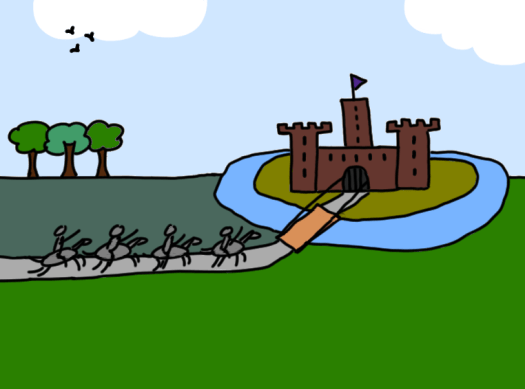
The rapid introduction of AI tools that seemingly do everything can make it feel like the barbarians are at the gate – that everything is going to change and everyone is going to be out of a job.

Perhaps we should pause for a minute.

There is a story, possibly apocryphal, about the war in the South Pacific.

Soldiers came in, built airfields, planes came with goods, and a thriving economy sprang up.

The war ended, and the soldiers left.

The islanders wanted the economy to go on, so they kept the runways paved, built new buildings out of bamboo and preserved the look of the airfields.

But no planes landed.

The point is that if a service is simple and surface level – then it is under threat from AI, automation and replication.

If it’s layered and intertwined, with a lot of tacit knowledge involved, then it’s harder to replace.

If you want this wrapped up in a single line it is still – make it hard to copy what you do to create value.