
Tuesday, 10.51pm
Sheffield, U.K.
A road’s just an opinion about which way to go. – Rudy Rucker
A few weeks back we went to visit the remains of a Roman fort at Housesteads.
Some unnervingly straight roads take you there.
It’s strange when you travel on a straight road in the UK.
If you do it usually means you’re on a road laid down by the Romans around 2,000 years ago.
I prefer to meander. It seems a more natural way to be. Or, I’m trying to excuse procrastinating.
I’m working on a paper about the history of Soft Systems Methodology (SSM).
I find that when I have a project to work on these days I start by avoiding working on the thing itself.
Instead, I find ways to think about how to work on the thing.
I started by re-reading John McPhee’s essay on Structure.
I go back to this one quite often because he insists that his students start with a structure of some sort. It can be an outline. It can be a diagram. But the starting point is always a structure.
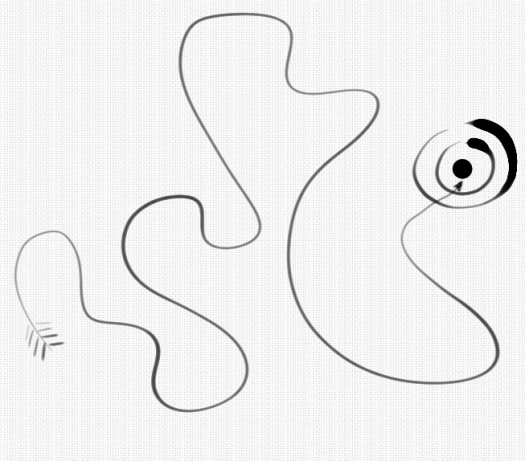
I like to start with a drawing of some kind – like the one that starts each of my posts.
The approach seems straightforward – you start with a structure, with an outline – something that you can build from like a design blueprint.
But, I think that sometimes the structure can only be seen when you aren’t looking for it.
It’s something you spy out of the corner of your eye as you distract yourself with something else.
I’ve read quite a lot about SSM over the years.
If I were following McPhee’s approach I’d first collect all my notes, sweep up all the raw material I have and put it in a pile.
Then, I’d go through this list, making and organising notes chronologically and thematically.
Then I’d look at my collections of notes and start to arrange them in a way that matched the structure I was thinking about.
And then I’d write.
This is the right way. A good way.
So why do I find it so hard to do?
Instead of following this approach I complained a lot in a series of notes.
Then I had something else to do.
When I had a few minutes free again, I tapped out an outline, something that started at the end, worked back to the beginning, and listed a number of themes that need to be put in some kind of order.
I’m finding that this approach seems to be helpful with other kinds of tasks as well.
Want to write some code?
Do your research. Read background information. Take notes.
Then, take a walk. Think about something else. Avoid working on the problem.
Then start work and see how the next stage goes.
This separation between stages, the willingness to give yourself time is hard to do – but it seems to help.
Perhaps it’s about giving your subconscious time to work on something while your conscious mind takes a break.
Still, the work does need to be done.
Perhaps tomorrow I should work on getting the outline finished.
Cheers,
Karthik Suresh
 Handcrafted insight
One Reply to “”