
Monday, 8.14pm
Sheffield, U.K.
I don’t write about good and evil with this enormous dichotomy. I write about people. I write about people doing the kinds of things that people do. – Octavia E. Butler
We live in uncertain times. The S&P500 is down 13% since the start of the year and no one really knows how things will play out.
Is this really something new?
Not really. Since I became aware that such things like markets existed, back at the start of this century, we’ve had a dot com crash, a housing crash, an energy crisis, the start of deglobalisation, a pandemic, a number of big and small wars, and what’s happening whenever you read this.
If you’re interested in making decisions under uncertainty what should you do, are there any models that can help?
I’m starting to think there aren’t.
Everything gets more complex the more you look at it.
Take something simple – the amount of time you spend reading versus the time you spend writing.
What do you read these days?
My list is depressing. I look at the BBC and CNN and get a set of world highlights.
I don’t bother with social media other than taking a brief look at LinkedIn.
I read the Economist when I remember to log into my library app, which suggested in its last issue that LinkedIn is the last space where you get useful information but that’s changing because users don’t spend enough time on it – less than an hour a week versus 35 hours on Tiktok if I remember correctly, although 35 hours – really?
I find stuff worth reading on Mastadon, where you come across pointers to posts like this one by Kat Hicks.
There’s a section in this post that talks about how you see what’s actually going on, the real rules that people play by when you’re not watching.
It talks about how to understand a thing you must also understand its opposite – things come in pairs.
This is similar to Kelly’s concept of bipolar constructs that underpins Colin Eden’s Strategic options development and analysis (SODA).
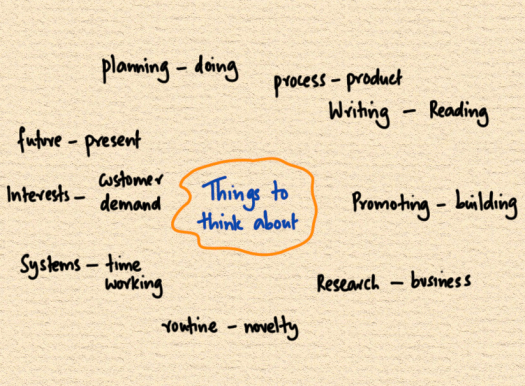
I have a lot on my mind right now and Hicks’ post reminded me of the power of pairs and I used them to jot down some of the things I’m thinking about.
Reading, in this case, led to writing.
I used a model to help me get started but, if you remember, I said earlier that I’m not sure models help that much.
So what’s going on?
I’m not going to go through the rest of my list in the image above, but what I think I’m trying to say is that life consists of contradictions.
We spend our days trying to figure out where to position ourselves between these extremes, driven partly by what we want to do and partly by what the environment demands from us.
And that means we have to be comfortable with uncertainty, with complexity, with the unavailability of clear answers and simple solutions.
We have to figure our way through situations that are never as bad as they seem and never as good as we’d like them to be.
We usually find that the future is obscured, that we see dimly, that of the many options that we could pick from none are compelling enough to commit to completely.
It’s when we commit that we take on risk. It’s when we commit that we reap rewards. How can things be both good and bad? And yet they always are.
I therefore reach this unhelpful conclusion.
Keep all your options open for as long as possible.
When given a choice between two things, do both.
Except when you have to make up your mind and commit to one thing.
Then do that.
Cheers,
Karthik Suresh
 Handcrafted insight