Why We Need To Try and Improve Rather Than Solve Situations

2025-03-27_improve-not-solve.png

Thursday, 8.57pm

Sheffield, U.K.

In boxing, they say it’s the punch you don’t see coming that knocks you out. In the wider world, the reality we ignore or deny is the one that weakens our most impassioned efforts toward improvement. – Katherine Dunn

Think of a situation, a problematic one.

Struggling to come up with one? Just have a look at the news – perhaps the productivity challenge that seems to afflict so many parts of the economy.

Why don’t things just work?

The larger operations get, the less nimble they are – elephants don’t dance, as the saying goes.

Managers in organisations find themselves in situations that they consider problematic. What tends to happen?

The most common response is increasing paralysis. Things can’t happen because other things need to happen first. And those other things require the first things to happen.

The Economist has an article about the need for countries in Europe to increase defence spending.

The recommended approach is to spend more money on tanks and drones and interceptor missiles.

But that needs more actual money.

Instead, a number of countries are using accounting techniques – reclassifying existing spending as defence spending, such as defence-related pensions.

Which is all very well if you want to hit a target. It’s much less useful if you want to actually defend yourself.

I don’t know if paralysis is the right term, there’s a lot of activity but no actual movement.

It’s the opposite of a duck, all flap but no glide.

At the other end of the scale is demolition, or what is now referred to as “delete” on the other side of the pond.

It’s more common in commercial settings where a new boss comes in and fires lots of people or sells off parts of the company.

It’s a form of surgery – cut off the parts that are diseased and what’s left has a chance to survive.

That assumes that the person in charge knows how to do surgery and isn’t hacking at random.

And, of course, that the patient survives once the surgery is done.

If you speak to insiders you realise that the medical system is not there to help you, it’s there to make money.

Far too many procedures are unnecessary.

We should really try and avoid hospitals altogether – the best defence is to stay healthy.

These first two strategies are the ones managers reach for first.

The third one, which they should reach for, is simple, but not easy.

It’s trying to improve a situation, rather than trying to find a solution.

Let’s take an example that comes up again and again in my experience.

You have a data problem of some kind – you need information to meet some obligation.

The first thing people do is look for a system – is there an app for that?

That’s looking for a solution – a one-stop shop, a magic bullet.

Magic isn’t real.

What’s real is that we do things a certain way right now.

We need to deliver something that we don’t do yet.

How do we improve what we’re doing so that we can deliver this new thing?

Improvement takes time, patience and understanding. You have to go to where the work is being done, see how it’s being done, and learn your way into making improvements.

Some people are too busy to take the time to make things better.

They are also too busy to have the time to learn what’s possible.

And I don’t really know how to address that situation – when people are unwilling or unable we either have to accept a paralysed situation or use coercive power.

And that’s no fun for anyone.

Trying to improve things is hard, unsexy, valuable work.

And, when it works, it can be fun.

Cheers,

Karthik Suresh
How To Prepare For The Coming Crisis

2025-03-15_into-the-storm.png

Saturday, 5.10pm

Sheffield, U.K.

Businesses, as well as individuals with desired talents, however, will usually find a way to cope with monetary instability as long as their goods or services are desired by the country’s citizenry. So, too, with personal skills. – Warren Buffett (2024 letter)

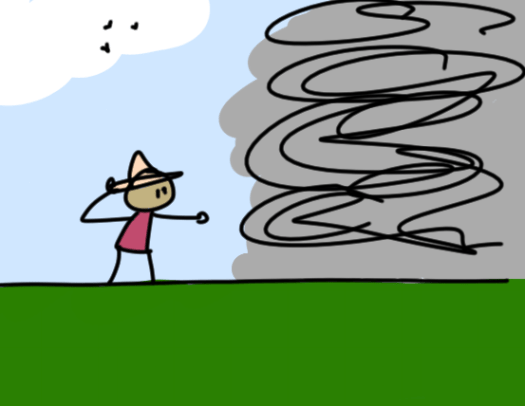
Things can seem a little bleak right now. It feels like we’re heading into stormy territory.

Markets are crashing.

The wave of optimism of the last few years, driven by hopes of an AI boom and a bonfire of regulation, have been replaced by uncertainty.

Markets hate uncertainty.

And then there is war, the actual kind and the trade kind.

Increasing protectionism and coercive politics make conflicts more likely.

How will things play out?

The one thing we know is that it’s impossible to predict what’s going to happen next.

Things could get worse. They could stay the same. They could get better. Who knows?

So, when there is such uncertainty what should you do? What should we do?

There are three things that should be in your strategy.

First, it’s about the long term.

As Benjamin Graham wrote, in the short term markets are voting machines. In the long term they are weighing machines.

If you have a 20-year horizon things will be different. If nothing else the main pieces in the game right now will be replaced on the board.

Some businesses will struggle. Others will do well. As long as you have a position in the whole market, you should stay there.

Time in the markets, as the saying goes, is more important than timing the market.

Second, it’s about sticking to your knitting

In Warren Buffett’s 2024 letter he writes that people will be able to cope with instability as long as what they do is still needed.

Try and be needed. Do useful things.

Build your business to do something people need, something that is rare and valuable, hard to imitate, which you can deliver competently.

It is time to focus on value because people are getting nervous, and when that happens they stop spending on things unless they need them.

And that sets off a downward spiral that is hard to stop – confidence is a fragile thing and unfortunately modern economies are propped up by confidence rather than substance.

Third, have a nut

I assume the term “nut” is about being like a squirrel – have a stash tucked away for the winter.

You need to have something in reserve, something that you can use if things go bad.

Something you can rely on if you have to walk away from a bad situation.

The problem with coercive methods is that they appeal to people in power and sometimes the only course of action you have is to have the power to walk away.

You cannot be controlled if you are not willing to be controlled.

Cheers,

Karthik Suresh

What We Really Need From A Product Or Service

2025-03-13_step-by-step.png

Thursday, 10.53pm

Sheffield, U.K.

Fantasy, abandoned by reason, produces impossible monsters; united with it, she is the mother of the arts and the origin of marvels. – Francisco Goya

Do you ever think about what you need from a product or service?

I find myself quite conflicted sometimes between what I need, what clients need, and what others think clients need.

Let me explain.

I was having a chat with someone about using a particular software application.

The app did something specific, as long as you gave it the data it needed.

There was still a lot of work involved in getting the data.

Once you had the data, the thing the software did wasn’t as necessary any more.

You had learned enough to do the rest of the work on your own.

I don’t think many products or services get this right.

Or, looking at it from the other end of the telescope, the products that survive do something right.

But, even then you sacrifice something.

Microsoft made it easy to use computers.

In doing so, they created a working environment where it’s easy to do easy stuff.

You just open a spreadsheet and add numbers in complicated ways.

It’s impossible, for most users, to do difficult stuff.

How many people do you know that can think of three ways to combine data from a hundred different spreadsheets?

It’s funny.

There are a thousand products that are vying for your attention.

The one thing you can be certain of is that not a single one will do everything you need.

If you push it, you’ll reach the limits eventually. Maybe even very soon.

Maybe we should think of software like we think of cars.

Worryingly, some are three-wheelers, economical perhaps but prone to tipping over if you go around a corner too fast.

Some are amazing, and come with a price tag to match.

There’s a tradeoff between factors such as speed, comfort, style, and cost.

How do you choose one? Pick the one that meets your needs.

The thing I am starting to see is that we should be using lean principles more when selecting software tools.

The most important principle is flow.

What happens next after you use the software? What happens before it? If the product doesn’t contribute to flow, then do you need it at all?

The second is to use what you already have.

If you’ve invested in systems, then you should make the most of them before buying anything else.

Then you should use Free/Libre/Open Source Software (FLOSS).

You should only choose something proprietory and controlled when you have no other choice.

Even then, think about what you will do if your access to that software is cut off – something that’s not unthinkable these days.

What will you do then?

I think we are moving into a world where it will be profitable to operate open source models.

The challenge these days is getting anyone to use your software at all.

The more users you have the more likely it is that you’ll find ones that are willing to pay.

You may not make billions but you’ll find a business model that creates value.

This may be a hard thing for some business people to understand.

Why would you invest in FLOSS?

It comes down to a belief that software is too important to be left to markets.

A child anywhere in the world should be able to access and use computers to find information, learn, and create.

People go to great lengths to control access to physical resources.

That’s bad enough.

We cannot afford to have others control our intellectual resources.

We need to be free to think.

That’s an unexpected conclusion.

What we need, from any product or service, is for it to help us stay free.

Cheers,

Karthik Suresh

Technology And Us

2025-03-12_handwriting.png

Wednesday, 9.53pm

Sheffield, U.K.

Technology is a useful servant but a dangerous master. – Christian Lous Lange

Technology should make our lives easier.

And it does.

But we also experience the unintended consequences of using technology.

Figuring out how to integrate technology into our lives without compromising the quality of our lives is a challenge more and more of us face.

An interesting example.

Yesterday, one of the not-so-small people in the house asked for help with his French homework.

I don’t speak French.

His pronunciation sounded problematic.

I took a picture of the page he was trying to practice, written in his handwriting.

ChatGPT transcribed it flawlessly.

Another AI generated French speech, complete with the right accent.

I sent the mp3 to his phone, and he had everything he needed to practice and learn the text.

Handwriting transcription would help me immensely.

Typing by hand makes my wrist hurt.

I’ve typed a lot of words in my time – and RSI was perhaps inevitable.

I work digitally because it’s efficient and because I don’t need paper.

But if I could just write by hand and get a decent transcription, then maybe I’d reduce wear & tear on my wrist.

That would be good, wouldn’t it?

The thing that worries us about technology is its impact on children.

We see them engrossed in devices, watching for much longer than we think is safe.

We see them move through a virtual world that is more pleasurable and fulfilling than the real world.

We fear they may get lost and never return.

Then there is technology that just makes things worse – like some workplace technologies.

The kind of technology that is about controlling and surveilling the worker rather than automating repetitive work.

Tech that prevents us getting work done, and instead pretends that process is the same as progress.

But there is progress.

And I remain optimistic that technology can do more good than bad for so many of us.

Cheers,

Karthik Suresh

When Should A Ladder Not Be Climbed

2025-03-11_ladders.png

Tuesday, 9.50pm

Sheffield, U.K.

Success breeds complacency. Complacency breeds failure. Only the paranoid survive. – Andy Grove

Is there a point when an organisation starts to fail?

Or are there crucial points, when the decisions they make lead to success or failure?

Let me put some context around the question.

A startup run by owner founders is a dynamic and interesting place to work.

We build things for clients. As owners, we take a keen interest in how to make things work better. We hire people with fire, people that want to work on interesting things that make a difference.

And the business grows.

Eventually, we take on staff and those staff come into job roles. There is a specification, often a hastily written one. There is a niche, a box, a hole to fit a human shaped peg.

And soon, we have more pegs in holes than creative product building types because we already have a product and customers and what matters is getting customers served.

Eventually, everything we do is so structured that people who want to build new things can’t do that because the existing structure constrains them.

They’re mummified in a web of their own making.

Well, actually, they just opt out, either leaving or being invited to leave.

After a while, what you’re left with is a company full of people who know how to do their jobs but don’t know how to build products.

It’s time to change leaders at this point but really that makes no difference.

What matters is the market you’re in.

As Warren Buffett has said, a great business will do well even with average management. A great management team will not be able to rescue a poor business.

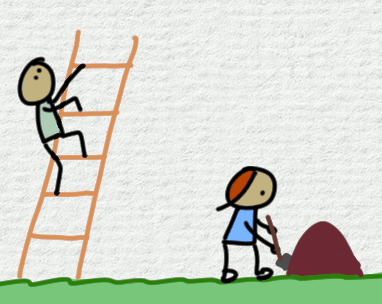
So why do people want jobs so badly – why do they want to climb ladders that lead nowhere?

I suppose some ladders do lead to big jobs and good benefits and a permanent feeling of unease.

What’s it like having a job where you don’t actually do anything?

Real satisfaction comes from being close to the ground, working on something that interests you.

Why not wrap a business around that instead?

Cheers,

Karthik Suresh

There Is A Sweet Spot For Thinking And Learning

2025-03-07_speed.png

Just remember, once you’re over the hill you begin to pick up speed. – Charles M. Schulz

I started the year planning to read the news more often.

I think it might make more sense just to stop altogether for the next four or so years.

Intelligence officials talk about monitoring chatter, a measure of the volume of communications.

You can use this technique with news as well now.

What I mean is that you don’t need to read the news, you just need to monitor how much something is mentioned.

Ten years back I had to read what was going on to know about certain bits of regulation.

Now, I can tell what’s happening and if its good or bad by monitoring my LinkedIn feed – not reading anything because who has time for that and posts are getting longer and longer – but just glancing at and noting the number of posts on any particular topic.

And this leads to a problem – what can you trust?

Not the mainstream news – even though I think many journalists want to tell a good story they’re forced down to do things that get clicks and traffic.

That is, if they still have a job. Because AI will clearly do that better and faster and cheaper.

Well, faster and cheaper anyway.

And the rest of the Internet is a cesspool of opinions anyway.

The most you can do is notice the pros and cons of a topic and see how things turn out.

Let’s take AI as an example.

My feed is filled roughly equally with evangelists and haters.

The evangelists think this will change everything.

The haters think it’s buggy and slow and not useful.

Me? I think it comes down to people and what feels right to them.

You’re probably somewhere on a slope when it comes to your experience of technology.

You don’t really like it, it gets in the way of doing what you really want to do. You don’t want to wrestle with a computer, you just want to get things done but it feels like you’re going backwards.

You use it because you have to but it really makes no difference. You’re about as fast with a computer as you are with a pencil and paper. It doesn’t add anything but it doesn’t get in the way either.

Then there’s a sweet spot, where you get the technology and the technology works for you. It’s accessible and understandable and you can get things done fast and well.

Finally, there’s the point where the technology moves too quickly for you to understand. Some people get it, but the rest of us are left behind.

Hopefully by that time you’ve made enough money to retire.

I think there’s a place for technology that doesn’t require human input, that replaces the effort altogether and there are countless examples of how that makes life better and civilisation possible.

But technology for people has to be at a level that serves them – that helps them to think and do what they need to do.

The right technology for me to think and work is unlikely to be the right one for you.

What’s important is getting a technology stack set up that lets you get on and work on what makes you happy.

And, of course, sometimes you just need to learn how to use the technology in front of you so that you can get on with the work.

There is a sweet spot, the right slope downhill that is fun rather than fearful.

That’s what you need to find.

Cheers,

Karthik Suresh

Why Do We Struggle To Be Productive In Organisations?

2025-03-05_information-systems.png

The least productive people are usually the ones who are most in favor of holding meetings. – Thomas Sowell

I’m looking at David Graeber’s “Bullsh*t jobs”, and just thinking about the challenge of doing useful work in an organisation, especially a large one.

The thing about being in a large organisation is that you have a real chance of making an impact.

Large organisations often prefer to work with other large organisations, so you are exposed to problems that you just wouldn’t see elsewhere.

You start to see how people make decisions about some really quite substantial sums of money.

And you also start to see how so many organisational problem situations are caused be internal rather than external forces.

Take hiring, for example.

When the amount of work we have increases we think that we need someone else – another body to help out.

That kicks off a process – you need to spec the role, figure out what the pay level should be, get permissions, advertise, interview, and appoint someone.

And then the cycle repeats itself – you have more work and your recruit has more work and it’s time to go and get someone new to help out.

Before we go down this route, however, we should really ask a couple of questions.

First, does this work need doing at all?

You’ll be surprised at just how much work is pointless work.

It’s not designed to be pointless – someone probably thought it was a really good idea – but it ends up being pointless because it’s not worth doing at all.

Of course, everything is more complicated than that.

Let’s argue that a particular type of work is pointless – like a formal performance review.

You don’t want to do it and your manager doesn’t want to do it. Surely you can just have a chat instead and talk about what went right or wrong.

That would be efficient, right?

But the reason you have these reviews is for more than feedback.

It’s a mechanism to show you’ve been treated fairly. A tool to ensure that the company has a record of how it’s dealt with you in case things go wrong.

So, from a legal point of view, doing all this extra work is worth it to avoid being sued.

And that’s hard to argue against.

Even though in almost every case you should.

The second question is whether you really need to hire someone.

Can a script do the job instead – what can you get a computer to do rather than a person?

Not because you don’t want to hire someone but because there is no point hiring a person to do something a machine should be doing.

Far too many jobs, especially temp positions, are of this type.

The difficulty is that the majority of people don’t have the skills needed to make computers work for them – and this is something, I am told, that’s getting worse for young people who have grown up tapping tablets.

Let’s wrap up this stream of thought.

Productive teams are small, have the minimum number of people needed to collaborate and use technology effectively to get things done.

Cheers,

Karthik Suresh

How Do You Make Yourself Resilient?

2025-03-04_freedom.png

Monday, 10.07pm

Sheffield, U.K.

We don’t have a monopoly. We have market share. There’s a difference. – Steve Ballmer

I’ve been thinking a little about resilience and what it means for us as individuals.

How do you think people get fired these days?

There are a lot of stories around but I think the general approach is that you have a short meeting with your boss and a HR rep and are told that you’ve been let go.

And that’s it. Your email is turned off. You lose access to company resources. You’re out there on your own.

So what happens next?

For the majority of people this is going to be discombobulating, a shock to the system.

If you’ve been cocooned in an organisation for a long time it’s hard to see how things can function without all that support around you.

Who’s going to give you a computer? Who’s going fix the printer? How do you set up a website? How does email work?

These are not hard things, if you know what you’re doing.

They might seem the hardest things ever if you’re facing them for the first time.

So, a first step to becoming more resilient is having alternatives in place before you need them.

If you were fired today what would you do?

Make a list of actions.

Then do as many of them now as you can.

You may never need to carry out your plan but if something does happen, you’ll thank your younger self for being prepared.

When it comes to computers why do so many people build their lives around online applications?

You don’t control them. They could get turned off at any time. They could double their prices.

There really is no reason to use them unless you have no alternative.

Install GNU/Linux on a spare computer and start using it and you’ll have all the software you need to get everything done.

But… that takes time and is hard. It’s much easier to log in on a browser and get on with it.

The problem is this – it’s a constant tradeoff between freedom and convenience.

It’s convenient to have a stable job, and it’s convenient to have someone else sort out the software for you, so you can focus on doing what you like.

But, when doing what you want to do depends on resources controlled by others, then you don’t really have a choice – there’s no freedom there.

Freedom is a function of the resources you control.

In one special and unique case, that of Free Software, you own resources that others own as well and no one has any less than anyone else.

There’s a final set of choices that are harder to work through.

Many technology services are built to capture market share – ideally everyone uses the one thing and it becomes an effective monopoly through capturing most of the market.

Think Google. And what OpenAI wants to be.

For some people going all in on Google made them rich.

Until changes in the algorithm broke their business models.

You might think all these thoughts are only relevant in this modern world of ours.

But it’s not.

I’m reading a biography of Shakespeare that reminds us that he once wrote “Like a fair house built upon another man’s ground; so that I have lost my edifice by mistaking the place where I erected it.

In other words, if you build on someone else’s land what you build belongs to the person who owns the land.

Read the terms of service for any product if you don’t think that’s the case.

And then, when you’re making choices, remember how the three little pigs made theirs.

Cheers,

Karthik Suresh

Using a Process View To Build Businesses

2025-03-03_process-view.png

Monday, 6.45pm

Sheffield, U.K.

If you can’t describe what you are doing as a process, you don’t know what you’re doing. – W. Edwards Deming

I have been thinking about transitions and how they take place.

I think we imagine that they will be big and impactful, we’ll know when they’re happening and there will be plenty of time to see what’s coming.

But what we see is the final spectacle, not the moments that lead up to it, such that the end, when it happens is always a surprise.

Think of those sheets of ice falling off Antarctic glaciers – the slow warming over time, the gradual weakening – and then the sudden, catastrophic failure.

We don’t want that to happen, not to us, and not to the businesses we build.

Instead, we want what Nassim Nicolas Taleb refers to as antifragility.

Disorder is something that happens periodically – life is just thing after another.

Disorder can be frightening. It can also be an opportunity.

And one way to go after the opportunities is to think of what needs to be done through a process view.

A process view is a popular way to look at the world because things happen one after another, history matters, and connections matter.

If we think about the process of doing anything – writing a book, starting a business, cooking a meal – the same principles apply.

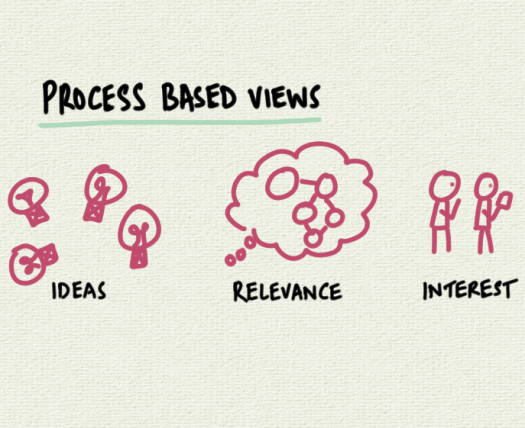
We start with ideas – questions, things that might work.

We filter them for relevance – are they things we can do? Do we have the capabilities and skills to execute? Do we have the resources we need?

Then, is it worth doing. Is it interesting enough to stop someone who is busy looking at their phone to stop and pay attention?

When you’re not sure what to do next, step back and set out your process.

Then begin.

Cheers,

Karthik Suresh