
Sunday, 6.07am
Sheffield, U.K.
Life is lived on levels and arrived at in stages. – Edwin Louis Cole
As some of you know, I began this blog with the aim of writing a million words in ten years to throw away. I had no idea what I would write about, what readers might like, or what I might get out of it. I knew that I liked writing and I wanted to do more of it, but better.
I have around 90,000 words left to go and I want to use these last 200 or so posts to get ready for the next stage, whatever that is. But first let’s look at the journey so far and what lessons I have learned.
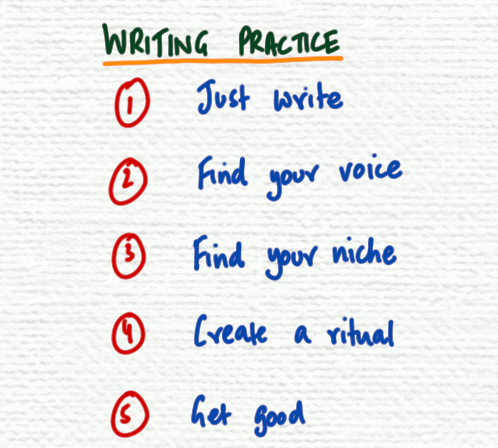
What makes a writing practice?
1. Just write
In the beginning it’s ok to have no idea what you’re doing. No one knows about you. You don’t have hundreds or thousands of readers waiting for your next post to drop. You’re unknown and anonymous and that’s a very freeing place to be.
At this stage the job is to create something. Anything. And create a lot of it.
You will not do great work from the beginning. It will not even be good. You might even be embarrassed by it looking back. But you’ll be making something. And that gets you started.
2. Find your voice
When we first start to write we think there is a particular way to do things – the “right” way. We need to use big words, show how clever we are, create complex arguments and talk about big, important things.
Eventually you realize that writing is a conversation. It’s a chat between you, the writer, and one friend.
It’s not a transcript of the conversation either. Such a document is full of “ums” and “like”. It’s the conversation you wished you could have, the one where you got your thoughts straightened out and plainly said what you thought. The time when you were understood.
If you write for long enough you’ll find your way of speaking through the scrawl. The style that marks your work. Look for this and hold on to it because this is where you find the real “you”.
3. Find your niche
It’s no fun writing about something that bores you. Find an area that is endlessly fascinating that you want to return to time after time.
For me that area is the intersection of decision making, visual thinking and technology.
In other words, I like to use drawing and writing as a way to learn and think about the world around me and make better choices that lead to peace of mind.
That gives me a lot to think, read and write about.
4. Create a ritual
Production requires a process. One that’s simple and repeatable.
I tend to write around the same time every day. Except today, and I’ll come back to that in the next section. I draw a picture. I write in a text editor. I have a set of scripts that make my writing faster. And I post to WordPress when I’m done.
This ritual make it easier to go from nothing to something to done.
I sometimes tweak the ritual and then realize that I shouldn’t have done that. It’s working. Step away and mess with something else instead.
5. Get good
This is the hard one. How do you make something that others like?
There is one answer to this and you can remember it with the acronyms WET and WETT.
Let’s start with the first one. I am trying to make my life harder by using WET to write each of the next 200 posts. WET stands for “Write Everything Twice”. I wrote this post by hand on blank A4 paper on a clipboard with a pencil last night and then rewrote it this morning. I didn’t type it up. I looked at my draft from yesterday and rewrote it.
My original draft had a first page that was trying to get into a story. The key stuff only started at paragraph 5. The draft worked its way into a sequence of ideas, which I reworked into a list.
This second version is better than the first. It’s tighter. More compact. More useful. Better.
How could I make it good?
I’m up against time on a blog post. I can justify a couple of hours but not much more. But for a paper that I plan to publish I can justify spending an hour on a sentence. And that’s where the second acronym comes in.
WETT stands for Write Everything Ten Times. Rework each sentence one at a time. This is a technique I learned from Jordan Peterson’s “Essay”. Take what you write, split it into sentences and write another version of each sentence and then another one until you are happy that it says exactly what you want to say.
Making your writing good is a process of iteration. Of working over and over until your message is crystal clear.
End note
Natalie Goldberg in “Writing down the bones” writes about her struggles with meditation and how her teacher said to her, “Why do you come to sit meditation? Why don’t you make writing your practice? If you go deep enough in writing, it will take you everyplace.”
It really will.
Cheers,
Karthik Suresh
 Handcrafted insight