The Trouble With Meetings

2024-05-24_meetings.png

Friday, 8.56pm

Sheffield, U.K.

If you had to identify, in one word, the reason why the human race has not achieved, and never will achieve, its full potential, that word would be ‘meetings.’ – Dave Barry

I had an idea.

I have to give a presentation at a conference at the end of the month and it’s on using writing and drawing to think more clearly.

What better way to prepare than to work through a script over the next few posts with you?

So let’s begin with a question: why are meetings so dreadful?

I think it’s down to one simple reason – we’re not biologically designed to have them.

When we were frogs and fish decision making was simple: we either ate it, tried to have sex with it, or ran away from it.

When we became wolves and buffalo and lions we did those three things but we also added a fourth thing: let’s do what the others are doing.

We created group behaviour in social groups.

Most group behaviour deals with the same issues – shall we go there together or run away together? Or if everything’s ok, shall we stop and fight amongst ourselves?

Ok, but let’s focus specifically on that curious aspect of modern life – the meeting.

I think meetings don’t work because our brains can’t cope with the cognitive demands of the task when we try and run a meeting without the help of tools.

Think about the last meeting or call you had. Did you all have a conversation? Did you feel heard? Do you remember what everyone else said? Did you stay on track or drift? Did you make a decision? Were you happy?

Many meetings can be visualised as a period of time when people get together and let the air out of their lungs. And when they’re done talking nothing is left but the sound of silence.

This is because you can’t listen to someone else, listen to yourself working out what you’re going to say, listen to yourself creating a response to what you’re hearing, and remember what else was said earlier by someone else.

Your brain just can’t keep up. It simply drops the information.

“No problem”, you say. “I take notes.” And that’s great. That’s an answer. But that helps you. What about the group?

What we’ve done as a species is take things outside our bodies. There’s a technical term for this that I can’t remember but it basically means that we couldn’t survive on our own any more. We’ve externalised our digestive system, for example. We’ve got to cook food before we eat it in many cases.

It’s the same with our brains. If we want to use them effectively we need to get a lot of stuff out of there so we can function more effectively in information rich situations like a meeting. We invented writing to help with this and it’s an incredibly efficient way to hold on to more information than you can remember.

This is the essence of my argument for the presentation. If you take notes you remember more. If you take notes for everyone in a shared space that everyone can see then you transform the meeting experience for people. I call this approach “Rich Notes” and it’s a way of helping small groups grapple with complicated problems in a brain friendly way. It helps you load and unload data from everyone’s brain in real time to help you have better conversations, appreciate other people’s points of view and reach agreement on what to do next.

Sounds like magic?

But it’s not easy to do.

In the next post I’ll talk about what Rich Notes are, as I understand them at this point in time.

Cheers,

Karthik Suresh
The Entrepreneur’s Guide To Growing Up

2024-05-23_explorer-manager.png

Thursday, 8.41pm Sheffield, U.K

The entrepreneur always searches for change, responds to it, and exploits it as an opportunity. – Peter Drucker

I came across a paper by Fine et al., (2022) that looked at operations management for entrepreneurs. Entrepreneurs have been ignored by researchers. Most research is done in large companies and the standard subjects taught in universities focus on the needs of mature firms with large supply chains and complex operations. Startups are different. They don’t follow a formula. Some find customers and then figure out operations. Others do the reverse.

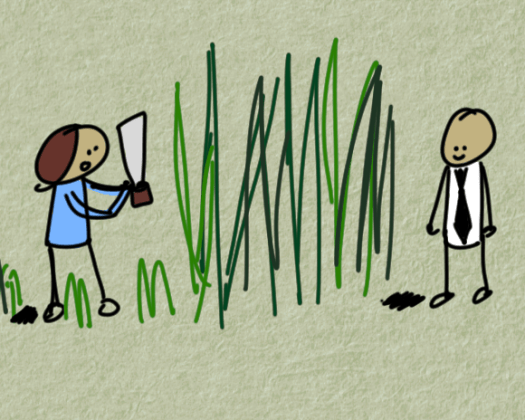
People who love startups will identify with the metaphor of a small group hacking through dense jungle. You need guts, courage, a belief in yourself, and the ability to withstand mosquito bites and the odd tiger attack. Cash is everything. Speed of movement is more important than quality. You want a determined team that can improvise on the fly rather than waiting for direction. Good communication, quick decisions, and getting away from charging elephants quickly is vital for survival.

At some point, the startup founders get through the jungle and find a place to make camp. They might stay here for a while. They might even create a village. But how do you handle that transition effectively? There are at least 10 things to think about.

1. Process

You need to go from ad-hoc one-off things to repeatable activities. If you follow a series of steps to get things done, then you can reflect on those steps and make them better over time.

2. Professionals

It’s time to get the professionals in. Find some “grown-ups” that wear suits and manage things and put them in charge.

3. Culture

This is how people behave when you aren’t around. Culture comes from the top. They way the boss behaves is the way everyone else acts.

4. Automation

Computers should make your life easier. Learn how to use them well.

5. Segmentation

Create a package of work that you can sell that provides a bundle of benefits to a customer. Do one thing and do it to completion. When you’ve tapped your market expand carefully without damaging your first offering.

6. Platforms

It works for some businesses if you’re lucky or a first mover or have lots of money or are lucky.

7. Collaboration

Leave your ego at the door and get good at working with others. Relationships will help you grow faster but you’ll have to share profits with your partners.

8. Capitalization

If you need money, you’ll need to share equity and give up control over your business. Pick your funders carefully.

9. Replication

Once you have a working model, you’ll want to do this over and over again, either the same way or with some customisation. Think about that.

10. Evaluation

Take time to check where you’re going. Are your numbers on track? What’s the voice of the process telling you? Hope this sparks a few thoughts.

Cheers,

Karthik Suresh

References

Fine, C.H., Padurean, L., Naumov, S., 2022. Operations for entrepreneurs: Can Operations Management make a difference in entrepreneurial theory and practice? Production and Operations Management 31, 4599–4615. https://doi.org/10.1111/poms.13851

How To Plan A Content Schedule

2024-05-21_planning.png

Tuesday, 8.15pm

Sheffield, U.K.

Adventure is just bad planning. – Roald Amundsen

If the purpose of business is to create a customer then the purpose of marketing is to create a conversation.

People can’t talk to you if they don’t know you exist. If they’re not aware of you.

It’s easier than ever to get in front of people.

Or is it?

More accurately, you have a small chance of getting your content into the social media feed if you post something relevant and the algorithmic gods smile on you.

It is, when you think about it, the mathematics of the casino.

LinkedIn plays the role of the house.

I’m picking LinkedIn because it’s the platform for B2B firms.

The algorithm has to work well enough to give you a buzz but not so well that you don’t need to use the paid promotion options.

It also has to keep you hooked by showing you a small handful of superstar winners that so you can see what wild success looks like.

Too cynical?

I don’t know. It’s the game we have to play. And it’s easier to play a game when you like doing what you’re doing and have a plan. One that will give you an outcome regardless of what happens on the platform.

Why am I telling you this?

Over the next few weeks I will be running an experiment to see if I can systematically create content for my professional practice on LinkedIn.

I mentioned yesterday that this blog is where I think and my professional practice is where I do.

So I’d like to share with you how I’m going to go about planning this experiment.

The first thing is putting some constraints around the kind of content I’m going to share.

I’m going to stick with 5,000 year old technology: text and handmade drawings.

Luk Smeyers has a great resource on creating a content machine if you’re a consultant.

And it comes down to a few key points.

  1. What can you write about that others will find valuable?
  2. What topics are your audience interested in?
  3. Can you create and stick to a schedule

A good idea is to create a cadence and share a particular kind of thing each day of the week.

Smeyer’s example is is advice on Monday, case studies Tuesday and Wednesday, newsletter on Thursday, advice as a carousel Friday, a reshare Saturday, and a shoutout to other creators on Sunday.

I don’t know if I can be as consistent – it all depends on how much time it takes but if it’s all taking too long there’s a simple fix.

Reduce the scope to fit the time you have.

The important thing is to ship. You don’t lose until you stop playing.

Cheers,

Karthik Suresh

How To Use Reflection To Build A Business

2024-05-20_reflection.png

Monday, 8.33pm

Sheffield, U.K.

By three methods we may learn wisdom: First, by reflection, which is noblest; Second, by imitation, which is easiest; and third by experience, which is the bitterest. – Confucius

There are two learning loops we all use all the time.

The first is single loop learning, which is thinking about what you do.

If you take a metaphorical step back and look at yourself doing what you do, that’s double loop learning.

Also known as reflection.

The “real” work happens in the doing, where the shovel meets the dung, the rubber meets the paper and the groceries meet the bag.

Reflection is about whether you’re going about the doing in the right way.

You can use one easy question for both types of thinking.

How do you help your client?

Ask it with the correct emphasis.

How do you help your client?

What value do they get from you? What is the bundle of benefits you offer?

What physical thing, monetary saving or peace of mind do you offer?

Then ask, how do you help your client?

What is it about the way you apply yourself – what knowledge, what approach do you bring to bear on their situation?

What is unique about your background and methods?

Why would those be particularly useful for a specific type of client?

The best way to think about these ideas is to write and apply what you’ve learned to build your business.

One kind of thinking is about the job. The other is about the “meta” aspects of the job. Keep these two separate. For example, I use this blog as a place to explore the meta but I use my professional social media to think about my specific area of practice.

Be clear about you you’re talking to and why.

How do you know when you’ve done enough thinking?

You’re never really done, but a good way to do this is to ask questions.

If you’ve thought about your work and written something about it then ask “What will my client do after reading this?”

You’ve hit the mark if reading what you’ve written leads to action, to doing something.

If you’ve written a reflective piece then you can ask, “What will I change about myself now?”

Growth begins when you recognize that something has to change.

You can do all this work and put your writing in a drawer, but you might be tempted to share it.

There are pros and cons.

You’ll get feedback – people will like what you write and say so or you’ll get ignored.

Feedback is good.

But we’re a social species and it’s easy to get addicted to checking whether people have noticed and responded to what you’re saying.

Feedback is to help you get better, not to make you feel better or worse.

That’s what reflection is for.

Cheers,

Karthik Suresh

The Challenge With Being Productive

2024-05-19_productivity.png

Sunday, 9.05pm

Sheffield, U.K.

Should you find yourself in a chronically leaking boat, energy devoted to changing vessels is likely to be more productive than energy devoted to patching leaks. – Warren Buffett

How many productivity systems have you tried? Sometimes I feel like I’ve tried all of them.

Each one’s strengths is also a weakness.

Here are some of the challenges I struggle with.

1. Notebook or loose leaf?

Notebooks are beautiful to work with but information, once captured, is stuck like a dinosaur in a tar pit.

You need to remember where things are and if you write a lot going back to book 3 when you’re working on book 8 to find a quote or paper summary can be trying.

Loose leaf sheets are easy to move and we can keep related information together but after a small amount of use becomes a nightmare to administer if you’re not on top of things.

It’s just easier to throw the pile away and start again.

Track everything or just the important stuff?

Do you list every action or hope that the world will remind you when something needs doing while you focus on the one or two things that you really have to do?

Losing track of tasks leads to problems. Sometimes they’re small things and can be fixed easily. Sometimes they’re bigger and customers get upset. Sometimes it’s missing your taxes and you’re then in trouble.

The danger with being on top of the small stuff is that at the end of the year you have nothing to show because all the little details were done but you had no time left to work on your big goals.

Analog or digital?

Do you go straight to the computer or work offline first?

Are computers for data analysis and text editing while paper is for thinking and first drafts or are you just making it slower to get your work done?

This is a difficult one.

Computers make things faster. But it also makes our lives slower.

I spend too much time scrolling and not enough time thinking and reading.

When I was younger, I could read five books in a day. These days I have to wait for holidays or eke out a few tens of pages at a time.

Is that progress?

I’m not convinced. We’re so afraid of missing out, about not being visible, that we give away our time for free – the one non-renewable resource that you can’t produce more of.

End note

We could have a long chat about just these three topics.

People have been successful using different methods. Richard Branson and his notebooks. David Allen favoured loose leaf sheets. Some people have many lists. Others have none.

The tools you have aren’t going to do the work for you.

They’re there to support you in doing the work.

So the only person that can decide if a tool is good or bad is you, by using it in action.

The test is whether using the tool helps you produce the outputs you want to create. Then you can decide whether to keep it or not.

What really matters is that every day you take another step into the future.

Cheers,

Karthik Suresh

The Stages Of My Writing Practice

2024-05-19_writing-practice.png

Sunday, 6.07am

Sheffield, U.K.

Life is lived on levels and arrived at in stages. – Edwin Louis Cole

As some of you know, I began this blog with the aim of writing a million words in ten years to throw away. I had no idea what I would write about, what readers might like, or what I might get out of it. I knew that I liked writing and I wanted to do more of it, but better.

I have around 90,000 words left to go and I want to use these last 200 or so posts to get ready for the next stage, whatever that is. But first let’s look at the journey so far and what lessons I have learned.

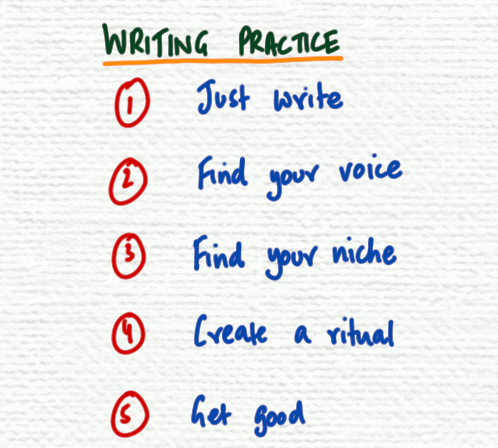
What makes a writing practice?

1. Just write

In the beginning it’s ok to have no idea what you’re doing. No one knows about you. You don’t have hundreds or thousands of readers waiting for your next post to drop. You’re unknown and anonymous and that’s a very freeing place to be.

At this stage the job is to create something. Anything. And create a lot of it.

You will not do great work from the beginning. It will not even be good. You might even be embarrassed by it looking back. But you’ll be making something. And that gets you started.

2. Find your voice

When we first start to write we think there is a particular way to do things – the “right” way. We need to use big words, show how clever we are, create complex arguments and talk about big, important things.

Eventually you realize that writing is a conversation. It’s a chat between you, the writer, and one friend.

It’s not a transcript of the conversation either. Such a document is full of “ums” and “like”. It’s the conversation you wished you could have, the one where you got your thoughts straightened out and plainly said what you thought. The time when you were understood.

If you write for long enough you’ll find your way of speaking through the scrawl. The style that marks your work. Look for this and hold on to it because this is where you find the real “you”.

3. Find your niche

It’s no fun writing about something that bores you. Find an area that is endlessly fascinating that you want to return to time after time.

For me that area is the intersection of decision making, visual thinking and technology.

In other words, I like to use drawing and writing as a way to learn and think about the world around me and make better choices that lead to peace of mind.

That gives me a lot to think, read and write about.

4. Create a ritual

Production requires a process. One that’s simple and repeatable.

I tend to write around the same time every day. Except today, and I’ll come back to that in the next section. I draw a picture. I write in a text editor. I have a set of scripts that make my writing faster. And I post to WordPress when I’m done.

This ritual make it easier to go from nothing to something to done.

I sometimes tweak the ritual and then realize that I shouldn’t have done that. It’s working. Step away and mess with something else instead.

5. Get good

This is the hard one. How do you make something that others like?

There is one answer to this and you can remember it with the acronyms WET and WETT.

Let’s start with the first one. I am trying to make my life harder by using WET to write each of the next 200 posts. WET stands for “Write Everything Twice”. I wrote this post by hand on blank A4 paper on a clipboard with a pencil last night and then rewrote it this morning. I didn’t type it up. I looked at my draft from yesterday and rewrote it.

My original draft had a first page that was trying to get into a story. The key stuff only started at paragraph 5. The draft worked its way into a sequence of ideas, which I reworked into a list.

This second version is better than the first. It’s tighter. More compact. More useful. Better.

How could I make it good?

I’m up against time on a blog post. I can justify a couple of hours but not much more. But for a paper that I plan to publish I can justify spending an hour on a sentence. And that’s where the second acronym comes in.

WETT stands for Write Everything Ten Times. Rework each sentence one at a time. This is a technique I learned from Jordan Peterson’s “Essay”. Take what you write, split it into sentences and write another version of each sentence and then another one until you are happy that it says exactly what you want to say.

Making your writing good is a process of iteration. Of working over and over until your message is crystal clear.

End note

Natalie Goldberg in “Writing down the bones” writes about her struggles with meditation and how her teacher said to her, “Why do you come to sit meditation? Why don’t you make writing your practice? If you go deep enough in writing, it will take you everyplace.”

It really will.

Cheers,

Karthik Suresh

What Will Make Your Business Succeed In 2024?

2024-05-17_service-success.png

Friday, 9.47pm

Sheffield, U.K.

Coming together is a beginning; keeping together is progress; working together is success. – Edward Everett Hale

What’s going to make you stand out?

It looks like AI is going to take over the world. We seem to see new capabilities every day. It can write better than we can, make better poems, draw better pictures, create better videos and do everything faster.

Or can it?

I think we’re still trying to work out our relationship with this new machine. And perhaps the way to think about it is consider our relationships with earlier machines.

The car made the horse irrelevant but it didn’t remove the need for transport.

By making it easier to travel we ended up travelling more – but did that result in a better situation?

Define better?

It’s better in that you can drive further in a day than you ever could before.

But it’s also resulted in commuting, something that will ruin your health as you sit for hours every day and snack on chocolate and crisps.

Technology makes things different. And different does not mean better.

What we’re already seeing is a lot of auto-generated rubbish.

And it really is unreadable, some of this stuff, generic and vanilla and just plain boring.

Now that will change. The algorithms will work out what we pay attention to and fine tune content so that we’re drawn to keep consuming it.

But while it’s doing that you have time to react. And what you’ve got to do is lean into the “human” bits of what you do.

Here’s the thing. The only thing that’s worthwhile doing is providing a human with something to do.

Give someone a good story, a great experience, a thing they love.

I know that when I read something from a real person that I like it makes me feel good.

And when I read something good that has a whiff of AI generated stuff I feel a little cheated, a little like my trust has been violated.

I wanted to connect with you – not have a machine play with my neural circuitry and make me respond in the way it wanted.

No one likes being manipulated.

But we all like to connect and experience something real.

How should you respond?

I think technology is often a good thing. AI can help. It should definitely be part of your workflow and you should try and see how it can help you do better work.

But you’ve got to remember that in many cases there’s a person that you’re trying to connect with.

In 2024, if you want to succeed, one way is to make your service as personal as possible.

How do you do that?

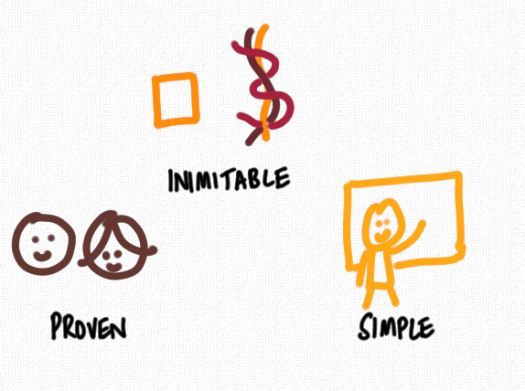
There are three things to think about.

First, what is it about the way you do things that is inimitable – that’s hard to copy?

For me it’s the hand made approach to thinking that I use. It’s simple, a pencil and paper, doodles to work through ideas. The kind of thing that is literally generated by my body.

You can do it, but you’ll do it differently. An AI can do something but I’m not sure what without a brain to connect with it.

Second, make stuff people like. Make things for people. Don’t just create “content”. Create something a person wants to read or engage with because it has a part of you in it.

And finally, talk about what you do in simple terms – connect and teach others. Write about your work and why you do it.

That’s why I’m quite keen on watching how the search engine Clew works out. It’s a place where you can find real people writing rather than the auto-generated spam that the big technology providers are leaning into developing.

I’m hoping that there is still a place for a human approach to service.

Cheers,

Karthik Suresh

The One Message To Get Across If You Want The Sale

2024-05-16_what-we-want.png

Thursday, 9.20pm

Sheffield, U.K.

One of my great regrets, and I don’t have many, is that I spent too long putting people’s status and reputation ahead of their more important qualities. I learned far too late in life that a long list of letters after someone’s name is no guarantee of compassion, kindness, humour, all the far more relevant stuff. – Bill Nighy

I have had Will Storr’s “The science of storytelling” lying around for a long time.

Yesterday I finally blitzed through it.

Stories, it turns out, are fundamental to human nature. They’re wired into our biology. Language evolved, some think, so that we could tell stories.

But what is the power of story?

Stories are the basis of tribal propaganda. We can bring together and hold the minds of a group with a story that makes them heroes and the others the enemy. Stories are how leaders get and hold power.

Stories can make people do bad things. More violence has been done by people who believed that they were following an ideal way of being than has been done for greed and ambition, or pure sadism.

Why am I telling you this?

Because if you have the power of storytelling you must use it carefully. You can do great harm.

But you can also do good.

But first, let’s talk about how it can make you money.

Imagine you have a product and you have a prospect in front of you.

What do you have to get across – what’s the one message they need to get – so that you make the sale?

Have a think – it’s not obvious.

Is it that it solves a pain that they have? Perhaps.

Is it that they’ll make money? Meh.

We are social beings and what’s the one thing we crave?

Status.

We crave status. We want to have it now. We want to have more of it. And we’re miserable when we see people who have more of it than us.

Well, maybe you don’t. But it’s safe to assume that your prospect does. A little bit at least.

So what you have to do is get across how you will help them gain status.

If you’re a consultant, how will your approach help them look good in front of their boss, or get more power and responsibility/

And it’s not hard to remember that adverts for luxury watches and cars are all about status.

Or, closer to where the naked lust for status is more visible, just see how children fight over a desirable Pokemon card.

Use your storytelling skills to show your prospect how you will raise their status and you will become rich.

Cheers,

Karthik Suresh

The Business Lessons That Are Difficult To Sustain

2024-05-15_knowledge-development.png

Thursday, 9.01pm

Sheffield, U.K.

All philosophy lies in two words, sustain and abstain. – Epictetus

This is the final post in my book reading project on John Seddon’s book “Freedom from Command and Control”.

All the posts are listed here.

Seddon’s ideas are different from the ones you will find in the mainstream – and so it’s tempting to assume they’re not relevant.

After all, if something works then everyone will be doing it. Right?

Wrong.

Here’s a puzzle that my brother-in-law asked me. An elephant can pass through the eye of a needle. But its tail does not. Why is that?

If you want to improve your business you have to think differently.

This is the difference between a command-and-control approach and one based on thinking in systems.

Instead of separating measures and work you should integrate the two.

This means that accountants sitting far away from where the work is done crunching numbers and creating reports don’t add value.

Walking the floor and looking at what’s going on does.

Splitting your team into divisional silos and functions that don’t talk to each other creates conflict and pushes up costs.

Creating flow, with a clean output from one area being the input to the next reduces costs.

Instead of thinking that the only people with brains are the top leadership get all of your team to bring their brains to work. Reward them for doing so.

Finally, you don’t get better by codifying method – by creating forms or lecturing about processes.

You get better by doing the work, thinking about methodology, trying things out and learning. Writing things down helps – but it needs to done by those who do the doing rather than imposed by someone who wants a tick mark from an auditor.

When you create a business that does this you have happy customers and happy employees and you have something that creates social value.

This is not the kind of thing we’re taught to look for.

And that’s because it’s simple. It doesn’t require new systems, big technology, AI or anything else.

It’s just about people working well together.

So it doesn’t have a big marketing budget. Just like weight loss drugs are sold to you instead of beans and rice. They’ll both help you lose weight and reduce your risk from chronic diseases, but one costs a grand and a half a month for the rest of your life and the other is pennies a day.

Which one do you think people will market to you?

This is something to think about.

If it’s being sold to you, it’s probably bad for you.

Did you work out what the elephant story was trying to teach you?

It’s really hard to get an elephant through the eye of a needle. The elephant is big, the needle is small. It’s a big task – like changing your entire way of thinking to see what works and what doesn’t.

Some people succeed, they fit their elephants through the needle and figure out what change is needed – what they have to do.

And now that they’ve worked it out you’d think that everyone would follow?

It’s been shown to be possible – surely the elephant’s tail will pass through quickly. All these other people will take the opportunity and go after these better ideas and methods.

But they don’t. Sometimes they go backwards and reimplement command and control in an organisation that has managed to get rid of it.

Despite all the advances in technology the best way to build a business is with people who like doing what they do with customers who appreciate their work.

Focus on building a business that does that.

Cheers,

Karthik Suresh