
Tuesday, 12 March 2023
I think that somehow, we learn who we really are and then live with that decision. – Eleanor Roosevelt
In a standard lifetime we make only a handful of truly important decisions.
Often, we don’t even realise we’re making them unless we pay attention.
At every moment a million possibilities await you but choosing one path closes off others.
Or so I used to think.
I’m interested in making good decisions. As we all should be. As we should teach our children. I remember one of my children’s primary school teachers laughing about having to run after four-year olds shouting “Make good choices!”
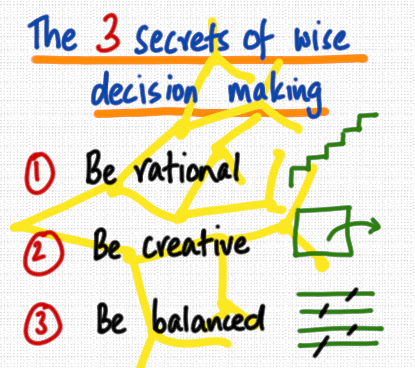
There’s a book called the three secrets of wise decision making that I go back to every once in a while.
The first “secret” is to be rational. Look at the information in front of you with your brain switched on rather than your emotions. Fear and greed make for poor long term decisions. Reserve them for the times when you need to deal with tigers or diamonds.
The danger is that you make a decision and then look for reasons to justify your choice. A good indicator of whether you’re being rational, says the writer, is whether you react to information that challenges your ideas with interest or with defensiveness or anger.
You have to live with the consequences of your decision, and it is your ten-year older self that will look back with approval or regret at a decision that cannot be changed.
The second secret is “creativity” – which is really quite hard to define but you know it when you see it.
It’s easy to get stuck and think that the options you see are the only ones you have. Stepping out of the box seems impossible but it’s something you still have to do – or something you should try and do before settling for an option.
It’s dangerous to say you can’t do something or something can’t be done because there is probably someone busy getting on doing just that as you speak.
The last secret is “balanced judgement”, which is about formally taking the effort to consider multiple factors that matter. The simplest way to think about this is to draw a set of lines and look at them as a survey instrument. You need more than one question on there to get some balance into your decision making.
There are a number of tools that can help you get better at doing each of these steps but one of my favourites is the decision tree – something that sits behind all these approaches.
The decision tree represents all the possible futures that you can have, how the decision you make now ripples through and creates new pathways or closes other ones down.
Sometimes you can straddle two branches for a while, at other times you have to pick one or the other.
It’s never easy to make these choices. You have to figure out what you’re heading for: are you maximising opportunity; or minimising regret?
And, as I often do, the deciding criteria is the one set out in ‘Zen and the art of motorcycle maintenance’.
Will making this choice give you peace of mind?
Cheers,
Karthik Suresh
 Handcrafted insight