
For every complex problem there is an answer that is clear, simple, and wrong. – H.L. Mencken
It’s the time of year when we set goals and resolutions and get ready to go.
The momentum will last days, maybe weeks, and then our energy runs out and we go back to doing whatever it is we were doing before.
That’s because change is hard.
And complicated.
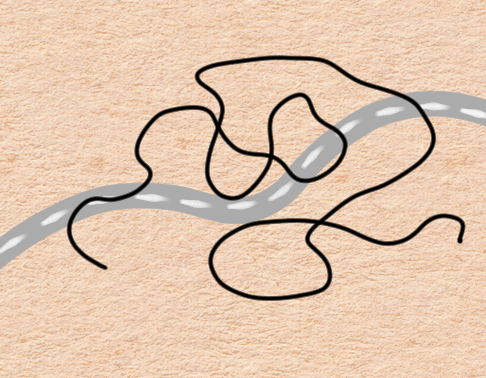
And it doesn’t happen in a straight line.
Let’s take weight loss – that problem of abundance.
We can lose weight by cutting calories and increasing exercise, but the relationship is nonlinear.
Cut too many calories and your body goes into starvation mode, conserving what you have and slowing down weight loss.
Exercise too much and your body becomes more efficient, doing more with less.
There’s a place where we get stuck – a sort of plateau or local optimum.
Getting away from this requires a tremendous amount of energy and an understanding of multiple interrelated and conflicting factors.
For example, in many cases the best type of anything is the type you don’t use.
The cheapest energy is the unit you don’t use.
The best code is the one you don’t write – it can’t have a bug.
The best food has the least added to it – it’s closest to being natural.
Once we get stuck in a loop of using energy, say fuel for commuting, then it’s very hard to get away from burning what you need to get to work.
The pandemic showed us there is a different way.
We can remove the miles embedded in the delivery of products and services.
We can serve clients without burning fuel and going to where they are.
We can create products without transporting them – at least those that can be 3d-printed at home.
We can reuse and share and buy old rather than new.
Perhaps a good resolution for the year ahead is to do less – and see what kind of impact that has on the quality of everything we do.
Cheers,
Karthik Suresh
 Handcrafted insight