
Sunday, 7.51pm
Sheffield, U.K.
It has been said that man is a rational animal. All my life I have been searching for evidence which could support this. – Bertrand Russell
Economic theory from around the nineteenth century held that human beings were rational, self-interested creatures that pursued strategies that were optimal.
This was the world of economic man – Homo economicus.
In the 1970s and 80s we were introduced to behavioural economics that suggested more factors affected decision making than a cold blooded assessment of the costs and benefits – we had to look at psychology, cognition, emotion, culture and social elements as well.
I accepted this as the case, and so it was a little jarring when I listened Dr Doug Lisle talk about decision making.
For example, he talked about why we do anything – and there are three reasons which he calls the motivational triad.
First, we do things because we seek pleasure – with the main things for animals being food and sex.
Second, we avoid pain.
And third, we conserve energy and try to be as efficient as possible in how we acquire resources so that we increase the chances of survival.
For humans in particular, in addition to sex and food, we should probably add some kind of cognitive reward category – because we watch TV and read for mental pleasure – something that we don’t have in common with sharks.
Anyway.
Dr Lisle talks about how when we’re making decisions we’re really running several complicated simulations or scenarios to work out how to maximise pleasure, minimise pain, and conserve energy.
That’s a pretty rational way to act, if you think about it.
Let’s say you’re in a meeting trying to get a group to agree to do something.
Maybe you want them to choose Option A. You know that’s the best thing for the company.
But they stall, they complain, they hesitate – they just don’t seem willing to commit.
Why is that?
The chances are that you haven’t pushed their motivating buttons.
Does the decision help them gain pleasure or avoid pain?
In a corporate situation the pain is probably something that has to be done but just takes a long time or is hard to do.
Like cleaning out toilets.
You could dig a hole and clean it by hand but you’re more likely to approve a proposal to install proper toilets.
But when it’s not that clear and obvious maybe we should look at the energy conservation element.
If you want them to do something – follow a process, fill in paperwork, report regularly – and the effect is to make their job harder or take longer or be less efficient then they’ll push back.
Even if it’s better for the organisation as a whole if it’s worse for them, then they’ll avoid the choice.
What you see as irrational behaviour might actually be your inability to see the rationality at play.
But, we have to admit that there are situations where we don’t make rational choices.
Is that our fault?
I’m not sure.
I think we’re neurologically wired to make good choices. That’s how we’ve survived.
What’s happened, however, is that we’ve changed our environment faster than we’ve changed our brains.
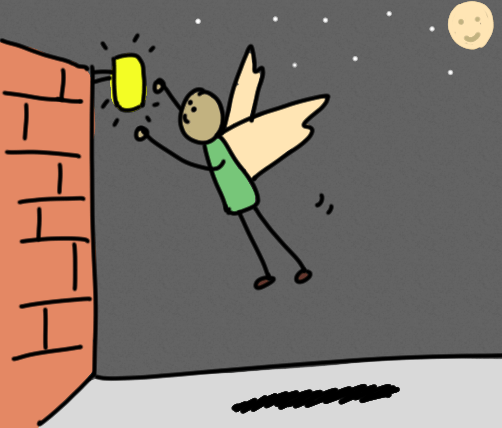
If you have a porch light you’ll see moths at night flying towards the light.
In the old days, when the light was hot they might even die.
That’s not rational, is it?
Except, for the moth, it is.
They’ve evolved to seek the brightest source of light in the sky at night – which is the moon, and by flying up they know that they’re going to find clear space to navigate.
Then we installed all these mini moons everywhere and messed up their perfectly rational strategy.
Our brains are similarly perfectly wired for the natural conditions of a few tens of thousands of years ago.
But now, civilisation and industrialisation have changed our world, so our old navigation systems don’t work anymore – not all the time anyway.
What we think we should do is not always the right choice in this new world.
This means that for those of us that have to work with others to make collective decisions and experience that frustration you feel when they just can’t arrive at the conclusion you know is right may have to change the way we approach the situation.
We have to realise that one of two things may be happening.
- We may be unable to see their rationality.
- Their rationality may no longer be suitable for the decision situation.
We have to change, or they have to.
And we have to be wise enough to know which one needs to be done.
Cheers,
Karthik Suresh
 Handcrafted insight