
Saturday, 7.05pm
Sheffield, U.K.
For a lot of people, one of the reasons they don’t like to work for founders of startups is that they can be sensitive and protective around what they’ve built. You have an emotional attachment to the early marketing and technology materials, and you don’t want to hear that anything’s wrong with them. – Lynn Jurich
I watched Stutz again today – the documentary by actor Jonah Hill about the methods used by his psychotherapist Phil Stutz.
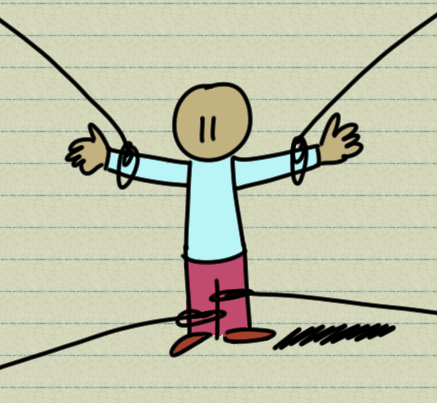
I’m most interested in the fact that Stutz draws models to help people work through situations – each model is a hand-drawn visual on an index card that captures a particular idea – that there’s a shadow that you are avoiding, a maze you might be stuck in and so on.
One of the ideas that jumped out at me this time around when watching was the idea of attachment.
Attachment is something that plays quite a big part in Eastern philosophy – we’re taught that it’s not a good thing.
Do your work without being attached to the results, for example.
If you take this idea to its logical conclusion you end up with an instruction to be attached to nothing – not material stuff, not relationships with friends, not even family.
Some people take this instruction literally, stories from the East are full of tales of wandering mendicants, travelling saints and gods who left everything, have nothing, who avoid any form of attachment altogether.
What do you make of this story, for example.
A boy bird and girl bird meet, fall in love, set up a nest together and have some baby birds.
One day when they’re out looking for food a hunter sees them and finds the nest, and sets a trap.
The parent birds, seeing their babies caught in the trap, try to rescue them and the mum gets caught as well.
The dad bird, desperate at all his family being caught, tries to rescue them and gets caught as well.
The hunter, having achieved his aims, goes home happy, has a nice meal and goes to bed.
The end.
Okay, so what’s the lesson here?
Are you slightly unhappy that the birds didn’t win – that the hunter got his way in the end?
Did you have chicken for dinner this evening?
Is it that the parent birds shouldn’t have gotten together because if they hadn’t been attached to family then they wouldn’t have had to suffer the loss of their children?
Would that have been a good outcome?
Sociology and biology suggest not.
Biologically, the only purpose living beings appear to have is to keep living – to create new beings in their image and pass on their genes.
Sociologically, we know how unhappy people get when they’re alone.
Perhaps the lesson is more subtle than that.
Being aware of how attached you are prepares you to think more clearly about your situation.
What would you do if it all went bad?
How would you feel if it all ended – if you were in the position of the birds?
What would you do differently if you acknowledged the possibility that the situation you have is temporary, that it could all end – would you treat the people in your life differently?
Would you make different choices knowing that what you have could vanish at any time?
Conversely, if you stare the fact that things can end in the face, would you be less attached to things than you are right now.
You might have created a thing – a new process, a technique – something that you really like but that is now not really as good as alternatives?
Can you let go?
When I was growing up the stories I was told was that attachment was literally a bad thing – you had to be unattached to be happy.
It’s something that people from my culture and background probably take for granted.
But maybe that’s not the real lesson.
The lesson is that we have to be able to visualise the outcomes – both good and bad – that we might encounter.
That’s where the tools come in – to help us do that.
And now knowing that – try and make better choices about what we do next.
Cheers,
Karthik Suresh
 Handcrafted insight