Old Books And Drawings – Doodles From The Past

manuscript-drawings.png

Artists are just children who refuse to put down their crayons. – Al Hischfeld

Thorpe (2016) is a study of marginal drawings in a special collection of rare books and manuscripts. LJS361 is a 1327 book of tables and sermons that passed from a medieval convent into a place where children had access to it. Drawings in the book, the paper argues, were done by young children – but how can you tell?

It turns out that children draw differently as they get older – something you probably already knew. When little, they draw tadpole figures, a big circle for a head and legs sticking out straight down attached directly to the head. As they get older they start to recognise different body components and draw them separately, so you get a head and a body and arms and legs, possibly stick ones.

As they get older you find an increasing amount of intellectual realism, as they draw features that are detailed and sophisticated, representing elements of what they actually see – resulting in drawings that become visually realistic as well.

Many of us stop drawing too early in life and so we’re stuck at the effective drawing age of 6-10 years. You can tell that your drawing is like this if you struggle to create expressive figures – if your creations are locked into stiff poses. We try and bring out what’s important about the drawing, so we often draw human faces using a frontal view, while we draw horses using a sideways view. With people we like to see expressions but a horse head front on has less information than a sideways representation. Children drawing also like to balance things out, for example in the way they show arms and legs.

There are a number of other specific features discussed in the paper that suggest that drawings were the work of children rather than adults. And it’s a charming look into the play world of children a few hundred years ago – they drew and doodled just like your children do now. The book might have been boring but it was a surface to scribble on and that made the time go by.

Cheers,

Karthik Suresh

References

Thorpe, D.E. (2016), “Young hands, old books: Drawings by children in a fourteenth-century manuscript, LJS MS. 361”, Cogent Arts & Humanities, Vol 3.

What Can Presidential Doodles Tell Us About Republicans And Democrats?

personality.png

Monday, 8.03pm

Sheffield, U.K.

Every now and then, a presidential candidate surprises us with a truly human and honest moment. – Ron Fournier

In the last thirteen or so posts I’ve been looking at people who doodled as they worked. I may have reached the end of this path of enquiry when I stumbled across the book Presidential Doodles by the creators of Cabinet Magazine.

The book had its genesis in an idea to publish doodles by famous people from the 20th century but when found a couple of presidential doodles the compilers couldn’t resist a compilation of the works of “doodlers-in-chiefs”.

The book is amusing, whimsical and has a range of doodles and ways of doodling. It shows how some of the most public people in the world found an outlet for their restless energy while doing a hugely important job. Others were fascinated by the insight these scrawls afforded into the minds of people given the power to make big decisions – and you ended up with a descent into psychography and an attempt to see inside their heads and find “anxieties, issues, neuroses and penchants.”

There is a problem with this, however. It’s just not very interesting. So someone was bored, or listening very carefully – and they let their pen move on the page. Does that tell us anything useful? Did making that scrawl help them in some way – and is there anything we can learn from that?

The one interesting psychological insight on page 204 is that during a meeting a reporter collected doodles made by Republicans and Democrats. All the Republicans had drawn geometric shapes while the Democrats had drawn animals and people’s faces. Does that tell us that conservatives are more likely to be rational and pattern seekers, people that live within rules, while democrats are more empathetic and care about people? Is it possible that asking someone to do a drawing could help you to understand what they’re like – a psychological profile based on the art they make?

I’ve just said the psychology of art is not that interesting, but maybe it is. I do have a book somewhere in my stack about art and therapy. I suppose you’d need to do some research into that – which is something interesting in itself. How could you study something like that?

Now, I do need to step away from this line of enquiry because it isn’t my area of focus or interest. Although it is interesting. I was looking at drawing as an aid to writing and there are fewer examples of people who do that. It looks like there are lots of people who draw to fill the time before writing – but how many use it as a tool – as part of their process? One writer who does in John McPhee and he’s written in Draft No. 4 about how he draws a diagram that captures the structure of the article he’s going to write.

So where should I go from here? I’m going to do one more post on drawings made in old manuscripts and then we’ll change direction and explore a different path.

Not sure which one though.

Cheers,

Karthik Suresh

How To Build And Maintain A New Habit

habit-change.png

Sunday, 7.26pm

Sheffield, U.K.

Sow an act and you reap a habit. Sow a habit and you reap a character. Sow a character and you reap a destiny. – Charles Reade

I was reading Dr Michael Greger’s How not to diet, a big book stuffed with real research insights, and came across a bit on making and keeping habits. The points he makes are so good that I want to record them here to help me remember them later.

We’re getting to that time of year when we look back and reflect on what we’ve done – was it what we planned, was it enough, could we have done more? Should we have done more?

There are a few things that started to converge for me as I read through the literature associated with understanding and insight into situations and what they need. An important theme is the idea of the ledger – the daily record of what has been traded, what has been done or achieved. We can have grand plans but those plans will be achieved or not depending on what we do every day. If you make a profit every day then you can be certain that you will end the year in profit. If you want until the last month to check how you’re doing then you’ll probably be unhappy with what you find.

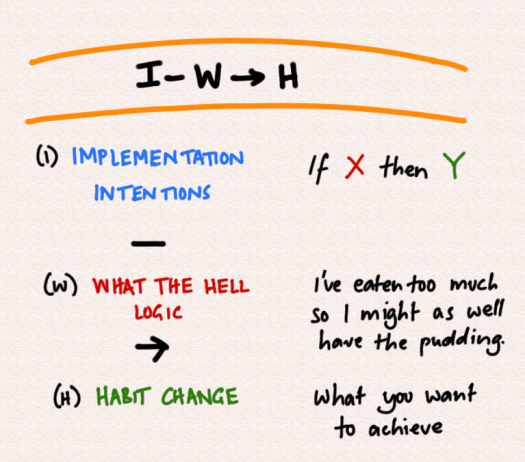
If you want to change something then the first thing to do is decide in advance what you’re going to do when the opportunity to make a choice presents itself. This is called an implementation intention and it’s quite simple. It’s writing down a statement in the form “If this then that.” When I started this blog, for example, my intention was quite simple – to write every day. But life is bigger than one thing. When you focus on one intention others fall by the wayside. While I focused on writing, other things suffered – I spent less time on exercising, eating healthily. A focus on one thing almost always leaves less time for other things.

The way to rebalance is to reset or rewrite your intentions. A way that works for me is to do what is most important first thing in the morning. For years that’s been reading and writing. But some years that was getting exercise. It’s deciding what matters and when you’re going to do it.

The challenge is that it takes a while to rewire yourself – to get a new habit going. Probably a couple of months, if not more. That’s going to be much easier to do if you take the thinking out of it – just create a set of rules that you follow every day.

Which brings us to the second part of the problem – the what the hell theory. This essentially says that once you fail to do something then you tend to give up and don’t see the point in still trying. This is easy to see when it comes to dieting. You may have avoided sugary foods for ages but then you’re in a situation where you just can’t refuse. And once you’ve had more than you should you think, “What the hell…” you’ve already had too much, what difference will a bit more make. So you stuff yourself.

But it does matter – those are still calories you don’t need. The right thing to do is stop but that takes effort.

If you can do these two things – decide in advance how you will act and choose to stop yourself from doubling down when you fail – you’ve got two powerful tools that can help you start and maintain new habits.

Cheers,

Karthik Suresh

Writing As A Way To Work Through Pain

bukowski-style.png

Friday, 8.22pm

Sheffield, U.K.

A book should serve as the ax for the frozen sea within us. – Franz Kafka

I’m writing a set of posts on drawing as a part of writing. A few years ago, at the local library, I picked up a copy of Charles Bukowski on Writing – and it sat on the shelf for a while. I don’t remember much from it but it had doodles – drawings and one of the things I do remember is that Bukowski added drawings to his submissions when he sent it off to attract the attention of the editor.

I looked up Bukowski again for this post and flipped through the first hundred or so pages of Charles Bukowski by Barry Miles. I wish a little that I hadn’t. Bukowski’s early years were grim, an abusive father, an outsider, a child living with daily violence at every place. He was a Nazi sympathizer until war was declared when he got rid of his propaganda. And then life seems to get hard and stay hard, no money, manual work life in low places. Alcoholism. And writing.

Writing is what seems to have saved him or at least sustained him. As a student he turned in 30 stories, all good, when his classmates were asked to turn in two or three. He read everything in the library. He liked Hemingway – and the idea of making something simple, then simpler still, then simpler yet. His writing style was to use simple words, nothing you needed a dictionary to understand, and was all loosely autobiographical.

I flipped through a book and a collection of poems and I find little in there but pain and the process of survival. It’s not a life that anyone should have had but it’s there, it exists, others presumably are living it now. Many years ago I was in a charity bookshop browsing the shelves and a homeless person wandered in. I remember flashes of him now, thick glasses, broken and held together with tape. Cloudy eyes behind them. A dirty green jacket. The smell.

He spoke to me. I wasn’t expecting it but answered and after some chat he pulled out some pages he had been writing and showed them to me. I can’t remember anything about them, not if they were good or bad. But that image, that person without a place with some writing stuffed into his jacket, appears to be the kind of life Bukowski lived and came out from and had some success with later.

The drawing above is in the style of Bukowski – I’ve tried to copy the free flow and sparse lines that he uses. They’re quite similar in look to the drawings of James Thurber and it looks like Bukowski drew hundreds of these but many have been lost over time – he didn’t keep copies of what he mailed out. Drawing for him, it seems, was just as important as writing – perhaps the two worked together.

The one thing to take away from Bukowski’s story is the power of art to free us from our own history.

Cheers,

Karthik Suresh