Maybe Some Things Are Not As Deep Rooted As You Think

roots.png

Monday, 8.24pm

Sheffield, U.K.

Your only obligation in any lifetime is to be true to yourself. Being true to anyone else or anything else is not only impossible, but the mark of a fake messiah. – Richard Bach

There is, or rather was, a small tree in our garden, or a large bush, depending on how you see things.

It was of questionable utility, good for hanging toys on, bad for squeezing past and brilliant at pulling jumpers and ruining clothes.

Still it was there, and we didn’t want to get rid of it. Instead, we trimmed it back and tried to live with it.

This summer it leaned over, further and further, stretching out towards the sun until the other day I tried, just to see what would happen, to push it back.

And it moved.

Not just a little bit, but completely loose in the soil. So wobbly in fact that it didn’t seem to make sense to leave it there.

So I pulled it out – not with any great effort. It was so loosely rooted, possibly rotted, that it came out with no difficulty at all.

Certainly without the kind of difficulty one would expect from any self-respecting tree with proper roots.

I am no gardener and this may seem like a not very nice thing to do but in my defence, the tree had it coming.

And I suppose that points to two things that are worth remembering.

The first is that some problems may appear so big when you look at the branches that you don’t realise that they have no roots – and you could simply pull them out if you were minded to.

The other is that if you want to build anything of lasting value you need to look at what really matters.

It’s a metaphor that seems quite applicable to our modern lives.

You can spend a lot of time taking pictures, posting them on social media, harvesting likes and comments and not have any time left over to put together an album at home.

If you create content for platforms – putting all your stuff on Medium or LinkedIn – what happens to your own site?

That’s why so much advice tells you to create your own portfolio – put the time aside to create your body of work.

Perhaps you can do both – create a deep store of original content and be very good at promoting it to the world through channels – be the kind of person that can tend root and branch equally well.

Or you can eschew the fluff and focus on the work.

I suppose we all feel that it would be nice to be rich and famous.

But really, how happy would you be once you had all that?

It’s possible that might depend on how deep your roots were – whether you knew how to cope with sudden wealth or not.

Most lottery winners, we are told, get through all their winnings rather quickly.

Few invest it in a diversified set of index trackers.

Maybe we should remember a Zen koan – one of those little stories designed to open one’s mind.

A monk asked Jōshū in all earnestness, “What is the meaning of the patriarch’s coming from the West?”

Jōshū said, “The oak tree in the garden.”

Cheers,

Karthik Suresh

Do You Know What You Are Truly Meant To Do?

uncarved-block.png

Do you have the patience to wait until your mud settles and the water is clear? – Lao Tzu, Tao Te Ching

On the weekend we wander through charity shops looking for interesting books.

Today, hidden away in the children’s section I found one that should get a prize for the ironic use of capitals.

It is Benjamin Hoff’s The tao of Pooh and in the foreword addresses a question that has been bothering me for a while.

There is an argument that the whole of western thought is based on the work of Aristotle – an argument that is laid out in Robert Pirsig’s Zen and the art of motorcycle maintenance.

The essence of this argument is that Aristotle invented reductionist scientific thinking – the art of breaking things into pieces and learning how they worked.

This eventually led to the industrial revolution, the technological ascendancy of the West and to the modern world we have today.

Along the way the West lost touch with other kinds of ideas – ones to do with spirituality and belief and the kinds of things science finds hard to deal with.

As a result, Hoff’s colleagues argued that all of the Great Masters of Wisdom came from the East.

Hoff disagreed and wrote the book to explain why, based on the stories of one of the Great Masters from the West – Winnie-the-Pooh.

If you have any interest in gaining Great Wisdom from Great Philosophers here is a quick summary of some key concepts (as I see it).

  1. Aristotle: Science rules.
  2. Confucius: We must have order.
  3. Buddha: Life is suffering.
  4. Lao-tse: What’s for breakfast?

One of the things I try to do while writing this blog is come up with mental models – conceptual models that can be used to understand the world around us.

Some people spend a lot of time thinking deeply about things and then they try and work out if what they think is right – can they prove it in some way?

So, most management and self-help non fiction will pull together an idea with supporting evidence and put it forward as something for you to consider.

Take one I’m reading at the moment: Cal Newport’s Deep Work.

In essence the book says work without distraction.

That’s the message, really. The rest is, as Landsburg said about economics, commentary.

There is a thing that happens when people try and write a book about something simple.

The simple thing becomes surprisingly complex.

Take Dan Roam’s The back of the napkin, for example.

In essence the book says that if you try and draw what you’re thinking it’s easier for people to understand.

By the end of the book Roam has a complex matrix of images and structures that you can combine to create messages – some kind of intricate, interlocking communications mechanism.

This is what happens when you try and reduce things to their component parts – a simple whole becomes a complicated and messy set of parts and you lose track of what you’re trying to do in the first place.

If you go too far down this road you become an Academic – someone who spends all their time looking at the trees and unable to see the forest.

And that wholeness is one of the most important parts of Taoism, Hoff explains, and is appropriately called P’u, which sounds a bit like Pooh and means “the uncarved block”, or “the tree in a thicket” or “the uncut wood”.

In essence – it’s the whole tree – representing the whole you.

We spend a lot of time trying to be what we think others expect of us – from dressing in suits for meetings to choosing where to live and how to act.

We’re so busy doing all this that we miss the natural, simple, plain and honest parts of living.

Like what’s for breakfast.

If you’re in too much of a rush to eat in the morning, or you’re always on a diet or you’re out of the house before the kids are up – are you living the life that you really want?

It’s all very well reading about deep work and what philosophers think but when it comes down to it do you know what really matters?

It’s probably worth quoting the extract that starts the book – because it makes the point rather well.

“When you wake up in the morning, Pooh,” said Piglet at last, “what’s the first thing you say to yourself?”

“What’s for breakfast?” said Pooh. “What do you say, Piglet?”

“I say, I wonder what’s going to happen exciting today?” said Piglet.

Pooh nodded thoughtfully.

“It’s the same thing,” he said.

Cheers,

Karthik Suresh

How Do You Select Tools If You Do Knowledge Work?

core-tools.png

Friday, 9.18pm

Sheffield, U.K.

The Stone Age was marked by man’s clever use of crude tools; the information age, to date, has been marked by man’s crude use of clever tools. – Anonymous

If you had to set up in business tomorrow what tools would you need?

For most knowledge workers an office suite might seem like the most useful package – the trinity of Word, Excel and Powerpoint perhaps?

These tools each have a clear purpose: you write documents, do analysis and tell stories.

And get quite stressed.

If you have had the opportunity to work on a consultancy project of any magnitude you will be aware of how, as documents and spreadsheets and presentations get bigger and bigger, the difficulties associated with opening and working with them increase.

Even if you haven’t – but you have had to write a dissertation using Microsoft Word – you have probably experienced the frustration of losing work or struggling to get the file the way you want.

The end result is, in many cases, late nights and angst and stress as you wrestle with the tools that are supposed to help you out.

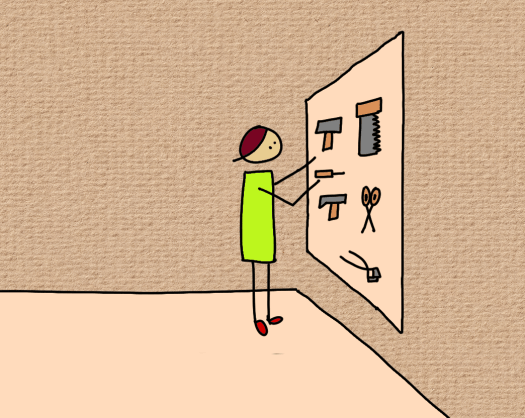
One way to look at tools is to think of what happens when you use a hammer to help you during a project.

If you need to bang a nail into a wall so you can hang a picture the hammer works in a certain way.

If you need to bang in the last nail on your multi-storey construction the hammer will work in exactly the same way.

As tools go the hammer isn’t fazed by how complex your project is. It just does the job it’s designed to do.

If you are a craftsman or a tradesperson who has to rely on your tools for a living you will probably take some care in selecting them.

Many years ago I was introduced to electronics repair by a technician who took me to a store where we purchased some high quality kit – from screwdrivers and needle nose pliers to an analogue multimeter.

These tools are still with me today, a couple of decades later and although some have been used to stir pots of paint along the way by others who should know better, they still work as well as they did on day one.

And there is no way I would use a Swiss Army Knife or a Leatherman as my primary tool when taking apart a machine.

So why is it that knowledge workers spend their lives working on problems with the digital equivalent of a multi-purpose tool from a dollar store?

Or worse, we do everything through interfaces – web based or app based that suggest that you can create works of complexity and beauty by pressing the right combination of buttons.

There is something fundamentally wrong with this – and that’s probably why most people don’t actually get very good at using digital tools.

Perhaps what’s happening is that we are too far away from the thing we are working on.

With a mechanical tool you are right there with the job.

I remember once having to repair a motorcycle brake system – the calliper was stuck and I couldn’t work out how to get the thing off.

As Pirsig writes in Zen and the art of motorcycle maintenance, I was stuck as well.

What is the equivalent of that kind of stuckness in knowledge work?

Is it perhaps not being able to work out what an algorithm does, what argument to make next in your essay or which font to select?

With physical problems the tools you use are designed to fix the problem.

With knowledge work the main tool you have is your brain – your ability to think about and focus on the problem at hand.

Digital tools don’t help you think any better.

In fact, perhaps the purest approach to carrying out great knowledge work is to sit quietly and think deeply.

The tools you select to help you should help you to capture, organise and communicate complex thoughts and ideas worth sharing.

Tools that encourage you to write one line emails, send out updates and log into portals should probably be seen as a form of entertainment.

But if you really want to get work done you should choose your digital tools with the same care with which a master craftsperson selects their tools.

But the tragedy is many people don’t even know they have that choice.

Do you?

Cheers,

Karthik Suresh

Why We Need To Understand The Difference Between Consensus And Accommodation

politics.png

Thursday, 8.15pm

Sheffield, U.K.

How can you govern a country which has 246 varieties of cheese? – Charles de Gaulle

If you look at the vast collection of literature that is loosely categorised as self-help you’ll find lots of tips to make things better.

Life hacks, they are now called – as if you can find a clever route that will make all problems vanish.

I suppose there are hacks that help you in practical ways.

A quick search suggests that you could grow rose cuttings in potatoes – that’s pretty useful information for some people.

But there are other problems that are less well served by looking for a hack.

Especially problems that involve working with other people.

This is something that those of us that are technical find hard to learn.

For example, do you believe that for a given office based task there is an optimal solution?

For most real world tasks there is more than one way to do it – and the approach you takes sits on a continuum between doing everything manually and automating everything altogether.

Take a practical example like checking whether a bill is right.

You could get out a calculator and work through the numbers.

You could create a spreadsheet and recreate the bill.

You might create a script that processes a file with the billing data and gives you a result.

You might be comfortable with one or more approaches but others will start to struggle at different points based on their skill sets.

The optimal approach then, if you want to work with others, is not one that depends on the solution but one that depends on the people involved.

And this is something that is not always easy to appreciate.

Peter Checkland, in his book Soft systems methodology in action writes about the problem of getting different people to go along with a plan of action.

This is the basic issue faced in a large number of problems – from how you do a task with a co-worker to how you decide which projects to do in your company and how your government makes policy decisions.

The thing that underpins it all is a process of politics – the activity by which different people figure out how to get along.

Checkland talks about the importance of achieving an “accommodation” in order to make meaningful progress.

An accommodation is something that people can live with, something they are prepared to go along with.

It differs from consensus in that people don’t have to agree that something is right or that they like it – just that they can accept it.

The point Checkland makes is that if you want to improve a situation you don’t need to find consensus.

It might be nice to have a consensus, to be in a situation where everybody agrees that a particular course of action is the best possible one.

In reality, such situations are rare.

Real situations have more to do with culture, politics and power than they have to do with technical virtue.

And culture, politics and power influence the stand people take on a particular issue – and the challenge you face is one of getting them to go along with your idea – to ‘accommodate’ you.

And people who don’t understand that struggle to get their projects through organisations, big or small.

This may seem like a technical and fairly pedantic point.

But it’s important for any non-trivial organisational problem you might come up against.

If it’s just yourself you have to convince, then that’s easy.

If you need to get another person or a group to go along with you, you need to understand where they’re coming from – their interests and what they can live with and decide whether you can live with that.

And if you’re rigorous in the way you approach that need for understanding, you will probably make meaningful progress in whatever project you’re trying to do.

In short, learn how to do politics because it matters.

Cheers,

Karthik Suresh

What Does Your Product Deliver For Your Customer?

three-fundamentals.png

Wednesday, 7.21pm

Sheffield, U.K.

We aren’t in an information age, we are in an entertainment age. – Tony Robbins

In the book Just for fun: The story of an accidental revolutionary about Linus Torvalds, the inventor of Linux, talks about his three rules or basic categories of motivation.

He says people do things to survive, for their social lives and for entertainment.

And, actually, the things they do tend to follow that order.

For example, we once needed fire to cook food and stay warm – it helped with survival.

In many societies the number of chimneys you had started to signal status – in fact there were taxation systems built around the number of hearths you had in your house.

And now we have fireworks, firepits and arson – forms of entertainment for different folk.

It’s a loose categorisation – a sort of derivative of Maslow’s hierarchy – but is it simply an interesting point of view from someone who has a giant profile in a particular field or is it actually something useful?

You might find it surprisingly useful if you use it as an aid to thinking about the way you market what you have to sell.

Few of us can really claim that what we do is essential for survival.

If you live in a relatively modern economy everything you need to survive is found in a shop somewhere – or on Ebay or Amazon.

It’s unlikely that what you do is necessary for people’s social life either – unless you’re in the business of making BMWs or a dating app.

The majority of us probably don’t work in businesses that really address points 1 or 2 in the picture above.

That must mean that what we’re selling is entertainment.

How can that be? If you sell training courses on video creation, for example, how is that entertainment?

Is it not something to do with social life – something that means the person learning has status or an income from their content?

Linus seems to have quite a loose definition of entertainment – it’s not just limited to lounging on a sofa watching telly.

Instead, he counts doing work as entertainment.

Especially if you work on a computer.

The fact is that if you are affluent enough to own a computer or work on one at work you probably are ok on the survival side of things.

And really, whatever you work at needs to do more for you than suck the life out of you.

There’s a Dilbert cartoon that sums up that kind of life perfectly.

Dilbert goes to his manager to have a chat about his career.

His manager says, “My plan is to work you until your health deteriorates and your skills are obsolete. Then I’ll downsize you.”

Dilbert is ill at the thought – his manager has never had a plan work so quick before.

So, really, if you’re at work you need to enjoy what you do – you need to be entertained by what you do.

Maybe not laugh out loud entertained – but entertained in a this is good fun and I’m doing something useful with my day sort of way.

And if that’s good for you that’s good for your customer.

Which means that your marketing might need to focus on how you entertain your customer.

How do you make their day better, and how do you make it easier and more pleasurable for them to get their work done?

How does the thing you offer help them to do their job better and get the satisfaction that comes from being competent at their job?

Many of us don’t think this way – we think about savings and return on investment as being key drivers.

The key driver, however, is perhaps how you help someone be entertained.

Because that’s what they’ll probably put some money down for.

Cheers,

Karthik Suresh

How Do You React When You See Something Different?

fabricate.png

Tuesday, 11.10pm

Glastonbury, U.K.

First they came for the socialists, and I did not speak out – because I was not a socialist. Then they came for the trade unionists, and I did not speak out – because I was not a trade unionist. Then they came for the Jews, and I did not speak out – because I was not a Jew. Then they came for me – and there was no one left to speak for me. – Martin Niemöller

One often thinks that people in power have a plan – we hope they have a plan – but do they?

Is there a plan to make things better – or are most plans about self preservation.

Are they about doing what is in your interests?

And how does something good or useful emerge from lots of people working on making things better for themselves?

The reason why this is an interesting question is because of the nature of the world right now.

It seems to be dividing into groups of people that are scared of losing what they have and people who… are not yet scared.

Let’s look at those that are scared a little more closely.

Across the world you see the emergence of political parties that are in positions of leadership pushing an agenda of fear – of protecting their constituents against nasty “other” people.

You don’t need to look far to spot the leaders of such movements – they used to once be called “strong men.”

When people are scared they look to someone who says they can protect them – the people who sound like they have a plan.

This is natural really – we’ve evolved to live in groups and fight for the things we need to survive with other groups.

A state of constant tension and frequent warfare is how it should be.

The fact that it isn’t – at least in some parts of the world – is something to be grateful for.

But it’s also something that needs to be protected.

If you live somewhere where there is tolerance and the rule of law then that’s a much better place than most of the world.

But it doesn’t take long for that to change.

“The only thing necessary for the triumph of evil”, said the parliamentarian Edmund Burke, “is for good men (now people) to do nothing.”

But it’s one thing stopping people from doing what comes naturally – reacting out of fear with violence.

It’s another teaching tolerance.

And the single most effective thing there seems to be a shared identity.

Even if it’s a fabricated one.

In a programme on the BBC called As Others See Us by Neil MacGregor, he visits the USA to see what the Americans think of the British.

In one segment a historian talks about how the way in which the British are seen has been “fabricated” by the media of the last half century.

The two countries are brought together by a shared memory of movies and music across the decades that go from the war to the Beatles.

It has little connection to history and fact and much to do with emotion.

This interests me when it comes to my own work.

For example, if you read the Mr Men and Little Miss books you know they are all about emotions wrapped up in packages.

Most of my doodles, when they involve people, just have eyes – they observe and contemplate, but without emotion.

It seems to me that the opposite of being scared is actually quite hard to get your head around.

Do you fabricate stories that make people feel closer together?

Do you try and think your way to a solution?

Or do you put your head down and get on with work?

At what point do you act?

Cheers,

Karthik Suresh

How To Get So Good That People Tell Their Friends About You

practicing-deliberately.png

Monday, 9.13pm

Sheffield, U.K.

Start copying what you love. Copy copy copy copy. At the end of the copy you will find yourself. – Yohji Yamamoto

On Twitter the other day Paul Graham, the founder of Ycombinator, retweeted this – “Be so good they can’t ignore you” can be adjusted to “make something so good that people have to tell their friends about it.”

So, how do you do that?

The bad news is that there are few shortcuts to getting that good.

Or should that be – there are no shortcuts?

There are a few books I’m working through that make this point in different ways.

Joel Spolky in his book Joel on Software starts by reminding us that “Life is just too short to hate your job.”

What you spend your time doing matters more than you realise.

We spend astonishing amounts of time in front of screens – and only some of that time is spent working.

The problem is that most of this time is not “good time” – instead it’s fragmented and disconnected bursts of work pockmarked by interruptions.

And in such a world it’s hard to get things done.

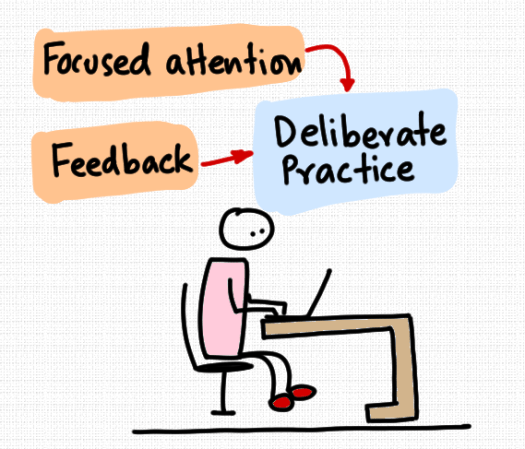
Cal Newport in his book Deep Work points to K. Anders Ericsson’s work which pulled together disparate ideas that were related in a field called Performance Psychology and came up with the term Deliberate Practice as the way to improve performance.

There are two core elements to deliberate practice – focused attention on a task and feedback on how you are doing.

I wonder how many of us find that we have the time to do the former and if we are given the latter in our working environments.

More importantly, do we consider these factors when we’re responsible for training others or even when we’re trying to help our kids get better at something?

The thing about focused attention is that it takes time – weeks are good, days are doable, hours are a minimum.

You are not going to get good work done if you have to rush doing it in five minute intervals.

You need time.

And that means dealing with the things that consume your time – which in this day and age is almost everything around you.

From phones and email to friends and family – they can all be time sinks.

Some of those sinks you want and need – but others do more harm than good.

If you listen to anyone who does work that you like you’ll probably find that they spent a long time getting good at what they do.

It’s clear that Joel Spolsky has spent a lot of time thinking about software.

But the trick, he says, is to start at the foundations of the machine and build up from there.

If you’re into Mr. Men books you should look at some videos of Andy Hargreaves showing you how to draw the characters on YouTube.

It’s hard, he says, to draw circles – and he prefers to draw squares.

You don’t get much more basic than that.

And if you like words there are always those from Churchill on which words to use – “Short words are best, and the old ones, when short, are best of all.”

There is an art to getting better at something – and that is to practice – but practice in the right way with focused attention and feedback.

And if you take the time to do that then what emerges, eventually, may be remarkable enough to share with your friends.

Cheers,

Karthik Suresh

What Your Bank Doesn’t Tell You About Paying Off Debt

thermostat.png

Sunday, 8.40pm

Sheffield, U.K.

Debt is like any other trap, easy enough to get into, but hard enough to get out of. – Josh Billings

I’ve been browsing through Donella H. Meadow’s Thinking in systems and realising that I was completely wrong about things I took for granted.

For example, she talks about what happens when there are two competing things happening at the same time.

The simplest example is the problem you have in winter managing your room temperature.

If you left your house for a week or so with the heating off what would happen?

The heat in the house would flow outside through the windows and gaps until the outside temperature and inside temperature were pretty much the same.

Now, when you get back and don’t want to spend your time shivering, you turn up the thermostat.

This monitors the gap between what you want and what the room temperature is and turns on your radiators until the gap between the setting and the temperature is nothing.

So far so simple.

Now, some of you may have experienced an argument with the others that live in your house that goes something like this.

You want to save money and so keep the thermostat at 20 degrees because that should be enough.

The other people in the house, little and large, disagree and push it up to 25.

I always thought it was reasonable to assume that if the setting was 20 then the room temperature would end up at 20 and then the thing would turn off.

That’s an example of doing the wrong thing because it seems logical – and the problem comes from forgetting about the other loop – the one constantly causing heat to leak out of your house.

You need to figure out how to deal with the losses that are happening at the same time as the gains.

Meadows says that people normally learn to set the thermostat at a higher temperature to get the level of comfort they want – which is why it turns out that I’m wrong and the others are right to do what they’re doing.

Meadows points out that this issue is not really that serious – you can muddle your way through to a solution but it can cause all kinds of problems in other situations – and your bank knows this.

The key point is this – the action you take can only affect the future – and you take action after realising that there is a gap – which happens after some time.

In other words there is a delay between changing the setting and the change in the room temperature (the stock).

The delays in the system are important – and the delays happen from both sides, the thing that causes the stock to increase and the thing that causes it to decrease.

And this is where we come to debt…

Meadows writes, “If you want to pay off your credit card (or the national debt), you have to raise your repayment rate high enough to cover the charges you incur while you’re paying (including interest).”

So that’s something else I’ve been doing wrong.

If you pay for holidays and online purchases on a credit card you might have experienced the shock that comes with paying off a large balance every month.

Even if you’re good and pay it all off it never seems to disappear – it’s like this anchor that’s attached to you every month.

Well, that’s because your credit card purchases take place in a similar way to the thermostat model.

So, I thought I’d try this out – get a year’s worth of credit card expenses and see how the system keeps us in debt.

Well, it turns out that the banks don’t want you to do the modelling.

If I were suspicious, and I am, I’d think that the fact that they provide only three months of transactions to download as a csv suggests they don’t want you to look too closely.

And then, the nature of the csv, which makes sure all numeric fields come in as text and have additional symbols that make it hard to add everything up, suggests that someone is trying to raise the barriers to analysis.

Or am I too cynical?

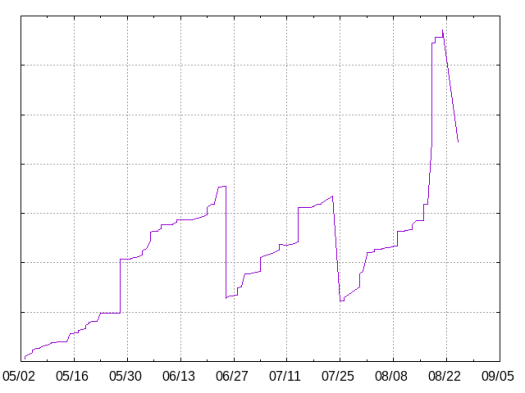
Anyway, the spending pattern that happens is shown in the chart below.

debt-orig.png

What you’ll see is that although everything is paid off every month (the sharp downward line) the leakage in additional costs over the course of the month means that there is a constant level of debt.

What happens if you pay a little bit extra off every month?

What happens is in this next chart.

debt_test.png

What you see is that your total debt can go to zero – but only if you pay more than you need to.

This is actually a very important point because we spend so much of our time trying to hit targets but if our mental model doesn’t take into account all the factors that matter we won’t reach our goals.

For example, I aim to write every day but I haven’t written for 13 days for a variety of reasons.

Last year out of 365 writing days I managed 251 posts – that’s more than a hundred days that just leaked away.

If you’re trying to lose weight by cutting calories, perhaps instead of targeting 2,000 a day you need to go for 1,800 because there’s going to be leakage.

If you need to raise cash go for $1.2 million rather than $800k.

Now, you might argue, this is just common sense.

Surely this is just setting “stretch goals”?

I’d argue that once you understand the model it’s more than that – it’s realising that you need to look at the whole picture.

Meadows writes, “The human mind seems to focus more easily on stocks than on flows. On top of that, when we do focus on flows, we tend to focus on inflows more easily than on outflows. Therefore, we sometimes miss seeing that we can fill a bathtub not only by increasing the inflow rate, but also by decreasing the outflow rate.”

The thermostat problem seems small – but it’s the essentially the same problem as the issue of climate change.

And no one would argue that’s an easy one to set right.

Cheers,

Karthik Suresh

p.s two interesting links

An example of creating a proper model

MIT’s self study programme on systems dynamics